Key Takeaways
- APPs 1.7, 1.8 and 1.9 take effect on 10 December 2026. Schedule 1, Part 15 of the Privacy and Other Legislation Amendment Act 2024 (Cth) inserts them, and section 2 of that Act fixes the date: the day after the 24 months that began with Royal Assent on 10 December 2024.
- Every health practice is covered, whatever its turnover. Section 6D(4)(b) of the Privacy Act 1988 (Cth) takes anyone who provides a health service and holds health information out of the small business exemption.
- The test has three limbs and all three must be met. The practice has arranged for a computer program to make a decision, or do a thing substantially and directly related to making it; the decision could reasonably be expected to significantly affect an individual's rights or interests; and the individual's personal information is used in the program.
- The policy must then state three kinds of thing: the personal information used, the decisions made solely by the program, and the decisions the program substantially and directly helps make.
- The OAIC published its ADM guidance on 30 September 2026. Chapter 1 of the APP guidelines (version 2.0) gained a section on decisions made by a computer program, with a fact sheet and a flowchart. The fact sheet lists programs "used to prioritise the provision of health or disability services to individuals" among decisions generally in scope.
- A non-compliant policy falls in the s 13K low tier: up to 200 penalty units ($72,800) for an individual and 1,000 penalty units ($364,000) for a body corporate, at $364 a unit from 1 July 2026. The OAIC can issue an infringement notice instead of going to court.
- RACGP criterion F11 on artificial intelligence asks for much of the same evidence, but it is a separate accreditation requirement that applies only to practices using AI.
From 10 December 2026, if a computer program uses a patient's personal information to make a decision that could significantly affect them, or to do something substantially and directly related to making it, your privacy policy must say so. The duty is APPs 1.7 to 1.9 of the Australian Privacy Principles, and it binds every health practice regardless of size.
Most GP and allied health practices do not think of themselves as users of automated decision-making. Many are. Online triage that sorts requests by urgency, billing software that suggests an MBS item from the note, AI scribes that propose diagnoses, and recall tools that rank patients by risk can all meet the test, depending on how they are set up. The broader picture (APP 6 and model training, APP 8 and overseas vendors, consumer AI tools) is in our AI privacy compliance guide for healthcare.
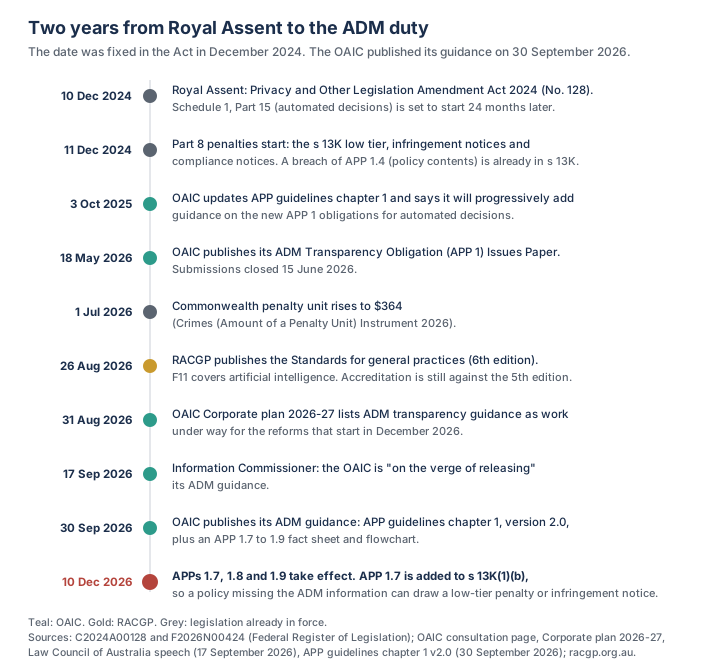
Status check: September 2026
Settled: the date and the words. Section 2 of the amending Act fixes Schedule 1, Part 15 at 10 December 2026, and the OAIC's September 2026 speeches still give that date. The APP text quoted below is from the Act as made.
Published 30 September 2026: the OAIC's guidance. Chapter 1 of the APP guidelines, now version 2.0, has a new section, "Information relating to decisions made by a computer program" (paragraphs 1.35 to 1.78), with a fact sheet and a flowchart. The OAIC's statement says they reflect 90 written submissions to the consultation on its ADM issues paper of 18 May 2026. What it adds for practices is in its own section below.
New since April: the RACGP published the Standards for general practices (6th edition) on 26 August 2026, and criterion F11 covers artificial intelligence.
Time left: 71 days, or just over 10 weeks, from this update to 10 December 2026 (calculated).
Does the ADM duty apply to a small practice?
Yes. The Privacy Act's small business exemption covers a business with annual turnover of $3,000,000 or less, but section 6D(4)(b) says an entity is not a small business operator if it "provides a health service to another individual and holds any health information except in an employee record".
A sole GP and a two-room physiotherapy clinic are therefore APP entities, and both must meet APPs 1.7 to 1.9 from 10 December 2026. An allied health practice that delivers NDIS supports is covered for the same reason.
What counts as automated decision-making under APP 1.7?
APP 1.7 as inserted reads:
1.7 Without limiting subclause 1.3, the APP privacy policy of an APP entity must contain the information covered by subclause 1.8 if:
(a) the entity has arranged for a computer program to make, or do a thing that is substantially and directly related to making, a decision; and
(b) the decision could reasonably be expected to significantly affect the rights or interests of an individual; and
(c) personal information about the individual is used in the operation of the computer program to make the decision or do the thing that is substantially and directly related to making the decision.
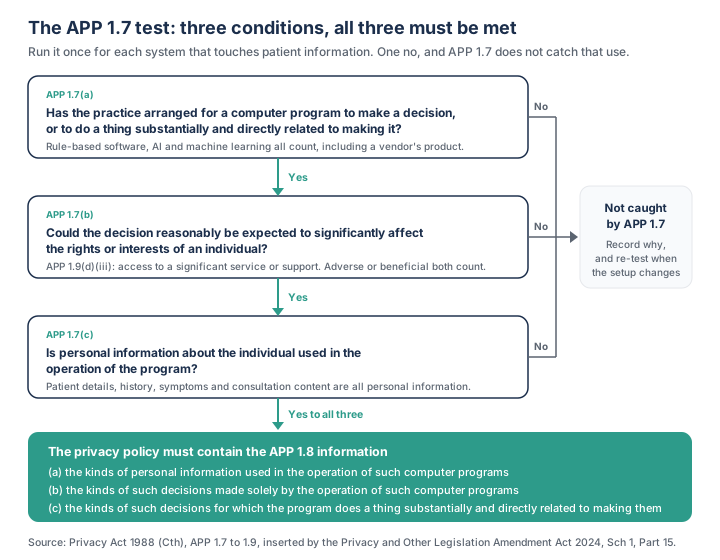
Each limb is explained in the Explanatory Memorandum, which the OAIC's guidance follows closely.
Computer program. Paragraph 336 of the Explanatory Memorandum gives it its ordinary meaning, covering "pre-programmed rule-based processes, artificial intelligence and machine learning processes". The OAIC's guidance adds that generative AI tools, including chatbots, fall within it. A spreadsheet formula can qualify.
Substantially and directly related. Full automation is not required. Paragraph 337 says a program may "recommend a decision to a human decision-maker, or guide a human decision-maker", and that "substantially means where it is a key factor in facilitating the human's decision making" and "directly means where the thing has a direct connection with making the decision". The OAIC's issues paper gave an example: a spreadsheet that scores and triages callers to a crisis line is caught, while one that only works out a caller's age from a date of birth is directly related but not substantially.
Significantly affect. APP 1.9(d)(iii) lists "a decision that affects the individual's access to a significant service or support", and paragraph 343 of the Explanatory Memorandum gives access to healthcare services as an example. APP 1.9 also says the effect counts whether it is adverse or beneficial, and that "making a decision includes refusing or failing to make a decision". A triage tool that declines a booking is making a decision.
Arranged for. The duty sits with the entity that arranged for the program to make or assist the decision, even when a vendor runs it. Paragraph 1.45 of the guidance says entities should understand how a computer program is used in a third-party product and what types of decisions it makes. Using a vendor's platform does not move the disclosure onto the vendor.
What does the OAIC's guidance add for practices?
It names health services. Among the decisions that "would generally be considered in scope", the fact sheet lists "computer programs used to prioritise the provision of health or disability services to individuals". Its first worked example is a health and aged care provider whose spreadsheet scores people on health information such as blood pressure and medication, then ranks them; staff use the ranking to decide whom to contact and book. That is in scope, and it stays in scope if the ranking is used to decide whom not to contact. Chapter 1 also lists "access to healthcare, emergency or aged care services" among the rights and interests generally in scope (after paragraph 1.66).
On human review, the guidance says a decision may be in scope "even where a computer program output does not replace the entire decision-making process or is subject to human review" (under paragraph 1.41). Paragraph 1.53 lists factors to weigh, including how heavily staff rely on the output and how likely they are to override it. A program used for something other than facilitating the decision, such as a word processor used to write it up, is not caught (paragraph 1.40).
On the policy, paragraph 1.70 allows decisions and kinds of information to be grouped, provided the detail is meaningful to a reasonable person, and paragraph 1.71 says a policy should "clearly articulate where more sensitive types of information (e.g. health information or biometric templates) are used". Where an entity is unsure whether a use is caught, the fact sheet says to take a cautious approach and include the APP 1.8 information.
The guidance does not mention AI scribes, MBS item suggestion or booking platforms by name. Where each falls below is our reading, checked against it.
Which practice systems are likely to be caught?
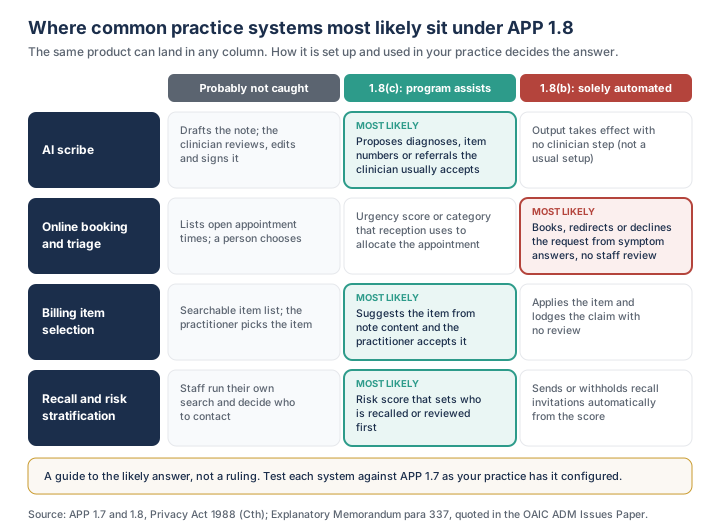
The same product can sit in different places in two practices. What decides it is the feature set you have switched on and what your staff do with the output.
AI scribes and clinical documentation
A scribe that transcribes a consultation and drafts a note the clinician reviews and signs is doing documentation. It is hard to call that a key factor in a decision about the patient. The position changes when the scribe proposes diagnoses, problem-list entries, item numbers or referrals, and the clinician accepts them as a matter of routine. That output is a key factor with a direct connection to a decision about care or billing, which is the APP 1.8(c) category.
The same tools now fall under criterion F11 of the RACGP Standards for general practices (6th edition). F11.A reads "Where the practice uses artificial intelligence, it does so safely and securely and consistent with existing standards", and expects documented processes that support clinical oversight of AI outputs. F11 and the ADM disclosure are separate obligations, one assessed at accreditation (still against the 5th edition until transition arrangements are announced) and one enforced by the OAIC, but they draw on the same evidence: a list of AI tools, the patient data each uses, and the point where a clinician checks the output. Our guide to the 6th edition covers the rest of F11.
Online booking and triage
Booking platforms that take symptoms and history, then assign urgency, restrict appointment types or route patients to a clinician, are using personal information in a decision about access to healthcare. If the platform books, redirects or declines the request with no staff review, the decision is made solely by the program. If reception works from its urgency score, the program is doing a thing substantially and directly related to the decision.
Billing and item selection
Some practice management systems suggest or pre-fill an MBS item from the content of the clinical note. That uses health information and affects what the patient pays and what Medicare pays. A suggestion the practitioner accepts sits in APP 1.8(c). Software that applies the item and lodges the claim with no review would be deciding on its own. The ANAO's September 2026 audit of AI billing software covers who answers for a wrong suggestion and what the record must still show.
Recall and risk stratification
A tool that scores patients for chronic disease risk and sets who is recalled, or reviewed first, is shaping access to care. Where staff act on the ranking, it is an assisting program. Where invitations go out or are held back automatically on the score, the program is deciding.
What must the privacy policy say under APP 1.8?
Where APP 1.7 is met, APP 1.8 requires the policy to contain:
(a) the kinds of personal information used in the operation of such computer programs; and
(b) the kinds of such decisions made solely by the operation of such computer programs; and
(c) the kinds of such decisions for which a thing, that is substantially and directly related to making the decision, is done by the operation of such computer programs.
The table sets each paragraph beside illustrative wording. The examples are ours, not OAIC text, and yours must describe your own systems.
| APP 1.8 paragraph | What the policy states | Illustrative wording for a practice |
|---|---|---|
| (a) Kinds of personal information | The categories of information the programs use | "Our online booking system uses the symptoms, age and appointment history you enter. Our AI scribe uses the audio and content of your consultation." |
| (b) Decisions made solely by a program | Decisions that take effect with no person reviewing them | "Our booking system allocates urgent same-day appointments from your answers to its symptom questions." |
| (c) Decisions a program substantially and directly assists | Decisions a person makes where the program's output is a key factor | "Our software suggests Medicare items from clinical notes, which your practitioner reviews before billing." |
APP 1.8 asks for kinds, so the policy describes categories of information and categories of decision. It does not ask for the logic of the model. A line such as "we may use technology to assist some decisions" names no kind of information and no kind of decision, so it does not give the APP 1.8 content.
Item 89 of the amending Act applies APP 1.7 to decisions made after it takes effect, whether the program was set up, or the personal information collected, before or after that day. Systems already in place on 10 December 2026 are covered.
What should a practice do before 10 December 2026?
- List every system that touches patient information and makes or feeds a decision: booking and triage, AI scribes, billing, recall, clinical decision support and patient chatbots. Include tools a vendor runs for you.
- Run each one through the three limbs of APP 1.7. Record the answer and the reason, including the systems that fail a limb, so a later change of setup can be checked against it.
- For each system that meets all three, write the APP 1.8 lines: the kinds of information used, and whether its decisions are made solely by the program or assisted by it.
- Check the wording against the OAIC's guidance, whose fact sheet ends with two sample privacy policy sections (Examples 6 and 7), and publish the revised policy before 10 December 2026.
What are the penalties from 10 December 2026?
Item 87 of the amending Act adds APP 1.7 to section 13K(1)(b) of the Privacy Act as subparagraph (iia), beside the existing entries for APP 1.3 (having a privacy policy) and APP 1.4 (its contents). Section 13K(4) caps the penalty at 200 penalty units. Section 82(5)(a) of the Regulatory Powers (Standard Provisions) Act 2014 multiplies that by five for a body corporate. Section 80UB makes s 13K contraventions subject to infringement notices, and s 80UC lets the OAIC issue a compliance notice.
The penalty unit is $364 for contraventions from 1 July 2026 under the Crimes (Amount of a Penalty Unit) Instrument 2026. The dollar figures below are calculated from the unit counts; they are not published amounts.
| Who | Maximum court penalty per contravention | Infringement notice, one contravention |
|---|---|---|
| Anyone other than a body corporate | 200 penalty units ($72,800) | 12 penalty units ($4,368) |
| Body corporate | 1,000 penalty units ($364,000) | 60 penalty units ($21,840) |
| Listed corporation | 1,000 penalty units ($364,000) | 200 penalty units ($72,800) |
The infringement amounts come from s 104(2) of the Regulatory Powers Act (the lesser of one-fifth of the court maximum, or 12 units for an individual and 60 for a body corporate) and s 80UB(1A) of the Privacy Act for listed corporations.
The higher tiers in s 13H (up to 2,000 penalty units, five times that for a body corporate) and s 13G (for a serious interference, up to the greatest of $50 million, three times the benefit or 30% of adjusted turnover for a body corporate) apply to interferences with privacy generally, not to the content of the policy. The Federal Court ordered the first civil penalties under the Privacy Act on 8 October 2025: $5.8 million against Australian Clinical Labs over the February 2022 Medlab Pathology data breach.
The OAIC's Corporate plan 2026-27 sets "Regulated entities are transparent and open about how they adopt and use AI and automated decision-making" as a strategic outcome. Its regulatory priorities page still shows the 2025-26 list, which names the application of artificial intelligence. No 2026-27 list had been published at 30 September 2026.
Frequently Asked Questions
Does the automated decision-making obligation apply to small GP practices?
Yes. Section 6D(4)(b) of the Privacy Act 1988 (Cth) excludes anyone who provides a health service and holds health information from the small business exemption, whatever the turnover. A sole-practitioner clinic has the same APP 1.7 to 1.9 obligations as a large group.
When must the privacy policy be updated?
By 10 December 2026, when APPs 1.7 to 1.9 take effect. They apply to decisions made from that day, including decisions made by systems set up earlier and using information collected earlier.
When does an AI scribe count as automated decision-making?
When its output is a key factor in a decision about the patient. A scribe that drafts a note the clinician reviews and signs is unlikely to meet APP 1.7. One that proposes diagnoses, item numbers or referrals the clinician routinely accepts is likely to be doing a thing substantially and directly related to a decision, which belongs under APP 1.8(c).
What must my privacy policy say about automated decision-making?
Three things, under APP 1.8: the kinds of personal information the programs use, the kinds of decisions they make solely, and the kinds of decisions they substantially and directly help make. Name categories specific enough that a patient can tell what information is used and for which decisions.
Does the obligation apply if a person reviews the output before acting?
Yes. Where the output is a key factor in the person's decision, the duty still applies: APP 1.7(a) covers a program that does "a thing that is substantially and directly related to making" a decision, and the Explanatory Memorandum says that includes recommending or guiding a human decision-maker. The OAIC's guidance agrees that a decision can be in scope where the output "is subject to human review" (chapter 1, under paragraph 1.41). Those decisions go under APP 1.8(c).
What are the penalties for a non-compliant privacy policy after 10 December 2026?
Up to 200 penalty units ($72,800) per contravention for an individual and 1,000 penalty units ($364,000) for a body corporate under s 13K, at the $364 unit in force from 1 July 2026 (calculated). The OAIC can instead issue an infringement notice, of 12 penalty units ($4,368) for an individual and 60 penalty units ($21,840) for most bodies corporate, or a compliance notice.
Has the OAIC published guidance on the ADM obligation?
Yes, on 30 September 2026. Version 2.0 of chapter 1 of the APP guidelines has a section on decisions made by a computer program (paragraphs 1.35 to 1.78), and the OAIC published a fact sheet and a flowchart with it. The fact sheet lists computer programs used to prioritise the provision of health services among the decisions generally in scope.
Is this the same as the new privacy tort or RACGP criterion F11?
No. The statutory tort for serious invasions of privacy in Schedule 2 of the same Act lets individuals sue in court. RACGP criterion F11 is an accreditation requirement for practices that use AI. APPs 1.7 to 1.9 are a privacy policy duty enforced by the OAIC.