Key Takeaways
- The start date moved. New framework planning is now "expected to start from 1 April 2027", not 1 July 2026. Participants aged 18 and over begin moving across from April 2027, and the transition "is expected to be completed by December 2030 for all participants".
- The assessment has four parts, not one: a core needs assessment across 12 domains, a personal and environmental circumstances questionnaire (PECQ), targeted assessments, and a translation of all three into assessed categories of NDIS supports.
- The core needs assessment is "based on a modified version of the Instrument for the Classification and Assessment of Support Needs (I-CAN) version 6", not I-CAN v6 off the shelf. It records the frequency and level of support needed.
- There are 23 targeted assessments in 4 groups: 8 disability related health supports, 12 assistive technology, 2 home environment supports (home modifications and specialist disability accommodation), and 1 behaviour support.
- The allied health hook is in the targeted assessments. For most of them the NDIA assessor checks whether the participant already has reports from a medical or allied health professional, and "the NDIA will provide forms for health professionals to provide any required evidence".
- Support needs assessments are conducted by a "trained, accredited NDIA assessor", an NDIA employee acting for the purposes of section 32L of the NDIS Act, with an NDIA delegate reviewing the report.
- Budgets are grouped into 18 categories of NDIS supports, 8 flexible and 10 stated, not the 17 categories with 5 flexible reported earlier. Therapy is a flexible category. Plans run for up to 5 years.
- None of this is law yet. Consultation on four of the eight new framework planning rules closed on 14 October 2026. The department says a What we heard report will follow shortly, and exposure drafts of all eight are promised "later in 2026".
New framework planning is the new way the NDIA will decide what supports a participant needs and how much funding sits in their plan. It replaces the independent allied health report as the primary evidence source for most adult plans with a structured conversation run by an NDIA assessor. For occupational therapists, physiotherapists and speech pathologists, that changes both the referral mix and where clinical evidence enters the system.
The timing has moved, and the detail has arrived. When this guide was first published the working assumption across the sector was a 1 July 2026 start. The department's consultation opened on 19 August 2026 now says new framework planning "is expected to start from 1 April 2027", and the consultation paper published with it sets out the assessment in far more detail than was previously public.
Status check: October 2026
The 1 July 2026 start date that appeared in earlier coverage of new framework planning, including earlier versions of this guide, has not happened and is no longer the government's position. On 19 August 2026 the Department of Health, Disability and Ageing opened the New Framework Planning and NDIS Supports Consultation and published a news item stating that new framework planning "is expected to start from 1 April 2027 and will be introduced gradually". The New Framework Planning Rules consultation paper goes further: "Participants aged 18 years and over will begin gradually moving from old framework planning (the current way of making NDIS plans) to new framework planning from April 2027. The transition is expected to be completed by December 2030 for all participants."
That is the first firm date the department has ever attached to new framework planning, and it is later than the one most provider commentary was written against. Two things follow. Your clients keep their current plans until a new framework plan is approved for them, so nothing in a plan changes on a fixed date. And the design is still proposed: the rules that would make it bite are NDIS rules, legislative instruments made under the National Disability Insurance Scheme Act 2013, and none of the eight new framework planning rules has been made yet. The consultation paper says plainly that "the information in this paper may change as we receive feedback, continue refining the policy, and learn from NDIA testing".
The consultation closed at 11.59 pm AEDT on 14 October 2026. The consultation page now says "We are analysing your feedback and will publish a What we heard report shortly", and that "The exposure drafts of all eight new framework planning rules will be available for information and further consultation later this year." Neither the report nor the drafts had been published by 20 October 2026.
What new framework planning actually changes
Under the current system, allied health providers play two roles in NDIS planning: service providers delivering funded supports, and report writers producing the functional capacity assessments and specialist reports that form the primary evidence base for a participant's plan budget. New framework planning reduces the second role for most adult participants. From April 2027, participants moving to the new system will have their support needs determined through what the consultation paper calls "a guided conversation between a NDIS participant and a trained, accredited NDIA assessor", defined in the paper's glossary as "a trained and accredited NDIA employee who undertakes a support needs assessment or replacement assessment for the purposes of section 32L of the Act". The assessor writes the support needs assessment report, and an NDIA delegate reviews it before it informs the budget.
Participants can bring a support person, receive a copy of the report and can share it. If a participant has concerns about the process or the report, the NDIA delegate decides whether a replacement assessment is needed, and one of the consultation questions asked the sector when a replacement assessment should be arranged.
Allied health reports from treating providers do not disappear from the process. They move: from being the evidence that sets the budget, to being the evidence that feeds a targeted assessment. That distinction is the whole of the change for report-writers, and the next section is where it lives.
The four parts of a support needs assessment
The single biggest thing the August 2026 consultation paper adds is that the support needs assessment is not one instrument. It has four parts, and allied health evidence enters at the third. Understanding which part your report feeds is what tells you whether the work survives the transition.
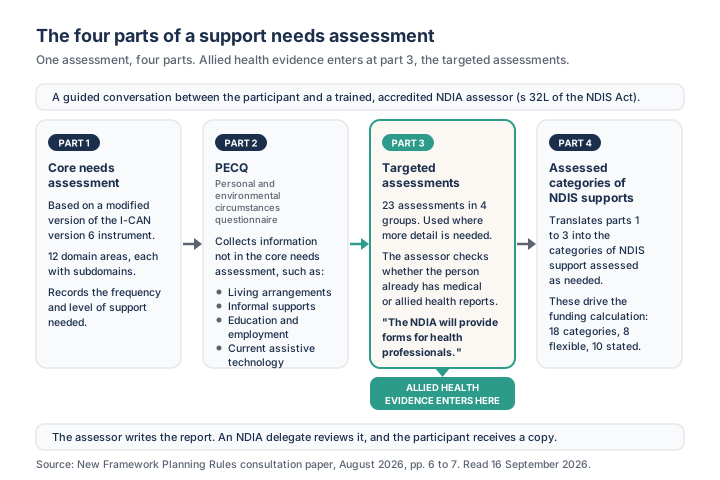
1. Core needs assessment. This assesses core disability support needs across 12 domain areas and "records the frequency and level of support needed". The paper states it "is based on a modified version of the Instrument for the Classification and Assessment of Support Needs (I-CAN) version 6". That word "modified" matters: this is not I-CAN v6 as published, and the modifications have not been released. The 12 domains, each with its own subdomains, are mobility, domestic life, self-care, community, social and civic life, communication, learning and applying knowledge, general tasks and demands, life-long learning, interpersonal interactions and relationships, behaviour of concern, mental and emotional health, and physical health.
2. Personal and environmental circumstances questionnaire (PECQ). This "collects additional information about a participant that may not be recorded in the core needs assessment", giving living arrangements, informal supports, education and employment, and current assistive technology as examples. Its stated purpose is to "identify individual circumstances that may impact a participant's budget".
3. Targeted assessments. Used "where a more detailed assessment of a participant's needs is required". Not every participant gets one; some get several. There are 23 individual targeted assessments across 4 groups.
4. Assessed categories of NDIS supports. The rules for translating the first three parts into the categories of NDIS support the participant has been assessed as needing, which then drive the funding calculation. The department's support needs assessment fact sheet describes this fourth part as "instructions to assessors", which is the same function described from the assessor's side.
The 23 targeted assessments, and where your reports go
| Group | What it covers | Number of assessments |
|---|---|---|
| Group 1 | Disability related health supports: wound and pressure management, respiratory, epilepsy and seizure, dysphagia, dietary and nutrition, diabetes, continence, lymphoedema | 8 |
| Group 2 | Assistive technology: prosthetics and orthotics, communication, personal mobility and transfers, toileting and bathing, recreation and leisure, beds, furniture and fixtures, assistance animals, dog guides, vehicle modifications, environmental controls and mounting devices, hearing AT, vision AT | 12 |
| Group 3 | Home environment supports: home modifications, specialist disability accommodation | 2 |
| Group 4 | Behaviour supports | 1 |
Read that list as a referral map. Almost every row is a support an OT, physiotherapist, speech pathologist, dietitian or continence nurse currently writes evidence for, and the consultation paper keeps them in the loop explicitly: "For most targeted assessments, the NDIA assessor will need to check if the participant has relevant reports from a medical or allied health professional, to decide whether a targeted assessment is needed."
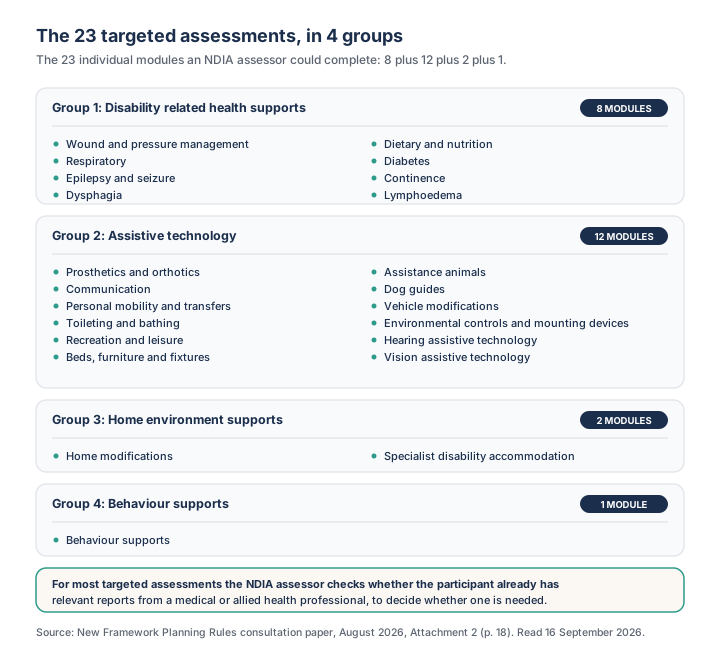
Two consequences follow. A current, on-file allied health report can be the thing that triggers or avoids a targeted assessment, which makes the currency of your reports a scheduling question, not just a clinical one. And the line that should shape your templates is this: "The rules will set out the minimum information required for a targeted assessment, and the NDIA will provide forms for health professionals to provide any required evidence." That is a shift from a free-form report to a form with a minimum information set. Each targeted assessment is to have three components behind it, a minimum requirements table, a questionnaire for the NDIA assessor and a manual, and none has been published. Prescribing clinicians stay in the process for equipment and modifications: "if a participant needs assistive technology, home modifications or vehicle modifications, a health professional such as an occupational therapist will complete a report about the types of supports the participant needs."
The rollout timeline
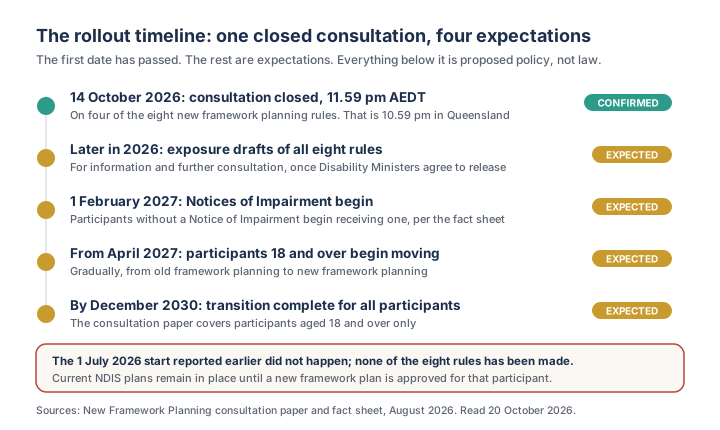
The rollout is gradual and runs for close to four years. These are the dates as the department states them in October 2026.
| Date | What happens | Status |
|---|---|---|
| 14 October 2026 | Consultation closed on four of the eight new framework planning rules, at 11.59 pm AEDT | Closed |
| Not dated | What we heard report on the consultation, which the department says it will publish "shortly" | Expected |
| Later in 2026 | Exposure drafts of all eight rules released for information and further consultation, after Disability Ministers agree to their release | Proposed |
| 1 February 2027 | Participants who have not yet received a Notice of Impairment begin receiving one | Proposed, per the fact sheet |
| From April 2027 | Participants aged 18 and over begin gradually moving from old framework planning to new framework planning | Expected |
| By December 2030 | Transition "expected to be completed" for all participants | Expected |
Two cautions on reading that table. First, every row from the exposure drafts down is a proposal, not a commencement: the mechanism that makes any of it operate is a set of NDIS rules made under the National Disability Insurance Scheme Act 2013, and none has been made. Second, nothing happens to a given participant on a date. The paper's wording is that "current NDIS plans will remain in place until a new framework plan is approved", and participants "will be informed before any changes affect them". The paper covers participants aged 18 and over only and gives no date or assessment approach for anyone under 18, so treat any under-18 timing quoted elsewhere as unsourced.
Flexible budgets and the 18 support categories
Under new framework planning, plans will have two types of funding: stated supports and a flexible budget. Stated supports must be used for the stated purpose. The flexible budget can be used across NDIS supports that are not stated supports, giving participants more choice about which providers they use and for what purposes. The paper says "the intention is for more funding to be in the flexible budget for most NDIS participants", and that plans will run for "up to 5 years".
Correct one number if you are working from earlier coverage, including earlier versions of this guide. The August 2026 consultation paper says funding "will be grouped into 18 categories of NDIS supports", of which "8 are in the flexible budget" and "10 in the stated supports budget". That supersedes the 17 categories with 5 flexible that circulated earlier. The wider move from 36 support categories to 18 is covered in our NDIS support categories guide.
Therapy is category 18, and it is flexible. The paper defines it as "evidence-based allied health supports that improve or maintain a participant's functional capacity across daily living, communication and community participation", and says that includes "assessment, prescription, implementation, adjustment and training in the use of assistive products where required to support functional outcomes". Disability related health supports, both the nursing and the consumables categories, are also flexible. Assistive technology assets, home modifications, specialist disability accommodation, behaviour support and support coordination are stated. A flexible therapy budget cuts both ways: a participant can redirect flexible funding toward your service even if therapy was not identified during planning, and can just as easily move it away.
The Thriving Kids dimension
For allied health providers working with children, the picture also turns on the Thriving Kids program. The NDIS access changes consultation paper records that in January 2026 National Cabinet agreed governments would "contribute $4 billion over 5 years to implement the first phase of Foundational Supports, known as 'Thriving Kids'", supporting "children aged 8 and under with developmental delay and/or autism with low to moderate support needs", and that "Thriving Kids will commence from October 2026, reaching full rollout by January 2028".
Pair that with the access date. The same paper says "access reforms will be implemented from 1 January 2028", so the boundary between the NDIS and Thriving Kids for new applicants lands with the access changes rather than in mid-2027, as earlier coverage including this guide had it. How Thriving Kids services will be funded and billed is not set out in the paper, which says only that the TAG "will not advise on access thresholds for Thriving Kids". Our Thriving Kids provider impact guide covers the referral and revenue effects.
What allied health providers should do now
Split your report work into the two kinds that diverge
Identify what proportion of your NDIS revenue comes from functional capacity assessments and specialist planning reports, versus ongoing therapy delivery. Then split the report-writing half again, into reports that set a whole plan budget and reports that support one specific support: a wheelchair, a home modification, a communication device, a seizure or dysphagia management need. The first shrinks under new framework planning. The second becomes targeted assessment evidence and survives. Take the four groups above and mark which rows your practice already writes for; each unmarked row your discipline could credibly cover is a referral line worth opening before April 2027.
Get ready for forms, not reports
The NDIA has said it "will provide forms for health professionals to provide any required evidence", with a minimum information table behind each targeted assessment. Nothing is published yet, so the preparation is structural: make sure your report templates are assembled from discrete, reusable findings that can be transcribed into a form, and that your clinical record captures the frequency and level of support a person needs, not only what they cannot do.
Watch for the What we heard report and the exposure drafts
Submissions closed at 11.59 pm AEDT on 14 October 2026. The consultation hub says the department will publish a What we heard report shortly, and that the exposure drafts of all eight rules will be available for information and further consultation later in 2026, which is the next chance to comment on the wording. Two of the published consultation questions were aimed squarely at report-writers: what parts of the support needs assessment process need more explanation, and in what circumstances a replacement assessment should be arranged. Read the report and the drafts for the answers to those two first.
Prepare clients for what to expect
Clients aged 18 and over are the first cohort, from April 2027, and they will be contacted before they are moved. The honest answer for most of 2026 is that the rules are not made yet. Use the ClinicComply compliance calendar to track the reform milestones that apply to your client cohort, the NDIS compliance quiz for a rapid gap assessment, and our guide to NDIS billing for non-face-to-face allied health supports for the billing rules that continue to apply.
Frequently Asked Questions
Will my OT reports still matter after new framework planning starts?
Yes. Allied health reports feed the targeted assessments, the third of the four parts of a support needs assessment. The paper says that "for most targeted assessments, the NDIA assessor will need to check if the participant has relevant reports from a medical or allied health professional", and that for assistive technology, home modifications or vehicle modifications "a health professional such as an occupational therapist will complete a report". What changes is that your report no longer sets the whole plan budget. The core needs assessment run by the NDIA assessor does that.
When will my clients transition to new framework planning?
Participants aged 18 and over begin gradually moving across from April 2027, and the transition "is expected to be completed by December 2030 for all participants". Current plans stay in place until a new framework plan is approved, and participants are contacted before they are moved. The 1 July 2026 start reported earlier, including in earlier versions of this guide, did not happen, and the paper gives no date or assessment approach for participants under 18.
Will the NDIA give allied health professionals a form to complete?
Yes, that is the stated intention: "the rules will set out the minimum information required for a targeted assessment, and the NDIA will provide forms for health professionals to provide any required evidence". Each of the 23 targeted assessments is to have a minimum requirements table, a questionnaire and a manual behind it. None has been published, so the forms do not exist yet. Make sure your clinical record captures the frequency and level of support a person needs in a form that transcribes cleanly into a structured template.
What is I-CAN v6 and how does it work?
I-CAN v6 (Instrument for the Classification and Assessment of Support Needs, version 6) is a structured assessment tool developed by the Centre for Disability Studies. The core needs assessment inside new framework planning is not the published instrument: the consultation paper says it "is based on a modified version" of it, and the modifications have not been released. What the paper confirms is that the core needs assessment covers 12 domain areas, each with subdomains, and records both the frequency and the level of support a person needs.
Can participants request an independent allied health assessment?
Not as a right the consultation paper describes. The paper's route is a replacement assessment: "if a participant is concerned about the assessment process or the report, the NDIA delegate will work with them to decide if a replacement assessment is needed", and that replacement is itself conducted by an NDIA assessor under section 32L. One of the published consultation questions asked in what circumstances a replacement assessment should be arranged, so the trigger is still open. Decisions made on a plan keep the standard review rights under the NDIS Act 2013, an internal review and then the Administrative Review Tribunal, and an allied health report remains the evidence a participant can put before either.
What are flexible budgets under new framework planning?
Flexible budgets are the portion of an NDIS plan where funding can be used across NDIS supports that are not stated supports, rather than being tied to a specific line item. The August 2026 consultation paper says funding will be grouped into 18 categories of NDIS supports, 8 of them flexible and 10 stated, which supersedes the 17 categories with 5 flexible reported earlier. Therapy is one of the flexible categories, so spending on therapy depends on the participant's own priorities rather than being prescribed by the plan.
When did the new framework planning consultation close?
At 11.59 pm AEDT on 14 October 2026, which was 10.59 pm in Queensland. It opened on 19 August 2026 and covered four of the eight new framework planning rules: how support needs will be assessed, how reasonable and necessary budgets will be developed, how a participant can use their plan, and how a new framework plan can be changed. The other four were consulted on between January and March 2026. The department says it is analysing the feedback and will publish a What we heard report shortly. Exposure drafts of all eight rules are promised later in 2026 for information and further consultation, once Disability Ministers agree to their release.
Do providers need to change how they bill NDIS for therapy services?
No. New framework planning does not itself change the rules for delivering and billing therapy supports. Registered providers still need to comply with the NDIS Practice Standards, the Support Catalogue pricing, and the rules around non-face-to-face supports. What changes is how participant budgets are set and structured, not the billing rules that apply once a participant has a plan in place. For current billing obligations for allied health, see our guide to NDIS billing for non-face-to-face allied health supports.
Part of