Key Takeaways
- The RACGP released the Standards for general practices (6th edition) on 26 August 2026. It has five standards: Foundations of general practice (F), Clinical governance (CG), Patient participation (PP), Continuous quality improvement (CQI), and an optional Point-of-care testing standard (PoCT).
- The four core standards hold 35 criteria sets: F1 to F11, CG1 to CG13, PP1 to PP10, and CQI1. Counting the criteria listed in the RACGP's mapping guide gives 92 criteria across those four standards.
- All criteria must be met for accreditation except those labelled aspirational. There are three in the four core standards: F8.F, CG3.J and CQI1.C. The 5th edition's flagged and unflagged indicator approach is gone.
- Nineteen criteria are marked New in the mapping guide, concentrated in F1 governance, F3 environmental sustainability, F10 digital health technologies, F11 artificial intelligence, CG4 sustainable practice and antimicrobial stewardship, CG7 clinical risk, CG13 secondary use of data, PP4 informed consent, PP6 environmental information, and CQI1 environmental performance.
- Consumer expectation statements accompany each criteria set. They are not accreditation requirements.
- Practices are still assessed against the 5th edition. Transition arrangements under the National General Practice Accreditation Scheme have not been published.
The RACGP released the Standards for general practices (6th edition) on 26 August 2026, marking 30 years since the first edition in 1996. This post is the contents map: what is in each standard, which criteria are new, and how the required and aspirational split works now that indicators are gone.
If you want the action plan rather than the structure, our companion post covers what changes for your practice and what to do now.
How the 6th edition is put together
The structure page sets out the shape. Five standards, each containing one or more named sets of criteria, and each criterion carrying an alphanumeric code built from three parts: the standard prefix, the position of the criteria set within the standard, and the position of the criterion within that set. So CG3.E is the fifth criterion in the third criteria set of the Clinical governance standard.
| Prefix | Standard | Criteria sets |
|---|---|---|
| F | Foundations of general practice | F1 to F11 |
| CG | Clinical governance | CG1 to CG13 |
| PP | Patient participation | PP1 to PP10 |
| CQI | Continuous quality improvement | CQI1 |
| PoCT | Point-of-care testing (optional) | PoCT1 to PoCT8 |
Every criteria set is accompanied by guidance in two parts, "Why this is important" and "Meeting these criteria", plus a list of supporting resources. The RACGP asks practices to read the guidance in full, because it carries the context and intent behind each criterion. One word in the guidance does a lot of work: "could" signals that the examples given are neither mandatory nor exhaustive, so a practice is not required to implement every example listed or adopt any of them exactly as written, provided the criterion itself is met.
The RACGP describes the 6th edition as written with a focus on outcomes rather than processes. In its words, criteria describe what practices are expected to achieve rather than prescribing how they must achieve it, with clearer separation between requirements (criteria and sub-criteria) and guidance material.
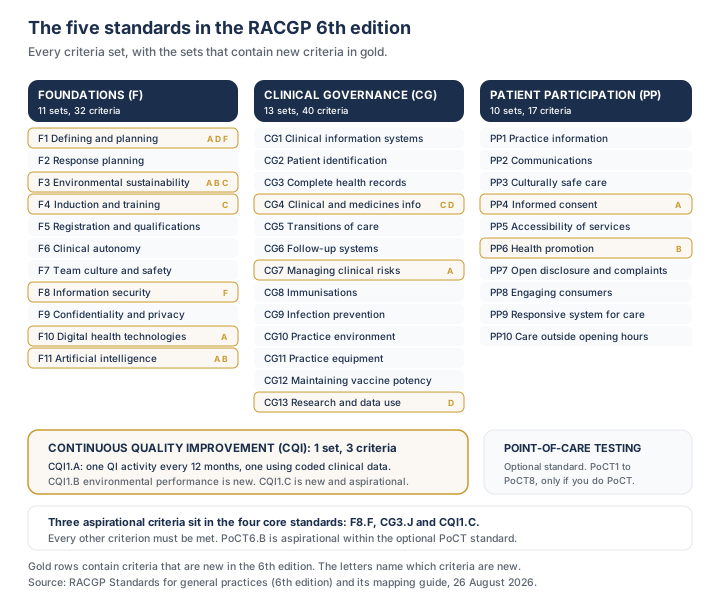
Foundations of general practice (F1 to F11)
Foundations is the largest standard by criteria count. Tallying the mapping guide gives 32 criteria across 11 sets, and it is where most of the new material sits: 11 of its criteria have no 5th edition equivalent.
| Criteria set | What it covers | New criteria |
|---|---|---|
| F1 Defining and planning for the practice | Mission and values, strategic and operational planning, document control, ethics, governance framework and governance risk | F1.A, F1.D, F1.F |
| F2 Response planning | Emergency, business continuity and disruption planning, consolidated into one criterion | |
| F3 Environmental sustainability and responsibility | Climate resilience, sustainability strategies, sustainability leadership | F3.A, F3.B, F3.C |
| F4 Induction, training and supporting performance | Induction, role-specific training and competency, abuse and violence response, professional development, CPR certification | F4.C |
| F5 Registration and qualifications of practitioners | Practitioner registration and credentials, GP qualifications | |
| F6 Clinical autonomy of practitioners | Clinical autonomy in patient care | |
| F7 Practice team culture, safety and involvement | Workforce health, safety and wellbeing; team engagement, feedback and communication | |
| F8 Information security | ICT continuity, recovery and cyber security; digital governance; digital communications; social media; record storage and destruction; informing patients about digital communication tools | F8.F (aspirational) |
| F9 Confidentiality and privacy | Privacy, confidentiality and health information management; authorised access to clinical information | |
| F10 Digital health technologies | Governance of digital health technologies | F10.A |
| F11 Artificial intelligence | Safe and accountable use of AI; evaluation and monitoring of AI use | F11.A, F11.B |
Three sets deserve a note. F3 is new in its entirety: F3.A asks the practice to identify climate-related risks to its operations and implement strategies to improve climate resilience, F3.B asks for documented strategies to reduce direct and indirect greenhouse gas emissions, and F3.C asks for at least one team member with primary responsibility for environmental sustainability.
F11 applies conditionally. The RACGP is explicit on its what practices need to know page that the Standards do not require practices to adopt or use AI tools, and that the AI criteria are only applicable and mandatory for practices that use them. F11.A covers safe and secure use consistent with existing standards, including documented informed consent where AI touches an aspect of a patient's care. F11.B covers assessment of AI risk before implementation and monitoring afterwards.
F8 carries the cyber security and digital governance material, which the RACGP describes as significantly strengthened against the 5th edition. Its one aspirational criterion, F8.F, asks the practice to inform patients about the digital communication tools it uses to support their care.
Clinical governance (CG1 to CG13)
Clinical governance is the largest standard by criteria sets, with 13 sets and 40 criteria on our count of the mapping tables. Most of it is retained or expanded from the 5th edition rather than new, but two of the expanded criteria carry more weight than their category suggests.
| Criteria set | What it covers | New criteria |
|---|---|---|
| CG1 Clinical information systems | Digital clinical information systems | |
| CG2 Patient identification | Patient identification and record matching | |
| CG3 Facilitating complete patient health records | Demographic details in codable fields, Aboriginal and Torres Strait Islander status, consultation records, clinical documentation, coded health summaries and allergies, medicines lists, shared decision-making, consent discussions, patient communications | CG3.J is aspirational (expanded) |
| CG4 Provision of clinical and medicines guidelines | Evidence-based medicines information, clinical and emergency guidelines, sustainable clinical practice, antimicrobial stewardship | CG4.C, CG4.D |
| CG5 Transitions of care | Referrals, handover and coordination; transfer of patient health information | |
| CG6 Follow-up systems | Managing results, recalls and reminders; high-risk results outside opening hours | |
| CG7 Managing clinical risks and incidents | Clinical risk management system; incident and near miss management | CG7.A |
| CG8 Immunisations | Workforce immunisation | |
| CG9 Infection prevention and control, including reprocessing | Infection control policy, IPC coordinator, cross-infection risks, patient information, reprocessing reusable medical devices, sterilisation traceability | |
| CG10 Practice environment | Practice environment supports safe, quality care | |
| CG11 Practice equipment | Primary, emergency and resuscitation equipment; training; spirometry; medicines, samples and consumables | |
| CG12 Maintaining vaccine potency | Cold chain policy and procedures; cold chain leadership | |
| CG13 Research | Ethics approval, research indemnity, sharing identifiable information, sharing deidentified information | CG13.D |
CG1.A is the criterion practice managers will feel first. The mapping guide classes it as Expanded from indicators C6.2A and C6.2B, but the RACGP's what-to-know page states the consequence directly: paper health records are no longer acceptable, and practices must use a digital clinical information system. CG1.A acknowledges that hybrid arrangements may still be needed, for instance where a practice has patients at residential aged care facilities, but all systems must be digital. Where a practice runs more than one digital clinical information system, CG1.A requires up-to-date health summaries in each and a record of each consultation in each patient health record, including where the clinical notes are recorded.
CG3 adds two requirements to a set that otherwise aligns with the 5th edition: demographic and identification details recorded in codable fields, and known allergies (or an explicit record of no known allergies) in every active patient health record. CG3.J, the aspirational criterion, extends codable collection to ethnicity, birth sex, gender and preferred pronouns.
CG9 now requires practices that reprocess reusable medical devices to apply a risk-based approach in line with the RACGP's Infection prevention and control guidelines or another model meeting the current Australian standard. CG9.E, reprocessing, had no equivalent criterion in the 5th edition, where the material sat inside GP4.1A and the IPC guidance.
CG10 goes the other way. Multiple facilities indicators from the 5th edition are consolidated into a single outcomes-focused criterion, with less emphasis on infrastructure and more on whether the environment supports safe, quality care.
Patient participation (PP1 to PP10)
Patient participation has 10 criteria sets and 17 criteria. Only two criteria are new, but one of them changes what most practices document.
| Criteria set | What it covers | New criteria |
|---|---|---|
| PP1 Information about your practice | Providing practice information to consumers | |
| PP2 Communications | Communication with consumers, emergency messaging, digital communication systems, social media use | |
| PP3 Respectful, culturally appropriate and culturally safe care | Respecting rights, diversity and cultural safety | |
| PP4 Informed consent | Informed consent for procedures and treatments; informed consent for third-party presence | PP4.A |
| PP5 Accessibility of services | Accessible services for people with disability | |
| PP6 Health promotion and preventive care | Health promotion and preventive care information; environmental information relevant to healthcare | PP6.B |
| PP7 Open disclosure and complaints | Open disclosure; complaints management | |
| PP8 Engaging consumers | Consumer engagement and improvement | |
| PP9 Responsive system for patient care | Triage systems; access to consultation types | |
| PP10 Care when the practice is not open | Access to after-hours care |
PP4.A is the change to look at. The 5th edition required consent processes where a third party was present during a consultation, which is retained as PP4.B. PP4.A adds processes to obtain and document informed consent for clinical procedures and treatments generally.
PP8 reframes rather than adds. The 5th edition required practices to collect patient feedback. The 6th asks practices to engage with consumers formally and informally, understand their experience, and use that insight to improve care. The RACGP gives structured surveys and consumer groups as examples of formal engagement, and everyday conversations, opportunistic feedback or digital insights as informal engagement, with the guidance examples deliberately non-exhaustive.
Continuous quality improvement (CQI1)
CQI is one criteria set with three criteria, and it is worth reading in full because it is short and specific.
CQI1.A requires the practice team to undertake continuous quality improvement activities. Underneath that sit six sub-requirements: training for the team members with primary responsibility for QI, a system to identify QI activities, at least one quality improvement activity every 12 months, one of which includes the use of coded clinical data, a record of team feedback about QI systems, documentation of improvements made in response to feedback, complaints or audits, and processes to report performance data and QI activities to practice leadership.
CQI1.B is new: the practice assesses and acts on its environmental performance to track progress toward sustainability goals and compliance with its documented emission reduction strategies, reporting that assessment to practice leadership.
CQI1.C is new and aspirational: the practice measures environmental-impact metrics to assess and manage its overall environmental footprint.
The point-of-care testing standard
The fifth standard is optional. The RACGP describes it as an optional standard for point-of-care testing, and it applies only to practices that perform PoCT. It runs eight criteria sets: PoCT1 clinical purpose, PoCT2 clinical responsibility, PoCT3 qualifications, education and training of PoCT practitioners, PoCT4 facilities for testing, PoCT5 performance of tests, PoCT6 data management, PoCT7 quality control procedures, and PoCT8 external quality assurance program. The standard also carries its own section on PoCT and the Australian Register of Therapeutic Goods.
One aspirational criterion sits inside it: PoCT6.B, worded as the practice facilitating the recording of PoCT results using a nationally recognised coding system. That criterion is outside the mapping guide, which covers only the four core standards.
Under the current National General Practice Accreditation Scheme, point-of-care testing is accredited against the separate RACGP Standards for point-of-care testing (5th edition). Whether and how the optional 6th edition standard replaces that arrangement is part of what the Commission says will be provided in due course.
Required and aspirational criteria
The 5th edition marked indicators as flagged or unflagged, and only flagged indicators were mandatory for accreditation. That is gone.
The 6th edition's required and aspirational criteria page states that all criteria need to be met to achieve accreditation apart from aspirational criteria, which the RACGP encourages practices to meet but which are not essential to achieve accreditation. The what-to-know page puts the same point the other way around: all criteria are mandatory unless labelled as aspirational.
Three aspirational criteria sit in the four core standards:
- F8.F: the practice informs patients about the digital communication tools it uses to support their care.
- CG3.J: the active patient health record supports collection, where relevant, of additional demographic details in codable fields including ethnicity, birth sex, gender and preferred pronouns.
- CQI1.C: the practice measures environmental-impact metrics to assess and manage its overall environmental footprint.
The same page also fixes terminology that runs through the document. A patient is a person seeking or receiving healthcare; a consumer is a person using a health service or someone supporting that person; a consumer representative is a consumer providing advice on behalf of others. On the workforce side, the practice team is everyone who works or provides care in the practice, the clinical team is the members holding health qualifications, employed members work under a formal employment agreement, and Independent Doctors in Practice is defined in the glossary. Those distinctions decide which criteria apply to whom, so they are worth reading before you map criteria to people.
Consumer expectation statements
Each criteria set is accompanied by a consumer expectation statement. The RACGP developed them with consumers to capture what each criterion means to patients, and describes them as outlining what consumers value, need, prefer and expect so that decision-making in practices is person-centred.
They are not a requirement that practices must meet as part of accreditation. The RACGP says so directly on the what-to-know page. Read them as intent, not as an assessment item.
What the mapping guide does and does not tell you
The RACGP has published a mapping of the 6th edition to the 5th edition, an 8-page PDF listing every criterion in the four core standards against its related 5th edition content and one of three change categories:
- Retained / consolidated: requirements retained from the 5th edition, including where multiple indicators have been combined into one criterion.
- Expanded: requirements that existed in the 5th edition but have been strengthened, broadened or clarified.
- New: requirements introduced for the first time in the 6th edition.
Tallying those tables gives 92 criteria across the four core standards: 32 in Foundations, 40 in Clinical governance, 17 in Patient participation and 3 in CQI. By category, 19 are New, 39 Expanded and 34 Retained or consolidated. Those totals are our count of the published tables rather than a figure the RACGP states, so check them against the guide if you are relying on them.
The guide carries its own warning, and it is worth quoting the substance of it. The RACGP describes the mapping as a navigational and familiarisation resource only, and says practices should not rely on it to determine accreditation requirements or assess compliance with the 6th edition. Its reasoning is that a criterion mapped to a 5th edition indicator may have different sub-criteria, guidance, terminology, scope and assessment expectations, and that some criteria mix new requirements with retained ones. It also notes that change classifications are applied at criterion level, so a criterion marked Retained or Expanded can still contain new sub-criteria.
Accreditation against the 6th edition will be assessed against the published Standards and the associated accreditation requirements, not against the mapping.
Where the transition stands
Practices are still accredited against the 5th edition. The RACGP's FAQ says further information about the transition arrangements, including timing and accreditation requirements, will be communicated by the Australian Commission on Safety and Quality in Health Care, and that all practices undergoing accreditation will need to meet the 6th edition Standards following the determined transition period. The media release says the arrangements under the National General Practice Accreditation Scheme will be published on the Commission's website soon.
As at 23 September 2026, the Commission's dedicated page for the 6th edition, updated 26 August 2026, says accreditation under the NGPA Scheme currently uses the 5th edition of the Standards and that information about arrangements for the 6th edition will be provided in due course, and that implementation is separate from accreditation assessment. No date has been announced, and no dual-edition window length has been confirmed by either body.
Our migration guide sets out what that means for your next assessment and what preparation is worth doing before the arrangements land.
Where to read it
The 6th edition is published in full on the RACGP website, with a downloadable PDF from the standards hub. The pieces worth reading first are the structure of the Standards, the required and aspirational criteria page, and the what practices need to know FAQ, which carries per-criteria-set detail on what changed.
While you wait for the transition arrangements, the 44 criteria of the 5th edition are what an assessor rates. Our RACGP Accreditation Readiness Quiz gives you a fast baseline against them, our self-assessment guide works through them one at a time, and our common accreditation failures post covers what catches practices out at assessment.
Frequently Asked Questions
How many standards are in the RACGP 6th edition?
Five: Foundations of general practice, Clinical governance, Patient participation, Continuous quality improvement, and Point-of-care testing. The RACGP describes the last of these as an optional standard that applies only to practices performing point-of-care testing, so most practices are working with four.
How many criteria are in the 6th edition?
The four core standards hold 35 criteria sets: F1 to F11, CG1 to CG13, PP1 to PP10 and CQI1. Counting the criteria listed in the RACGP's mapping guide gives 92 across those four standards, split 32 in Foundations, 40 in Clinical governance, 17 in Patient participation and 3 in CQI. That total is our tally of the published mapping tables, not a figure the RACGP states. The optional Point-of-care testing standard sits outside the mapping guide and adds PoCT1 to PoCT8.
What is an aspirational criterion?
A criterion the RACGP encourages practices to meet but which is not essential to achieve accreditation. Three sit in the four core standards: F8.F (informing patients about digital communication tools), CG3.J (additional demographic details in codable fields) and CQI1.C (measuring environmental-impact metrics). PoCT6.B is aspirational within the optional Point-of-care testing standard.
What happened to the flagged and unflagged indicators?
They are gone. The 5th edition marked indicators as flagged or unflagged, with only flagged indicators mandatory. In the 6th edition all criteria must be met for accreditation unless labelled aspirational.
What are consumer expectation statements?
Statements developed with consumers and attached to each criteria set, capturing what that set means to patients and what consumers value, need, prefer and expect. The RACGP states that they are not a requirement practices must meet as part of accreditation.
Is the point-of-care testing standard mandatory?
No. The RACGP calls it an optional standard for point-of-care testing, and it applies only to practices that perform PoCT. Under the current National General Practice Accreditation Scheme, point-of-care testing is accredited against the separate RACGP Standards for point-of-care testing (5th edition), and how the optional 6th edition standard fits the scheme is part of what the Commission says will be provided in due course.
Which criteria are new in the 6th edition?
Nineteen criteria are marked New in the mapping guide: F1.A, F1.D, F1.F, F3.A, F3.B, F3.C, F4.C, F8.F, F10.A, F11.A, F11.B, CG4.C, CG4.D, CG7.A, CG13.D, PP4.A, PP6.B, CQI1.B and CQI1.C. Note that a criterion classified as Retained or Expanded can still contain new sub-criteria, which is why the RACGP says the mapping should not be used to determine accreditation requirements.
Where do I read the 6th edition Standards?
On racgp.org.au. The full text is published under the Standards 6th edition hub with a downloadable PDF, alongside the mapping guide to the 5th edition and the "what practices need to know" FAQ.
Does the 6th edition apply to my practice yet?
Not yet. Practices are still assessed against the 5th edition. The RACGP says the Australian Commission on Safety and Quality in Health Care will publish transition and implementation arrangements under the National General Practice Accreditation Scheme, and no date has been announced. Your accrediting agency will confirm which edition your next assessment runs against.
Part of