Key Takeaways
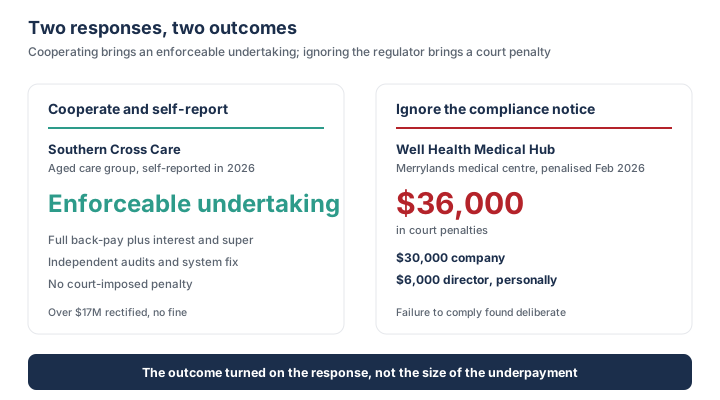
- A Merrylands medical centre, Well Health Medical Hub, was penalised $36,000 in February 2026 ($30,000 against the company and $6,000 against its sole director personally) for deliberately failing to act on a Fair Work compliance notice about an underpaid registered nurse. This is the practice-side case the sector rarely sees named.
- Fair Work also accepted two enforceable undertakings from one aged care group in ten weeks in 2026: Southern Cross Care (NSW and ACT) for more than $11.7 million owed to 5,500 staff (signed 2 April 2026), and Southern Cross Care (WA) for about $5.4 million owed to nearly 2,000 staff (signed 28 May 2026).
- Both were root-caused to systems, not intent: a time-and-attendance system and manual payroll process that misapplied award and enterprise-agreement entitlements. The WA underpayments ran from January 2017 to November 2025, more than eight years, before an internal review caught them.
- Underpayments are recoverable by staff for up to six years, and since 1 January 2025 intentional underpayment ("wage theft") is a criminal offence under the Fair Work Act with penalties up to $9.1 million or three times the underpayment for a body corporate.
- The two big-dollar cases are aged care and disability employers, but the root cause (a payroll system never correctly configured for the award) is the exact risk a small practice carries, and Well Health shows the regulator will pursue a suburban medical centre and its director too.
- The most common award pitfalls for practices are wrong classification levels, flat rates that do not cover penalties, unpaid overtime, missed allowances, and applying the wrong award to nurses.
- An enforceable undertaking is offered to employers who cooperate and self-report; the alternative is court action. Fair Work Ombudsman Anna Booth said the cases show employers must check their systems are fit-for-purpose.
Two Southern Cross Care entities signed Fair Work enforceable undertakings in 2026, together repaying over $17 million to about 7,500 workers after payroll systems misapplied award and agreement entitlements for years. For any practice that runs a roster and a payroll system, the transferable lesson is that underpayment is usually a configuration failure, not dishonesty, and it is fixable before Fair Work is involved. And as a Sydney medical centre found in February 2026, the enforcement risk is not hypothetical for practices.
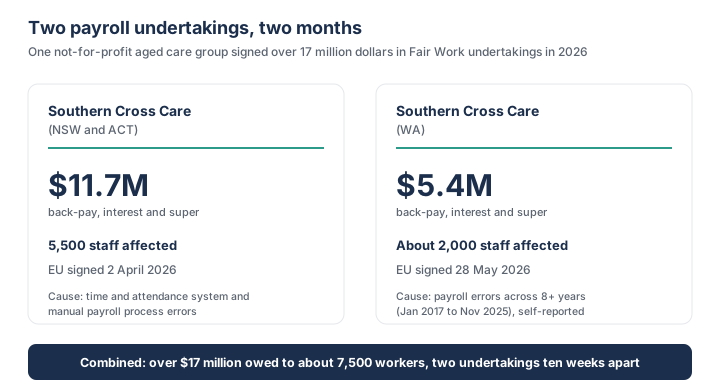
What happened: two undertakings, $17 million, ten weeks apart
In the first half of 2026 the Fair Work Ombudsman accepted two enforceable undertakings from entities in the Southern Cross Care group. On 2 April 2026, Southern Cross Care (NSW and ACT) agreed to rectify more than $11.7 million, including interest and superannuation, to 5,500 staff. The provider reported that its underpayments were caused by issues with its time-and-attendance system and a manual payroll process that was inconsistent with enterprise-agreement requirements. It had already back-paid more than 3,600 employees over $10 million by the time the undertaking was signed.
Ten weeks later, on 28 May 2026, Southern Cross Care (WA) signed a separate undertaking to rectify about $5.4 million to nearly 2,000 staff. Those underpayments ran from January 2017 to November 2025, more than eight years, and were self-reported to Fair Work in December 2024 after employee and union queries prompted an internal review. Affected workers included registered and enrolled nurses, aged care and home care employees, and hospitality staff, with individual back-payments ranging from under a dollar to more than $95,000.
Fair Work Ombudsman Anna Booth said an enforceable undertaking was appropriate because the not-for-profit employers cooperated and committed to fixing the problem, and that the matters show employers must check their systems are fit-for-purpose and are paying staff everything they are owed.
A medical centre has already been penalised: the Well Health case
The clearest sign that this is not only an aged care problem came in February 2026, when the Federal Circuit and Family Court penalised a Sydney medical centre over an underpaid nurse. Well Health Medical Services Pty Ltd, which operated Well Health Medical Hub in Merrylands in western Sydney, was fined $30,000, and its sole director, Irfan Khan, was personally fined a further $6,000.
The underpayment itself was modest. A single full-time registered nurse, employed between October 2020 and September 2023, was underpaid minimum wages and annual leave loading under the Nurses Award 2020 and the National Employment Standards, was not paid for accrued but untaken annual leave when she left, and was not paid for her final 46 hours of work. What escalated the matter to court was the response. A Fair Work inspector issued a compliance notice in December 2023 requiring the practice to calculate and back-pay what was owed, and the practice did not comply. Judge Peter Papadopoulos found that failure was deliberate and described Khan as an "intentional participant", which is why the director was penalised in his own name alongside the company.
That contrast is the whole lesson of this post. Southern Cross Care cooperated, self-reported and was offered an enforceable undertaking with no court-imposed penalty. Well Health ignored the regulator and was taken to court, where the penalty fell on both the business and the individual behind it. The size of the original underpayment did not decide the outcome; the response did.
Why is this a medical practice problem and not just an aged care one?
The two big undertakings are aged care, home care and retirement-living operators, not general practices. Well Health is the exception that proves the point: a small medical centre, one nurse, and a five-figure penalty that reached the director personally. Whether the employer is a large aged care group or a single-site practice, the reason these cases matter is the same root cause. In both undertakings the underpayment was not fraud or deliberate wage theft. It was a payroll or time-and-attendance system that was never correctly configured to apply the relevant award or agreement, and the errors then accrued unnoticed across thousands of shifts and many years.
That failure mode does not depend on being a large employer. A single-site practice paying a handful of receptionists, nurses and allied health staff runs the same machinery: an award with penalty rates, overtime and allowances, a rostering or timesheet system, and a payroll process that has to translate one into the other correctly every fortnight. If the translation is wrong, the shortfall is small per shift and invisible on any single payslip, which is exactly why it compounds. Underpayments are recoverable for up to six years, so a quiet configuration error becomes a five- or six-figure liability by the time anyone checks.
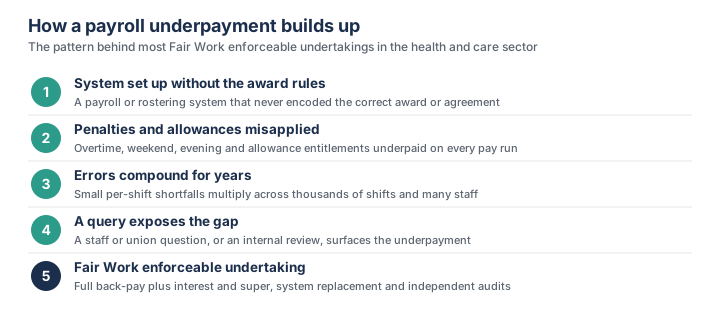
How does a payroll system underpay staff for years without anyone noticing?
The mechanism is consistent across almost every underpayment matter Fair Work publishes. A payroll or rostering system is set up once, often years ago, with an interpretation of the award that is incomplete or has drifted out of date. From then on, every pay run applies the same flawed rules: a weekend penalty that is set too low, an overtime threshold that never triggers, an allowance that is never paid, or a classification level that undervalues the role. Because the base rate looks right and the payslip is internally consistent, nothing looks wrong.
The error only surfaces when someone with the award in one hand and a payslip in the other does the comparison: a new payroll officer, an enterprise-agreement renegotiation, a staff member who checks their penalties, or a union query. That is what happened at Southern Cross Care (WA), where an internal review triggered by employee and union questions uncovered more than eight years of underpayment. By that point the liability spans the whole recovery window and every affected worker, which is how a per-shift error of a few dollars becomes millions.
Which award pitfalls hit small practices hardest?
Most practice staff are covered by the Health Professionals and Support Services Award (MA000027), while registered and enrolled nurses are usually covered by the Nurses Award 2020 (MA000034). The pitfalls below are the recurring reasons a practice underpays without meaning to. You can check each one against your own payroll using the Fair Work Ombudsman's pay and award tools.
| Pitfall | Where it bites | The award element |
|---|---|---|
| Wrong classification level | Paying an experienced administrator or allied health worker at an entry grade | Classification streams and levels |
| Flat rate that swallows penalties | Weekend, evening and public holiday work bundled into one hourly rate | Penalty rates |
| Unpaid or unrecognised overtime | Hours worked beyond the rostered or ordinary hours | Overtime provisions |
| Missed allowances | Uniform, laundry, first aid and on-call not paid | Award allowances |
| Nurses on the wrong award | Applying the Health Professionals Award to RNs or ENs | Nurses Award 2020 (MA000034) |
| Annualised salary that never reconciles | Salaried staff working penalty or overtime hours the salary does not cover | Annualised wage arrangement rules |
| Missing the 1 July increase | Every year the Annual Wage Review takes effect | Annual Wage Review |
The two that catch practices most often are misclassification (placing a role at the wrong level, often because a job has grown but the pay point has not) and annualised salaries that were never reconciled against what the person would have earned under the award for the hours they actually worked. A clear, current position description that matches duties to the correct classification is the simplest control against the first.
What is an enforceable undertaking, and could it apply to a practice?
An enforceable undertaking is a legally binding agreement a regulator accepts instead of taking an organisation to court. Under section 715 of the Fair Work Act 2009, the Fair Work Ombudsman can accept a written undertaking in which an employer acknowledges the contraventions, rectifies them in full (back-pay plus interest and superannuation), and commits to corrective actions such as replacing the payroll system, commissioning independent audits at its own cost, and reporting progress. Every undertaking is published on a public register.
An undertaking is offered to employers who cooperate and, ideally, self-report, which is why it was available to Southern Cross Care. It is not a soft option: it is a multi-year, court-enforceable commitment, and if an employer breaches it the regulator can enforce the terms in court without re-proving the original conduct. There is no size threshold. A small practice that underpaid staff and cooperated could be offered an undertaking; a practice that ignored a known underpayment is far more likely to face litigation and, where the conduct is intentional, the criminal wage-theft provisions that commenced on 1 January 2025.
How do you self-audit your practice payroll before Fair Work does?
You do not need to wait for a complaint. A focused self-audit closes the gap that turns a small error into a large liability, and demonstrates the good faith that makes an undertaking rather than prosecution likely if something is found. Work through the following:
- Confirm the right instrument for every role. Match each employee to the correct award or agreement (Health Professionals and Support Services Award for admin and many allied health staff, Nurses Award for RNs and ENs, and check whether any enterprise agreement applies).
- Recheck classifications against duties. Compare what each person actually does to the classification definitions, and correct anyone sitting below their real level. Keep position descriptions current so the mapping is documented.
- Reconcile any annualised salaries. For salaried staff, calculate what they would have earned under the award for the hours they actually worked over the last 12 months, and top up any shortfall.
- Verify the system rules. Confirm your payroll or rostering software applies the current penalty rates, overtime thresholds and allowances, and that it was updated for the most recent 1 July increase.
- Check superannuation. Underpaid wages usually mean underpaid super. Confirm contributions on all ordinary time earnings using the ATO super for employers guidance.
- Diarise the recurring triggers. Set a reminder for the Annual Wage Review each 1 July and a periodic payroll reconciliation, so a one-off fix does not drift back out of date.
If a self-audit finds a shortfall, back-pay it promptly with interest and super, document what you did, and consider whether to notify Fair Work. Cooperation and rectification are exactly the factors the Ombudsman weighs when deciding between an undertaking and court action. For the broader employment-law picture, see our guide to practice manager employment law, and for the classification questions that sit underneath payroll, the employee versus contractor breakdown. Payroll tax is a separate state liability and is covered in the medical practice payroll tax status post.
Frequently Asked Questions
Are medical practices at risk of a Fair Work underpayment claim?
Yes. Any employer that applies a modern award or enterprise agreement can underpay staff through misconfiguration, and the Fair Work Ombudsman actively targets the health and care sector. In February 2026 a Merrylands medical centre, Well Health Medical Hub, was penalised $36,000 (including $6,000 against its director personally) over a single underpaid nurse after ignoring a compliance notice. The larger 2026 Southern Cross Care undertakings involved aged care providers, but the root cause (a payroll system that misapplied award entitlements) is the same risk a small medical or allied health practice runs.
What is an enforceable undertaking with Fair Work?
An enforceable undertaking is a legally binding agreement the Fair Work Ombudsman accepts instead of taking an employer to court. The employer acknowledges the underpayment, back-pays affected staff with interest and superannuation, and commits to fixes such as system replacement and independent audits. It is published on a public register and can be enforced in court if breached.
How far back can staff claim underpaid wages?
Employees can generally recover underpaid wages for up to six years. That is why a small per-shift error compounds into a large liability: by the time an underpayment is discovered, it usually spans the full recovery window and every affected worker. Superannuation shortfalls can be recovered by the ATO over even longer periods.
Is underpaying staff a criminal offence in Australia?
Since 1 January 2025, intentional underpayment of wages ("wage theft") is a criminal offence under the Fair Work Act, with penalties up to $9.1 million or three times the underpayment for a company. Honest mistakes and miscalculations are not criminal, but they are still recoverable, and a safe-harbour applies only where an employer follows the Voluntary Small Business Wage Compliance Code.
Which award covers medical practice staff?
Reception, administration and many allied health staff in a private practice are usually covered by the Health Professionals and Support Services Award (MA000027). Registered and enrolled nurses are typically covered by the Nurses Award 2020 (MA000034). Doctors are generally award-free. Matching each role to the correct instrument is the first step in getting pay right.
How do we prevent a payroll underpayment in our practice?
Confirm the correct award for every role, check classifications against actual duties, reconcile any annualised salaries against award entitlements, verify your payroll system applies current penalties, overtime and allowances (including the 1 July increase), and check superannuation on all ordinary time earnings. Diarise the Annual Wage Review and a periodic reconciliation so the fix stays current.
Part of