Latest NDIS fraud figures (2026): the Fraud Fusion Taskforce has disrupted 2,500+ providers, blocked $86 million in suspicious claims, opened 635 active investigations, and the NDIA now reviews 20,000 high-risk claims every month. Mandatory registration for SIL and platform providers begins 1 July 2026. The first wave of five-year Worker Screening Checks started expiring in February 2026. QIP exits NDIS auditing on 30 April 2026. Here is what every compliant provider should do right now.
Key Takeaways
- The NDIS Fraud Fusion Taskforce has disrupted over 2,500 providers and blocked $86 million in suspicious claims; the NDIA now reviews 20,000 high-risk claims per month.
- All Supported Independent Living and online platform providers must be registered with the NDIS Commission by 1 July 2026 or cease delivering those supports entirely.
- The first wave of five-year NDIS Worker Screening Checks started expiring in February 2026 - build a centralised tracking system with automated reminders rather than relying on quarterly spreadsheet checks.
- QIP is exiting NDIS auditing on 30 April 2026, so providers using QIP must engage an alternative JAS-ANZ approved auditor now before availability tightens.
- The shift to continuous compliance means your documentation needs to be available on demand at all times, not assembled in the weeks before an audit.
The Australian Government is not messing around with NDIS fraud anymore. In the past twelve months alone, the NDIS Fraud Fusion Taskforce has disrupted more than 2,500 providers, launched over 635 active investigations, and blocked $86 million in suspicious claims before they were paid out. Criminal prosecutions have doubled. Search warrants are being executed in bulk. And the enforcement infrastructure is only getting bigger, with more than $550 million invested in fraud prevention since 2022.
If you are a compliant NDIS provider, this is actually good news. The crackdown is cleaning up the sector and levelling the playing field. But it also means the bar for demonstrating your compliance is rising. Here is what is happening, what is coming next, and what your practice should be doing right now to stay ahead of it.
The Crackdown by the Numbers
The Fraud Fusion Taskforce, established in November 2022, brings together the NDIA, the Australian Federal Police, Services Australia, and the NDIS Quality and Safeguards Commission. Its results over the past year have been significant.
In January 2026, a Sydney man appeared before the Downing Centre Local Court charged with his alleged role in defrauding $3.5 million from the NDIS. In February 2026, a Darwin man was charged after allegedly abusing his position as a public servant to facilitate $5 million in suspicious NDIS claims. In late 2025, the Taskforce and its Financial Crime Working Group executed 33 search warrants targeting criminal gangs suspected of orchestrating up to $50 million in fraudulent claims.
The Northern Territory has been a particular focus, with the NDIS Commission executing eight investigative warrants and conducting more than 50 site visits between September and December 2025. Investigators found providers offering cash, alcohol, and cigarettes to pressure participants into signing up, then claiming funds for services never delivered.
Short Term Accommodation (STA) providers have also been hit hard. A ten-month crackdown saw STA claims drop by 47%, saving more than $132 million. Over 3,000 providers have left the STA sector since the enforcement began.
The NDIA now reviews 20,000 high-risk claims per month. The days of submitting questionable claims and hoping nobody checks are over.
What This Means for Compliant Providers
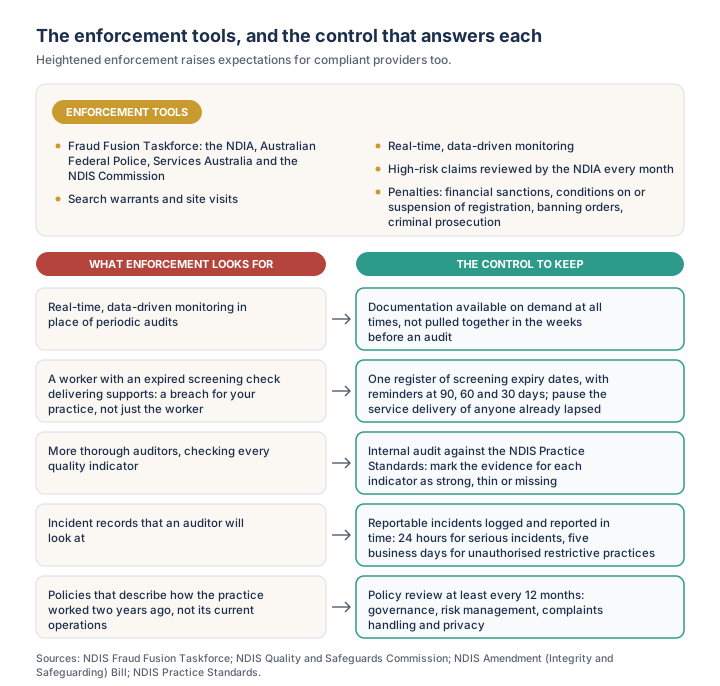
If your practice is doing the right thing, you might wonder why any of this matters to you. The answer is that heightened enforcement raises expectations across the board. Auditors are more thorough. The Commission is moving from periodic audits to real-time, data-driven compliance monitoring. And the new legislative framework, the NDIS Amendment (Integrity and Safeguarding) Bill, introduces tougher penalties for misconduct and unsafe practices.
The shift to continuous compliance means your documentation needs to be available on demand at all times, not just pulled together in the weeks before an audit. The Commission wants to see that your policies are living documents, your incident records are maintained in real time, and your workforce compliance (including worker screening checks) is actively tracked.
This is exactly the kind of ongoing compliance management that ClinicComply's NDIS compliance tracking is built for. Rather than scrambling before each audit cycle, you can maintain a live view of where your practice stands against every NDIS Practice Standard requirement, with automated deadline tracking for policy reviews and screening renewals.
The July 2026 Mandatory Registration Deadline
One of the biggest compliance dates on the horizon is 1 July 2026. From that date, all Supported Independent Living (SIL) providers and online platform providers must be registered with the NDIS Quality and Safeguards Commission. This includes providers who have previously operated as unregistered providers delivering SIL supports to self-managed or plan-managed participants.
If your practice delivers SIL supports and you are not yet registered, the clock is ticking. Unregistered SIL providers who fail to register by the deadline will need to stop delivering those supports entirely.
There is an additional complication: QIP, one of the major approved quality auditors, will stop conducting NDIS audits after 30 April 2026. If QIP is your current auditor and your accreditation is expiring after that date, you need to engage a new JAS-ANZ approved quality auditor. Finding and booking an auditor takes time, especially as demand ramps up toward the deadline. Waiting until May to sort this out is a risk you do not want to take.
New NDIS Practice Standards specifically for SIL providers will also take effect from 1 July 2026, with a stronger focus on quality and safety in shared accommodation settings. If you are registering for SIL for the first time, make sure you are preparing against the new standards, not the current ones.
Worker Screening Renewals: The Deadline Many Providers Are Missing
Here is a compliance gap that is catching a lot of practices off guard. The first wave of five-year NDIS Worker Screening Checks began expiring on 1 February 2026. If your practice has workers who obtained their screening checks in early 2021, those checks may have already lapsed or will lapse in the coming months.
A worker with an expired screening check cannot deliver NDIS supports. If they continue to do so, that is a compliance breach for your practice, not just for the individual worker. Tracking screening expiry dates across your entire team, and triggering renewals well in advance, is a system you need to have in place now. Not a spreadsheet you check once a quarter.
There is also a technology transition underway. PRODA (the existing provider authentication system) is being replaced by myID and RAM. The Commission originally scheduled the transition to end on 30 September 2026 but, as at 30 September 2026, gives no end date. If your team is renewing screening checks during this period, expect some process changes and allow extra time.
Five Things Your Practice Should Do This Month
First, run an internal compliance audit against the NDIS Practice Standards. Check every quality indicator and document where your evidence is strong, where it is thin, and where it is missing entirely. A gap analysis now gives you time to fix issues before they become audit findings.
Second, verify every worker's screening check status. Build a centralised register of screening expiry dates and set up reminders at 90 days, 60 days, and 30 days before each expiry. If anyone has already lapsed, pause their NDIS service delivery until the renewal is processed.
Third, review your incident management system. Make sure reportable incidents are being logged, managed, and reported within the required timeframes (24 hours for serious incidents, five business days for unauthorised restrictive practices). An auditor will look at this.
Fourth, update your policies. If your last policy review was more than 12 months ago, it is overdue. Governance, risk management, complaints handling, and privacy policies all need to reflect your current operations, not how your practice worked two years ago. If you need a starting point, ClinicComply's NDIS policy templates are aligned to the Core Module and ready to customise.
Fifth, check your auditor arrangements. If QIP is your auditor and your registration cycle extends beyond April 2026, start engaging with alternative JAS-ANZ approved auditors now. Availability will tighten as the July deadline approaches.
If you are managing NDIS compliance alongside RACGP accreditation, Privacy Act obligations, or other frameworks, keeping all of this in separate systems quickly becomes unmanageable. ClinicComply brings all of your compliance frameworks into one dashboard with live checklists, deadline tracking, and evidence linking, so nothing falls through the cracks. Start your free 30-day trial to see how it works.
Frequently Asked Questions
What is the NDIS Fraud Fusion Taskforce?
The Fraud Fusion Taskforce is a multi-agency body established in November 2022 that brings together the NDIA, the Australian Federal Police, Services Australia, and the NDIS Quality and Safeguards Commission. It investigates suspected NDIS fraud and coordinates enforcement actions. Since its creation, the Taskforce has disrupted more than 2,500 providers, launched over 635 investigations, and doubled the rate of successful criminal prosecutions.
How many NDIS providers have been investigated for fraud?
As of early 2026, the Fraud Fusion Taskforce has more than 635 active investigations underway. Over 2,500 providers have been disrupted for non-compliant claims, and the NDIA has reviewed more than 100,000 provider claims, rejecting $86 million worth. The government has invested over $550 million in NDIS fraud prevention since 2022.
What happens if you fail an NDIS audit in 2026?
If an auditor identifies non-conformances during your NDIS audit, you will typically be given a timeframe to address them and provide evidence of corrective action. For minor non-conformances, this might be a few weeks. For major non-conformances, particularly around participant safety, the NDIS Commission may impose conditions on your registration, suspend your registration, or refuse to register or re-register your practice. The severity of the response depends on the nature and risk level of the findings.
Do all SIL providers need to register by July 2026?
Yes. From 1 July 2026, all Supported Independent Living providers must be registered with the NDIS Quality and Safeguards Commission. This includes providers who have previously operated as unregistered providers delivering SIL supports to self-managed or plan-managed participants. Online platform providers must also register by this date. Unregistered providers who fail to meet the deadline must cease delivering SIL supports.
When do NDIS worker screening checks expire?
NDIS Worker Screening Checks are valid for five years from the date of issue. The first wave of checks began expiring on 1 February 2026, affecting workers who were screened in early 2021. Providers are responsible for tracking their workers' screening expiry dates and ensuring renewals are completed before the checks lapse. A worker with an expired check cannot deliver NDIS supports.
What are the penalties for NDIS non-compliance in 2026?
The NDIS Amendment (Integrity and Safeguarding) Bill introduces tougher penalties for misconduct and unsafe practices. Penalties can include financial sanctions, conditions on registration, suspension of registration, and criminal prosecution for fraudulent conduct. The NDIS Commission also has the power to issue banning orders against individuals, preventing them from working with NDIS participants. For fraud specifically, criminal prosecution can result in significant prison sentences.
How do I prepare for an NDIS audit?
Start with a thorough internal audit against the NDIS Practice Standards relevant to your registration groups. Document your evidence for every quality indicator. Review and update all policies. Verify worker screening status across your team. Ensure your incident management records are complete and current. If you are not sure which of the 36 registration groups you hold or what audit they trigger, start there; our audit pathways guide then covers each stage from engaging an auditor to the Commission's decision.
The NDIS compliance landscape is tightening, and that is a positive thing for providers who take their obligations seriously. The practices that invest in continuous compliance now will move through audits smoothly, avoid enforcement scrutiny, and build the kind of trust with participants and referrers that drives long-term growth. Check out our compliance resources for more practical guides, or start your free 30-day trial at cliniccomply.com.au to get your NDIS compliance organised today.