Key Takeaways
- It is law. The House agreed the Senate's 32 amendments on 19 August 2026, and the Bill received Royal Assent on 20 August 2026 as the National Disability Insurance Scheme Amendment (Securing the NDIS for Future Generations) Act 2026, Act No. 66 of 2026, registered on the Federal Register of Legislation as C2026A00066 with a status of In force.
- Seven rows of the clause 2 table commence on 27 August 2026, the seventh day after assent: Sch 1 Pts 1 to 3, Sch 2 Pts 1 to 4 (including the s 45B 7-year record duty), Sch 2 Pt 7 (the s 67G immunity rewrite), Sch 2 Pt 9 (the fraud offences, ss 59A to 59AF and s 98A), Sch 3 Pts 1 to 3 (including the s 45C ministerial pricing power) and Sch 4.
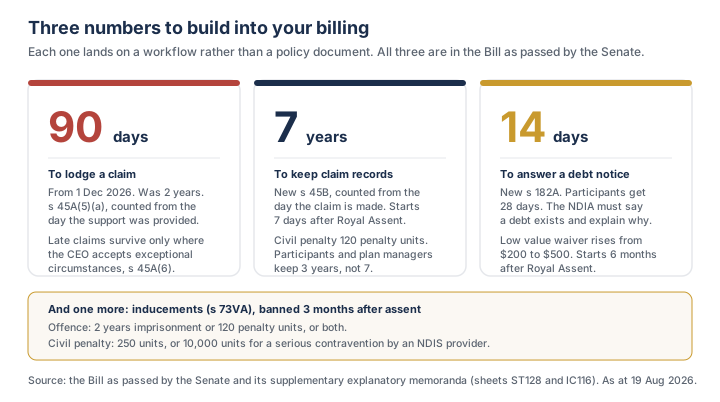
- The claim window falls from 2 years to 90 days on 1 December 2026 under amended s 45A(5)(a), now a confirmed date rather than a contingent one. Late claims survive only where the CEO accepts exceptional circumstances under s 45A(6).
- Providers must keep claim records for 7 years from the day the claim is made, under new s 45B, with a civil penalty of 120 penalty units. Participants and plan managers keep records for 3 years.
- Giving an inducement becomes an offence on 20 November 2026 under new s 73VA: 2 years imprisonment or 120 penalty units or both, plus a civil penalty of 250 units, or 10,000 units for a serious contravention by a provider.
- The Minister's support determination power (Sch 1 Part 4) starts on 1 October 2026, and the determination has been made. The National Disability Insurance Scheme (Support) Determination 2026, made 28 September and registered 29 September 2026 as F2026L01332, takes effect the same day: it cuts funding for social, economic and community participation by 50 per cent and improved daily living skills by 10 per cent in old framework plans that come into effect on or after 1 October 2026. New s 47B lets a participant needing continuous 24-hour care apply within 90 days for a variation restoring that funding, and a companion instrument, F2026L01331, sets who qualifies.
- Whistleblower protections start 1 July 2027 (Sch 3 Part 4), and the s 182A debt notice framework starts 20 February 2027, giving providers 14 days to answer a debt notice and participants 28.
- The Minister's 18 August release states: "Current NDIS access and planning arrangements will remain in place until changes are introduced gradually over the next few years. There will be no changes to access until 1 January 2028. The NDIA will communicate with participants before changes affect them."
- The department's access consultation paper puts numbers on that: "Access reforms will be implemented from 1 January 2028, with current NDIS participants reassessed over a 3-year transition period." A Technical Advisory Group on NDIS Functional Capacity, established in July 2026, is still choosing the assessment approach, and no tool and no threshold has been named.
- Three consultations are open at once. NDIS access changes closes 2 October 2026, the support coordination and connection service closes 2 October 2026, and four of the eight new framework planning rules close 14 October 2026. Everything in them is a proposal until NDIS rules are made under the NDIS Act 2013 or the NDIA commissions a service.
Is the Securing the NDIS Bill law yet?
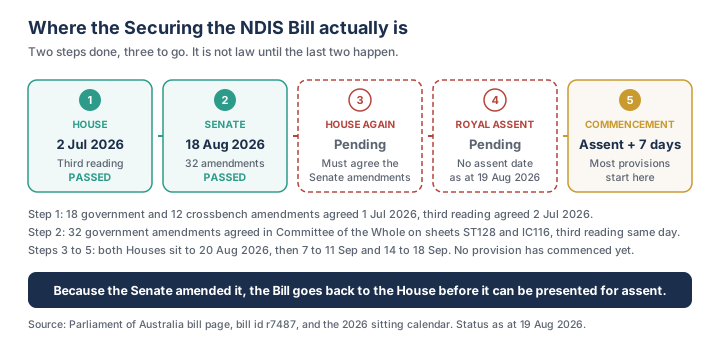
Yes. The House of Representatives agreed to the 32 Senate amendments on 19 August 2026, which is the day the Parliament of Australia bill page for r7487 records as finally passed both Houses. Royal Assent followed on 20 August 2026, and the same page records the assent as Act no. 66, year 2026. The Act is on the Federal Register of Legislation as C2026A00066, registered 21 August 2026, status In force. The department's news item, the NDIS Amendment (Securing the NDIS for Future Generations) Bill 2026 has passed Parliament, confirms it.
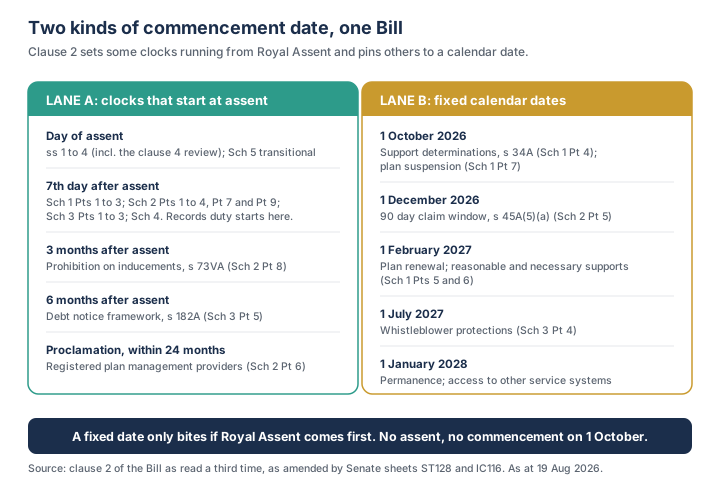
That changes what the dates are for. Every rolling clock in clause 2 now has a fixed anchor, and the Register has published the resulting dates in column 3 of the commencement table, so they no longer have to be worked out by hand. The seventh day after assent is 27 August 2026. Three months after assent gives 20 November 2026. Six months gives 20 February 2027.
The fixed calendar dates (1 October 2026, 1 December 2026, 1 February 2027, 1 July 2027, 1 January 2028) are confirmed for the same reason: assent came before all of them. Every date below can now go in a calendar rather than a watch list.
What happened in Parliament, and when?
The Bill was in Parliament for three months and was amended in both Houses. Sixty-two amendments were agreed to: 30 in the House on 1 July 2026 and 32 in the Senate on 18 August. The version that received assent is not the version introduced in May, and it is not the version most provider commentary was written against.
| Date | Stage |
|---|---|
| 14 May 2026 | Introduced and read a first time in the House; second reading moved; referred to the Senate Community Affairs Legislation Committee |
| 26 and 27 May 2026 | Second reading debate, House |
| 28 May 2026 | Second reading agreed to, House |
| 23 June 2026 | Committee interim report |
| 1 July 2026 | Consideration in detail: 12 crossbench and 18 government amendments agreed to |
| 2 July 2026 | Third reading agreed to, House |
| 12 August 2026 | Introduced and read a first time in the Senate; second reading moved |
| 14 August 2026 | Committee final report tabled, recommending the Bill be passed, with Coalition additional comments and dissenting reports from the Australian Greens and Senator David Pocock |
| 17 August 2026 | Second reading debate, Senate |
| 18 August 2026 | Second reading agreed to; 32 government amendments agreed in Committee of the Whole (sheets ST128 and IC116); third reading agreed to |
| 19 August 2026 | House of Representatives agreed to the 32 Senate amendments; finally passed both Houses |
| 20 August 2026 | Royal Assent. Act No. 66 of 2026 |
| 21 August 2026 | Registered on the Federal Register of Legislation as C2026A00066, status In force |
| 27 August 2026 | Commencement begins: seven rows of the clause 2 table start |
The sponsor was Mark Butler MP, Minister for Health and Ageing and Minister for Disability and the NDIS, with Senator the Hon Jenny McAllister carrying it in the Senate. The bill id is r7487. The clause 2 commencement table, with its published dates, is in the Act itself at C2026A00066; the bill as read a third time in the House carries the version that went to the Senate, and each Senate amendment sheet has its own supplementary explanatory memorandum: sheet ST128 for access, planning, support determinations, debt recovery, indexation and plan management funding, and sheet IC116 for integrity. The Minister's media release of 18 August 2026 and the department's Final changes fact sheet sit on top of those.
What did the Senate change on 18 August 2026?
The 32 amendments split along the two sheets. Sheet IC116 is an integrity package adding three Parts to Schedule 2 and one to Schedule 3: a ban on inducements, new fraud offences, a rewrite of the s 67G immunity, and whistleblower protections modelled on the Corporations Act 2001. Sheet ST128 clarifies access and planning: it carves subclasses of plans out of support determinations, creates a variation pathway for participants needing 24-hour care, restores a deemed refusal on unscheduled reassessments, builds a notice framework around debt recovery, and funds plan management outside the reasonable and necessary budget. The Minister described them as amendments "to strengthen participant safeguards, make the laws clearer and easier to understand, and support new arrangements for plan management providers". For providers, the integrity half is the half that creates new exposure, and it does not all arrive at once: the fraud offences and the s 67G rewrite start 27 August 2026, while the inducement ban waits until 20 November 2026.
Integrity amendments providers must plan for
The prohibition on inducements is new Division 4A, s 73VA, and it is the most operationally awkward change in the package. A provider contravenes it by giving, offering or agreeing to give a gift, benefit or other thing (something other than a support itself) that is reasonably likely to induce a person to engage the provider to provide, continue, add to or increase supports under a plan, or to manage plan funding. It applies whether or not the person induced is the participant, so nominees, informal supports and decision-makers are covered.
The exceptions are the boundary you have to sit inside. Legitimate pricing practices are excluded: charging under the price limit, consistent and transparent volume, package or administrative discounts, waivers for hardship, cancellation, disruption or billing error, introductory pricing that is not misleading and not tied to referrals, and discounts open to participants generally on the same terms. Low-value branded merchandise is excluded (hats, stationery, fridge magnets, lanyards, tote bags, water bottles) along with a birthday card or a cake. NDIS rules can permit more, but they are category D and can never permit alcohol, tobacco or e-cigarette products, cash or cash-like products (gift cards, vouchers, money orders and digital currency, under a new s 9 definition), electronic devices, or illicit pharmaceuticals or drugs.
The new fraud offences sit in a new Division 4 of Part 1 of Chapter 4, ss 59A to 59AE, with s 59AF setting the knowledge element for serious contraventions and s 98A covering nominees. All require intent or knowledge, so an honest error in a claim is not caught. "Serious contravention" uses the existing s 11B definition: a systemic pattern of conduct or a significant failure.
| Conduct | Section | Penalty | Serious contravention by an NDIS provider |
|---|---|---|---|
| False or misleading statements, information or documents to the Commission | s 59A | 12 months or 120 penalty units, or both | 5 years or 1,000 penalty units, or both |
| False or misleading statements to the Agency for access, planning, claiming or administration | s 59AB | 12 months or 120 penalty units, or both | 5 years or 1,000 penalty units, or both |
| Obtaining an NDIS payment knowing there is no entitlement, or that it exceeds the entitlement | s 59AC | 12 months or 120 penalty units | 5 years or 1,000 penalty units |
| Obtaining payment through fraud, including deception and impersonation | s 59AD | 5 years or 1,000 penalty units | 10 years or 2,000 penalty units |
| Concealing, disposing of, altering or falsifying a required record, with intent to defraud or obstruct | s 59AE | 2 years or 240 penalty units | Not separately specified |
| Abuse of position as a participant's nominee | s 98A | 120 penalty units | Not separately specified |
| Giving, offering or agreeing to give an inducement | s 73VA | 2 years or 120 penalty units, or both (civil penalty 250 penalty units) | Civil penalty of 10,000 penalty units |
Sections 59A and 59AB also carry a civil penalty of 120 penalty units, rising to 10,000 units for a serious contravention by a provider. The only published dollar figure is in the IC116 explanatory memorandum, which puts 120 penalty units at $43,680 at 1 July 2026, implying a unit value of $364. On that figure, 250 units calculates to $91,000, 1,000 units to $364,000, 2,000 units to $728,000 and 10,000 units to $3.64 million. Those four conversions are calculated, not published.
Section 67G, the immunity from producing documents, has been rewritten because courts split on whether providers could use it to refuse production, with Tasmania v TJG [2021] TASSC 47 and Attorney General for NSW v MM [2025] NSWCA 238 pointing different ways, and providers had used it to withhold care plans from work health and safety regulators. New s 67G(2) is an exhaustive list: the CEO, Board members, the Commissioner, Advisory Council members, actuaries, Agency and Commission officers, and their consultants and contractors. Providers and their employees are not on it. Separately, an amended s 202B lets the Commissioner delegate banning orders (ss 73ZN, 73ZO) and anti-promotion orders (ss 73ZOA, 73ZOC) to EL2 employees, so enforcement can be signed off further down the line.
Whistleblower protections (Sch 3 Part 4) align the NDIS with the Corporations Act model from 1 July 2027. They cover disclosures made while seeking legal, medical, psychological, professional or workplace support, require a discloser to show only a reasonable possibility that they qualify, reverse the burden of proof in civil penalty proceedings about detriment, and define detriment to include dismissal, injury, altered duties, harassment, psychological harm and damage to reputation or financial position.
Access, planning and payment amendments
Support determinations were already narrowed in the House to assistance with social, economic and community participation and improved daily living skills, with subgroups essential to health, safety and wellbeing able to be excluded. Senate amendments (8) and (9) go further: a determination can carve out a subclass of plans identified from information already in NDIA records, such as claiming data or how a plan is managed. Amendment (10) inserts new s 47B, letting a "high support needs participant", one who requires continuous 24-hour care, apply within 90 days of the determination applying to their plan for a variation restoring enough funding to maintain that care. The fact sheet frames the trigger as "after their plan is reassessed or renewed".
Unscheduled reassessments were the other pressure point. The Act extends the NDIA's decision window from 21 days to 90. Amendment (5) restores a deemed refusal at day 90 through new s 48(4), so review rights attach if the Agency does not decide. Amendment (6) deletes "unanticipated" from new s 48A(3), so a foreseeable but significant and ongoing change in living, education, work or informal support arrangements still qualifies.
Debt recovery gains a notice framework in new s 182A. The NDIA must tell a participant or provider that a debt exists and explain why. Providers get 14 days to respond, participants 28, and the Agency must then say whether it intends to recover. The low-value waiver threshold rises from $200 to $500. Amendment (18) adds new s 182(4)(e): no debt arises from a record-keeping breach where the person can show another way that they were entitled to the payment. That is a safety valve against the 7-year retention duty, but it is an evidentiary argument you have to run, not an exemption.
The rest of sheet ST128 is quieter. New ss 32KA and 32KB allow the Minister to consider making an indexation instrument whenever a pricing determination under new s 45C is made or varied, which is a power to consider rather than a duty to index. Under Sch 4 items 1A and 5A, plan management is funded in the statement of participant supports, outside the reasonable and necessary budget (s 32D(2)(f), s 32L(1A)). New s 9B(1)(a) lets a functional capacity assessment take account of assistive technology a person would ordinarily use, such as glasses, walking sticks, grab rails, orthotics and hearing aids, and for a child, age-appropriate assistance from other people. The reasonable and necessary provisions spell out what a parent is expected to provide, as distinct from the extra support a child needs because of disability. Amendment 17 grandparents existing participants: the 1 January 2028 exclusion for impairments covered by another compensation scheme applies only to people who apply from that date, with a new s 25B rule-making power so nobody falls between systems while a compensation claim is pending.
When does each part of the Act commence?
Clause 2 is where the dates live, and it is the part of an Act almost nobody reads. It sets three kinds of trigger: the day of assent, a period running from assent, and a fixed calendar date. Now that assent has been given, all three resolve to real dates, and the Register publishes them in column 3 of the commencement table. The dates below are that column, not our arithmetic.
| Provision | What it does for providers | Commences | Clause 2 trigger |
|---|---|---|---|
| Sections 1 to 4 | Short title, commencement, schedules, and the clause 4 statutory review | 20 August 2026 | Day of Royal Assent |
| Sch 1 Parts 1 to 3 | Defines functional capacity; limits unscheduled plan reassessments; strengthens the link between impairment and need for support | 27 August 2026 | 7th day after assent |
| Sch 1 Part 4 | Support determinations: the Minister's power to reduce funding for specified groups of supports in old framework plans | 1 October 2026 | Fixed date |
| Sch 1 Part 7 | Plan suspension | 1 October 2026 | Fixed date |
| Sch 1 Parts 5 and 6 | Plan end dates, renewal and the end of rollovers; reasonable and necessary supports | 1 February 2027 | Fixed date |
| Sch 1 Parts 8 and 9 | Tightens the meaning of permanence; eligibility where another service system or compensation scheme applies (new applicants only) | 1 January 2028 | Fixed date |
| Sch 2 Parts 1 to 4 | Fraud measures: provider registration, civil penalties and regulatory powers, information gathering, and the new s 45B record retention duty | 27 August 2026 | 7th day after assent |
| Sch 2 Part 5 | Cuts the claim window in s 45A(5)(a) from 2 years to 90 days | 1 December 2026 | Fixed date |
| Sch 2 Part 6 | Registered plan management providers | A day fixed by Proclamation. If it is not proclaimed within the 24 months beginning on 20 August 2026, it starts on the first day of the first calendar month to start after that period ends | Proclamation, with a 24-month backstop |
| Sch 2 Part 7 | Rewrites the s 67G immunity so it covers NDIA and Commission officers only, not providers | 27 August 2026 | 7th day after assent |
| Sch 2 Part 8 | Prohibition on inducements, new Division 4A and s 73VA | 20 November 2026 | The day after 3 months from assent |
| Sch 2 Part 9 | Additional penalties for fraudulent conduct, ss 59A to 59AF and s 98A | 27 August 2026 | Immediately after Sch 2 Parts 1 to 4 |
| Sch 3 Parts 1 to 3 | Governance: pricing decisions move to the Minister under new s 45C; automation of administrative action; minor amendments | 27 August 2026 | 7th day after assent |
| Sch 3 Part 4 | Whistleblower protections | 1 July 2027 | Fixed date |
| Sch 3 Part 5 | Debt recovery: the s 182A notice framework, the $500 waiver threshold, alternative evidence | 20 February 2027 | The day after 6 months from assent |
| Sch 4 | New framework planning, enabling provisions | 27 August 2026 | 7th day after assent |
| Sch 5 | Transitional rules | 20 August 2026 | Day of Royal Assent |
Sch 2 Part 6 is the only row without a published date, because a Proclamation has not been made. On the backstop, the 24 months beginning on 20 August 2026 end on 19 August 2028, so the latest possible start is 1 September 2028. That figure is calculated from the clause, not published in column 3.
The Sch 4 row is enabling provisions rather than a switch: it lets new framework planning be built, and the department's consultation Have your say on new framework planning and NDIS support rules, opened 19 August 2026, says new framework planning is "expected to start from 1 April 2027" and will be introduced gradually. The rules that would make it operate are still out for consultation until 14 October 2026, which is covered below.
Clause 4 sits above all of it. The Minister must cause an independent review of the amendments, independent of both the NDIA and the department, run alongside the review under s 4 of the Getting the NDIS Back on Track No. 1 Act 2024. It must consider access, participant outcomes, review and appeal rights, provider market viability and sustainability, thin markets, and how the changes interact with foundational supports, with the report tabled within 15 sitting days.
What happens on 1 October 2026 with participant budgets?
Schedule 1 Part 4 starts on 1 October 2026, and what it starts is a power. The power belongs to the Minister, who may make a support determination under new s 34A: a legislative instrument that reduces funding for a specified group of supports in old framework plans by operation of law. The Minister made one on 28 September 2026. The National Disability Insurance Scheme (Support) Determination 2026 was registered on 29 September as F2026L01332 and takes effect on 1 October 2026, the day the power starts. Section 5 cuts funding for assistance with social, economic and community participation by 50 per cent and for improved daily living skills by 10 per cent, and section 6 applies the cuts to "all old framework plans that come into effect on or after 1 October 2026". It is a disallowable instrument, so the Parliament can still examine it.
From 1 October 2026, the cut reaches each participant only when their next plan takes effect. The determination's explanatory statement says plans created or reassessed from 1 October 2026 are caught, and renewed plans from 1 February 2027, with the intent that every participant funded for these supports is reset by 30 September 2027. Once a participant moves to a new framework plan, from April 2027, the determination stops applying to them.
The carve-outs are wide and the Senate widened them again. A determination is limited to assistance with social, economic and community participation and improved daily living skills. The department's fact sheet lists budgets that are not affected: critical care such as eating, drinking, dressing, toileting, laundry, cleaning, nurse care and medication; home and vehicle modifications; personal mobility equipment and transport; continence and menstrual consumables; and specialist disability accommodation. The determination itself excludes six subgroups: supports in employment, high intensity supports, and intensive and complex behaviour supports within the participation group, and disability related health supports, customised and wearable technology, and hearing services within the daily living skills group. Schedule 1 of the instrument lists the support items in each. A companion instrument made the same day, the National Disability Insurance Scheme (High Support Needs Participants) Determination 2026 (F2026L01331), sets which participants count as high support needs under s 47B and requires the CEO to vary a plan where the cut leaves the funding insufficient to maintain continuous 24-hour care. It also takes effect on 1 October 2026.
The Government's stated use of the power, published at health.gov.au/securingtheNDIS, is to reset funding for social, civic and community participation by 50% on average and capacity building daily activities by 10%, progressively from 1 October 2026. The determination now puts those two percentages into law. The operational deadlines that land that month, the SIL and platform registration cut-off and the new NDIS Commission portal on 12 October, are in NDIS changes on 1 October 2026.
The service agreement advice has not changed. Agreements signed before October should let scope and hours be reset on plan reassessment or variation without breach, and clients should be briefed before their next review rather than at it. What you should not do is tell a participant what their new budget will be. The determination now exists, but it reaches each participant only when their next old framework plan takes effect, and the amount cut depends on what that plan allocates to the six excluded subgroups, so wait for the new plan before you reset hours.
What is the full reform timeline to 2030?
The table below is the Government's policy timeline, published at health.gov.au/securingtheNDIS and last updated 14 August 2026, with the parliamentary milestones added. It is not clause 2. Several of the largest items on it, including the registration expansion, the plan management panel, the support coordination panel, the payments uplift and Thriving Kids, are administrative or rules-based programs rather than commencements in the Act.
| Date | The change | In clause 2? |
|---|---|---|
| 14 May 2026 | Bill introduced and referred to the Senate Community Affairs Legislation Committee | Parliamentary milestone |
| 2 July 2026 | Third reading agreed to in the House after 30 amendments | Parliamentary milestone |
| From July 2026 | Uplift to the NDIS claims and payments systems begins, rolled out by end of 2030 | Policy, administrative |
| 18 August 2026 | Third reading agreed to in the Senate after 32 government amendments | Parliamentary milestone |
| 19 August 2026 | House agreed the Senate amendments; finally passed both Houses | Parliamentary milestone |
| 20 August 2026 | Royal Assent, Act No. 66 of 2026 | Yes: ss 1 to 4 and Sch 5 commence |
| 27 August 2026 | Tighter unscheduled reassessment criteria; s 45B record retention; new fraud offences; s 67G rewrite; s 45C pricing power | Yes: Sch 1 Pts 1 to 3, Sch 2 Pts 1 to 4, 7 and 9, Sch 3 Pts 1 to 3, Sch 4 |
| 1 October 2026 | Support determination takes effect: social, economic and community participation funding cut 50 per cent and improved daily living skills 10 per cent, in old framework plans taking effect from this date (renewed plans from 1 February 2027) | Power yes, Sch 1 Pt 4. The cut itself is by instrument: F2026L01332, made 28 September 2026 |
| 1 October 2026 | Thriving Kids state-delivered services begin for children 8 and under with low to moderate needs | Policy, separate program |
| 2 October 2026 | Consultations close: NDIS access changes, and the support coordination and connection service | Policy, consultation |
| 14 October 2026 | Consultation closes on four of the eight new framework planning rules | Rules to be made under the Act |
| 20 November 2026 | Prohibition on inducements takes effect | Yes: Sch 2 Pt 8 |
| 1 December 2026 | Claim window falls from 2 years to 90 days | Yes: Sch 2 Pt 5 |
| 20 February 2027 | Debt notice framework and $500 waiver threshold | Yes: Sch 3 Pt 5 |
| From 1 February 2027 | Tighter reasonable and necessary assessment for new entrants, reassessment for existing participants, plan renewal changes | Yes: Sch 1 Pts 5 and 6 |
| From 1 April 2027 | New framework planning transition begins for participants aged 18 and over, expected to complete by December 2030 | Policy and rules; the enabling provisions are Sch 4 |
| From July 2027 | Mandatory registration expands to personal care, daily living supports and supports in closed settings, full implementation by end of 2030 | Policy and rules, not clause 2 |
| 1 July 2027 | Whistleblower protections | Yes: Sch 3 Pt 4 |
| 1 October 2027 | New plan management approach: a commissioned panel, beginning with a 6 month transition | Policy. Sch 2 Pt 6 commences separately by proclamation |
| 1 January 2028 | NDIS and mainstream boundary changes for prospective participants; access based on standardised functional capacity assessment, with current participants reassessed over a 3-year transition | Yes: Sch 1 Pts 8 and 9. The assessment itself is policy, still being designed |
| 1 July 2028 | Newly commissioned support coordination and connection service begins; participants stop receiving support coordination funding in their plan budget | Policy, commissioning |
| End of 2030 | Registration expansion fully implemented; payments system rollout complete | Policy |
Two items sit on the policy page without a hard date: reforms to strengthen Commission and NDIA powers "over the next 18 months", and consultation on commissioning home and living supports, which began in July 2026. A $200 million Inclusive Communities Fund is also part of the package. The NDIS Quality and Safeguards Commission reform hub is where registration-expansion detail lands, and the department's page on the Bill was last updated 18 August 2026.
Mandatory registration expansion, July 2027
Registration for Supported Independent Living and platform providers came in from 1 July 2026 under earlier amendments and is unaffected by this Act. The next wave is a policy commitment, not a clause 2 commencement: from July 2027, mandatory registration extends to personal care, daily living supports and supports delivered in closed settings, the three categories named at the National Press Club on 22 April 2026, with full implementation targeted by end of 2030. If any part of your service mix touches personal care, in-home daily living support, or delivery in a residential, custodial or locked clinical setting, map your scope against the registration groups now. Our registration groups explainer sets out whether each group faces a verification or a certification audit, and the differential price for unregistered providers from 1 January 2027 is in our unregistered provider price cut guide.
Plan management, 1 October 2027
The policy date is 1 October 2027, when the open market gives way to a commissioned panel with a 6 month transition. The statutory piece is separate: Sch 2 Part 6, registered plan management providers, commences on a day fixed by Proclamation, and if none is made within the 24 months beginning on 20 August 2026 it commences on the first day of the first calendar month to start after that period ends, which calculates to 1 September 2028. The registration architecture for plan managers can therefore switch on before the commissioning model does. The Senate added one commercially important change: under Sch 4 items 1A and 5A, plan management in new framework plans is funded in the statement of participant supports, outside the reasonable and necessary budget, so it no longer competes with a participant's support hours.
Support coordination, 1 July 2028
Support coordination moves to a commissioned model from 1 July 2028. This is a commissioning decision, not a provision of the Act, so the date can move without any legislative step. The direction matches the registration pause applied in 2025: a redesign of how the function is procured rather than deregulation.
The design is now out for consultation, and it is more than a procurement change. The Support Coordination and Connection Consultation, opened 7 September 2026, closes at 11.59 pm AEST on 2 October 2026. Its consultation paper says the NDIA "would directly commission providers to deliver SCC services", replacing the current arrangement of "approximately 11,000 support coordinators across Australia" paid from plan funding. From 1 July 2028 a participant "will no longer be given funding in your NDIS plan to pay for a support coordinator"; an eligible participant's service "will be paid for by the NDIA and delivered directly by an SCC provider".
Three things are proposed rather than decided: the commissioning model (a lead organisation per region is "the preferred model, based on early thinking", a multi-provider model remains under consideration), the regions (Primary Health Network, Local Hospital Network, Partners in the Community and ABS SA4 regions are all named as candidates), and the payment model, which the paper treats as open. The indicative timeline is design in mid to late 2026, procurement across 2027, transition support in early 2028, commencement from 1 July 2028. The work between now and then is positioning for inclusion through governance, outcomes evidence and incident reporting maturity, and, before 2 October 2026, saying which region definition and payment model your service can operate under.
Claims, payments, and the two numbers that change your billing
The NDIA's claims and payments uplift began rolling out in July 2026 and runs to the end of 2030. It is an administrative program, but the Act puts two hard numbers behind it.
The first is the 90-day claim window. From 1 December 2026, amended s 45A(5)(a) cuts the lodgement period from 2 years to 90 days from the provision or acquisition of the support. The 2-year window itself only became operative on 3 October 2025, so this is the second change to the same clock inside 14 months. The explanatory memorandum reasons that claims older than 90 days are disproportionately unpayable or unverifiable with the participant, and 1 December was chosen so older claims can be lodged first. Section 45A(6) is untouched, so the CEO can still accept a late claim in exceptional circumstances, but that is a discretion, not a fallback. A quarterly catch-up billing cycle has to become a fortnightly or monthly one.
The second is the 7-year record retention duty in new s 45B, which starts on 27 August 2026. Providers must keep records relating to a claim, or the support it relates to, of a kind prescribed by NDIS rules, for 7 years from the day the claim is made unless the rules prescribe less, with a civil penalty of 120 penalty units. Participants and plan managers keep records for 3 years, nominees and child representatives for 5. Note the asymmetry: the 3-year figure circulating in provider commentary is the participant figure, not yours. The claiming mechanics are in our 1 July 2026 changes guide, and the enforcement backdrop in our NDIS fraud crackdown guide.
The package carries three published scheme targets from the 22 April 2026 National Press Club address: annual growth falling from 5 to 6% to around 2%, participant numbers stabilising near 600,000 by 2030, and average plan size returning from about $31,000 to $26,000. They explain the sequencing of everything above.
What is out for consultation right now?
Three NDIS consultations are open at once on the department's NDIS Reforms Consultation Hub, and none of it is law. What would make each one bite differs: NDIS rules are legislative instruments made under the National Disability Insurance Scheme Act 2013, the access changes rest on Schedule 1 Parts 1, 8 and 9 of this Act plus evidence requirements still being designed, and the support coordination service is a commissioning decision with no legislative step at all.
| Consultation | Opened | Closes | What it decides |
|---|---|---|---|
| NDIS access changes | 31 August 2026 | 2 October 2026 | How access is assessed once diagnosis lists go, from 1 January 2028 |
| Support coordination and connection | 7 September 2026 | 2 October 2026 | How the commissioned SCC service works from 1 July 2028 |
| New framework planning and NDIS supports | 19 August 2026 | 14 October 2026 | Four of the eight new framework planning rules, and the NDIS Supports Transitional Rule |
The hub also records a deferral: "the Government has decided to defer public consultation on market reforms for social and community participation and capacity building activities following stakeholder feedback on the volume of consultation underway". Those are the two support groups the support determination cuts from 1 October 2026, so the market reform detail for them waits longer.
Access: 1 January 2028, and a 3-year reassessment transition
The access consultation paper states: "Access reforms will be implemented from 1 January 2028, with current NDIS participants reassessed over a 3-year transition period." Schedule 1 Parts 8 and 9 of the Act reach only people who apply from 1 January 2028, so that date is a new-applicant date; the reassessment of the existing cohort is separate and runs for three years beyond it.
What replaces diagnosis is not yet chosen. Eligibility "will be based on a standardised, evidence-based assessment of a person's functional capacity", and a Technical Advisory Group (TAG) on NDIS Functional Capacity, "established in July 2026 by Commonwealth, state and territories governments", is still looking "at different assessment approaches, tools and thresholds". No tool and no threshold is named, and the department says "we are not yet consulting on all of the details". Keep functional evidence in a form that maps to daily function rather than diagnosis, and do not rebuild assessment templates against an instrument that does not exist yet. The same paper fixes the Thriving Kids dates: governments agreed to "contribute $4 billion over 5 years", and "Thriving Kids will commence from October 2026, reaching full rollout by January 2028".
New framework planning: the rules, not the Act
Schedule 4 of this Act is enabling provisions, commenced 27 August 2026. The rules that make it operate are the subject of the New Framework Planning and NDIS Supports Consultation, which closes at 11.59 pm AEDT on 14 October 2026: four of the eight rules are out now, and exposure drafts of all eight are promised later in 2026. Participants aged 18 and over "will begin gradually moving" across "from April 2027", and the transition "is expected to be completed by December 2030 for all participants". Our new framework planning guide for allied health providers covers the four-part support needs assessment and where clinical evidence enters it, and the move from 36 support categories to 18 is in our support categories guide.
What should providers do now the clocks are running?
Every item below is keyed to a date, and the dates are no longer conditional. Work in the order they arrive, not the order the schedules appear in.
- Treat 27 August 2026 as live, not imminent. The s 45B record duty, the fraud offences in ss 59A to 59AF, s 98A and the s 67G rewrite all start that day. Nothing about them is staged or transitional, so the position you are in on 27 August is the position you will be assessed against.
- Move record retention to 7 years and shorten the claim cycle to under 90 days, before 1 December 2026. Check what your practice management or accounting system actually retains, and confirm it covers records relating to the support, not only the invoice. Then close every workflow where a claim can sit unlodged past 90 days.
- Audit marketing, referral incentives, gifts and discounts against s 73VA before 20 November 2026. Check welcome gifts, referral rewards, gift cards, prize draws, sign-up bonuses and any discount not open to participants generally on the same terms. Write down which exception each surviving practice relies on, because that is the record you will want if the Commission asks.
- Put a scope-reset clause in every service agreement before 1 October 2026, allowing hours and scope to be reset on plan reassessment or variation without either party being in breach. Do it while it is a template change rather than a renegotiation.
- Fix your document-production position on the basis that s 67G will not help you, from 27 August 2026. If your response to a work health and safety regulator, court or tribunal has ever assumed the NDIS Act immunity, rewrite it.
- Get debt-notice ready before 20 February 2027. Fourteen days is short for a provider that has to reconstruct a claim history, so decide now who opens NDIA correspondence, who assembles the evidence and where the s 182(4)(e) alternative-evidence argument would come from.
- Brief nominees, team leaders and admin staff on the new offences. Sections 59A to 59AE require intent or knowledge, so honest errors do not become criminal. Knowingly submitting a false claim, or altering a record to obstruct a review, now carries its own offence, and s 98A puts a specific penalty on abuse of a nominee position.
- Plan managers and support coordinators: treat the next 24 months as a commercial reset. Plan managers should track the Sch 2 Part 6 proclamation as well as the 1 October 2027 commissioning date. Support coordinators should build the evidence base for panel inclusion.
- Paediatric providers: fold Thriving Kids into your 2026 to 2027 service model. It starts 1 October 2026 as a state-delivered program and is not part of this Act. Our Thriving Kids provider impact guide covers the referral and revenue effects.
- Make your submissions before 2 and 14 October 2026. Three consultations close within a fortnight of each other, and each one decides something an Act cannot: how access is assessed from 1 January 2028, how support coordination is bought from 1 July 2028, and the four planning rules that set budgets from April 2027. Once the exposure drafts land, the question changes from what the rules should say to whether the drafting works.
Frequently Asked Questions
Is the Securing the NDIS for Future Generations Bill law yet?
Yes. The House of Representatives agreed to the 32 Senate amendments on 19 August 2026, so the Bill finally passed both Houses that day, and it received Royal Assent on 20 August 2026 as Act No. 66 of 2026. It is registered on the Federal Register of Legislation as C2026A00066, status In force. Sections 1 to 4 and Schedule 5 commenced on assent, and the next commencement date is 27 August 2026.
What starts on 27 August 2026?
Seven rows of the clause 2 commencement table, all of them the seventh day after assent or immediately after it. Schedule 1 Parts 1 to 3 (functional capacity, limits on unscheduled plan reassessments, the impairment and support link); Schedule 2 Parts 1 to 4 (the fraud measures, including the new s 45B duty to keep claim records for 7 years); Schedule 2 Part 7 (the s 67G immunity rewrite, which providers can no longer rely on); Schedule 2 Part 9 (the fraud offences in ss 59A to 59AF and s 98A); Schedule 3 Parts 1 to 3 (governance, including the Minister's s 45C pricing determination power); and Schedule 4 (the new framework planning enabling provisions).
What did the Senate change in the Bill?
Thirty-two government amendments across two sheets. Sheet IC116 added a ban on inducements (s 73VA), new fraud offences (ss 59A to 59AE, with s 59AF and s 98A), a rewrite of the s 67G immunity so providers cannot rely on it, and whistleblower protections from 1 July 2027. Sheet ST128 added support determination carve-outs, the s 47B 24-hour care variation, a deemed refusal on reassessments, the s 182A debt notice framework, indexation and plan management funding.
When does the 90-day NDIS claim window start?
1 December 2026, under Schedule 2 Part 5. That is now a confirmed date, since the Act received Royal Assent on 20 August 2026 and 1 December is a fixed date in the clause 2 table. Amended s 45A(5)(a) cuts the claim period from 2 years to 90 days from the provision or acquisition of the support. Section 45A(6) is unchanged, so the CEO can still accept a late claim where exceptional circumstances apply.
Do the budget resets now go ahead?
Yes, from 1 October 2026, plan by plan. Schedule 1 Part 4 gives the Minister the s 34A power from that day, and the Minister made the National Disability Insurance Scheme (Support) Determination 2026 on 28 September 2026. It was registered on 29 September as F2026L01332 and takes effect on 1 October 2026. It cuts funding for social, economic and community participation by 50 per cent and improved daily living skills by 10 per cent in old framework plans that come into effect on or after 1 October 2026, with renewed plans caught from 1 February 2027. Six subgroups, including supports in employment and disability related health supports, are excluded. A participant's budget changes only when their next plan takes effect.
When does the ban on inducements start and what is the penalty?
20 November 2026, under Schedule 2 Part 8, which starts the day after the end of 3 months beginning on the day of assent. New s 73VA makes it an offence punishable by 2 years imprisonment or 120 penalty units, or both, and a civil penalty of 250 penalty units, rising to 10,000 units for a serious contravention by an NDIS provider. Legitimate pricing practices and low-value branded merchandise are excepted; cash-like products, alcohol, tobacco and electronic devices can never be permitted.
How long must NDIS providers keep records under the Act?
Seven years from the day the claim is made, under new s 45B, for records relating to a claim or the support it covers, of a kind prescribed by NDIS rules. The duty starts 27 August 2026 and applies to claims made on or after that day. The civil penalty for failing to keep them is 120 penalty units. Participants and plan managers keep records for 3 years and nominees for 5, so the 3-year figure in general commentary is not the provider obligation.
How is this Act different from the Integrity and Safeguarding Act 2026?
The earlier package, covered in our integrity and safeguarding provider guide, tightened fraud controls, redefined NDIS supports and introduced the In and Out supports lists. This Act sits on top of it and legislates the operating architecture: how budgets are set and adjusted, how plans are renewed, claim windows and record duties, and the framework for plan management registration. They are sequential, not alternatives.
When do the current NDIS consultations close?
Three are open. NDIS access changes closes 2 October 2026. The support coordination and connection consultation closes at 11.59 pm AEST on 2 October 2026. The consultation on four of the eight new framework planning rules, plus the NDIS Supports Transitional Rule, closes at 11.59 pm AEDT on 14 October 2026. All three sit on the department's NDIS Reforms Consultation Hub.
What changes for NDIS access on 1 January 2028?
Access stops relying mainly on diagnosis. From 1 January 2028 eligibility "will be based on a standardised, evidence-based assessment of a person's functional capacity and how it impacts their day-to-day living", the diagnosis-based access lists are replaced, and current participants are "reassessed over a 3-year transition period". The Technical Advisory Group on NDIS Functional Capacity has not yet named a tool or a threshold. In the Act, the related provisions are Schedule 1 Part 1 (commenced 27 August 2026) and Parts 8 and 9 (commencing 1 January 2028).
When does provider registration expansion start?
From July 2027 for personal care, daily living supports and supports in closed settings, with full implementation targeted by end of 2030. Those categories were named at the National Press Club on 22 April 2026. This is a policy and rules program rather than a clause 2 commencement, so definitions and transition arrangements come from the NDIS Commission. SIL and platform providers were already captured from 1 July 2026.
Part of
NDIS Provider Compliance