Key Takeaways
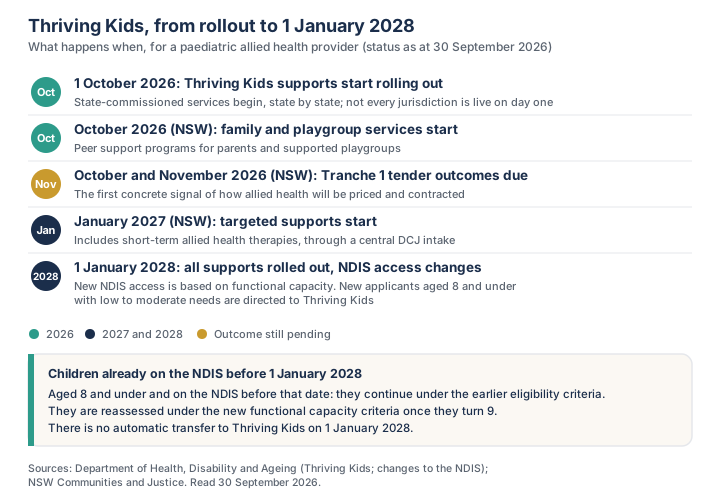
- Thriving Kids, the first phase of Foundational Supports, begins state-delivered rollout on 1 October 2026 and is expected to be at scale by 1 January 2028.
- It is jointly funded at $4 billion over five years, with the Commonwealth contributing $2 billion (at least $1.4 billion of that goes directly to states to commission services) and the states matching with $2 billion.
- Eligibility is children aged 8 and under with developmental delay and/or autism with low to moderate support needs. A formal autism diagnosis is no longer the gateway: access is based on a functional needs assessment.
- Targeted supports include psychology, occupational therapy, speech pathology, physiotherapy and audiology, delivered through community settings (homes, early childhood education, schools) with no gap fees for families.
- NDIS access does not change until 1 January 2028. Children aged 8 and under already on the NDIS before then continue to be reassessed under the pre-2028 eligibility criteria until they turn 9, when the new functional capacity criteria apply; from 1 January 2028, new applicants aged 8 and under with low to moderate needs are directed to Thriving Kids instead.
- As at 30 September 2026, seven jurisdictions have signed Thriving Kids bilateral agreements with the Commonwealth (ACT, NSW, NT, SA, Tasmania, Victoria and WA); Queensland is not on the list. In NSW, family and playgroup services start from October 2026 and targeted supports, including short-term allied health therapies, from January 2027, with tender outcomes due in October and November 2026.
- For paediatric allied health providers this is the single biggest book-of-business shift in 2026: the NDIS Early Childhood approach contracts for new entrants, and revenue moves from NDIS plan-managed line items to state-commissioned, no-gap delivery.
What is Thriving Kids and when does it start?
Thriving Kids is the first phase of the new Foundational Supports system created by the Securing the NDIS for Future Generations reforms. It establishes a national, state-delivered system of early-intervention supports for children aged 8 and under with developmental delay and/or autism with low to moderate support needs. State-commissioned services begin on 1 October 2026 and the system is expected to be at full scale by 1 January 2028. Children with higher support needs continue to access the NDIS. The program is jointly funded by the Commonwealth and the states and territories at $4 billion over five years, with the Commonwealth committing at least $1.4 billion of its $2 billion share as direct funding to states to commission Thriving Kids services. See the Department of Health, Disability and Ageing's Thriving Kids program page for the operating timeline, and the Foundational Supports fact sheet for the funding breakdown.
How is Thriving Kids different from the NDIS Early Childhood approach?
Today, a child under 9 with developmental concerns generally enters the NDIS via the Early Childhood approach: an early childhood partner triages the child, a plan is built, and the family purchases supports from registered or unregistered NDIS providers on a fee-for-service basis. Thriving Kids changes the gateway, the setting and the funding flow. Diagnosis is replaced by a functional needs assessment delivered through community settings. Services are commissioned by states from a panel of providers and delivered free of out-of-pocket cost, with a Key Worker coordinating across early childhood education, health and family supports. The NDIS continues for children whose needs are high enough to meet the substantially-reduced-functional-capacity threshold.
| Dimension | NDIS Early Childhood approach (today) | Thriving Kids (from 1 October 2026) |
|---|---|---|
| Gateway | Diagnosis (autism) or developmental delay, NDIS access request | Functional needs assessment, no diagnosis required |
| Age cohort | 0 to 8 (Early Childhood approach is 0 to 9) | 0 to 8 with low to moderate needs |
| Setting | Provider clinics, in-home, family-chosen | Homes, early childhood education and care, schools, community health |
| Who delivers | NDIS-registered and unregistered providers chosen by family | State-commissioned panel providers, coordinated by a Key Worker |
| Funding flow | NDIS plan budget, plan- or self-managed, per session | State-commissioned, paid directly to providers, no gap fees |
| Eligibility for new entrants under 8 with low to moderate needs after Jan 2028 | Generally no longer NDIS-eligible at this level | Default pathway |
| Higher-needs children | NDIS | Remain on NDIS |
The Conversation's analysis "No diagnoses and no gap fees for physios and speechies" summarises the funding shift and the no-gap principle confirmed in the Advisory Group's final report.
Which states deliver Thriving Kids first?
Rollout is staged by bilateral agreement between the Commonwealth and each state and territory. The 1 October 2026 national start date is the earliest point at which any state begins delivery; not every jurisdiction will be live on day one.
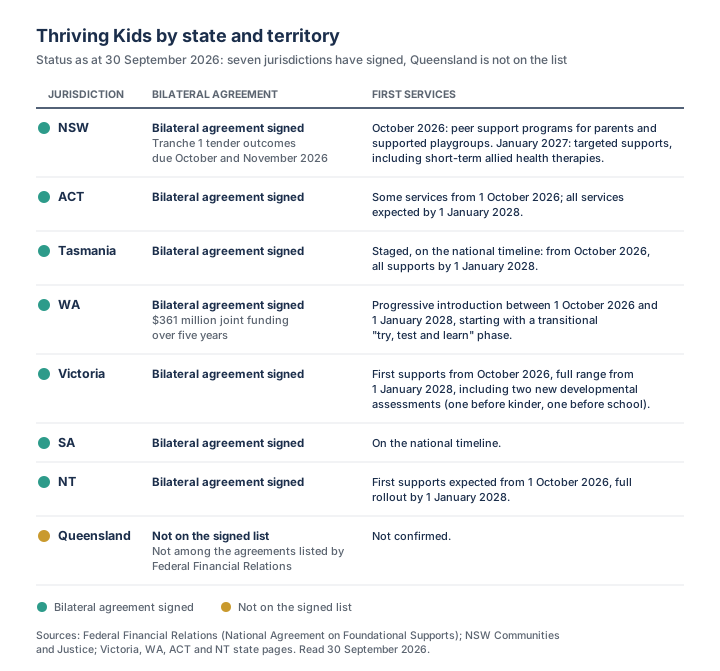
| Jurisdiction | Status as at 30 September 2026 | First services |
|---|---|---|
| NSW | Bilateral agreement signed. Tranche 1 procurement: Expression of Interest in May 2026, invited Request for Tender in July 2026, outcomes to be published in October and November 2026. A panel for private allied health practitioners is being explored. | From October 2026: peer support programs for parents and supported playgroups. From January 2027: targeted supports, including short-term allied health therapies, through a central DCJ intake. |
| ACT | Bilateral agreement signed. | Some services from 1 October 2026; all services expected by 1 January 2028. |
| Tasmania | Bilateral agreement signed. | Staged, on the national timeline (from October 2026, all supports by 1 January 2028). |
| WA | Bilateral agreement signed; $361 million in joint funding over five years. | Progressive introduction between 1 October 2026 and 1 January 2028, starting with a transitional "try, test and learn" phase. |
| Victoria | Bilateral agreement signed. | First supports from October 2026, full range from 1 January 2028, including two new developmental assessments (one before kinder, one before school). |
| Queensland | Not among the signed bilateral agreements listed by Federal Financial Relations. | Not confirmed. |
| SA, NT | Bilateral agreements signed. | NT: first supports expected from 1 October 2026, full rollout by 1 January 2028. SA: on the national timeline. |
The Federal Financial Relations National Agreement on Foundational Supports page lists the signed bilateral agreements. NSW Communities and Justice has published program detail, procurement status and service categories, and Victoria, Western Australia, the ACT and the Northern Territory publish their own timelines. For the earlier position, NDS reported that NSW procurement opened in May 2026, and Occupational Therapy Australia summarised the NSW, Tasmania and WA position.
Will children under 8 still access the NDIS after Thriving Kids?
Yes, but not in the same numbers. Two cohorts remain NDIS-eligible: children with a permanent and significant disability that meets the disability requirements, and children aged 8 and under with developmental delay and/or autism whose support needs are substantially reduced functional capacity (high needs). Children whose needs are low to moderate, the group that has driven most of the NDIS Early Childhood approach's growth, will be directed to Thriving Kids for new access requests from 1 January 2028. The transition rules are deliberately generous to existing participants: any child aged 8 or under already on the NDIS, or who joins before 1 January 2028, stays on the NDIS and is reassessed under the eligibility rules that exist now until they turn 9. The Department says that once they turn 9 "they will be reassessed under the new eligibility criteria based on functional capacity".
What happens to children already on the NDIS before January 2028?
Children aged 8 and under who are NDIS participants prior to 1 January 2028 continue under the current NDIS framework. Plan reviews and reassessments use the pre-2028 eligibility criteria until the child turns 9, when the new functional capacity criteria apply. There is no automatic transfer to Thriving Kids on 1 January 2028 for that cohort. New access requests for children with low to moderate needs after Thriving Kids is at scale are the cohort most affected: those families will be directed to the state-delivered system rather than receive an NDIS plan. Providers should expect a long tail of existing NDIS plans running alongside Thriving Kids work for several years, then a gradual contraction of the under-8 NDIS book.
What should paediatric allied health providers do to prepare?
The reform has three operational consequences for clinics: a new funder, a new place of work, and a new pricing model. Each needs a deliberate response in 2026.
- Decide whether to join state panels. Procurement is happening jurisdiction by jurisdiction. NSW opened its two-stage process in May 2026. Watch your state health or disability department's procurement portal and submit an Expression of Interest where you intend to keep delivering paediatric services. Panels will likely require a service model that includes outreach to schools and early childhood centres, not just clinic-based sessions.
- Re-cost your service model. Thriving Kids supports are delivered with no gap fees, meaning all revenue comes from the state contract. That changes your margin assumptions: there is no top-up from private fees or NDIS short-notice cancellation policies. Build pricing schedules and outreach travel time into the bid. If you currently rely on hourly NDIS rates being higher than your state-contract benchmark, the gap is your business model risk.
- Map your existing under-8 NDIS caseload. Identify which clients are likely to retain NDIS eligibility (higher needs) and which are likely to be moved across at reassessment. Communicate proactively. Families currently using your service under an NDIS plan are anxious about continuity; a clear letter explaining that they can stay on the NDIS until reassessment and that you are also bidding for Thriving Kids delivery removes that anxiety.
- Build a Key Worker capability. Thriving Kids supports are coordinated by a Key Worker who liaises across early childhood education, health and family supports. If your model today is one-clinician, one-clinic-room, you will not match the design. Workforce planning, supervision structures and shared documentation across disciplines need to be in place before bids.
- Tighten your incident, reportable conduct and policy stack. State commissioning contracts will inherit working-with-children and child-safe standards regardless of NDIS registration status. Aspect, the National Disability Services peak and several state departments have flagged child safety, complaints handling and worker screening as bid prerequisites. Read Aspect's provider summary for the practical implications.
If your clinic is also navigating the broader NDIS registration shift, our NDIS registration groups explainer and NDIS Practice Standards modules guide cover where Thriving Kids sits relative to NDIS audit pathways. For allied health providers reconfiguring how time is billed under the new framework, see our non-face-to-face allied health billing guide and the broader NDIS New Framework planning guide.
How does Thriving Kids fit into the wider NDIS reform program?
Thriving Kids is one of two named pieces of the second-wave NDIS reform package. The other is the Securing the NDIS for Future Generations Bill, introduced 14 May 2026 and now Act No. 66 of 2026 (Royal Assent 20 August 2026), which legislates needs-based assessments, the new participant budgets framework and a staged graduated registration model. Thriving Kids is the demand-side change: it shifts where low-to-moderate-needs children are served. The Bill is the supply-side and access-side change: it reshapes how every NDIS participant is assessed and how providers register. The two move on parallel timelines through 2026 to 2028. The Securing the NDIS for Future Generations timeline is the official sequencing document and is worth bookmarking; it ties together the dates that affect the under-8 cohort with the dates that affect all participants. The earlier NDIS Amendment Bill 2025, which dealt with integrity and safeguarding, is the foundation the current reforms build on, not a replacement.
What is still unsettled?
As at 30 September 2026, three items are not yet final. Watch for them.
- Queensland's bilateral agreement. Victoria has signed; Queensland is not on the Federal Financial Relations list of signed agreements. Until it is, the practical commencement date in Queensland is uncertain even though the national date is fixed.
- Provider panel structures and rates. NSW's Tranche 1 tender outcomes are due to be published in October and November 2026, and DCJ is exploring a panel for private allied health practitioners, with more information once Tranche 1 is complete (expected November 2026). That is the first concrete signal of how Thriving Kids will price and contract allied health. Other states are likely to follow a similar model but may not be identical.
- Interaction with NDIS Early Childhood partners. Existing Early Childhood Partner contracts run alongside Thriving Kids during the transition. The NDIA has signalled it will publish guidance on how Partners triage new requests once Thriving Kids is live, particularly the rules for steering a family to Thriving Kids rather than starting an NDIS access request.
Frequently Asked Questions
When does Thriving Kids start?
Thriving Kids commences state-delivered services on 1 October 2026 and is expected to be at full scale across all jurisdictions by 1 January 2028. The national start date is fixed; the order in which states go live depends on each bilateral agreement between the Commonwealth and the state or territory. In NSW, family and playgroup services start from October 2026 and targeted allied health supports from January 2027. As at 30 September 2026, seven jurisdictions have signed bilateral agreements; Queensland is not among them.
Will children under 8 still be able to access the NDIS?
Children with higher support needs (substantially reduced functional capacity, or a permanent and significant disability) remain eligible for the NDIS. Children aged 8 and under with developmental delay and/or autism whose needs are low to moderate will be directed to Thriving Kids for new access requests from 1 January 2028, rather than receiving an NDIS plan. Existing NDIS participants under 8 stay on the NDIS and are reassessed under the pre-2028 eligibility rules until they turn 9.
Is a formal autism diagnosis still required?
No. One of the design principles of Thriving Kids is that access is based on a functional needs assessment, not on a diagnostic label. Families do not need to wait for a paediatrician-confirmed autism diagnosis to receive supports. This is a deliberate response to long diagnostic wait lists and to evidence that early functional intervention does not depend on diagnostic certainty.
What happens to children already on the NDIS before January 2028?
Any child aged 8 or under who is already an NDIS participant, or who joins before 1 January 2028, continues under the NDIS and is reassessed under the eligibility criteria in place prior to 1 January 2028 until they turn 9, when the new functional capacity criteria apply. There is no automatic transfer to Thriving Kids on that date. Providers and families should expect existing plans to run for some time alongside Thriving Kids, with reassessment outcomes determined by the pre-2028 rules.
What should paediatric allied health providers do to prepare?
Watch your state procurement portal and prepare to submit an Expression of Interest. Re-cost your service model on the assumption of no gap fees and state-contract pricing. Map your existing under-8 NDIS caseload between those likely to retain NDIS eligibility and those likely to move across at reassessment, and communicate proactively. Build the Key Worker, outreach-to-school, multi-disciplinary capability that state panels will expect. Tighten child-safe, complaints handling and worker screening policies because state contracts will require them regardless of NDIS registration status.
Are gap fees allowed under Thriving Kids?
No. Thriving Kids targeted supports (allied health, including psychology, occupational therapy, speech pathology, physiotherapy and audiology) are delivered with no out-of-pocket cost to families. State contracts pay providers directly for commissioned services. Providers should not assume top-up private fees are available and should plan their margins on the state contract alone.