Key Takeaways
- The instrument is F2026L01167, registered 7 September 2026. The Therapeutic Goods Legislation Amendment (2026 Measures No. 1) Regulations 2026 replaces item 2.15 of Schedule 4 to the Medical Devices Regulations from 1 November 2026.
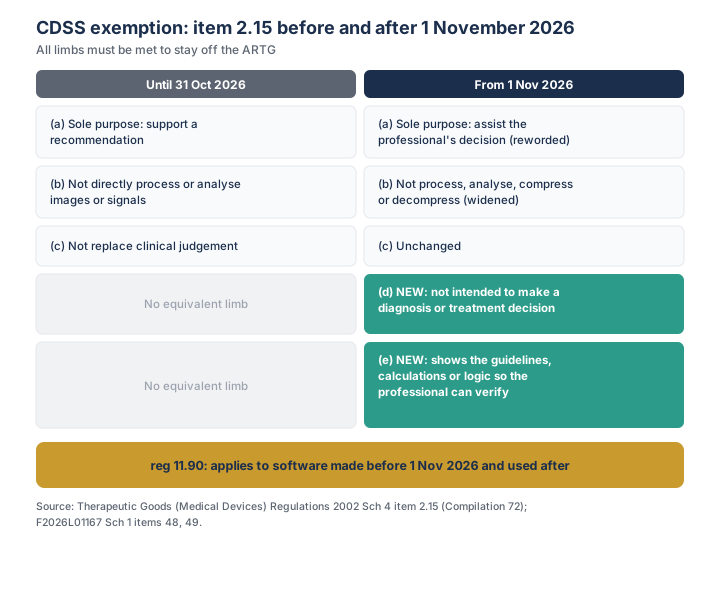
- Two new limbs tighten the CDSS exemption. Limb (d) requires the software not be intended to make a clinical diagnosis or treatment decision; limb (e) requires it to display the guidelines, calculations or logic so a health professional can "readily interpret and verify" each recommendation.
- Existing software is caught. New regulation 11.90 applies the new item 2.15 to devices manufactured before 1 November 2026 that are intended to be used on or after that date.
- The TGA already says AI decision support cannot use the exemption. TGA guidance states "an AI-enabled CDSS will not meet the exemption criteria", and "Opaque CDSS do not meet exemption criterion (c) and are not exempt."
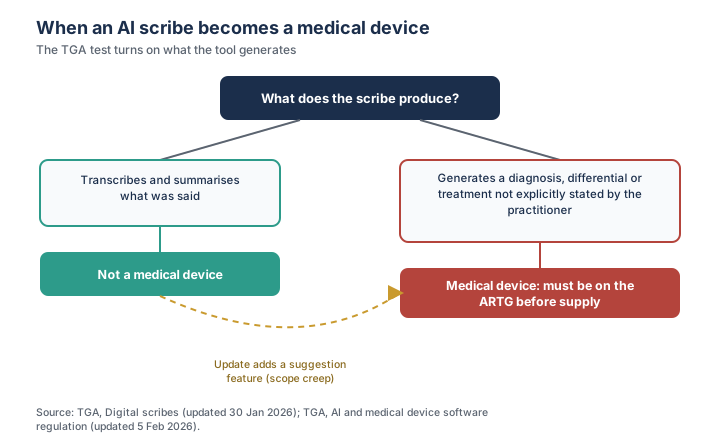
- A scribe that only transcribes is not a medical device. One that generates a diagnosis, differential diagnosis or treatment recommendation "not explicitly stated by the healthcare practitioner" is a device and must be on the ARTG before supply.
- The offence and civil penalty provisions target the sponsor. Section 41MI(1) carries 5 years imprisonment or 4,000 penalty units, or both, but a defendant who was not the sponsor has a statutory defence. The practice's job is to inventory its tools and ask each vendor for its basis.
From 1 November 2026, decision-support software keeps its ARTG exemption only if it is not intended to make a diagnosis or treatment decision and it shows the clinician the guidelines, calculations or logic behind each recommendation. Regulation 11.90 applies that test to software you already use. Ask each vendor for its ARTG entry or exemption basis, in writing, before 1 November.
What changes on 1 November 2026?
The Therapeutic Goods Legislation Amendment (2026 Measures No. 1) Regulations 2026, register ID F2026L01167, was made by the Governor-General on the advice of Mark Butler, Minister for Health and Ageing, dated 3 September 2026, and registered 7 September 2026. Section 2 item 4 starts Schedule 1, Part 3 on 1 November 2026. Part 3 does one thing to CDSS: item 48 repeals and substitutes the "kinds of medical devices" cell at table item 2.15 of Schedule 4 to the Therapeutic Goods (Medical Devices) Regulations 2002. The conditions column is not changed, so the exemption survives; what changes is the definition of the software that fits it.
The TGA's news item of 8 September 2026 says the amendments "do not change the scope of the CDSS exemption or introduce new regulatory requirements". The explanatory statement says the new item 2.15 "seeks to clarify that some products will not meet CDSS exemption criteria, and remove perceived ambiguity for stakeholders". Both are true on their own terms; a practice reading only one would misjudge how much work 1 November creates. The amendment follows a 2024 TGA consultation that "received majority support from respondents", and the exemption itself dates from February 2021, introduced "to reduce regulatory burden relating to low-risk CDSS devices".
One more limb was reworded without comment: limb (a) changed from software "providing or supporting a recommendation" to software that "make[s] a recommendation ... for the sole purpose of assisting the health professional in making a decision". The explanatory statement comments only on limbs (b), (d) and (e); we note the change to (a) without interpreting it.
How do the old and new exemption criteria compare?
The table below sets the current item 2.15, in force until 31 October 2026, against the version that applies from 1 November 2026, quoting the instrument and the current regulations.
| Limb | Until 31 October 2026 | From 1 November 2026 | What changed |
|---|---|---|---|
| (a) | "for the sole purpose of providing or supporting a recommendation to a health professional about preventing, diagnosing, curing or alleviating a disease, ailment, defect or injury in persons" | "to make a recommendation to a health professional for the sole purpose of assisting the health professional in making a decision related to preventing, diagnosing, curing or alleviating a disease, ailment, defect or injury in persons" | Reworded. The explanatory statement does not comment on this change. |
| (b) | "not intended by its manufacturer to directly process or analyse a medical image or signal from another medical device" | "is not intended by its manufacturer to process, analyse, compress or decompress a medical image or signal from another medical device" | "directly" removed; "compress" and "decompress" added. |
| (c) | "not intended by its manufacturer to replace the clinical judgement of a health professional in relation to making a clinical diagnosis or decision about the treatment of patients" | Same words | Unchanged. |
| (d) | No equivalent limb | "is not intended by its manufacturer to make a clinical diagnosis or decision about the treatment of patients, including where the software is in vitro diagnostic software" | New. |
| (e) | No equivalent limb | "displays details of the clinical practice guidelines, calculations or logic used by the software, in a way that enables a health professional to readily interpret and verify any recommendations while using the software in a clinical context intended by the manufacturer" | New. |
Limb (d) is the sharper test: a module that returns a diagnosis is out, full stop. The TGA's worked example is a diabetes module in an EMR where an endocrinologist enters HbA1c and glucose results and the module "returns a diagnosis of diabetes mellitus and recommends a treatment plan": "This CDSS is not exempt. It does not meet the exemption criteria because it provides a diagnosis of diabetes mellitus based on the input data." The other pole is a tool that digitises the McIsaac (Modified Centor score) criteria for tonsillopharyngitis, where the GP enters age, fever, cough, exudate and swelling, the software outputs a probability score and treatment pathways, and "the GP" is left "to decide which, if any of the recommended options to follow". That one is exempt, because the scoring tool is evidence-based, referenced and published.
Limb (e) is the test a practice manager can run without a lawyer: the software must display the logic "in a way that enables a health professional to readily interpret and verify any recommendations". Our suggestion: sit with a clinician, trigger a recommendation, and look at the screen. If the basis is visible and checkable at that moment, it passes. If all the clinician gets is a number with nothing behind it, ask the vendor why.
Does the change apply to software we already use?
Yes. New regulation 11.90, inserted by item 49, applies the amended item 2.15 to devices "manufactured on or after the commencement" of Part 3, and to devices "manufactured before that commencement and ... intended by its manufacturer to be used on or after that commencement". The commencement is 1 November 2026, so there is no grandfathering on the face of it: software your practice has run for years is subject to the new limbs the moment it is used on or after that date.
That does not mean ripping anything out. It means the vendor's basis for staying off the ARTG has to hold against the new text, and only the vendor knows which basis it relies on, which is why the inventory and the written vendor question, covered below, are the real work.
Which tools in a practice could fall outside the exemption?
The TGA's CDSS guidance (last updated 29 January 2026) is blunt about AI: "an AI-enabled CDSS will not meet the exemption criteria." Under criterion (c), the software must "be transparent in how it generates recommendations (i.e. cannot use proprietary analysis or AI to generate recommendations)": "Opaque CDSS do not meet exemption criterion (c) and are not exempt", meaning a "black box" system viewable "only in terms of its inputs and outputs". Under criterion (a), it "must not: diagnose or screen for a condition, determine a treatment, override a clinician's judgement, or provide information for monitoring a patient".
The category is wide: the explanatory statement gives "a closed-loop blood glucose monitor" and "a web-based application that provides information about particular diseases or conditions based on a health practitioner's input of their patient's symptoms" as examples, and notes CDSS "could be any kind of software, including mobile applications and websites".
The table maps tools sitting in a typical practice onto what the TGA material says. The "what to ask" column is our suggested wording, not TGA text.
| Kind of tool in a practice | What the TGA material says | What to ask the vendor |
|---|---|---|
| Scoring or calculator built into clinical software, for example a McIsaac score | Exempt where the scoring tool is evidence-based, referenced and transparent, and the GP decides which option to follow (TGA worked example) | "Which guideline or formula does it use, and is it shown on screen?" |
| A module that returns a diagnosis or treatment plan | "This CDSS is not exempt" (TGA diabetes module example) | "What is the ARTG entry number?" |
| AI-enabled decision support or risk prediction | "An AI-enabled CDSS will not meet the exemption criteria" (TGA guidance) | "Is it on the ARTG? If not, what is the basis for supplying it?" |
| AI scribe that only transcribes and summarises | "Not considered medical devices" (TGA digital scribes page) | "Does any feature suggest diagnoses, investigations or treatment not said in the consult?" |
| AI scribe that generates a diagnosis, differential or treatment recommendation "not explicitly stated" | "Considered a medical device" (TGA digital scribes page) | "ARTG entry, or can the feature be switched off?" |
| Any tool after an update | Updates can change the intended purpose; the developer must stop supply or remove the functionality (TGA scope creep guidance) | "Tell us in writing when an update adds a clinical feature." |
The inventory has to be feature by feature, not product by product: a single product can carry note-taking and other features side by side. Heidi Health's pricing page, read 24 September 2026, lists "Live evidence suggestions" and "Evidence in patient visits" among its plan features alongside its scribe functions. We make no claim about those features, only that the ARTG question is answered per feature, not per product.
Is an AI scribe a medical device?
No, not if it only transcribes. The TGA's Digital scribes page (last updated 30 January 2026) says: "Digital scribes intended only to transcribe and translate clinical conversations into written records without performing analysis or interpretation are not considered medical devices." But one that "generat[es] a diagnosis, differential diagnosis or treatment recommendation not explicitly stated by the healthcare practitioner" is a device, and must "be included in the ARTG before they can be imported, exported, or supplied in Australia". Scribes that meet the device definition but sit off the ARTG "are being supplied illegally", and the TGA "may take compliance action against anyone who supplies such products".
The professional bodies do not speak with one voice. RACGP's AI scribes page says scribes "do not require regulation by the TGA as they do not have a therapeutic use". Yet RACGP's own Standards, 6th edition F11 says some AI tools "may be classified as medical devices" and "must be included on the Australian Register of Therapeutic Goods (ARTG) before they can be lawfully supplied or used". Ahpra's AI guidance says scribing is "usually" not TGA regulated, but its case study 2 found "since this tool suggested a diagnosis it meets the definition of a medical device". ACSQHC's ambient scribe scenario warns this can apply "even if this was not the original intent of the software".
The TGA's own AI review outcomes report (July 2025), Finding 4, says a scribe review is needed because users "frequently propose diagnosis or treatment options for patients beyond the stated diagnosis or treatment a clinician has identified during consultations". Dermatology Republic reported that the TGA's Tracey Duffy told the HIC2026 conference on 5 August 2026 that the review "has moved into compliance action", with an outcome coming "in the coming weeks". As at 24 September 2026 the TGA has published nothing. The bodies differ and the review is unfinished; we do not resolve either.
What is scope creep, and how does it reach your practice?
The TGA defines it plainly: "New features or functionality may change the intended purpose and cause the product to meet the definition of a medical device, sometimes referred to as 'scope creep' or 'feature creep'." Its worked example is a scribe that later adds a feature suggesting diagnoses not mentioned in the consult. The developer must then either not release that update, or complete the pre-market process and include the updated version in the ARTG.
MDA National calls the quiet version "silent scope creep". Its 21 September 2026 piece describes a doctor's scribe, set to auto-update, that introduces "suggested investigations" enabled by default and auto-populating into transcription notes, one appearing as "a 'suggested investigation' that you did not request". MDA advises auditing "all your clinical notes, from the date of update up until the present", because "developers can alter a program after you purchase it, introducing or remove features, which then update automatically." Its earlier July 2026 article is blunt: software offering AI assistance on diagnosis and treatment "meets the criteria for medical device software. This software should not be used until there is TGA approval."
This is why the TGA tells health professionals to "regularly assess whether it remains appropriate and compliant", including whether "software updates have introduced new functionality that may change the intended purpose". A tool that was safely outside the device definition at purchase can cross the line overnight without telling anyone. Consent and privacy duties apply to your scribe whether or not it is a device, covered in our AI privacy guide.
Who is legally responsible: the vendor or the practice?
The offence provisions in the Therapeutic Goods Act 1989 sit with whoever puts the device on the market. Section 41MI(1) makes it a criminal offence to import, export, supply or manufacture a medical device where no exception applies and its use "has resulted in, will result in, or is likely to result in, harm or injury to any person": "Imprisonment for 5 years or 4,000 penalty units, or both." Section 41MIB carries a civil penalty for supplying a device not on the Register: "for an individual, 5,000 penalty units; and ... for a body corporate, 50,000 penalty units." Both carry a non-sponsor defence, proved by the defendant: s 41MI(6) and s 41MIB(2) each say the offence or penalty "does not apply if the defendant proves that the defendant was not the sponsor of the device".
"Supply" is defined broadly in s 3(1), including "supply by way of administration to, or application in the treatment of, a person". Our reading, and it is ours: these provisions target whoever brings an unregistered device to market, and a practice that is not the sponsor has a statutory defence it must prove. Its exposure is therefore mostly indirect: the TGA's expectation that professionals check ARTG status, the RACGP's F11 expectation, professional obligations under Ahpra, and the practical risk of a tool being withdrawn mid-year. No TGA guidance says whether a clinician using decision-support software is "supplying" it; that question is unresolved, and your MDO or lawyer is the person to ask.
The duties that do bind the clinician sit elsewhere. The TGA's page for health professionals says: "you are responsible for the safe and appropriate use of software in your practice. Check the software is included in the ARTG: Check with the sponsor." RACGP F11 asks practices to "confirm that any AI tools used in clinical care" are registered on the ARTG where they are devices and "come with documentation from the vendor explaining regulatory status and intended use". One wrinkle: F11 says a device must be "lawfully supplied or used"; the Act names import, export, supply and manufacture. The "or used" is RACGP's wording, not the Act's.
What should a practice do before 1 November 2026?
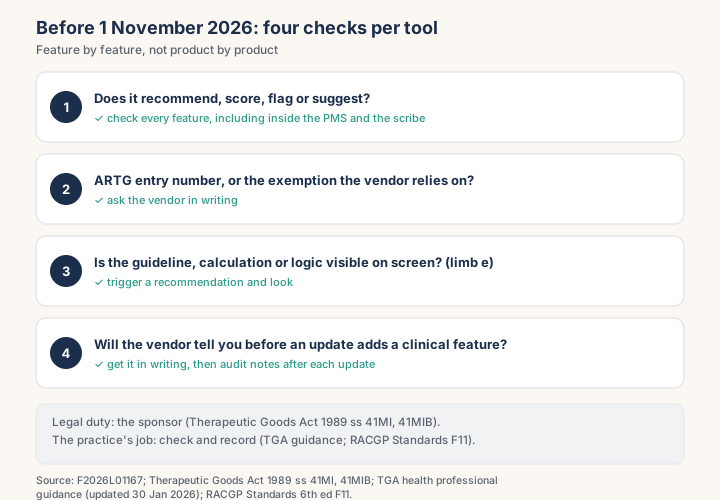
- List every clinical software feature that recommends, scores, flags, predicts or suggests, including modules inside your practice management system and your scribe, not just stand-alone products. Go feature by feature, since one product can carry a scribe and other functions.
- Ask the vendor in writing for its ARTG entry, or the exemption it relies on and confirmation it has notified the TGA, since "the sponsor of the device must notify the Secretary" of any importation or supply "within 20 working days".
- Check limb (e) yourself: when a recommendation appears, can the clinician see the guideline, calculation or logic on screen, in a way they can "readily interpret and verify"? This is our suggested check.
- Search the ARTG using "the manufacturer's name as listed in the instructions for use", and cross-check the TGA's list of AI-enabled medical devices in the ARTG.
- Switch off or restrict features that return a diagnosis or treatment decision where the vendor cannot give an ARTG entry. MDA National: such software "should not be used until there is TGA approval".
- Ask vendors to tell you before an update adds a clinical feature, and review scribe output after each update, as MDA advises, "from the date of update up until the present".
- Record the answers in your AI register or digital health technology register and your AI policy. Our AI acceptable use policy template and digital health technology governance policy template give the structure.
- Report adverse events or suspected non-compliance to the sponsor and the TGA. The TGA: "If the software causes harm or doesn't perform as expected, report it to the Sponsor and follow your organisation's incident management requirements."
Could the change still be stopped?
Technically, yes. The explanatory statement confirms the instrument is disallowable. Under section 42(1) of the Legislation Act 2003, notice of a motion to disallow may be given "within 15 sitting days" after the instrument is laid before a House, and if the resolution passes, the instrument "is repealed immediately". We have not checked the sitting calendar; treat 1 November 2026 as the operative date until Parliament says otherwise.
The other signal to watch is the TGA's digital scribe review, unpublished as at 24 September 2026 despite the reported "in the coming weeks" remark of 5 August 2026.
Frequently Asked Questions
Is my AI scribe a medical device?
No, if it only transcribes and translates clinical conversations into written records without analysis or interpretation. It becomes a medical device if it analyses or interprets those conversations, for example by generating a diagnosis, differential diagnosis or treatment recommendation "not explicitly stated by the healthcare practitioner". In that case it must be on the ARTG before supply.
Does the 1 November 2026 change apply to software we already use?
Yes. Regulation 11.90 applies the amended item 2.15 to devices manufactured on or after 1 November 2026 and to devices manufactured before that date but "intended by its manufacturer to be used on or after that commencement". There is no carve-out for software installed years ago.
Do I have to stop using a tool that is not on the ARTG?
Most tools do not need to be on the ARTG at all: exempt CDSS meeting all five limbs, and software that is not a medical device, stay off it. For a tool that returns a diagnosis or treatment decision with no ARTG entry, MDA National says it "should not be used until there is TGA approval". The legal position of a practice that merely uses such a tool is unresolved; ask your MDO.
What is the CDSS exemption?
Item 2.15 of Schedule 4 to the Therapeutic Goods (Medical Devices) Regulations 2002 exempts clinical decision support software from the ARTG, subject to conditions including sponsor notification to the TGA. From 1 November 2026 the software must meet five limbs: sole purpose of assisting a decision, no processing of medical images or signals, no replacing clinical judgement, no making a diagnosis or treatment decision, and visible guidelines, calculations or logic.
Does ChatGPT count as clinical decision support?
No. The exemption and the device definition both turn on the manufacturer's intended purpose, and a general-purpose large language model is not intended as CDSS. The TGA's off-label example puts the duty on the developer who learns the product is being used for health advice: implement controls to stop it, or seek approval for the new intended use. Separately, the OAIC recommends not entering "personal information, and particularly sensitive information, into publicly available generative AI tools".
How do I check whether software is on the ARTG?
Search the ARTG using the manufacturer's name as listed in the instructions for use, the TGA's stated method, and ask the sponsor to confirm. The TGA also publishes a list of AI-enabled medical devices in the ARTG. Record what you find, and when, since updates can change a product's status.
Does the TGA change affect my practice's accreditation?
F11 of the RACGP Standards 6th edition asks practices to confirm that AI tools used in clinical care are registered on the ARTG where they meet the device definition, and to hold vendor documentation of regulatory status. But accreditation under the NGPA Scheme currently uses the 5th edition, and ACSQHC says arrangements for the 6th edition "will be provided in due course". F11 is not yet assessed against.
What happens if a vendor update adds a diagnosis feature?
The TGA says the developer must either stop supplying the product until it is on the ARTG, or remove the feature that gives it a therapeutic use. MDA National advises auditing your clinical notes from the date of the update, since the feature may have been writing into records unnoticed. Then ask the vendor in writing what it intends to do.
Part of
Privacy & Cyber Security