Why this matters for your practice
The National Law creates offences a practice commits, not only its clinicians. Holding a person out as registered when they are not is section 116, with a maximum penalty of $120,000 for a body corporate. Advertising a regulated health service unlawfully is section 133, the same body corporate maximum. Directing or inciting a practitioner to do something that amounts to unprofessional conduct or professional misconduct is section 136, again $120,000 for a body corporate. Section 142 adds an employer's own notification duty: if you reasonably believe an employed practitioner has engaged in notifiable conduct, you must tell Ahpra (in Queensland, the Office of the Health Ombudsman). If you do not, Ahpra must report the failure to the responsible Minister, who must then report it to a health complaints entity, your licensing authority or another appropriate entity.
What is the Health Practitioner Regulation National Law?
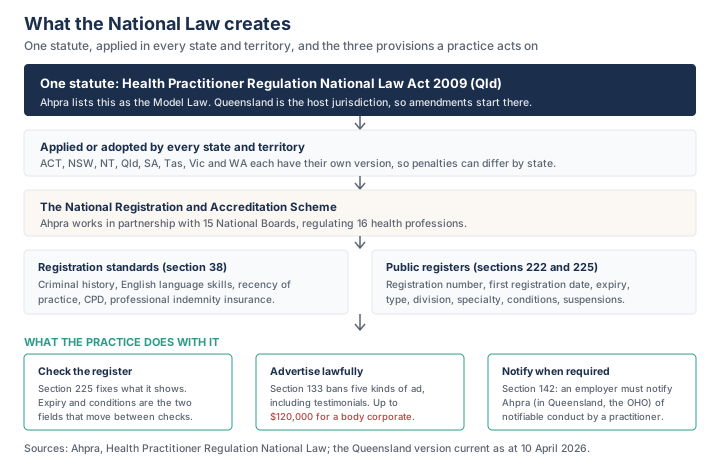
The Health Practitioner Regulation National Law is a nationally consistent law passed by each state and territory parliament. Ahpra's standard formula describes it as "the Health Practitioner Regulation National Law, as in force in each state and territory (the National Law)". Queensland is the host jurisdiction, so the Health Practitioner Regulation National Law Act 2009 (Qld) is what Ahpra lists as the Model Law, and amendments must be introduced into the Queensland Parliament for review, debate and passage. Section 3(1) states the object: to establish a national registration and accreditation scheme for the regulation of health practitioners and the registration of students. Section 3A makes protection of the public, and public confidence in the safety of services provided by registered health practitioners and students, paramount. The Law creates the National Registration and Accreditation Scheme, under which Ahpra works in partnership with 15 National Boards to regulate 16 health professions. It also creates the registration standards each Board must develop under section 38, and the public national registers required by section 222.
Which version of the National Law applies in my state or territory?
The National Law is not a Commonwealth Act. Each state and territory parliament applies or adopts it as its own law, which is why the same section number can carry a different penalty in one jurisdiction. Ahpra lists the version in force in each jurisdiction as follows, on Ahpra's National Law page.
| Jurisdiction | The law Ahpra lists |
|---|---|
| Model Law | Health Practitioner Regulation National Law Act 2009 (Qld) |
| Queensland | Health Practitioner Regulation National Law (Queensland) |
| Australian Capital Territory | Health Practitioner Regulation National Law (ACT) |
| New South Wales | Health Practitioner Regulation National Law (NSW No 86a of 2009) |
| Northern Territory | See Model law, Health Practitioner Regulation National Law Act 2009 (Qld) |
| South Australia | Health Practitioner Regulation National Law (South Australia) Act 2010 (SA) |
| Tasmania | Health Practitioner Regulation National Law (Tas) |
| Victoria | See Model law, Health Practitioner Regulation National Law Act 2009 (Qld) |
| Western Australia | Health Practitioner Regulation National Law (Western Australia) |
Three variations matter in practice.
Western Australia. The maximum penalty for advertising offences has not increased there and different penalties apply. Treating practitioners in Western Australia are also exempt from the requirement to make a mandatory notification about a practitioner-patient or student.
New South Wales and Queensland. Concerns about a practitioner are handled differently in those two states. In NSW the bodies are the NSW Health Professional Councils Authority and the NSW Health Care Complaints Commission; in Queensland it is the Office of the Health Ombudsman, as Ahpra sets out on the NSW and Queensland arrangements page.
What still goes to Ahpra. A mandatory notification about a health practitioner or student in NSW must still be reported to Ahpra. An alleged criminal offence must be reported to Ahpra in every state and territory, including those two. Some criminal offences are breaches of the National Law, including claiming to be a registered health practitioner when you are not, and unlawful advertising.
Which parts of the National Law land on the practice rather than the practitioner?
Each offence below is framed as a duty on "a person", and each states a separate maximum penalty for a body corporate. Ahpra's own advertising strategy says the requirements reach registered health practitioners, individuals who are not registered as health practitioners, and businesses, partnerships and corporate entities.
| Section | What it means for a practice | Maximum penalty |
|---|---|---|
| 113 | Do not use a protected title, or use one in relation to another person, in a way that could reasonably be expected to induce a belief the person is registered, unless they are | $60,000 or 3 years imprisonment or both (individual); $120,000 (body corporate) |
| 115A | Do not call a medical practitioner a surgeon unless they hold specialist registration in a surgical class | $60,000 or 3 years imprisonment or both (individual); $120,000 (body corporate) |
| 116 | Do not hold another person out as registered, or as qualified to practise, when they are not | $60,000 or 3 years imprisonment or both (individual); $120,000 (body corporate) |
| 133 | Do not advertise a regulated health service in any of the five prohibited ways | $60,000 (individual); $120,000 (body corporate) |
| 136 | Do not direct or incite a practitioner to do anything in the course of practice that amounts to unprofessional conduct or professional misconduct | $60,000 (individual); $120,000 (body corporate) |
| 142 | Notify Ahpra (in Queensland, the Office of the Health Ombudsman) when you reasonably believe an employed practitioner has engaged in notifiable conduct | No penalty stated, but a failure is reported to the responsible Minister and then to a health complaints entity, the employer's licensing authority or another appropriate entity |
Protected titles and holding out. Section 113 protects titles including medical practitioner, nurse, registered nurse, nurse practitioner, enrolled nurse, midwife, psychologist, physiotherapist, occupational therapist, pharmacist, paramedic and optometrist. Section 113(3) says the prohibition applies whether or not the title is used with or without any other words, and whether in English or any other language. A bilingual sign or a job title with an extra word in front of it is not a way around it. Section 115A adds the title "surgeon", which a medical practitioner may use only with specialist registration in surgery, obstetrics and gynaecology, or ophthalmology, or in another recognised specialty carrying "surgeon" in its specialist title.
Advertising. Section 133 prohibits advertising a regulated health service, or a business that provides one, in a way that is false, misleading or deceptive or likely to mislead or deceive; that offers a gift, discount or other inducement unless the advertisement also states the terms and conditions of the offer; that uses testimonials or purported testimonials; that creates an unreasonable expectation of beneficial treatment; or that directly or indirectly encourages the indiscriminate or unnecessary use of regulated health services. Section 133(4) defines a regulated health service as a service provided by, or usually provided by, a health practitioner. For the sector-specific detail, see the cosmetic advertising rules.
Directing or inciting. Section 136 says a person must not direct or incite a registered health practitioner to do anything, in the course of practising the profession, that amounts to unprofessional conduct or professional misconduct. Section 136(2) exempts the owner or operator of a public health facility, and a private practice has no such carve-out. A direction from management that crosses that line is an offence by the person who gave it.
The employer notification duty. Under the National Law only registered health practitioners, employers and health education providers are required to make a mandatory notification. Ahpra's guidelines define an employer more broadly than section 142 does: a person or organisation that employs a practitioner under an employment or service contract or as a volunteer. The obligation extends only to staff who are themselves registered practitioners. A notification should be made as soon as practicable, and section 237 protects a good faith notifier from civil, criminal and administrative liability, including defamation. Privacy obligations do not prevent a notification, and a non-disparaging clause in a resignation agreement does not exempt anyone from the duty. For the triggers and the thresholds, read who must report and what triggers the duty.
What the regulator or assessor expects
Registration standards define the requirements that applicants and registrants need to meet to be registered. Each of the 16 regulated professions has five core standards, which under section 38 each National Board must develop and recommend to the Ministerial Council. The five are criminal history, English language skills, recency of practice, continuing professional development, and professional indemnity insurance. The criminal history standard is common to all National Boards, and the English language skills standard is common to all except the Nursing and Midwifery Board of Australia and the Aboriginal and Torres Strait Islander Health Practice Board of Australia. The other three are specific to the individual Boards. Read the criminal history registration standard for that standard in detail. Under section 39 a National Board may also develop and approve codes and guidelines for the practitioners it registers, which is where conduct guidance such as telehealth and online prescribing sits.
The register exists because section 222 requires a public national register for each health profession, and section 224 requires it to be kept up to date and accurate. Section 225 fixes what it must show for each practitioner: the registration number, the date of first registration in the profession in Australia, the expiry date, the type of registration, the division, any recognised specialty, the fact of any reprimand, the fact or details of any condition imposed or undertaking accepted, the fact and period of any suspension, and details of any endorsement. That is why the register, not a certificate, is what a practice checks. Expiry and conditions on registration are the two fields that move between checks, which makes verifying a practitioner's registration a recurring task rather than an onboarding one. The wider set of employer duties is mapped in AHPRA and registration compliance.
Under section 130, practitioners and students must give their National Board notice of certain relevant events within seven days. An employer unsure of its own duty can call Ahpra's Health Service Liaison Team on 1300 361 041 and discuss it confidentially.
Common mistakes
Treating the National Law as the practitioner's problem. The offences in sections 116, 133 and 136 are committed by the business, and the body corporate maximum for each is $120,000. A practice owner who is not a registered practitioner is still within the Law's reach.
Quoting a penalty without checking the jurisdiction. In Western Australia the maximum penalty for advertising offences has not increased and different penalties apply, so a figure taken from the Queensland version may not be the one that bites on you.
Assuming a title is safe because it has an extra word or is in another language. Section 113(3) closes that door: the prohibition applies whether or not the title is used with other words, and whether in English or any other language.
Relying on a testimonial or a patient review in advertising. Section 133(1)(c) prohibits testimonials or purported testimonials about the service or business outright, with no exception for the ones a patient wrote unprompted.
Writing a non-disparaging clause into an exit agreement. Ahpra is explicit that such a clause does not exempt anyone from making a mandatory notification, and section 237 protects a good faith notifier from civil, criminal and administrative liability, including defamation.
Frequently asked questions
What is the Health Practitioner Regulation National Law?
It is a nationally consistent law passed by each state and territory parliament that establishes the National Registration and Accreditation Scheme. Ahpra describes it as "the Health Practitioner Regulation National Law, as in force in each state and territory (the National Law)". Queensland is the host jurisdiction, and the Health Practitioner Regulation National Law Act 2009 (Qld) is what Ahpra lists as the Model Law.
Is the National Law a federal law?
No. It is not a Commonwealth Act. Each state and territory parliament applies or adopts it as its own law, which is why Ahpra lists a separate version for each jurisdiction and why the same section number can carry a different penalty in one state, most visibly Western Australia on advertising offences.
Does the National Law apply to my practice if I am not a registered practitioner myself?
Yes. The offences in sections 113, 115A, 116, 133 and 136 apply to "a person", with stated maxima for both individuals and bodies corporate. Section 142 also puts a notification duty directly on an employer, and Ahpra's guidelines define an employer to include an organisation that engages a practitioner under an employment or service contract or as a volunteer.
What is the difference between the National Law and AHPRA?
The National Law is the statute. Ahpra is the agency the statute creates: section 23(1) reads "The Australian Health Practitioner Regulation Agency is established." It works in partnership with 15 National Boards to implement the scheme. Ahpra has five core functions: registration, accreditation, notifications, compliance, and setting professional standards, as set out on its page describing what Ahpra does.
Can a practice be prosecuted for advertising under the National Law?
Yes. Section 133 prohibits advertising a regulated health service, or a business that provides one, in any of five ways, including testimonials and offers of a gift or discount without stating the terms and conditions. The maximum penalty is $60,000 for an individual and $120,000 for a body corporate, except in Western Australia where the maximum has not increased and different penalties apply.
What happens if an employer does not make a mandatory notification?
Under the model provision, Ahpra must give a written report about the failure to the responsible Minister for the jurisdiction where the notifiable conduct occurred. The Minister must then report the failure to a health complaints entity, the employer's licensing authority or another appropriate entity as soon as practicable. Section 142 states no penalty, but that referral path is mandatory.
Has the National Law changed recently?
Yes, repeatedly. The 2022 reforms, the most significant since the scheme began in 2010, had all started as at 1 July 2024. The title "surgeon" was protected from 20 September 2023, and in Western Australia from 14 May 2024. The 2025 amendment Act became law on 9 April 2025, with changes in effect from 1 December 2025 and 10 April 2026. The rest start on dates to be decided by governments, which Ahpra will publish on its National Law amendments page.
Related terms
Go deeper
Last reviewed