Key Takeaways
- The Fair Work Commission's Expert Panel finalised the health professionals stream of the Health Professionals and Support Services Award (MA000027) in decision [2026] FWCFB 123, handed down 26 May 2026.
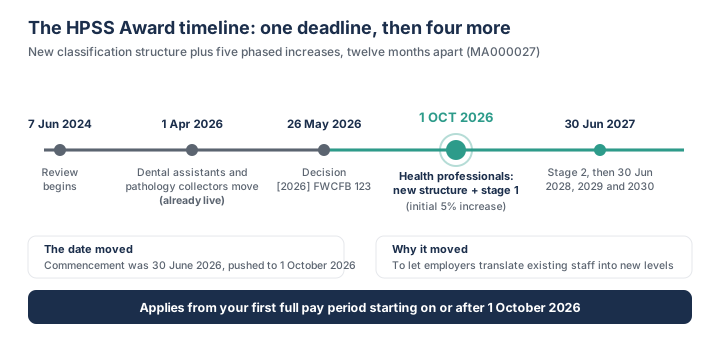
- A new classification structure and the first stage of new minimum rates take effect from the first full pay period starting on or after 1 October 2026. The increases then phase in over five approximately equal stages, twelve months apart, with the remaining four operating from 30 June in each of 2027, 2028, 2029 and 2030.
- The start date moved. The December 2025 decision set it at 30 June 2026; the Commission pushed it to 1 October 2026 so employers could work out the correct classification translations for existing staff and stay compliant with the Fair Work Act.
- This is not simply a pay rise. Every health professional on the award has to be mapped into a new level, based on their profession's standard minimum qualification (an AQF level, set out in Schedule B) and their experience. Getting a translation wrong is how a practice underpays without meaning to.
- Dental assistants and pathology collectors were done separately and are already live: their new levels applied from 1 April 2026 under Schedule J, with stage 1 increases of around 4 per cent (rising to 7.95 per cent for a Level 1 to Level 3 move and 9.26 per cent for Level 2 to Level 6), and a second stage from 1 January 2027. A practice that missed that change is already exposed.
- The stage 1 increase averages about 5 per cent but is not uniform. New Level 3 gets 7.27 per cent, new Level 2.2 gets nothing until stage 2, and a small set of AQF Level 5 and 6 pay points go down (the Commission puts the structural decreases at 0.36 to 7.8 per cent). A retained rates clause protects existing staff, who keep the higher of the two rates.
- Ignoring the paperwork carries real cost. In February 2026 the Federal Circuit and Family Court penalised the former operators of a Merrylands medical centre $36,000 ($30,000 against the company, $6,000 against its sole director) for deliberately failing to act on a Fair Work compliance notice about an underpaid registered nurse.
- The dollar rates are settled: every figure in the decision was in 1 July 2025 dollars, and determination PR814029, issued 7 September 2026, folds in the Annual Wage Review 2026 rise. A physiotherapist in their 7th year or more (AQF 7), for example, is on at least $1,689.50 a week ($44.46 an hour). This post carries the determination's full rate table.
From 1 October 2026, the Health Professionals and Support Services Award has a new classification structure for health professionals and the first of five annual pay increases. The change applies from your first full pay period starting on or after that date. The real work is not the pay run, it is correctly translating every existing employee into a new classification level before that pay period starts.
What did the Fair Work Commission actually decide?
On 26 May 2026 the Expert Panel issued decision [2026] FWCFB 123, which finalised the variations to the Health Professionals and Support Services Award 2020 dealing with the gender-based undervaluation of the work of health professionals. It is the last piece of a review the Commission began on 7 June 2024 across five awards in female-dominated sectors.
The Panel found that the award's minimum rates had not properly reflected the qualifications, skills, responsibility and complexity of the work, and that the fix required two things together: a rebuilt classification structure, and higher minimum rates attached to it. Both commence from the first full pay period starting on or after 1 October 2026.
The increases are not delivered in one hit. The December 2025 decision [2025] FWCFB 297 determined that they should be phased in over a maximum of five approximately equal stages, twelve months apart. That timetable survived. The first stage lands on 1 October 2026 and involves an initial increase averaging about 5 per cent (the level by level spread is below), and the remaining four operate from 30 June in each of 2027, 2028, 2029 and 2030.
Why did the start date move from 30 June to 1 October 2026?
This is the detail that tells you what the change really is. The December 2025 decision had set commencement at 30 June 2026. Employer parties came back and asked for more time, and at paragraph [80] of the May 2026 decision the Panel agreed, for a specific reason worth quoting in substance: employers may need further time to obtain the necessary information about some employees' qualifications and the work they actually perform, to implement the new structure including identifying the appropriate translations for current employees, and to make sure they comply with the Fair Work Act.
Read that again as a to-do list, because that is what it is. The Commission did not give practices three extra months to budget for a pay rise. It gave them three extra months to do a classification audit: to work out, employee by employee, what qualification each person holds, what work they are genuinely doing, and which new level that puts them on.
That is the compliance risk in this change. A pay rise you can absorb. A misclassification compounds silently, every pay cycle, until someone checks.
Who does the Health Professionals Award actually cover in a practice?
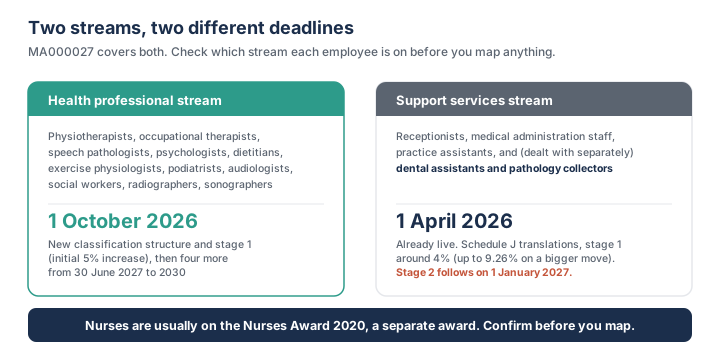
The Health Professionals and Support Services Award (MA000027) is the modern award covering most professional and support staff in private medical, allied health and health services practices. It runs two distinct streams, and the 1 October change hits one of them.
The health professional stream covers employees such as physiotherapists, occupational therapists, speech pathologists, psychologists, dietitians, exercise physiologists, podiatrists, audiologists, social workers, radiographers, sonographers and genetic counsellors. These are the employees being reclassified from 1 October 2026.
The support services stream covers receptionists, medical administration staff, practice assistants, dental assistants and pathology collectors. This stream was not left alone, but it was dealt with earlier and on a different timetable (see below).
Two things practices routinely get wrong here. First, nurses are generally not on this award; they are usually covered by the Nurses Award 2020, which is a separate instrument with its own rates. Second, the award applies by the work performed, not by the job title on the contract, so calling someone a "practice coordinator" does not settle which classification they sit in.
What already changed for dental assistants and pathology collectors?
If you employ dental assistants or pathology collectors, a change has already happened and you may not have actioned it.
The December 2025 decision finalised those two occupations separately, and the Fair Work Ombudsman confirms that a new classification structure operated for them from 1 April 2026. A new Schedule J (Classification Translation Arrangements) was added to the award, setting out exactly which new support services level each existing employee moves to, based on their previous level, their qualifications and their industry experience. The first pay increase applied from the first full pay period on or after 1 April 2026, and some employees receive a further increase from 1 January 2027.
The Commission set the first-stage increases at around 4 per cent for most, but higher where the translation jumps further: 7.95 per cent for an employee moving from Level 1 to Level 3, and 9.26 per cent for Level 2 to Level 6 (which applies to dental assistants with more than four years of experience). Employees already on a rate higher than the new minimum on 31 March 2026 keep their higher rate.
The practical point: this deadline has passed. If you employ dental assistants or pathology collectors and you have not run the Schedule J translation, you are potentially underpaying now, and the shortfall is accruing.
The timetable at a glance
| Date | What happens | Who it affects |
|---|---|---|
| 7 June 2024 | Commission initiates the gender-based undervaluation priority awards review across five awards | Sector-wide |
| 24 December 2025 | Decision [2025] FWCFB 297 finalises dental assistants and pathology collectors; sets the five-stage phase-in | Dental assistants, pathology collectors |
| 1 April 2026 | New classification structure and stage 1 increases (around 4 per cent) take effect; Schedule J translations apply | Dental assistants, pathology collectors |
| 26 May 2026 | Decision [2026] FWCFB 123 finalises the health professionals stream | Health professionals |
| 1 October 2026 | New health professional classification structure and stage 1 (initial 5 per cent increase), from the first full pay period on or after this date | Health professionals |
| 1 January 2027 | Second-stage increase for dental assistants and pathology collectors; full translation takes effect | Dental assistants, pathology collectors |
| 30 June 2027, 2028, 2029, 2030 | Remaining four phased increases | Health professionals |
How do you translate an employee into the new classification?
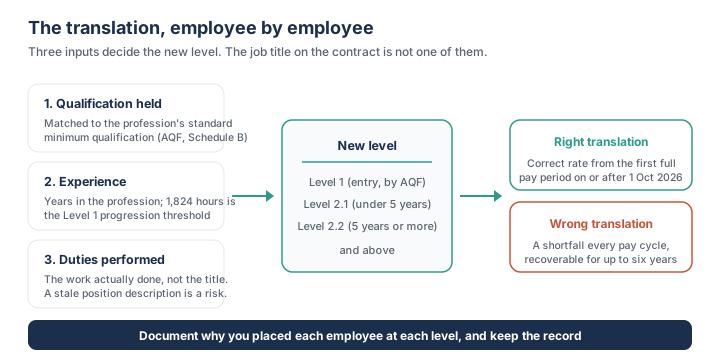
The new health professional structure is built on qualifications and experience rather than job titles, so the translation follows a defined path.
Level 1 is the entry level. It is anchored to the standard minimum qualification for each profession, which the award now sets out in Schedule B by reference to an Australian Qualifications Framework (AQF) level. A graduate physiotherapist entering the profession with an AQF Level 7 qualification, for example, is a Level 1 employee. Progression within Level 1 is tied to accumulated experience, with the decision using a threshold of 1,824 hours of similar experience for advancement.
Above that, the structure separates employees by the actual work and the depth of experience behind it. Level 2.1 applies to an employee with less than five years of experience in the profession performing the relevant roles and duties, and Level 2.2 to an employee with five years or more.
So the raw material you need for each employee is: the qualification they hold (and its AQF level), their years of experience in the profession, and an honest description of the roles and duties they actually perform. That last one is where a stale position description becomes a liability, because if the document says one thing and the work is another, the award follows the work.
Which AQF level is your profession on?
Level 1 pay is anchored to the standard minimum qualification for the profession, which the award now lists in Schedule B as an Australian Qualifications Framework level. This is the single most useful table in the change, because it sets where each of your people starts on the new scale.
| Profession | AQF level under Schedule B |
|---|---|
| Physiotherapist | 7 |
| Occupational Therapist | 7 |
| Exercise Physiologist | 7 |
| Podiatrist | 7 |
| Medical Imaging Technologist (including Medical Radiographer and MRI Technologist) | 7 |
| Pharmacist | 7 |
| Dental Hygienist | 7 |
| Oral Health Therapist | 7 |
| Dental Therapist | 7 |
| Sonographer | 8 |
| Psychologist | 9 |
| Audiologist | 9 |
| Chiropractor | 9 |
| Osteopath | 9 |
| Genetic Counsellor | 9 |
| Dietitian | 7, 8 or 9 |
| Speech Pathologist | 7, 8 or 9 |
| Social Worker | 7, 8 or 9 |
| Counsellor | 5 to 9 |
Where more than one level is listed, the employee's own qualification picks the level, under clause B.2(b). The full Schedule B list runs to 47 professions; the table above is the subset most private practices employ.
Three rules sit around that table and they catch people out.
The list is indicative, not exhaustive. At paragraph [25] the Panel confirmed Schedule B is a guide. A profession that is not named is still covered: under clause B.2(c) it takes the standard minimum qualification for entry to that profession, or failing that, the qualification the employee holds. Under clause B.2(d), where the employer requires a higher qualification than Schedule B lists, the higher one applies.
Level 1 runs off the profession's qualification, not the person's. At paragraph [84] the Panel was explicit that the standard minimum qualification "is intended to be a proxy for the profession's work value... it is not intended to be personal to the individual". A physiotherapist with a master's degree in a role that requires the standard four year degree is still on the AQF Level 7 scale. The extra qualification does not move them up Schedule B, though the duties it lets them perform may move them up the structure.
Some professions moved. Chiropractor was raised from AQF 7 to AQF 9, with the Panel describing the AQF 7 degree as "effectively an outlier for this profession". Medical Radiographer and MRI Technologist were narrowed to AQF 7 alone. Occupational Therapist was confirmed at AQF 7, and Speech Pathologist stays across 7, 8 and 9. If you employ a chiropractor, check the new level before you budget.
The translation table: where each current employee lands
The translation runs off one thing: the classification the employee holds on 30 September 2026, under the new clause J.4. Whatever level and pay point they sit on that day is the input; the table below is the output. It consolidates the separate tables in clause J.4.1 for previous Levels 1 and 2, and it is read across by the entry qualification for the employee's profession.
| Current classification | UG 2 entry | 3 year degree entry | 4 year degree entry | Masters entry | PhD entry |
|---|---|---|---|---|---|
| Level 1, pay point 1 | 1st year | n/a | n/a | n/a | n/a |
| Level 1, pay point 2 | 2nd to 3rd year | 1st year | n/a | n/a | n/a |
| Level 1, pay point 3 | 2nd to 3rd year | 2nd to 3rd year | 1st year | n/a | n/a |
| Level 1, pay point 4 | 4th to 6th year | 2nd to 3rd year | 2nd to 3rd year | 1st year | n/a |
| Level 1, pay point 5 | 4th to 6th year | 4th to 6th year | 2nd to 3rd year | 2nd to 3rd year | 1st year |
| Level 1, pay point 6 | 4th to 6th year | 4th to 6th year | 4th to 6th year | 2nd to 3rd year | 2nd to 3rd year |
| Level 2, pay point 1 | 7th year+ | 4th to 6th year | 4th to 6th year | 4th to 6th year | 2nd to 3rd year |
| Level 2, pay point 2 | 7th year+ | 7th year+ | 4th to 6th year | 4th to 6th year | 4th to 6th year |
| Level 2, pay point 3 | 7th year+ | 7th year+ | 7th year+ | 4th to 6th year | 4th to 6th year |
| Level 2, pay point 4 | 7th year+ | 7th year+ | 7th year+ | 7th year+ | 4th to 6th year (6th year of experience) or 7th year+ (7th year or more) |
Every cell is an experience point within the new Level 1. An "n/a" cell means that pay point does not arise for that entry qualification, because the entry point already sits above it.
Old Levels 3 and 4 translate by duties and experience rather than by the table:
- Old Level 3, performing Senior Clinician, Specialist, Supervisor or Educator duties with less than 5 years' experience in those duties, goes to new Level 2.1.
- Old Level 3, the same duties with 5 years or more, goes to new Level 2.2.
- Old Level 3, performing Advanced Clinician, Senior Specialist or Section Manager duties, goes to new Level 3.
- Old Level 4 goes to new Level 4.
The entry column matters more than it looks. Under clause 17.1 of the current award, the pay point an employee started on was set by qualification: pay point 1 for a UG 2 qualification, pay point 2 for a three year degree, pay point 3 for a four year degree, pay point 4 for a masters, pay point 5 for a PhD. That is the entry point the profession requires, which is why the same current pay point translates to different places for different professions. Two employees both sitting on Level 1 pay point 4 today can land on different experience points on 1 October, purely because one profession enters at a three year degree and the other at a four year degree.
The rates: what the decision set, and the 1 October 2026 figures
Read this framing before you read the numbers, because it changes what you can do with them.
Every dollar figure in the decision and its annexure is expressed in 1 July 2025 dollars, that is, before the Annual Wage Review 2026. The Commission folded the Annual Wage Review 2026 outcome into the new rates in determination PR814029, issued on 7 September 2026 (the decision annexure had allocated it print number PR810342). So the decision's own column is not what you pay from October: the determination's is.
The second and third columns below are the determination's minimum weekly and hourly rates. Until it issued, this table carried our own calculated figures (the annexure rate plus 4.75 per cent). Eight of the 24 weekly rates in the determination differ from that calculation by 10 cents, and two hourly rates by 1 cent. Three were lower than the determination: AQF 6 7th year+ and AQF 9 4th to 6th year (we had $1,659.20 and $43.66; the determination sets $1,659.30 and $43.67) and AQF 8 4th to 6th year (we had $1,584.80; it sets $1,584.90). If you loaded our earlier figures into payroll, replace them with the determination's.
| New classification | Stage 1 rate in the decision (1 July 2025 dollars) | From 1 Oct 2026 (PR814029, weekly) | From 1 Oct 2026 (hourly) |
|---|---|---|---|
| AQF 5, 1st year | $1,176.80 | $1,232.70 | $32.44 |
| AQF 5, 2nd to 3rd year | $1,249.50 | $1,308.80 | $34.44 |
| AQF 5, 4th to 6th year | $1,361.30 | $1,426.00 | $37.53 |
| AQF 5, 7th year+ | $1,471.40 | $1,541.30 | $40.56 |
| AQF 6, 1st year | $1,176.80 | $1,232.70 | $32.44 |
| AQF 6, 2nd to 3rd year | $1,249.50 | $1,308.80 | $34.44 |
| AQF 6, 4th to 6th year | $1,416.00 | $1,483.30 | $39.03 |
| AQF 6, 7th year+ | $1,584.00 | $1,659.30 | $43.67 |
| AQF 7, 1st year | $1,249.50 | $1,308.80 | $34.44 |
| AQF 7, 2nd to 3rd year | $1,345.10 | $1,409.00 | $37.08 |
| AQF 7, 4th to 6th year | $1,494.40 | $1,565.30 | $41.19 |
| AQF 7, 7th year+ | $1,612.90 | $1,689.50 | $44.46 |
| AQF 8, 1st year | $1,276.50 | $1,337.10 | $35.19 |
| AQF 8, 2nd to 3rd year | $1,379.40 | $1,444.90 | $38.02 |
| AQF 8, 4th to 6th year | $1,512.90 | $1,584.90 | $41.71 |
| AQF 8, 7th year+ | $1,643.40 | $1,721.40 | $45.30 |
| AQF 9, 1st year | $1,379.40 | $1,444.90 | $38.02 |
| AQF 9, 2nd to 3rd year | $1,475.10 | $1,545.20 | $40.66 |
| AQF 9, 4th to 6th year | $1,584.00 | $1,659.30 | $43.67 |
| AQF 9, 7th year+ | $1,675.40 | $1,755.00 | $46.18 |
| Level 2.1 | $1,857.20 | $1,945.40 | $51.19 |
| Level 2.2 | $1,893.30 | $1,983.20 | $52.19 |
| Level 3 | $1,893.30 | $1,983.20 | $52.19 |
| Level 4 | $2,385.80 | $2,499.10 | $65.77 |
Weekly rates are for a full-time employee; hourly figures use the 38 hour divisor.
Worked through one employee: a physiotherapist with eight years' experience currently sits on Level 2 pay point 3 at $1,607.40 a week, the 1 July 2026 rate. Physiotherapy is a four year degree entry profession at AQF Level 7, so the translation table puts them on new Level 1, AQF 7, 7th year+, at $1,689.50 a week under the determination. That is a rise of about 5.1 per cent.
The spread is the part to plan around. Most pay points sit near 5 per cent, but new Level 3 gains 7.27 per cent, new Level 2.1 gains 5.22 per cent, and new Level 2.2 gains nothing at all in stage 1, picking up its increase from stage 2. Some AQF Level 5 and 6 pay points actually go down: the Commission puts the range of those structural decreases at 0.36 to 7.8 per cent. Nobody currently employed loses money over it. The new clause J.4.3 is a retained rates clause: anyone classified on the award on 30 September 2026 is paid the higher of their translated rate or their 30 September 2026 rate. And at paragraph [76] the Panel rejected absorption, so annual wage review increases and the staged increases stack rather than offsetting each other. The remaining four stages then operate from 30 June in each of 2027, 2028, 2029 and 2030, which makes the gap from stage 1 to stage 2 about nine months, not twelve. Budget for that short first year.
What should a practice do for the 1 October 2026 change?
Treat this as a project with a deadline, not a payroll parameter change. A workable sequence:
- List every employee covered by MA000027, separating the health professional stream from support services. Confirm your nurses are on the correct award and are not sitting on this one by accident.
- Collect the evidence for each person: qualification held, AQF level, years of experience in the profession, and the duties actually performed. This is precisely the information the Commission said employers would need time to gather.
- Map each employee to the new level using Schedule B (standard minimum qualifications) and the new classification criteria.
- Run the dental assistant and pathology collector translations under Schedule J now, if you have not. That change is already live from 1 April 2026 and back-pay accrues.
- Check your payroll system will apply the new levels and rates from the first full pay period on or after 1 October 2026, not from 1 October itself. Those are different dates for most practices.
- Document the reasoning for each classification decision, and keep it. If a classification is ever queried, the contemporaneous record of why you placed someone at a level is your defence.
- Diarise the recurring dates: 1 January 2027 for the support services second stage, then 30 June each year from 2027 to 2030.
The step-by-step version of this exercise is in our guide on how to audit your award classifications.
What happens if you get it wrong?
Underpayments are recoverable by employees for up to six years, so a classification error found in 2030 reaches back to 2024. Since 1 January 2025, intentional underpayment has been a criminal offence under the Fair Work Act. And a misclassification is not a small error: moving someone one level down the structure is a permanent discount on every hour they work.
The enforcement posture is not theoretical for medical practices. On 2 February 2026 the Fair Work Ombudsman announced that the Federal Circuit and Family Court had imposed penalties totalling $36,000 on the former operators of Well Health Medical Hub in Merrylands, western Sydney: $30,000 against Well Health Medical Services Pty Ltd and $6,000 against its sole director, Irfan Khan.
The breach was not the underpayment itself, it was ignoring the paperwork. A Fair Work inspector issued a compliance notice in December 2023 after forming the belief the company had underpaid a full-time registered nurse (employed from October 2020 to September 2023) her minimum wages and annual leave loading under the Nurses Award 2020, had not paid out her accrued annual leave, and had not paid her for the last 46 hours she worked. The company did not comply with the notice. Judge Peter Papadopoulos found the failure was deliberate, that Mr Khan was an "intentional participant" in the breach, and that neither had shown any contrition. The court also ordered the company to do what the notice required anyway, including back-pay plus superannuation and interest.
Fair Work Ombudsman Anna Booth said employers who fail to act on compliance notices should be aware they can face court-imposed penalties on top of having to comply with the notice.
That case ran on the Nurses Award rather than MA000027, so it is not a classification case. It is included here because it is the clearest recent signal of what happens to a general practice that treats an award obligation as optional administration. The same regulator, the same court, and a far larger reclassification exercise now falls due on 1 October. For the broader pattern of how award misconfiguration turns into a multi-million dollar liability, see our analysis of the 2026 payroll underpayment enforceable undertakings.
Are the new dollar rates final?
Yes. At paragraph [97] of the May 2026 decision, the Commission said a determination would be published following the Annual Wage Review 2026, to incorporate any changes to the rates of pay that flow from that case. That determination is PR814029, issued on 7 September 2026 (the decision's annexure had allocated it print number PR810342). It comes into operation on 1 October 2026 and, under ss 165(3) and 166(5) of the Fair Work Act, takes effect for each employee from the start of their first full pay period starting on or after that date. The Commission's consolidated award now incorporates it.
So the classification structure, the commencement date and the stage 1 rates are all settled. The classification mapping is still the slow part: do it first, then load the determination's rates into payroll. Check them against the Fair Work Ombudsman's Pay and Conditions Tool, which the Ombudsman says has been updated with the 1 October 2026 rates, and the award itself before your first pay run under the new rates, rather than relying on a summary.
One caution on secondary sources: the Fair Work Ombudsman's summary page for this award (last updated 15 September 2026) says the translation examples will sit in clause J.3 of the award. In the determination they are clause J.4. Work from the determination and the award.
Frequently Asked Questions
When exactly do the new Health Professionals Award rates apply?
From the first full pay period starting on or after 1 October 2026, not from 1 October itself. For most practices those are different dates. If your pay cycle starts on a Monday, for example, the new classifications and rates apply from the first pay period beginning on or after 1 October, so the last September cycle runs out on the old rates.
Does this change affect nurses in my practice?
Generally no. Nurses are usually covered by the Nurses Award 2020, a separate award with its own rates and classifications, not the Health Professionals and Support Services Award. The 1 October 2026 change applies to the health professional stream of MA000027 (physiotherapists, psychologists, occupational therapists, dietitians and similar). Confirm which award each employee is actually on before you start mapping.
What is a classification translation and why does it matter?
A translation is the mapping of an existing employee from their current award level to the correct level under the new structure, based on their qualification, experience and the duties they actually perform. It matters because the Fair Work Commission expressly delayed commencement to 1 October 2026 so employers could do it. A wrong translation means an underpayment that accrues every pay cycle.
I employ dental assistants. Have I already missed a deadline?
Possibly. Dental assistants and pathology collectors were finalised in the December 2025 decision and their new classification structure took effect on 1 April 2026, with translations set out in Schedule J of the award. If you have not applied those translations, you may be underpaying now, and a further increase for some employees follows on 1 January 2027. Run that mapping before you turn to the October change.
How much are the pay increases?
The health professional increases phase in over five approximately equal stages, beginning on 1 October 2026 and continuing from 30 June in each of 2027 to 2030. Stage 1 averages about 5 per cent but is not uniform: new Level 3 gains 7.27 per cent, new Level 2.1 gains 5.22 per cent, new Level 2.2 gains nothing until stage 2, and some AQF Level 5 and 6 pay points decrease. The rates table above sets out every level, with the decision's 1 July 2025 dollars beside the 1 October 2026 rates from determination PR814029.
What records should I keep of my classification decisions?
For each employee, keep the qualification evidence (including its AQF level), the record of relevant experience, a current position description reflecting the duties actually performed, and a short note of why you placed them at the level you did. If a classification is ever challenged, whether by an employee or a Fair Work inspector, that contemporaneous reasoning is what you rely on.
Can anyone's pay go down on 1 October 2026?
Not for anyone already on the books. The new structure does contain lower rates at some AQF Level 5 and 6 pay points, and the Commission puts the range of those structural decreases at 0.36 to 7.8 per cent. But the new clause J.4.3 is a retained rates clause: an employee classified under the award on 30 September 2026 is paid the higher of their translated rate or their 30 September 2026 rate. So existing staff do not take a cut. The lower point on the scale only reaches people you engage after the change.
What is a physiotherapist's minimum rate from 1 October 2026?
Take a physiotherapist with eight years' experience, currently on Level 2 pay point 3 at $1,607.40 a week. Physiotherapy enters at a four year degree, AQF Level 7, so the translation table puts them on new Level 1, AQF 7, 7th year+. The decision set that rate at $1,612.90 in 1 July 2025 dollars. Determination PR814029 (7 September 2026), which folds in the Annual Wage Review 2026 increase, sets it at $1,689.50 a week ($44.46 an hour) from the first full pay period starting on or after 1 October 2026, a rise of about 5.1 per cent.
Part of