Key Takeaways
- No dollar figure and no commencement date appear anywhere in the draft report. The 46-page document contains no proposed fee, no percentage loading and no start date for any of its 23 recommendations.
- Public consultation closed at 11.59pm on 15 October 2026. No final report or government response had been published as at 20 October 2026, and the MRAC's next meeting is on 1 December 2026 in Canberra.
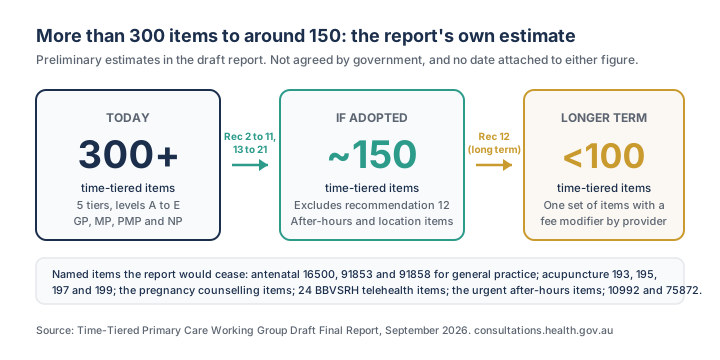
- Full implementation could cut time-tiered attendance items from more than 300 to around 150, and to fewer than 100 if the long-term recommendation 12 is implemented. These are preliminary estimates in the report.
- GPs would become ineligible for antenatal items 16500, 91853 and 91858 under recommendation 4, and would bill antenatal care through standard time-tiered attendance items instead.
- After-hours bulk-billing incentive items 10992 and 75872 would cease under recommendation 21, replaced by access to the standard bulk-billing incentives when providing after-hours care.
- The after-hours period would start at 6 pm on weekdays in every location, with an unsociable hours loading from 11 pm to 7 am, under recommendations 18 and 20.
No. Medicare is not paying more for long consults, and nothing in the MBS time-tiered review changes a single item today. What exists is a draft report from the Time-Tiered Primary Care Working Group, endorsed by the MBS Review Advisory Committee, whose public consultation closed at 11.59pm on 15 October 2026. It recommends that fee-per-minute rates better support longer consultations, but names no dollar figure and no start date.
The part almost everyone is getting wrong
I read the draft final report in full, all 46 pages. There is no dollar figure in it. Not a proposed fee, not a percentage loading, not a costing, not a commencement date for any of the 23 recommendations. The only fees in it are current ones, quoted as evidence of the problem. The "Medicare will pay more for long consults" headlines rest on one recommendation, and that recommendation does not say what they claim it says.
Recommendation 5, as printed in the recommendations list, reads: "MBS benefits for time-tiered items should equitably support appropriate and varied consultation lengths to ensure patients can access care that meets their individual clinical needs." That is the whole recommendation. No fee, no percentage, no date. The body of the report prints a second, differing wording of the same recommendation, referring to "MBS fees-per-minute" rather than "MBS benefits". The draft prints both. Neither version names a number.
The report is also explicit about its own status: "The following recommendations are the subject of public consultation and, once finalised, subject to acceptance by the Government. It should also be noted that the Government is responsible for setting appropriate fees for MBS items." The consultation page says the same thing: the recommendations are subject to public consultation and further consideration by MRAC and Government.
There is one line in the discussion text that comes closest to the headlines. The working group considered three options for fixing the fee-per-minute problem and concluded that "increasing the fees for levels C to E is the option that could be implemented fastest". That is discussion supporting recommendation 5, not the recommendation itself, and even that sentence names no figure.
What is the MBS time-tiered items review?
The review is a framework-level look at the time-tiered attendance items that carry most of general practice. In August 2024 the MRAC endorsed a review of primary care time-tiered MBS items and established the Time-Tiered Primary Care Working Group (TTWG) to lead it. The group is chaired by Professor Adam Elshaug and includes general practitioners, a rural GP, a nurse practitioner, a consumer representative, a health economist, an emergency physician and departmental officers. It met 8 times between 4 September 2024 and 25 May 2026.
The scale is the reason this review matters. Time-tiered primary care MBS items make up around 30% of all MBS services delivered and are the most used MBS items in primary care. In 2025, total MBS expenditure across primary care service types for levels A to E, after-hours and nurse practitioner services was around $7.7 billion. The MBS includes more than 300 time-tiered items across 5 time-tiers, levels A to E, for GPs, medical practitioners, prescribed medical practitioners and nurse practitioners.
The review looked at the framework, not item by item. Out of scope were time-tiered health assessments (under a separate review), MBS items already announced as ceasing, and time-tiered items used by practitioners outside primary care. The TTWG heard presentations from the RACGP, ACRRM, the AMA and RANZCOG, and ran a targeted consultation in July 2025 with the RACGP, ACRRM, the Australian College of Nurse Practitioners, the AMA, the Rural Doctors Association of Australia and NACCHO, reflecting positions agreed up to the working group's fourth meeting in February 2025.
The MRAC endorsed the report out of session on 25 August 2026 and the consultation opened on 3 September 2026. The report's data is mostly 2024 to 2025 data; the final report will carry updated 2025 to 2026 data.
What do the 23 recommendations actually propose?
The 23 recommendations run from principles to specific structural changes. None has legal effect today.
| Recommendation | What it proposes | Who it hits |
|---|---|---|
| 1 | Government adopts 5 key principles for primary care MBS items | All primary care |
| 2 | Standalone acupuncture and non-directive pregnancy support counselling items cease; services move to general time-tiered items | GPs and PMPs providing those services |
| 3 | Standalone BBVSRH telehealth items replaced by an exemption to the 12-month rule | GPs and PMPs providing telehealth BBVSRH care |
| 4 | GPs and other medical practitioners in general practice become ineligible for antenatal items 16500, 91853 and 91858 | GP antenatal billing |
| 5 | Fee-per-minute rates equitably support varied consultation lengths | All time-tiered billing |
| 6 | Bulk-billing incentives become a percentage of the MBS fee; rural loadings retained | Bulk-billing practices |
| 7 | Bulk-billing incentives available for nurse practitioner services where the patient is MyMedicare-registered with the practice | Nurse practitioner practices |
| 8 | Standardise language in item descriptors | All primary care items |
| 9 | Align time-tier durations across provider types and items | GPs, PMPs, NPs |
| 10 | Address fee differences caused by staggered indexation reintroduction | Affected item groups |
| 11 | Review non-GP medical practitioner time-tiered fees; at minimum match NP equivalents | Group A2 medical practitioners |
| 12 | Progressive transition to a single set of time-tiered items with a fee modifier by provider type | The whole item structure |
| 13 | Remove differential fees and separate items for mental health skills training status on MHTP and eating disorder plan items | GPs and PMPs |
| 14 | Out-of-rooms fees at least commensurate with residential aged care fees | GPs, PMPs doing visits |
| 15 | Replace out-of-rooms and aged care items with fee loading items, gated on MyMedicare registration | GPs, PMPs, NPs |
| 16 | Replace after-hours items with a fee loading | All after-hours billing |
| 17 | Apply the after-hours loading to face-to-face, eligible telehealth and NP attendance items | GPs, NPs, telehealth providers |
| 18 | Align the after-hours period across all locations, starting 6 pm weekdays | All after-hours billing |
| 19 | Use the practice's local time zone to determine after-hours | Cross-border and multi-timezone practices |
| 20 | Replace urgent after-hours items with a higher loading for 11 pm to 7 am, telehealth gated on MyMedicare | Urgent after-hours providers |
| 21 | Standard bulk-billing incentives apply after hours; items 10992 and 75872 cease | After-hours bulk billers |
| 22 | Fund appropriate and contemporary data collections for primary care policy | System level |
| 23 | Consider a mechanism for out-of-rooms services by other practice team members | Practice nurses and wider team |
The report's preliminary estimate is that full implementation of the recommendations excluding recommendation 12 could reduce time-tiered attendance items from more than 300 to around 150. Implementing recommendation 12, which the report describes as a long-term recommendation, has the potential to reduce the total to fewer than 100. These are the report's own preliminary estimates, not settled outcomes.
For context on what is at stake, here are the current published MBS benefits by level and provider type for 2026 to 2027, taken from the report's Table 3. These are the current fees, the report's evidence of the problem. They are not proposed figures, and nothing in the draft report says what would replace them.
| Level | General practitioner | Prescribed medical practitioner, MM 1 | Prescribed medical practitioner, MM 2 to 7 | Nurse practitioner |
|---|---|---|---|---|
| A | $20.55 | $11.00 | $16.50 | $12.75 |
| B | $45.05 | $21.00 | $35.95 | $27.80 |
| C | $87.10 | $38.00 | $69.70 | $52.55 |
| D | $128.35 | $61.00 | $102.65 | $77.55 |
| E | $207.90 | $98.40 | $166.30 | $117.20 |
The problem behind recommendation 5 is that the fee per minute falls as the consultation gets longer: as at 1 July 2025 the per-minute rates for levels C, D and E were lower than for levels A and B. The working group looked at three fixes (simply increasing the fees for levels C, D and E, the AMA's proposal for 7 time-tiers, and time blocks with a flag fall for the initial block), accepted that "a small 'flag fall' effect on short consultations is reasonable", and considered the current gap too great. It chose none of them in the recommendation.
Which item numbers would cease or change?
Every item below is live and claimable today. Nothing in the draft report changes any of them.
Antenatal items 16500, 91853 and 91858. Recommendation 4 would make GPs and other medical practitioners working in general practice ineligible for these items. Item 16500 covers routine face-to-face antenatal attendances and is more than 30 years old; 91853 and 91858 were added in 2020 for video and phone. As at 1 July 2026 the benefit was $48.00 out of hospital against an MBS fee of $56.45. In 2022 to 2023, 86% of antenatal attendances claimed in primary care were not co-claimed with another item, and the bulk-billing rate for item 16500 in general practice was 60.9% in 2023 to 2024, with bulk-billing incentives claimed on only 12.8% of services. Check item 16500 on MBS Online yourself.
Acupuncture items 193, 195, 197 and 199. Recommendation 2 would cease these standalone items, introduced in 1984, which replicate the durations of levels B, C and D attendances but require acupuncture as part of the service. Acupuncture services fell 18.2% between 2022 to 2023 and 2024 to 2025, claims for item 193 fell 27.5%, and item 195 was claimed only 4 times. As at 1 July 2026 item 197 paid $85.80 against $87.10 for item 36. Practitioners with an acupuncture endorsement or registration would keep the title and deliver the service through general time-tiered items.
Non-directive pregnancy counselling items. Also under recommendation 2. NDPC entered the MBS in 2006 for trained GPs and PMPs, for attendances of at least 20 minutes, and unlike acupuncture it is growing: GP services rose from 27,270 in 2020 to 2021 to 45,916 in 2024 to 2025. The working group saw little justification for separate items recognising CPD-level training with no ongoing CPD requirement, now that NDPC training sits inside the RACGP fellowship curriculum.
The 24 BBVSRH telehealth items. Recommendation 3 would replace the standalone bloodborne virus, sexual and reproductive health telehealth items, introduced in 2021 as temporary items, with a new exemption to the "patient's eligible telehealth practitioner" requirement, the 12-month rule. There are no equivalent face-to-face items.
The urgent after-hours items. Recommendation 20 would replace the current suite of urgent after-hours items with a higher rate loading between 11 pm and 7 am daily. Use of the urgent items has fallen continuously since 2015 while the 2020 unsociable-hours telehealth items have grown rapidly.
Bulk-billing incentive items 10992 and 75872. Recommendation 21 would cease both. These are the after-hours bulk-billing incentives for attendances outside consulting rooms where a practitioner based in Modified Monash 1 delivers the service in MM 2 to 7. Both are live today: item 10992 carries a fee of $13.35 with an 85% benefit of $11.35, and item 75872 a fee of $40.10 with an 85% benefit of $34.10, confirmed on MBS Online on 5 September 2026. Under the recommendation, medical practitioners providing after-hours care would instead use the same bulk-billing incentives that apply to standard attendance items.
Would GPs really be better off losing the antenatal item?
The report's argument is that the antenatal items are a poor deal disguised as a dedicated benefit. The MBS benefit for an antenatal attendance is only around 6% higher than a level B attendance, but holding the antenatal item precludes a GP from claiming level C, D or E when the attendance runs longer than 20 minutes. So a 30-minute antenatal consultation pays the $48.00 antenatal benefit, not the $87.10 that a level C attendance under item 36 carries.
The comparison is worse once incentives are counted. Antenatal attendances are not eligible services for the Bulk Billing Practice Incentive Program, and they attract only single bulk-billing incentives, while general attendance items at level B and above attract a triple incentive. Both the expansion of bulk-billing incentives to all Medicare-eligible patients and the introduction of the BBPIP took effect on 1 November 2025. Here is the report's own comparison, Table 1, of government payments for a bulk-billed patient in Modified Monash 1 areas. These are current published figures, not proposals.
| Payment | Antenatal attendance | Level B (item 23) | Level C (item 36) |
|---|---|---|---|
| MBS benefit, out of hospital | $48.00 | $45.05 | $87.10 |
| Bulk-billing incentive benefit | $7.50 | $22.40 | $22.40 |
| Total MBS benefit paid | $55.50 | $67.45 | $109.50 |
| Contribution to quarterly BBPIP payment | Nil | $5.63 | $10.89 |
| Total government payment | $55.50 | $73.08 | $120.39 |
On those numbers, a bulk-billed antenatal attendance in MM 1 brings in less total government payment than a level B attendance, and no BBPIP contribution at all. The working group concluded that primary care practices and practitioners "will not be financially disadvantaged" by the recommendation. Obstetricians would keep access to the antenatal items; the report suggests this could be achieved by amending the items to exclude medical practitioners working in primary care.
If the BBPIP mechanics matter to your practice, our BBPIP compliance guide covers how the program works today, before any of this changes.
What would change for after-hours billing?
The current after-hours arrangements run to 45 MBS items for non-urgent services and a further 6 for urgent services. Use has sat at around 7.7 million services a year since 2021 to 2022, down from a peak of 12.3 million in 2017 to 2018, with patients over 85 and under 5 the largest users.
The fee-per-minute problem is worse after hours. The after-hours level A item, MBS item 5000, has a fee of 168% of its standard-hours equivalent, item 3, but the after-hours level D item, MBS item 5060, is only 110% of its standard-hours equivalent, item 44. The longer the after-hours consultation, the worse the rate.
Start times are inconsistent too: 8 pm on weekdays and 1 pm on Saturdays in consulting rooms, but 6 pm on weekdays and 12 noon on Saturdays outside them. Recommendation 18 would start after hours at 6 pm on weekdays in every location, on the basis that award wage determinations show the cost of providing a service rises from 6 pm. Recommendation 19 would fix the practice's own time zone as the test.
Recommendations 16 and 17 would replace the after-hours items with a fee loading applying to any service in the after-hours period, covering face-to-face general attendance items, telehealth video and phone attendances delivered by the patient's eligible telehealth practitioner, and nurse practitioner attendance items. Recommendation 20 would add a higher rate loading for the unsociable hours of 11 pm to 7 am daily, replacing the urgent after-hours items, with the telehealth version of that loading available only if the patient is registered with the practice through MyMedicare. Loadings would stack: an after-hours service delivered outside consulting rooms would attract both the after-hours and the out-of-rooms loadings.
No percentage value for any of these loadings appears in the report. If you bill after-hours telehealth, our telehealth Medicare billing guide covers the rules that actually apply today.
Where does MyMedicare fit in?
Three recommendations gate a payment on MyMedicare registration with the practice providing the service: recommendation 7 (bulk-billing incentives for nurse practitioner services), recommendation 15 (the out-of-rooms and residential aged care loadings, for nurse practitioners on the same basis as medical practitioners) and recommendation 20 (the unsociable hours telehealth loading).
A concern raised in consultation was that gating payments on MyMedicare would exclude nurse practitioner-led practices. The working group's response was that MyMedicare clinics are accredited and that the principle at stake is continuity of care. Better inclusion of nurse practitioner-led practices was considered out of scope for this review. That is an unresolved edge, and one for nurse practitioner-led practices to check in the final report.
If your registration coverage is patchy, our MyMedicare compliance guide sets out what the program requires today.
What would have to happen before any of this changes your billing?
No recommendation in this report has any legal effect. MBS items are set by determinations made under the Health Insurance Act 1973 and registered on the Federal Register of Legislation, and none has been made for any of these recommendations. The sequence that would have to run is:
- Public consultation closed at 11.59pm on 15 October 2026.
- MRAC finalises the report.
- MRAC submits the final report to the Minister for Health and Aged Care for consideration.
- The Government decides and announces.
- MBS determination instruments are registered on the Federal Register of Legislation.
- MBS Online publishes the factsheets and the item changes take effect on a commencement date.
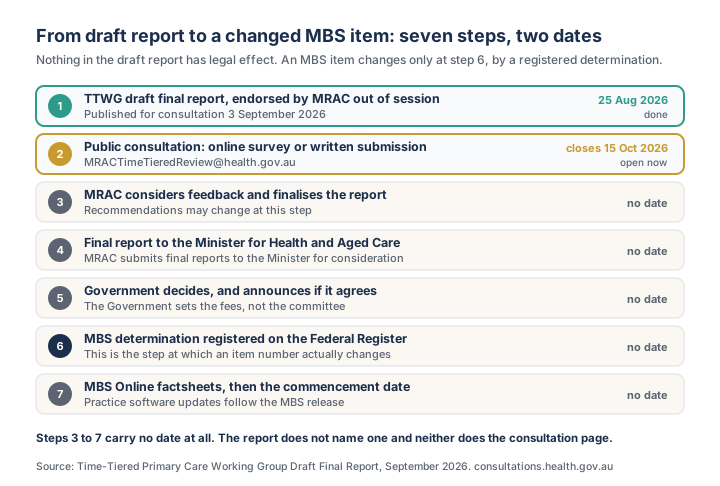
No date attaches to any step after 15 October 2026. The nearest fixed date is the MRAC's next meeting: its September 2026 communique says "The MRAC will meet in Canberra on 1 December 2026." Neither the report nor the consultation page, which now reads "Closed 15 Oct 2026", names a date for the final report or any government decision. As at 20 October 2026 no final report, outcomes page or government response had been published. The report's own appendix on what happens next says: "If the Australian Government agrees to the implementation of recommendations, it will be communicated through Government announcement", with information also made available on the Department of Health, Disability and Ageing website, including MBS Online, and in departmental newsletters.
For what a real MBS change looks like, the 1 November 2026 changes are the precedent: registered instruments on the Federal Register of Legislation, for example F2026L01101, registered 24 August 2026, adding four GP chronic condition management plan phone items, weeks before MBS Online published anything about them. That is the shape of an actual change, and it is what is absent here. We cover those changes in our guide to the 1 November 2026 MBS changes. Background on the review machinery is on the MBS Review Advisory Committee page and the MBS Continuous Review page.
What should a practice do now that consultation has closed?
- Read the draft final report, all 46 pages, or at minimum the recommendations list and the chapters that touch your billing mix. It remains the best statement of where the review is heading.
- If you lodged a submission before consultation closed at 11.59pm on 15 October 2026, through the survey on the consultation page or by email, keep a copy with your billing records. If you did not, that channel has closed.
- Model your exposure. Count how many items 16500, 91853, 91858, 193, 197, 10992 and 75872 you billed in the last 12 months, and work out what share of your billing is level B versus levels C to E. Those are the numbers that tell you which recommendations would bite hardest if the Government adopts them.
- Check your MyMedicare registration coverage, because recommendations 7, 15 and 20 all gate a payment on it.
- Change nothing now. Do not alter a single item code, fee or roster on the strength of a draft recommendation.
- Diarise the MRAC's 1 December 2026 meeting and watch for the final report and any government response after it. Those are the next real signals, not a headline about the draft.
- Watch for the MRAC's next consultation. Its September 2026 communique says public consultation on the review of MBS referred chronic condition management services (allied health and Aboriginal and Torres Strait Islander primary health care services for patients with a GP chronic condition management plan) "is anticipated to commence in late October" 2026.
Frequently Asked Questions
Is Medicare increasing rebates for longer consultations?
No. A draft report recommends that fee-per-minute rates for time-tiered items better support varied consultation lengths, but it names no dollar figure, no percentage and no start date. Public consultation on the report closed on 15 October 2026, and the report is subject to acceptance by the Government, which the report itself notes is responsible for setting appropriate fees.
When would the MBS time-tiered changes start?
No date exists. The report names no commencement date for any recommendation, and neither does the consultation page. Consultation closed on 15 October 2026. MRAC must now finalise the report, submit it to the Minister for Health and Aged Care, and the Government must decide and announce before any determination is registered.
Will GPs lose MBS item 16500 for antenatal appointments?
Not yet. Recommendation 4 of the draft report proposes making GPs and other medical practitioners working in general practice ineligible for items 16500, 91853 and 91858, but nothing has changed. The report argues practices "will not be financially disadvantaged" because antenatal attendances preclude level C, D and E claims and attract only single bulk-billing incentives. Obstetricians would keep the items.
Can I still claim MBS items 10992 and 75872?
Yes. Both items are live and claimable today, confirmed on MBS Online on 5 September 2026: item 10992 has a fee of $13.35 and item 75872 a fee of $40.10. Recommendation 21 proposes they cease and be replaced by standard bulk-billing incentives for after-hours care, but that is a draft recommendation with no legal effect and no commencement date.
When did submissions to the MBS time-tiered review close?
Submissions closed at 11.59pm on 15 October 2026, after the consultation opened on 3 September 2026, and the consultation page now reads "Closed 15 Oct 2026". Feedback went through the online survey on the consultation page or by email to MRACTimeTieredReview@health.gov.au. No final report or government response had been published as at 20 October 2026, and the MRAC next meets on 1 December 2026.
How many MBS items would the review remove?
The report's preliminary estimate is that full implementation of the recommendations excluding recommendation 12 could reduce time-tiered attendance items from more than 300 to around 150. Implementing recommendation 12, described as a long-term recommendation, has the potential to reduce the total to fewer than 100. These are preliminary estimates, not settled outcomes.
Would the after-hours period really start at 6 pm?
That is what recommendation 18 proposes: a single after-hours definition across all locations, commencing at 6 pm on weekdays. Currently after hours starts at 8 pm on weekdays in consulting rooms but 6 pm outside consulting rooms. The working group drew on award wage determinations showing the cost of providing a service increases from 6 pm. It is a draft recommendation with no date attached.