Key Takeaways
- Four new MBS items make phone GPCCMP services claimable from 1 November 2026. Items 92033 and 92034 cover a GP preparing and reviewing a GP chronic condition management plan by phone at $160.60 each; items 92063 and 92064 cover a prescribed medical practitioner at $128.55 each, with the benefit set at 100% of the fee.
- MBS Online published the November 2026 package on 1 October 2026. The news page lists seven instruments, and the data file MBS-XML-20261101.XML was "released 1 October 2026, effective 1 November 2026".
- The Medicare Healthy Kids Check has no new item number. It is billed on the time-tiered health assessment items 701, 703, 705 and 707 (GP, $71.00 to $321.75) or 224 to 227 (prescribed medical practitioner), once per child, at age 3.
- A phone care plan counts toward the timing rules. A phone prepare on 92033 or 92063 bars any other prepare item for 12 months, and a phone review bars another review for 3 months, unless exceptional circumstances exist.
- Modified Monash areas move to the 2023 model on 1 November 2026. The bulk billing incentive item (10990, 10991 or 75855 to 75858) depends on the practice location's MM area, so a location whose category changed claims a different item.
- "Residential care home" replaces "residential aged care facility" across the MBS tables. That covers 86 rows of the general medical services table, the diagnostic imaging and pathology tables, and four section 3C determinations. No fee changes.
- Nothing in the package can be claimed before 1 November 2026. A phone plan preparation on 31 October 2026 has no item to go to.
From 1 November 2026, a GP can prepare or review a GP chronic condition management plan by telephone and claim it for the first time, on new items 92033 and 92034 at $160.60 each. The same day, 3-year-olds become eligible for a Medicare Healthy Kids Check on the existing health assessment items, and Modified Monash areas switch to the 2023 model. MBS Online published the package on 1 October 2026.
What changes in the MBS on 1 November 2026?
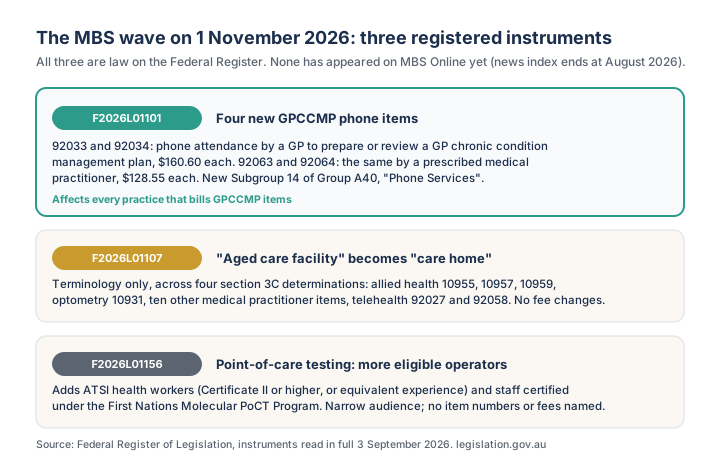
MBS Online lists seven legislative instruments behind the 1 November 2026 changes. Its November 2026 News page ("Page last updated: 01 October 2026") lists them under "Relevant Legislation", and the November 2026 Downloads page carries the data file practice software loads. Two instruments reach almost every general practice: the phone care plan determination registered in August, and a set of regulations registered on 2 October 2026.
That second instrument is the Health Insurance Legislation Amendment (2026 Measures No. 3) Regulations 2026, registered as F2026L01359. It amends the general medical services table (GMST), the diagnostic imaging services table (DIST), the pathology services table (PST) and the Health Insurance Regulations 2018 in five parts: the Healthy Kids Check, the GMST side of the phone items, the Modified Monash switch, the care home wording, and a run of smaller item changes. As at 8 October 2026 the news page lists it without a register link.
| Instrument | What it changes | Who it affects |
|---|---|---|
| F2026L01359 | Healthy Kids Check; phone items written into GMST rules at a 100% benefit; 2023 Modified Monash; "residential care home" in the GMST, DIST and PST; smaller item changes | Every general practice |
| F2026L01101 | Adds phone items 92033, 92034, 92063 and 92064 in new Subgroup 14 of Group A40 | Every practice that bills GPCCMP items |
| F2026L01107 | "Care home" wording in four section 3C determinations | Practices billing the named allied health, optometry and telehealth items |
| F2026L01156 | Expands eligible point-of-care testing operators | Mainly services in the First Nations Molecular Point-of-Care Testing Program |
| F2026L01055 | Makes in-hospital psychiatry telehealth items 92478 to 92483 permanent | Psychiatrists |
| F2026L01048 | Extends NTRK1-3 testing (item 73433) to adult glioma and related tumours | Pathology and oncology |
| F2026L01052 | Renames the transcatheter valve accreditation committee | Cardiology |
What are the new GPCCMP phone items 92033, 92034, 92063 and 92064?
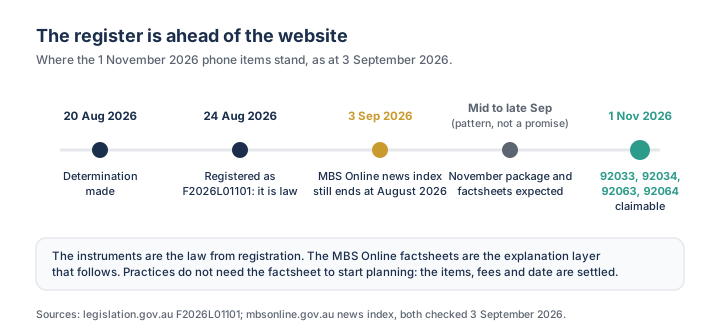
The four items sit in a new Subgroup 14 of Group A40, "GP chronic condition management plans services - Phone Services", inserted into the telehealth determination by F2026L01101, registered 24 August 2026. Two are for general practitioners and two for prescribed medical practitioners, the MBS term for non-GP medical practitioners who may provide these services. The descriptors below are verbatim from the instrument and match the November XML.
| Item | Descriptor | Fee |
|---|---|---|
| 92033 | Phone attendance by a general practitioner to prepare a GP chronic condition management plan for a patient | $160.60 |
| 92034 | Phone attendance by a general practitioner to review a GP chronic condition management plan prepared by the general practitioner or an associated medical practitioner | $160.60 |
| 92063 | Phone attendance by a prescribed medical practitioner to prepare a GP chronic condition management plan for a patient | $128.55 |
| 92064 | Phone attendance by a prescribed medical practitioner to review a GP chronic condition management plan prepared by the prescribed medical practitioner or an associated medical practitioner | $128.55 |
The fee structure mirrors the GPCCMP matrix exactly, and F2026L01359 adds table item 28HA to subsection 28(1) of the Health Insurance Regulations 2018, so the Medicare benefit is 100% of the schedule fee. The November XML shows a 100% benefit of $160.60 for 92033. F2026L01101 also renames the Subgroup 13 heading from "GP management plans, team care arrangements" to "GP chronic condition management plans", catching up with the framework that replaced the GPMP and TCA items on 1 July 2025.
Can a GP prepare a care plan over the phone today?
No. Until 1 November 2026 there is no MBS item for preparing or reviewing a GP chronic condition management plan by telephone. Subgroup 13 of Group A40 contains video items only, and the GPCCMP framework started on 1 July 2025 with in-person and video modalities. The new Subgroup 14 closes that gap.
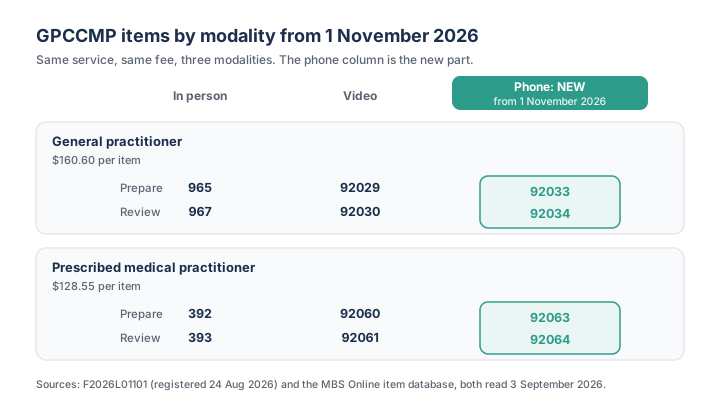
| Modality | GP prepare | GP review | GP fee | PMP prepare | PMP review | PMP fee |
|---|---|---|---|---|---|---|
| In person | 965 | 967 | $160.60 | 392 | 393 | $128.55 |
| Video | 92029 | 92030 | $160.60 | 92060 | 92061 | $128.55 |
| Phone (from 1 Nov 2026) | 92033 | 92034 | $160.60 | 92063 | 92064 | $128.55 |
Today, a chronic condition patient who cannot attend in person and cannot manage a video call has no claimable pathway for a plan preparation or review. From 1 November 2026 the phone call itself becomes the claimable service, at the same fee as the other two modalities.
To compare, item 92029 on MBS Online shows the video GP prepare descriptor that the phone items replicate. For the standing telehealth rules around these items, see our telehealth Medicare billing guide.
Do the phone care plan items need a 12-month face-to-face relationship?
No. Subsection 7(5) of the telehealth determination limits telehealth items to the patient's eligible telehealth practitioner, the 12-month face-to-face test. Paragraph 7(6A)(c), as amended by F2026L01101, switches that test off for 92029, 92030, 92033, 92034, 92060, 92061, 92063 and 92064. MBS note AN.1.1 lists the same exemption: "Preparing or reviewing a GP chronic condition management plan".
The exemption carries a record-keeping duty. Subsection 7(6C) says "the provider of the service must document in the patient clinical notes which exemption has been used and the clinical justification for that exemption". A phone plan note should therefore say that the GPCCMP exemption applies and why the service was done by phone.
Two conditions still apply under clause 1.1.04(4) of the determination. The patient must not be a care recipient in residential aged care. And the service must come from the general practice where the patient is enrolled in MyMedicare or, if the patient is not enrolled, from their usual medical practitioner; our MyMedicare compliance guide covers that test. Patients can still access up to five allied health services per calendar year under a GPCCMP, whatever the plan's modality. The instrument also writes the phone prepare items into the definition of "person with a chronic condition" in Schedule 4.
What can you not bill on the same day, and when does the 12-month clock start?
The phone items carry the same exclusions as the video items, and F2026L01359 now writes them into the GMST as well. Under GMST clause 2.16.11 and clause 1.1.05 of the telehealth determination, the items in paragraphs 2.16.11(a) to (f) do not apply to a service the practitioner provides to the same patient on the same day as a plan prepare or review in any modality. Those paragraphs include ordinary GP attendances such as 23 and 36, the after-hours items, and telehealth attendances such as 91800 and 91891. Book a phone plan and a phone consult for the same patient on the same day, and only the plan is claimable.
The timing table in GMST subclause 2.16.12(3), and its twin in clause 1.1.06 of the determination, count the phone items from 1 November 2026. Unless exceptional circumstances exist (a significant change in the patient's clinical condition or care circumstances):
| You want to claim | Not available if, in the period before | Phone items now counted |
|---|---|---|
| A prepare (965, 392, 92029, 92033, 92060, 92063) | 12 months: any prepare item | 92033, 92063 |
| A prepare | 3 months: any review, or contribution items 231, 232, 729, 731 and their video equivalents | 92034, 92064 |
| A review (967, 393, 92030, 92034, 92061, 92064) | 3 months: any review item | 92034, 92064 |
The trap is the 12-month bar. A plan prepared by phone on 3 November 2026 blocks an in-person 965 until November 2027. A recall list that looks only for the last 965 or 967 will miss phone services, so we recommend adding the phone items to every recall rule. F2026L01359 also adds the phone items to the exclusions on case conference items 235 to 240 and 735 to 758, and on ambulatory blood pressure item 11607.
How do you bill the Medicare Healthy Kids Check?
There is no new item number. F2026L01359 adds paragraph (h) to GMST subclause 2.15.2(1): "a Medicare Healthy Kids Check, in accordance with clause 2.15.11, for a patient who: (i) is 3 years old; and (ii) has not already received such an assessment; and (iii) is not an in-patient of a hospital". The factsheet (updated 28 August 2026) says the service "is available once per child per lifetime". You choose the item by the length of the attendance, as MBS note AN.0.36 sets out for every time-tiered health assessment.
| Tier (personal attendance time) | GP item | Fee | PMP item | Fee |
|---|---|---|---|---|
| Brief, not more than 30 minutes | 701 | $71.00 | 224 | $56.85 |
| Standard, 30 to under 45 minutes | 703 | $165.05 | 225 | $132.05 |
| Long, 45 to under 60 minutes | 705 | $227.75 | 226 | $182.15 |
| Prolonged, 60 minutes or more | 707 | $321.75 | 227 | $257.40 |
Fees are unchanged in the November XML, with a 100% benefit. The time is the doctor's. GMST clause 2.15.1 says items 701 to 715 "apply only to a service provided in the course of a personal attendance by a single general practitioner on a single patient", and AN.0.36 picks the tier by "the personal attendance time". Under clause 2.15.14 a practice nurse may assist with information collection, but by our reading nurse time does not lift the tier. The same clause says the assessment must be done by the patient's usual medical practitioner "if reasonably practicable".
The Professional Services Review's Director's update for August 2026 records a GP whose reviewed services included 707, with persisting concerns about "failing to meet the minimum time requirement, including time spent by a practice nurse with the patient as part of the attendance time". That GP agreed to repay $280,000.
Clause 2.15.11(2) lists what the assessment must include, which doubles as the evidence list for the record:
- (a) a history covering medical history and immunisation status, behaviour and wellbeing, developmental milestones, family and care arrangements including early childhood education, nutrition, physical activity, screen use, sleep, and toileting;
- (b) a basic physical examination, including eyesight, hearing, teeth and gums, and height and weight plotted against centile charts with body mass index;
- (c) an assessment using that information;
- (d) advice to the parent or carer;
- (e) any interventions and referrals;
- (f) "adding a record of the health assessment to the patient's medical record";
- (g) "offering a written report on the health assessment to the patient's parent or carer".
Record whether the parent accepted the written report. Referrals under (e) are where the check links to Thriving Kids: the factsheet names "Thriving Kids supports", and our Thriving Kids guide covers that rollout.
A practice cannot see claims made elsewhere, so the once-per-lifetime test rests on asking. Our suggestion: ask the parent at booking whether the child has had a Healthy Kids Check, record the answer, and name the target group on the claim. Services Australia says it rejects a subsequent health assessment claim that does not specify a different target group.
Children under 3 or over 4, and 3-year-olds who need more than one assessment, use the ordinary time-tiered attendance items, per the factsheet. Because the instrument says "is 3 years old", our reading is that the last eligible day is the day before the fourth birthday. An Aboriginal or Torres Strait Islander child can also have the item 715 health check ($254.10), which the factsheet says can be claimed "in addition", provided all services are clinically relevant. Our Medicare Healthy Kids Check guide goes further on whose time counts, the written report and what to set up before 1 November.
Does the Modified Monash change move your bulk billing incentive item?
It can. Until 31 October 2026, GMST clause 7.1.1 builds each Modified Monash area from the July 2016 edition of the Australian Statistical Geography Standard and 2016 population estimates, which by our reading is the data behind the 2019 model. From 1 November 2026, F2026L01359 repeals those definitions: each area becomes "an area with a 2023 MM category", read from the Department's model "as the model exists on 1 November 2026". DIST clause 3.1 follows the GMST.
The bulk billing incentive item turns on that category. The November XML ties each item to "a practice location in" a named area:
| Practice location | Standard incentive item | Fee |
|---|---|---|
| MM 1 (where no MM 2 to MM 7 item applies) | 10990 | $8.80 |
| MM 2 | 10991 | $13.35 |
| MM 3 or MM 4 | 75855 | $14.10 |
| MM 5 | 75856 | $15.10 |
| MM 6 | 75857 | $15.85 |
| MM 7 | 75858 | $16.95 |
The general practice support service items (75870, 75871 and 75873 to 75876) and the MyMedicare items (75880 to 75885) use the same MM bands, from $26.35 at MM 1 to $50.75 at MM 7.
The check takes a minute. The Department's Modified Monash Model page says "You can find the 2015, 2019 and (current) 2023 MMM classifications on the Health Workforce Locator". Enter each practice location's address in the Health Workforce Locator and compare the 2019 and 2023 categories. If they differ, the incentive item for services from 1 November 2026 follows the 2023 category; tell billing staff and check how your software assigns the item. If your practice is in the incentive program, our BBPIP guide covers the claiming side.
What else changes on 1 November 2026?
The care home wording reaches further than the four section 3C determinations in F2026L01107 (allied health items 10955, 10957 and 10959, optometry item 10931, ten other medical practitioner items, and telehealth items 92027 and 92058). Part 4 of F2026L01359 replaces "residential aged care facility" with "residential care home" across an 86-row table of GMST provisions (items 715 and 903 and the 5000 and 90000 series among them), in items 232 and 731, in DIST clause 2.3.3, and in PST items 73932 to 73935. Descriptors change; fees and claiming rules do not.
F2026L01156 adds two kinds of point-of-care testing operator: Aboriginal and Torres Strait Islander health workers with a Certificate II or higher (or equivalent experience), and staff certified through the First Nations Molecular Point-of-Care Testing Program. MBS Online's summary links the change to item 73813.
Part 5 of F2026L01359, with the four factsheets MBS Online added on 8 October 2026 (listed on its current factsheets page), covers the rest:
| Item | Change from 1 November 2026 | Who it touches |
|---|---|---|
| 11607 | Ambulatory blood pressure monitoring extended to patients aged 5 to under 18, using percentile thresholds | GPs, paediatricians |
| 12306 to 12322 | Participating nurse practitioners may refer for bone densitometry | Nurse practitioners, imaging |
| 14245 | Immunomodulating infusion may be given by a qualified health practitioner for the prescribing practitioner | Infusion clinics |
| 18360 | Adds IncobotulinumtoxinA (Xeomin) for focal spasticity | Rehabilitation, neurology |
| 45518 | "(H)" flag removed, so the service can be done out of hospital at the 85% benefit | Plastic surgeons |
| 61438 | Bulk billing incentive becomes payable | Nuclear medicine |
| 61564 | PSMA PET restaging allowed "once in any 12 month period", not "twice per lifetime" | Nuclear medicine, urology |
| 71099 | Crithidia method allowed for double-stranded DNA antibodies | Pathology |
| 73358 to 73360 | Paediatricians no longer need a clinical geneticist consultation before requesting | Paediatricians |
| 10997 | Typographical fix, "92301" becomes "93201" | Practice nurse billing |
| Clause 1.2.11 | Adds 14245 and 15990 to services others may provide; removes 41764 | Radiation oncology, ENT |
What should practices do before 1 November?
- Brief billing staff on the four numbers and the two fees. Items 92033 and 92034 at $160.60; items 92063 and 92064 at $128.55. A phone care plan claim dated before 1 November is not valid.
- Confirm your software has loaded the November 2026 data. The XML has been out since 1 October. Check that the four phone items appear, and that recall and eligibility rules count the phone items toward the 12-month and 3-month limits.
- Add the exemption line to your phone care plan template. Subsection 7(6C) wants the exemption and the clinical reason in the notes, and the MyMedicare or usual practitioner test still applies. Our Medicare changes from 1 July 2026 guide covers the earlier groundwork.
- Build a Healthy Kids Check template. Mirror the seven components of clause 2.15.11(2), record the GP's own attendance time, record the written-report offer, and name the target group on the claim.
- Run each practice address through the Health Workforce Locator. Compare the 2019 and 2023 MM categories and note any change to the incentive item.
- Do not claim any of the new services before 1 November 2026. The commencement date applies to every instrument in the package.
Frequently Asked Questions
What changes in the MBS on 1 November 2026?
MBS Online lists seven instruments. F2026L01101 adds phone care plan items 92033 and 92034 ($160.60) and 92063 and 92064 ($128.55). F2026L01359 adds the Medicare Healthy Kids Check on items 701 to 707 and 224 to 227, sets the phone items' benefit at 100%, moves Modified Monash areas to the 2023 model, replaces "residential aged care facility" with "residential care home" and amends about a dozen other items.
Can a GP prepare a chronic condition management plan by phone?
No, not until 1 November 2026. The current GPCCMP items cover in-person attendances (965 and 967) and video attendances (92029 and 92030). From 1 November 2026, item 92033 lets a GP prepare a plan by phone at $160.60, and item 92034 lets a GP review one by phone at the same fee, with a 100% Medicare benefit.
What are MBS items 92033 and 92034?
They are the GP phone items in new Subgroup 14 of Group A40, commencing on 1 November 2026. Item 92033 is a phone attendance by a general practitioner to prepare a GP chronic condition management plan, at $160.60. Item 92034 is a phone attendance to review a plan prepared by the general practitioner or an associated medical practitioner, also at $160.60.
Do the phone care plan items pay the same as the video items?
Yes. The fees match across the whole GPCCMP matrix: $160.60 for GP prepare and review, whether by 965 and 967 in person, 92029 and 92030 by video, or 92033 and 92034 by phone. The prescribed medical practitioner items pay $128.55 on the same basis. Table item 28HA of the Health Insurance Regulations 2018 sets the phone items' benefit at 100% of the fee.
What are items 92063 and 92064?
They are the prescribed medical practitioner phone items, commencing on 1 November 2026. Item 92063 is a phone attendance by a prescribed medical practitioner to prepare a GP chronic condition management plan, at $128.55. Item 92064 is a phone attendance to review a plan prepared by the prescribed medical practitioner or an associated medical practitioner, also at $128.55. They mirror video items 92060 and 92061.
What item number is the Medicare Healthy Kids Check?
It has none of its own. From 1 November 2026 it is a new health assessment type in GMST paragraph 2.15.2(1)(h), billed on time-tiered items 701, 703, 705 or 707 for a GP ($71.00 to $321.75) or 224 to 227 for a prescribed medical practitioner. It is for a child who is 3 years old, once per child per lifetime.
Where are the November 2026 MBS changes published?
On MBS Online, which published its November 2026 News and Downloads pages on 1 October 2026, and on the Federal Register of Legislation. The main instruments are F2026L01101 for the phone items and F2026L01359, registered 2 October 2026, for the Healthy Kids Check, the Modified Monash switch and the care home wording. As at 8 October 2026, no factsheet covers the phone items.