Key Takeaways
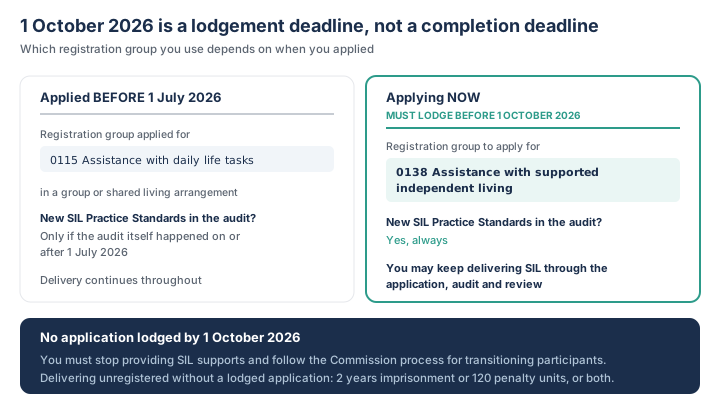
- The deadline is 1 October 2026, and it is a lodgement deadline, not a completion deadline. Mandatory registration commenced on 1 July 2026, but an unregistered provider already delivering SIL whose valid registration application went in before 1 October 2026 may continue delivering while the application is assessed.
- Apply under the new registration group
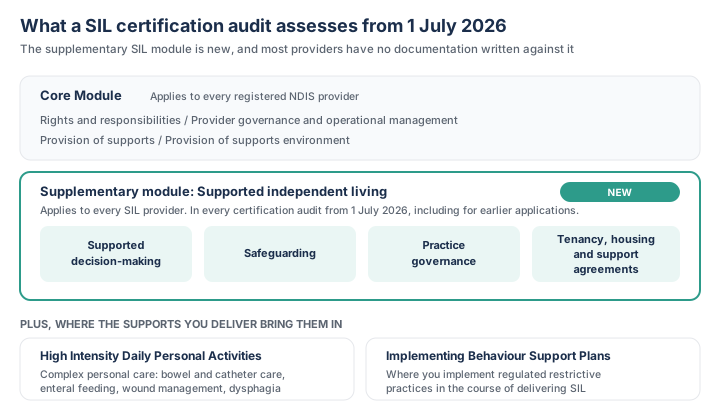
0138 Assistance with supported independent living. Providers who applied before 1 July 2026 applied under0115 Assistance with daily life tasks in a group or shared living arrangement. Anyone lodging now uses 0138. Lodging under the old group is the most common way to waste six weeks. - There is a new supplementary module of the NDIS Practice Standards for SIL, covering supported decision-making, safeguarding, practice governance, and agreements about tenancy, housing and support arrangements. Every certification audit occurring on or after 1 July 2026 includes it.
- A provider who has not applied by 1 October 2026 must stop delivering SIL. Not pause, not continue while sorting it out. Stop, and follow the Commission's participant transition process.
- Delivering SIL unregistered is a criminal offence carrying 2 years imprisonment or 120 penalty units, or both, under section 73B(4) of the NDIS Act 2013. It applies to individuals personally, so directors, managers and sole traders carry the exposure. The 5 year figure often quoted belongs to a different offence.
- The SIL definition is narrower than most providers assume. It requires support at all times of the day or most of the day. It is not SIL if the participant receives only a few hours of support a day or week, or chooses and manages their own support workers.
- The definition is now in the Rules. The amending Rules (F2026L00802) were registered on 24 June 2026 and took effect on 1 July 2026. The Commission's published definition still describes itself as a summary of draft amendments, so check scope against the Rules as made.
If you deliver Supported Independent Living and you are not registered, the date that decides your position is 1 October 2026. A valid registration application under registration group 0138 lodged before that date lets you keep delivering while the NDIS Commission assesses it. Without one, you must stop providing SIL supports entirely.
That is a meaningfully different obligation from the one most SIL providers were preparing for a year ago, when the assumption was that registration had to be complete by 1 July 2026. It is not, and understanding the distinction is worth several months.
What actually changed on 1 July 2026?
Three things commenced together, and they are easy to conflate.
Mandatory registration commenced. From 1 July 2026, providers delivering Supported Independent Living must be registered with the NDIS Commission, regardless of how their participants manage funding. The pathway that previously let a SIL provider operate unregistered while supporting self-managed and plan-managed participants closed.
The new SIL Practice Standards commenced. A new supplementary module was added to the NDIS Practice Standards specifically for supported independent living. Any certification audit conducted on or after 1 July 2026 assesses against it.
The transitional arrangements commenced. These are what create the 1 October date. The Commission published a set of transition pathways that let providers keep operating during the registration process rather than forcing a hard stop on 1 July.
What did not happen on 1 July 2026 is a requirement to hold completed registration. The Commission's own transition pathway for an unregistered provider currently delivering SIL and planning to apply states it plainly: providers can continue to deliver SIL during the application for registration if they apply by 1 October 2026.
Does mandatory registration actually apply to you?
The Commission has published a definition of supported independent living for this purpose, and it is narrower than the way the term gets used in practice. A provider assisting with supported independent living is one where:
- the participant requires support at all times of the day, or for most of the day, and
- the assistance helps them live in their home as autonomously as possible and access the community, by assisting with or supervising daily life tasks, and
- the provider is managing and delivering the SIL supports, making sure the participant receives home and living support in accordance with the package of supports.
Two explicit exclusions matter more than the inclusions:
- It is not SIL if a person only receives a few hours of support a day or week.
- It is not SIL if the person chooses and manages their own support workers, including directing, planning and rostering them.
That second exclusion carves out a genuine slice of the market. A provider supplying workers into an arrangement the participant directs themselves is in a different position from one managing and coordinating the package. Sole traders are not exempt: if you are delivering, managing and coordinating supports that meet the definition, you are a SIL provider and the obligation applies to you personally.
One important caveat on all of this. The Commission describes its published definition as a summary based on draft amendments to the National Disability Insurance Scheme (Provider Registration and Practice Standards) Rules 2018, and describes 0138 as something that "will be" added. Those amendments have since been made: the Mandatory Registration and Other Matters Rules 2026 were registered on 24 June 2026 and took effect on 1 July 2026. The Rules as made cover a participant who "requires constant, or immediately available, person-to-person supports at all times during a day, or for a substantial portion of a day", where the provider manages the package of supports. The two exclusions above are the Commission's guidance, not words in the Rules. If your scope is genuinely borderline, that is a reason to seek the Commission's view in writing rather than to assume you are outside it.
Which registration group do you apply under?
This is where providers are losing time, and it depends entirely on when you applied.
| Your situation | Registration group | Does the audit include the new SIL Practice Standards? |
|---|---|---|
| Applied before 1 July 2026 | 0115 Assistance with daily life tasks in a group or shared living arrangement | Only if the audit itself happened on or after 1 July 2026 |
| Applied from 1 July 2026 (before 1 October 2026 if already delivering SIL) | 0138 Assistance with supported independent living | Yes, always |
If you are lodging today, you apply for 0138 Assistance with supported independent living, plus any other registration groups relevant to the supports you deliver. Guidance written before mid-2026, including earlier versions of this article, told providers to apply under 0115. That was correct at the time and is wrong now.
If you applied before 1 July 2026 under 0115 and your audit has not yet happened, note the consequence in the second column: your audit will include the new SIL Practice Standards even though your application predates them. Do not prepare against the module list your auditor quoted you in 2025.
The new SIL Practice Standards module
Every registered SIL provider must have a certification audit and comply with the Core Module of the NDIS Practice Standards. That much is unchanged. What is new is the supplementary module for supported independent living, which has four elements:
Supported decision-making. How you support participants to make their own decisions about their lives, home and supports, rather than making those decisions for them or deferring automatically to a family member.
Safeguarding. The systems that identify and respond to risk of harm in a shared living setting, where a participant may have limited ability to report and limited contact outside the service.
Practice governance. Clinical and practice oversight of how supports are actually delivered, distinct from the corporate governance already assessed under the Core Module.
Agreements about tenancy, housing and support arrangements. How the housing relationship and the support relationship are documented and kept separate, so that a participant's home is not contingent on staying with a particular support provider.
That last element deserves attention from anyone who both houses and supports the same participants, because it goes directly to the conflict between the two roles. The Commission publishes an Evidence Guide for Providers and Workers alongside the standards, which sets out what applying each standard looks like in practice.
Beyond Core and the SIL module, the modules that applied before still apply where relevant. SIL commonly involves complex personal care (intimate care, bowel management, catheter care, enteral feeding, subcutaneous injections, wound management, dysphagia support), which brings in the High Intensity Daily Personal Activities Module. If you implement regulated restrictive practices you also need the Implementing Behaviour Support Plans Module, covered in our NDIS restrictive practices compliance guide. Your auditor confirms the exact scope from the supports you actually deliver.
Can you keep delivering while your application is assessed?
Yes, if the application went in before 1 October 2026. This is the single most important correction to the guidance circulating on this topic, including an earlier version of this post.
The Commission's transition pathway for an unregistered provider currently delivering SIL and planning to apply is explicit that the provider continues to deliver SIL supports through the preparation stage, the application, the audit process and the application review, provided the valid application went in before 1 October 2026. There is no gap in which delivery becomes unlawful while you wait for the Commission to decide.
What that does not do is create a general safe harbour. It is conditional on a valid application lodged before the date. An application that is incomplete, lodged under the wrong registration group, or lodged on 2 October does not attract the protection. And the underlying offence has not moved: delivering SIL without registration and without a lodged application is an offence under section 73B(4) of the National Disability Insurance Scheme Act 2013, carrying 2 years imprisonment or 120 penalty units, or both. A strict liability version (section 73B(5)) carries 60 penalty units, and a civil penalty of up to 10,000 penalty units applies for a serious contravention by a provider (section 73B(6)). The criminal offence attaches to individuals, not only to the company.
For completeness, because the wrong figure circulates widely: the 5 year maximum sometimes quoted for unregistered delivery belongs to a different offence entirely, breaching a banning order under section 73ZNA.
The certification audit, and how long it really takes
SIL registration requires a certification audit, the more intensive of the two pathways. The full stage-by-stage process is in our NDIS audit pathways guide; the SIL-specific version is below.
You lodge first, then the auditor engages. A Commission application must be lodged and given an application number before an approved quality auditor can formally begin. Lodging generates your scope of audit, which is the document the auditor prices against. This ordering is why the 1 October date is workable: lodgement is fast, the audit is not.
Desktop review. You submit policies, procedures and governance documentation against every criterion in your applicable modules. Auditors assess whether the documentation reflects how you actually operate. Generic, undated or unattributed policies are routinely written up as non-conformities at this stage, and each round of rework extends the timeline.
On-site visit. For SIL this usually means visiting participants' homes, not just a head office, and interviewing staff and, where appropriate, participants and families. Multi-site providers may have a sample of sites visited. Coordinating access across residential properties takes notice and adds time. Minor non-conformities can be closed with corrective action evidence after the visit; major ones must be resolved before the auditor can recommend registration.
Commission processing. The auditor's report goes to the Commission, which reviews it, completes its own suitability assessment of key personnel (criminal history, prior regulatory action, bankruptcy, prior involvement with a deregistered provider) and makes the registration decision. The suitability assessment runs in parallel with the audit rather than after it, which is another reason to lodge early.
End to end, three to six months remains the realistic range, and auditor capacity has been constrained by the volume of SIL providers entering the pipeline at once. Under the transitional arrangements that timeline is no longer a crisis, because you are not required to have finished by any particular date. You are required to have started by 1 October 2026.
What to do now
1. Confirm the definition applies to you. Work through the "all times of the day or most of the day" test and the two exclusions above. If you are genuinely borderline, ask the Commission in writing rather than assuming.
2. Confirm the application under 0138 went in before 1 October 2026. For a provider already delivering SIL, that was the only step with a hard date on it. If it did not go in, read "If you decide not to register" below: the Commission's position is that you must stop providing SIL. A provider planning to start SIL applies for 0138 Assistance with supported independent living plus any other relevant registration groups through the provider registration portal. From 12 October 2026 new applications start in the Commission's new portal, and the Commission's guidance says you can sign in to it with a PRODA account or a myID with RAM authorisation.
3. Approach several auditors at once. Contact four or five approved quality auditors simultaneously rather than sequentially, ask about availability for SIL certification audits including the new supplementary module, and get written timelines and quotes. The Commission publishes the approved auditor list.
4. Gap-analyse against the SIL module specifically. Most providers have some form of Core Module documentation. Almost nobody has documentation written against supported decision-making, practice governance or tenancy and support agreement separation, because those standards did not exist a year ago. Start there, not with the Core Module material you already have.
5. Separate your tenancy and support documentation. If you house and support the same participants, this is the element most likely to generate a major non-conformity. The agreements need to be distinct, and a participant's housing must not be contingent on retaining you as their support provider.
6. Verify worker screening for every risk-assessed role. Build a current register of workers, roles, whether each role is risk-assessed, and clearance status and expiry. Initiate applications immediately for anyone without a current clearance, since processing times vary by state and territory from weeks to months.
7. Build real incident and complaints registers. Auditors look for records of actual incidents reported, assessed and closed. An empty register is itself a finding.
8. Brief your board and key personnel on the personal exposure. The criminal offence applies to individuals. This is a governance conversation, not only an operational one.
Our NDIS policy templates cover the Core Module requirements and give you a structured starting point, and the NDIS Audit Cost Estimator gives you a cost range before you approach auditors. For the other deadlines landing in the same fortnight, see NDIS changes on 1 October 2026.
If you decide not to register
That is a legitimate decision, and the Commission has a defined process for it. If you are currently delivering SIL and choose not to apply, you must stop providing supported independent living supports and follow the notification and participant transition steps at Stopping the services you provide.
Manage this now. Participants in SIL arrangements cannot be left without support, and transitioning someone out of their home arrangement takes months, not days. Contact the Commission, the relevant Local Area Coordinator and participants' support coordinators as early as possible. A provider who exits responsibly is in a very different position from one that stops answering the phone in October.
Stopping SIL does not take you outside the Commission's reach. On 4 September 2026 the Commission wrote to more than 285,000 unregistered NDIS providers, identified through NDIS plan payments, reminding them that the NDIS Code of Conduct applies "whether or not you choose to register with the Commission" and that it "will take action against providers that breach the Code". Any supports you keep delivering unregistered stay under the Code.
Frequently Asked Questions
What is the real NDIS SIL registration deadline?
1 October 2026, for lodging a valid registration application. Mandatory registration commenced on 1 July 2026, but the NDIS Commission's transitional arrangements let an unregistered provider currently delivering SIL continue to deliver while its application is assessed, provided the application was submitted before 1 October 2026. Completed registration is not required by any fixed date.
Can I keep delivering SIL while my registration application is being assessed?
Yes, if you lodged a valid application before 1 October 2026. The Commission's transition pathway states that providers can continue to deliver supported independent living during the application, the audit and the application review. This protection depends on a valid, timely application; it does not apply to a provider who has not lodged one.
Which registration group do I apply for as a SIL provider?
0138 Assistance with supported independent living, a new registration group created for this purpose, plus any other registration groups covering your other supports. Providers who applied before 1 July 2026 applied under 0115 Assistance with daily life tasks in a group or shared living arrangement. If you are applying now, 0138 is the correct group.
What are the new SIL Practice Standards?
A supplementary module of the NDIS Practice Standards covering four elements: supported decision-making, safeguarding, practice governance, and agreements about tenancy, housing and support arrangements. It applies to every registered SIL provider, and every certification audit conducted on or after 1 July 2026 assesses against it, including audits for applications lodged before that date.
What happens if I have not applied by 1 October 2026?
You must stop providing supported independent living supports and follow the Commission's process for stopping services, which includes notifying the Commission and transitioning participants. Continuing to deliver SIL unregistered and without a lodged application is a criminal offence under section 73B(4) of the NDIS Act 2013.
What is the penalty for providing SIL without registration?
A maximum of 2 years imprisonment or 120 penalty units, or both, under section 73B(4) of the NDIS Act 2013. A strict liability version (section 73B(5)) carries 60 penalty units, and a civil penalty of up to 10,000 penalty units applies to a serious contravention by a provider (section 73B(6)). The penalty applies personally to directors, managers and sole traders, not only to the corporate entity.
Does mandatory SIL registration apply to sole traders?
Yes. If you are a sole trader delivering, managing and coordinating a participant's supports that meet the SIL definition, you are a supported independent living provider and the same obligations apply. There is no carveout for size, structure or number of participants. The criminal exposure also attaches to you personally.
Is it still SIL if the participant manages their own support workers?
No. The Commission's definition explicitly excludes arrangements where the person chooses and manages their own support workers, including directing, planning and rostering them. It also excludes arrangements where the person receives only a few hours of support a day or week. Both exclusions turn on the participant's level of need and control, not on the setting.
How long does a SIL certification audit take?
Three to six months end to end under normal conditions, covering preparation, desktop review, gap rework, the on-site visit, the audit report and Commission processing. Auditor capacity has been constrained by the number of SIL providers entering the pipeline together. Under the transitional arrangements this timeline no longer needs to fit before a deadline, because only lodgement is time-limited.
Do platform providers have to register for SIL?
Yes, where SIL supports are delivered through the platform. The Commission's position is that operating a digital matching or marketplace model does not reduce participant risk and does not justify a lighter regulatory standard than direct service provision. Platform providers should confirm which registration groups apply to the supports accessed through their platform.
Part of
Key terms