Key Takeaways
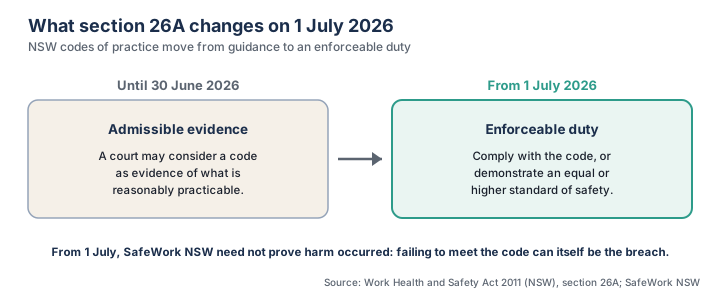
- From 1 July 2026, section 26A of the Work Health and Safety Act 2011 (NSW) commences, making it a duty to comply with an approved code of practice, or to manage the risk to a standard that is equal to or higher than the code. Codes stop being guidance alone and become an enforceable compliance benchmark.
- The change applies to every approved code in NSW (around 30), not just the psychosocial code. A practice no longer chooses whether a code applies: if a code covers a risk in your workplace, you either follow it or prove an equivalent standard.
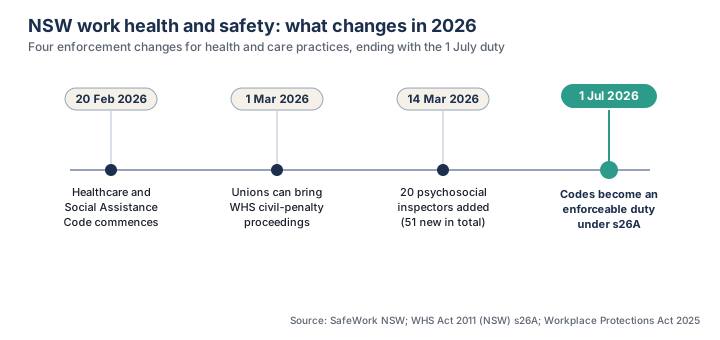
- A new Healthcare and Social Assistance Industry Code of Practice commenced in NSW on 20 February 2026 (approved under section 274 of the WHS Act). NSW is the first state to adopt it, ahead of the national model code.
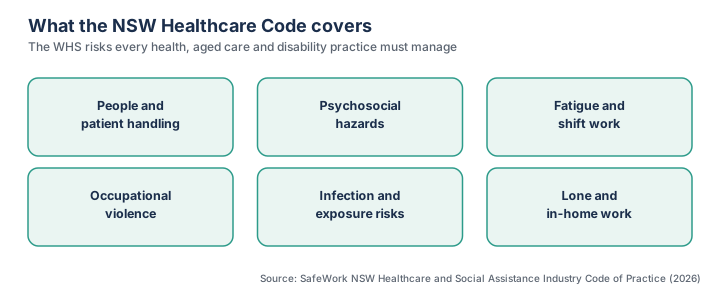
- The healthcare code covers patient and people handling, psychosocial hazards, fatigue, occupational violence and aggression, infection risks, and safety when working in clients' homes, the exact risks a medical, allied health, aged care or disability practice carries.
- SafeWork NSW added 20 new psychosocial inspectors (part of 51 additional inspectors, a rise of more than 12%) on 14 March 2026, funded by a $127.7 million four-year investment plus the $344 million Workplace Mental Health package. Its psychological health strategy names healthcare and social assistance among priority sectors.
- From 1 March 2026, registered unions can bring civil penalty proceedings for WHS breaches themselves where SafeWork NSW declines to prosecute or does not act within a set time, and a union can now be awarded up to half of any penalty (the moiety).
- SafeWork NSW does not need to prove an injury occurred. A failure to meet the standard in an applicable code can be enough to establish a breach of the WHS Act.
From 1 July 2026, NSW codes of practice become an enforceable duty under section 26A of the WHS Act 2011. A NSW health or care practice must now either comply with each approved code that covers a risk in its workplace, or demonstrate it is managing that risk to a standard equal to or higher than the code. The shift coincides with a new Healthcare and Social Assistance Industry Code and a much larger psychosocial inspectorate.
This is one of the most significant WHS changes NSW practices have faced in years, and it is easy to miss because nothing about the codes themselves changed. What changed is their legal weight. Below is what the new duty means in practice, the specific code your practice is now measured against, and the concrete steps to take before the date.
What changes on 1 July 2026?
Until now, a NSW code of practice was admissible evidence. A court could regard it as evidence of what was known about a hazard and what was reasonably practicable, but compliance with the code was not itself a legal obligation. From 1 July 2026, section 26A of the WHS Act 2011 (NSW) reverses that position. As SafeWork NSW puts it, the change makes it "a duty to comply with a code of practice, or alternatively provide a standard of health and safety equivalent or higher than the code".
In plain terms: if an approved code covers a risk that exists in your practice, you have two lawful options. Follow the code, or document how you are controlling that risk at least as effectively. There is no third option of treating the code as optional best practice. The change applies to every approved code in NSW, around 30 in total, which is why this is far broader than the psychosocial reforms that have drawn most of the attention.
The enforcement consequence matters most. SafeWork NSW does not have to prove that a worker was harmed. A demonstrated failure to meet the standard set out in an applicable code can, on its own, be enough to establish a breach of the Act. That moves the regulator's focus upstream, from investigating incidents to inspecting whether your controls match the code before anything goes wrong.
Which code applies to a health or care practice?
Several codes apply to a typical practice, but the one written for the sector is the new Healthcare and Social Assistance Industry Code of Practice, which commenced in NSW on 20 February 2026 under section 274 of the WHS Act. NSW is the first jurisdiction to formally adopt it, following Safe Work Australia's model code released in draft in July 2025. The SafeWork NSW healthcare and social assistance page and the code itself set out the risks it expects you to manage.
The code is deliberately broad because the sector's hazards are. It covers patient and people handling (manual tasks and mobilisation), psychosocial hazards, fatigue and shift work, occupational violence and aggression, infection and exposure risks, and the specific risks of working alone or in a client's home. A general practice, an allied health clinic, a community nursing service and a disability provider will each find their day-to-day risks named in it.
Other approved codes also bite. The table below shows the codes most NSW practices now have a duty to meet.
| Code of practice | Where it applies in a practice |
|---|---|
| Healthcare and Social Assistance Industry | The sector-wide code: people handling, occupational violence, infection, lone and in-home work |
| Managing psychosocial hazards at work | Job demands, bullying, exposure to traumatic content, occupational violence, role clarity |
| Hazardous manual tasks | Patient transfers, repositioning, lifting equipment and supplies |
| First aid in the workplace | First aid provision, kits and trained officers |
| Managing the work environment and facilities | Lighting, ventilation, layout, amenities, infection control design |
| How to manage work health and safety risks | The underlying risk-management method you must apply to all of the above |
Why are psychosocial hazards the inspection priority?
Psychosocial hazards are the area where NSW has put the most enforcement muscle, and healthcare is squarely in the frame. On 14 March 2026, SafeWork NSW announced 20 new mental health and safety inspectors, part of 51 additional inspectors overall, an increase of more than 12% to its active inspectorate. The uplift is funded by a $127.7 million investment over four years, alongside the broader $344 million Workplace Mental Health package.
These inspectors bring backgrounds in psychology, anti-bullying, workers compensation and trauma-informed practice, and they can issue on-the-spot fines, respond to reported psychosocial incidents and conduct proactive visits. SafeWork NSW's psychological health strategy names healthcare and social assistance among the high-risk sectors it is prioritising for compliance activity. For a practice, that means an inspector may ask not whether you have a generic policy, but whether you have identified the psychosocial hazards your staff actually face (occupational violence at reception, high job demands, exposure to distressing presentations, fatigue on long shifts) and put real controls in place.
Because the psychosocial code is now enforceable under section 26A, a missing or token psychosocial risk assessment is no longer a documentation gap to fix at the next review. It can be the breach itself. Practices that have treated psychosocial safety as a wellbeing initiative rather than a WHS control are the most exposed.
What does the new union prosecution power mean?
There is a second enforcement change practices should understand. From 1 March 2026, under the Industrial Relations and Other Legislation Amendment (Workplace Protections) Act 2025, registered industrial organisations (unions) can initiate civil penalty proceedings for WHS breaches themselves. A union can act where SafeWork NSW decides not to prosecute, or does not start proceedings within a set time after being consulted about an alleged breach.
The Act also restores the moiety: a union that succeeds can be awarded a portion of the penalty, up to half. On a penalty of $1 million, that is up to $500,000. Combined with broadened right-of-entry powers that now allow union officials to take measurements, conduct testing and make audiovisual recordings, the practical effect is that a practice's WHS conduct can be tested by a second party even when the regulator does not act. For unionised workforces in aged care, disability and nursing settings, this raises the stakes on getting code compliance right rather than relying on a quiet regulatory environment.
Does this apply to practices outside NSW?
The enforceable-duty change is NSW-specific. Section 26A is an amendment to the NSW WHS Act, so practices in Victoria, Queensland and the other states are not yet under a statutory duty to comply with codes in the same way. In most jurisdictions, codes remain admissible evidence of what is reasonably practicable, which is still a strong reason to follow them.
That said, two points make this relevant nationally. First, the Healthcare and Social Assistance Industry Code is based on a Safe Work Australia model code, and the other harmonised states typically adopt model codes in time, so the content is a preview of where the sector standard is heading everywhere. Second, the substance of the code is simply good practice: managing people handling, occupational violence, fatigue and psychosocial risk is the standard a regulator or court anywhere will measure you against. A practice in any state can use the NSW code as the benchmark to gap-assess against now, ahead of its own jurisdiction adopting it.
What should your practice do before 1 July?
The window is short, but the work is structured. The priority is to be able to show, for each risk a code covers, either compliance with the code or an equal-or-higher control. Use these steps.
| Step | Action | Evidence to keep |
|---|---|---|
| 1 | Identify every approved code that covers a risk in your practice (start with the healthcare and psychosocial codes) | A list of applicable codes |
| 2 | Read the new healthcare code and gap-assess your current controls against it | A documented gap analysis |
| 3 | Run a psychosocial risk assessment for the hazards your staff actually face | A dated risk assessment and control plan |
| 4 | Update or write the policies and procedures the codes expect (manual handling, occupational violence, fatigue) | Version-controlled documents with review dates |
| 5 | Train staff on the new procedures and record attendance | Training records and sign-off |
| 6 | Schedule the next review so controls stay current | A recurring review task with a due date |
The thread running through every step is evidence. Under section 26A, the question an inspector or a court asks is whether you met the code, and you answer that with documented risk assessments, current policies, training records and review dates, not with good intentions. A practical starting point is a WHS walkthrough of your premises to surface the hazards, followed by a risk register that records each hazard, its rating and its control. If your practice has not formalised these obligations before, the broader employment and WHS responsibilities for practice managers and the healthcare employment compliance pillar set the wider context.
Frequently Asked Questions
When do NSW codes of practice become enforceable?
Section 26A of the Work Health and Safety Act 2011 (NSW) commences on 1 July 2026. From that date it is a duty to comply with an approved code of practice that covers a risk in your workplace, or to manage that risk to a standard equal to or higher than the code. This applies to every approved code in NSW, around 30 in total.
Does the new duty mean I must follow every code exactly?
No. You must either follow the applicable code, or demonstrate you are managing the risk to a standard that is equivalent or higher. The alternative path requires evidence: a documented risk assessment showing your controls achieve the same or better protection. You cannot simply decide a code does not apply if it covers a risk present in your practice.
What is the Healthcare and Social Assistance Industry Code of Practice?
It is a SafeWork NSW code that commenced on 20 February 2026, the first jurisdiction to adopt the national model code. It gives practical guidance on managing the sector's WHS risks: patient and people handling, psychosocial hazards, fatigue, occupational violence and aggression, infection risks, and safety when working alone or in clients' homes.
Will SafeWork NSW inspect my practice for this?
It is more likely than before. On 14 March 2026 SafeWork NSW added 20 psychosocial inspectors (part of 51 new inspectors) and named healthcare and social assistance among its priority sectors. Inspectors can conduct proactive visits, respond to reported incidents and issue on-the-spot fines, and they do not need to prove harm occurred to find a breach.
Can a union prosecute my practice for a WHS breach?
From 1 March 2026, yes. Registered unions in NSW can initiate civil penalty proceedings for WHS breaches where SafeWork NSW declines to prosecute or does not act within a set time after being consulted. A successful union can also be awarded up to half of any penalty imposed.
Does this affect practices outside NSW?
The enforceable-duty change under section 26A applies only in NSW. In other states, codes remain admissible evidence of what is reasonably practicable rather than a statutory duty. Because the healthcare code is based on a national model code, however, its content is a strong benchmark for practices in every jurisdiction to assess against now.
Part of
Employment & WorkplaceKey terms