Why this matters for your practice
The survey visit is the day every relevant indicator in the RACGP Standards for general practices (5th edition) is given a rating. Anything rated 'not met' opens a remediation period capped at 65 business days, and if the practice still does not meet one or more relevant mandatory indicators at final assessment, accreditation is not awarded. Accreditation is voluntary, but the Commission lists it as an eligibility criterion for Commonwealth funding through the Practice Incentives Program (PIP), the Workplace Incentive Program (WIP) Practice Stream and MyMedicare. The practice pays for the assessment: all costs associated with an assessment are the responsibility of the general practice being assessed.
What is an accreditation survey visit?
An accreditation survey visit is the initial assessment under the National General Practice Accreditation (NGPA) Scheme, which "provides the framework for accreditation to the Royal Australian College of General Practitioners (RACGP) Standards for general practices (5th edition) and RACGP Standards for point-of-care testing (5th edition)". The Scheme is operated by the Australian Commission on Safety and Quality in Health Care (the Commission) and commenced in January 2017.
A practice that operates from physical premises, where clinical assessments of patients take place in a building or a bus that it manages, must have its initial routine assessment conducted on site. A practice that operates without physical premises and travels to an externally managed facility to see patients must be assessed virtually. Either way, a team appointed by the practice's approved accrediting agency reviews compliance against the relevant indicators through a visual inspection, interviews with key personnel, and a review of documents, and awards a rating for each one.
The terminology differs by source. The Commission calls the event the initial assessment and the people assessors; the RACGP Standards call them surveyors and the event a visit. Both name the same thing. The Commission separates the process from the result: "Assessment is the process of reviewing a general practice has met the Standards. Accreditation is the outcome awarded to successful general practices." The rest of the cycle is covered in RACGP accreditation.
Who comes to the practice on the day?
The Standards set the team at a minimum of two surveyors: one appropriately qualified GP surveyor, and one appropriately qualified nurse, practice manager, allied health professional or Aboriginal and Torres Strait Islander health worker or health practitioner with relevant experience in general practice. A team may include a third person, such as a non-health practitioner or consumer trained in the Standards, and it visits each location from which the practice operates.
| Role | Who it can be | Minimum requirement |
|---|---|---|
| GP surveyor | A GP vocationally registered under the Health Insurance (Vocational Registration of General Practitioners) Regulations 1989 | FRACGP or ACRRM Fellowship if appointed after 31 October 2017; at least five years' full-time or equivalent part-time experience as a vocationally registered GP; at least two sessions a week of face-to-face patient contact in an accredited general practice for the last two years, or within the last two years |
| Non-GP surveyor | An appropriately qualified nurse, practice manager, allied health professional, or Aboriginal and Torres Strait Islander health worker or health practitioner | At least five years' full-time equivalent experience; at least 16 hours a week in an accredited general practice for the last two years, or for at least two years and not more than two years ago |
| Optional third team member | A non-health practitioner or consumer | Appropriately trained in the Standards |
All surveyors must demonstrate a good understanding of confidentiality issues relating to general practice, personal health information and patient privacy, and must complete ongoing surveyor training as required by the Scheme.
Two conflict of interest rules apply. Consultants engaged to prepare a general practice for an assessment are not permitted to attend or participate in the assessment process under the NGPA Scheme, and accrediting agencies must ensure assessors who provide general practice accreditation consulting services do not review the organisations where they have consulted.
Four agencies are approved to assess against the Standards: the Australian Council on Healthcare Standards, AGPAL Group of Companies, Global-Mark Pty Ltd, and Quality Practice Accreditation Pty Ltd. The first and last can also assess the RACGP Standards for point-of-care testing (5th edition). NDIS providers sit under a separate scheme with its own process: see an NDIS certification audit.
What happens on the day, and what happens after it?
Compliance is reviewed through three activities: a visual inspection, interviews with key personnel, and a review of documents. Every relevant indicator then gets one of four ratings. Met means all requirements are fully met. Not met means part or all of the requirements of the indicator are not met. Not applicable means the indicator is not relevant to the general practice being assessed, determined in accordance with Advisory GP26/01. Not assessed means the indicator is not part of the current assessment process and was therefore not reviewed. The agency will advise the practice during the assessment of any indicators that could be rated 'not met', so nothing in the initial report should be new.
If a significant risk is identified, meaning one where there is a high probability of a substantial and demonstrable serious adverse impact for patients who access care from the general practice, the assessors must notify the practice and the accrediting agency immediately, under Advisory GP18/04. Where that happens, the final assessment must be conducted on site, or virtually for a practice operating without dedicated physical premises.
In a virtual assessment, all relevant areas must be viewed and assessed including interactions with patients, and that should be with the permission of patients: the practice advises patients an assessment is under way and gives anyone who wants to take part information about the process and a consent form. A general wide sweep of the camera does not need permission and is treated as similar to an assessor being on site.
The Scheme publishes timeframes around the visit, but no NGPA Scheme document sets a length for the visit itself. The agency confirms the schedule with the practice.
| Step | What happens | Timeframe |
|---|---|---|
| Booking the initial assessment | The practice and its agency set the date, and the practice carries the risk of the dates it chooses | At least four months and no more than eight months before the accreditation expiry date; earlier than eight months needs approval before the assessment commences |
| Initial assessment | Visual inspection, interviews with key personnel, review of documents, and a rating for every relevant indicator | One visit, length not set by the Scheme |
| Initial report | Confirms the rating of each relevant indicator and the additional evidence required for any rated 'not met' | Within five business days of the conclusion of the initial assessment |
| Remediation period | The practice implements changes and provides the additional evidence | Up to 65 business days, the length depending on the practice's performance |
| Final assessment | The agency determines whether the indicators rated 'not met' have been remediated | When all additional evidence is submitted, or at the end of the remediation period, whichever is earlier |
| Final report and decision | Accreditation awarded and a certificate issued for practices that meet all relevant mandatory indicators | Within 20 business days |
| Accreditation | The outcome, where awarded | Three years |
The expiry date is calculated two ways. For newly accredited practices, and those that request an early assessment, it is three years from the date the agency determined the accreditation outcome. For previously accredited practices, it is three years from the previous accreditation expiry date, unless the outcome was determined past that date.
If at the final assessment the practice does not meet one or more relevant mandatory indicators, accreditation is not awarded, and the practice may engage an accrediting agency of its choice for another routine assessment. A practice with 20% or more mandatory indicators rated 'not met' at the initial assessment must also undertake a repeat assessment within six months of the routine assessment being finalised. The Commission determines the need for one from assessment outcome reports and notifies both the practice and the agency, under Advisory GP23/03. Standardised repeat assessments have been implemented from 1 January 2024.
What the regulator or assessor expects
The Commission publishes what practices actually fail. Its data covers 6,898 services assessed against the 5th edition from April 2023 to July 2026: 6,638 general practices and 260 Aboriginal Medical Services. All 125 indicators are reported, ordered by the number of practices that did not meet them at the initial routine assessment. The five highest were:
- GP3.1A, qualifications, education and training of healthcare practitioners: 2,066 practices
- C3.5B, work health and safety: 1,545 practices
- QI2.1B, health summaries: 1,517 practices
- C8.1B, education and training of non-clinical staff: 1,199 practices
- GP3.1C, qualifications, education and training of healthcare practitioners: 1,155 practices
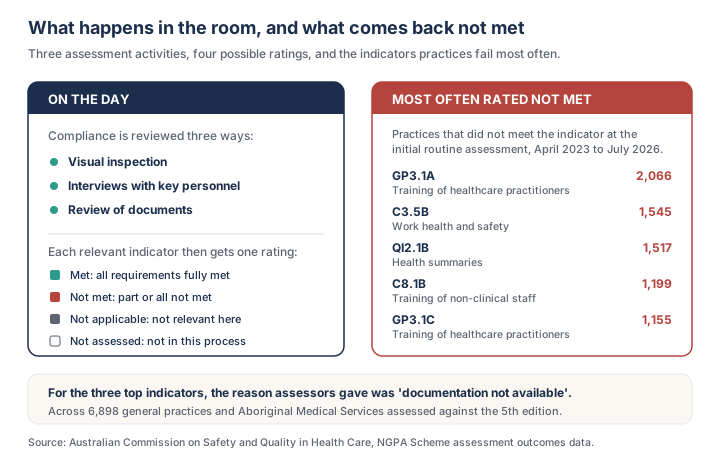
The reason matters more than the ranking. For the three top indicators rated as 'not met', the main reason assessors gave was 'documentation not available' from the general practice during the initial assessment. The pattern is largely consistent across major city and rural or remote locations. Most critical issues warranting escalation to healthcare complaints organisations have related to GP4.1 infection prevention and control including sterilisation, GP6.1 maintaining vaccine potency, GP2.2 follow-up systems, and QI2.2 safe and quality use of medicines.
The RACGP leaves the method to the practice. Because the 5th edition is outcomes-focused, a practice chooses how it demonstrates that it meets the intent of each indicator and what evidence supports that, and the agency must only be satisfied that the intent is met and appropriate evidence exists. What counts is covered in accreditation evidence and the guide to building an evidence pack.
Common mistakes
Treating the self-assessment as part of the assessment. A self-assessment is not a formal requirement of the NGPA Scheme, though an accrediting agency may require one. Assessors are not involved in it, and agencies cannot determine whether the Standards have been met at that stage. The method is in the guide to running a self-assessment.
Having the evidence but not being able to produce it on the day. 'Documentation not available' is the published main reason assessors gave for the three most commonly failed indicators. The record often exists somewhere, but not where anyone can retrieve it while a surveyor is waiting.
Booking outside the four to eight month window. The initial assessment should be undertaken at least four months and no more than eight months before the accreditation expiry date, which minimises the risk of accreditation expiring before the process is complete. Anything earlier needs approval before the assessment starts.
Expecting the consultant who prepared you to be in the room. Consultants engaged to prepare a general practice for an assessment are not permitted to attend or participate in the assessment process under the NGPA Scheme.
Assuming a 'not met' rating ends the process. It opens a remediation period of up to 65 business days. The exception is scale: 20% or more mandatory indicators rated 'not met' triggers a repeat assessment within six months. The pattern of what goes wrong is in the failures practices repeat, and the wider picture in general practice accreditation.
Frequently asked questions
What happens at an accreditation survey visit?
A team of at least two surveyors from the practice's approved accrediting agency reviews compliance against every relevant indicator through a visual inspection, interviews with key personnel, and a review of documents. Each relevant indicator receives a rating of Met, Not met, Not applicable or Not assessed. The agency advises the practice during the assessment of any indicator that could be rated 'not met'.
Who conducts a general practice accreditation assessment?
A surveyor team appointed by the practice's approved accrediting agency: at least two surveyors, one an appropriately qualified GP and one an appropriately qualified nurse, practice manager, allied health professional or Aboriginal and Torres Strait Islander health worker or health practitioner. A third trained person, such as a consumer, may join. The four approved agencies are ACHS, AGPAL, Global-Mark and Quality Practice Accreditation.
How long before my accreditation expires should the assessment happen?
At least four months and no more than eight months before the accreditation expiry date. To undertake it earlier than eight months before expiry, approval must be obtained before the assessment commences. Accrediting agencies advise on preferred dates, but it is ultimately the practice's responsibility to evaluate and accept any risks associated with the dates it chooses.
What happens if an indicator is rated 'not met'?
The practice gets a remediation period to implement changes and demonstrate all requirements of the specified indicators have been met, capped at 65 business days. The agency provides an initial report within five business days confirming each rating and the additional evidence required. A final assessment then determines whether the indicators have been remediated, with a final report within 20 business days.
Can the consultant who helped us prepare attend the assessment?
No. Consultants engaged to prepare a general practice for an assessment are not permitted to attend or participate in the assessment process under the NGPA Scheme. Accrediting agencies must also ensure assessors who provide general practice accreditation consulting services do not review the organisations where they have consulted.
Is the survey visit conducted against the 5th or 6th edition of the Standards?
The 5th edition. The Commission states that accreditation under the NGPA Scheme currently uses the 5th edition of the Standards, and that information about arrangements for the 6th edition will be provided in due course. No transition date has been published, so practices are assessed against the 5th edition until the Commission says otherwise.
Related terms
Go deeper
Last reviewed