Why this matters for your practice
Infection prevention and control is assessed at criterion GP4.1, "Infection prevention and control, including sterilisation", in the General practice module of the RACGP Standards for general practices (5th edition). The six indicators ask for named people and documents, not clean habits: a clinical team member with primary responsibility for infection control, a written practice-specific policy, a team member responsible for educating the practice team, and sterilisation load numbers traceable to patients. Each of those is either in place before accreditation or it is not. The second pressure point is reprocessing. The RACGP's reprocessing guidance has been updated to align with AS 5369:2023, and a transition period applies until 1 January 2028. Practices are encouraged to start transition planning as early as possible.
What is infection prevention and control?
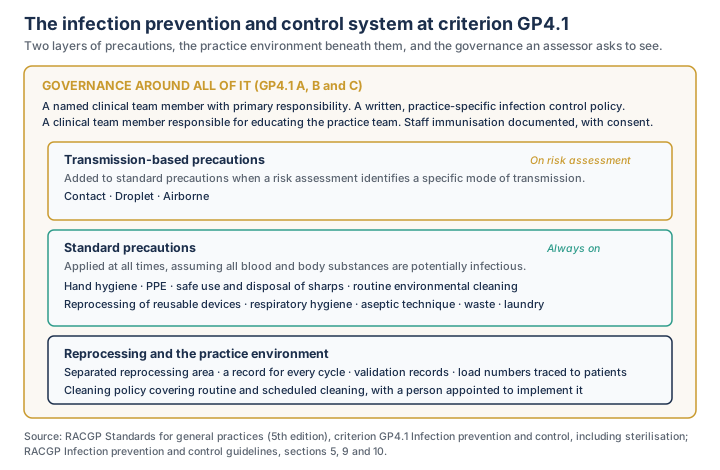
Infection prevention and control in general practice rests on two layers of precautions. Standard precautions are "routine work practices that are implemented consistently to achieve a basic level of infection prevention and control". They are applied at all times, based on the assumption that all blood and body substances, including respiratory droplet contamination, are potentially infectious. Transmission-based precautions are "used with standard precautions to further reduce the risk of infection via a specific mode of transmission: contact, droplet or airborne", and are implemented as determined by a risk assessment. Beneath both sit the national and general practice guideline layers. The NHMRC's Australian Guidelines for the Prevention and Control of Infection in Healthcare (2019) were produced with the Australian Commission on Safety and Quality in Healthcare, are published on the MAGICapp platform, were developed for use in all healthcare settings including office-based practices, and contain guidance on PPE, standard and transmission-based precautions and outbreak management in section 3. The RACGP's Infection prevention and control guidelines for general practices and other office-based and community-based practices sit alongside them, but the RACGP is explicit that practices "are not accredited against Infection prevention and control guidelines, but may refer to them in meeting some criteria set out in the Standards."
What does RACGP criterion GP4.1 require?
Criterion GP4.1 sits under GP Standard 4, "Reducing the risk of infection", whose statement reads: "Our practice has systems that reduce the risk of infections." The six indicators are:
| Indicator | What the practice must have |
|---|---|
| GP4.1 A | A named clinical team member with primary responsibility for coordinating infection control, sterile equipment, reprocessing procedures with documented monitoring and validation, safe storage and stock rotation of sterile products, and waste management |
| GP4.1 B | A written, practice-specific policy that outlines the practice's infection control processes |
| GP4.1 C | A clinical team member with primary responsibility for educating the practice team about infection prevention and control |
| GP4.1 D | Team-wide management of cross-infection risks covering good hand hygiene practices, use of PPE, triage of patients with potential communicable diseases, safe storage and disposal of clinical waste including sharps, and safe management of blood and body fluid spills |
| GP4.1 E | Patient-facing information on respiratory etiquette, hand hygiene, and precautionary techniques to prevent the transmission of communicable diseases |
| GP4.1 F | Sterilisation load numbers from the sterile barrier system recorded in the patient's health record when sterile items have been used, and the patient's name recorded against those load numbers in a sterilisation log or list |
The RACGP says your infection control policy must contain the name of the team member or members responsible for infection control and sterilisation processes; the appropriate use and application of standard and transmission-based precautions; management of sharps injury; management of blood and body-substance spills; hand hygiene; environmental cleaning of clinical and non-clinical areas of the practice; use of aseptic and sterile procedures; procedures for reprocessing (sterilising) instruments onsite or offsite, with documented evidence that this reprocessing is monitored and validated; waste management, including safe storage and disposal of clinical waste and sharps; where patients and the practice team can access PPE; and how and when practice team members are educated on the appropriate application, removal, and disposal of PPE.
Staff immunisation documentation sits under GP4.1 A: the practice must ensure practice team members' immunisations are documented, with their consent. Employers must keep an up-to-date record of the immunisation status of their employees, stored in accordance with confidentiality and privacy requirements. The overlap with work health and safety is explicit: the practice cleaning policy must cover work health and safety issues including use of PPE, relevant immunity and immunisation, and procedures for managing exposure to blood or other body substances. Sharps, clinical waste and infection control are also on the checklist for a WHS walkthrough. The 6th edition of the Standards carries this at CG9, inside its clinical governance standard, but practices are assessed against the 5th edition today.
What changed for reprocessing under AS 5369:2023?
The RACGP's reprocessing guidance has been updated to align with AS 5369:2023, Reprocessing of reusable medical devices and other devices in health and non-health related facilities, which replaces the prior national standards AS/NZS 4187:2014 and AS/NZS 4815:2006. The RACGP says: "A transition period applies until 1 January 2028. During this period, practices may continue to follow the previous RACGP reprocessing guidance while preparing for the transition to the updated requirements."
| Area | Prior guidance | Aligned to AS 5369 |
|---|---|---|
| National standard referenced | AS/NZS 4187:2014 and AS/NZS 4815:2006 | AS 5369, Reprocessing of reusable medical devices and other devices in health and non-health related facilities |
| Cleaning equipment | Manual cleaning is acceptable | Washer-disinfector is required for pre-cleaning (manual cleaning alone no longer sufficient, except when the manufacturer advises) |
| Initial treatment timing | "Promptly after use" (undefined) | Ideally within 1 hour, no later than 4 hours after use |
| Training | Staff must be competent | Structured, documented training and competency assessment required; formal qualifications are not mandatory |
| Traceability | Strongly encouraged | Explicit requirement to record device tracking, batch/cycle numbers, and patient linkage |
| Validation | Annual validation of steriliser only | Validation applies to all reprocessing equipment, including washer-disinfector, with defined monitoring intervals |
| Outsourcing | Allowed to any external provider | Must be a hospital or an accredited facility (including accredited general practice), or co-located site that surveyors can access |
Validation is required when new equipment is installed, when equipment is repaired, moved or upgraded, annually at minimum, and when changes affect the sterilisation process. All validation steps must be documented and retained, including technician validation reports, calibration certificates, staff competency records, and challenge load diagrams and cycle data. For every cleaning and sterilisation cycle, the practice needs to record the equipment used, the date of sterilisation, load number, packs and items in the load, cycle settings (time, temperature, dosage, etc.), who performed the task, and visual inspection results. The practice also needs a designated reprocessing area physically separated from treatment and administration areas, with a workflow pattern that prevents contamination of clean areas. Shared spaces are acceptable only if physical and functional separation is maintained.
A practice that sends instruments offsite still carries the evidence burden. If the facility is accredited, the practice must have a copy of the facility's accreditation certificate. If it is not accredited, the practice must be satisfied it would meet accreditation requirements for sterilisation and must keep copies of its reprocessing policies and procedures, sterilisation policies and procedures, and results of annual validation.
What the regulator or assessor expects
At RACGP accreditation the assessor is looking for a system, and the system has named parts. There is a named infection control coordinator whose responsibilities are documented. There is a written practice-specific policy containing the RACGP's required contents, from the responsible team member's name through to PPE education. Staff immunisation records are kept up to date, with consent, and stored to confidentiality and privacy requirements. There is the practice cleaning policy, covering both routine and scheduled cleaning, with an appointed person responsible for implementation, and it binds cleaners who are not part of the practice team too. Where the practice reprocesses reusable equipment, there is a traceability process capable of identifying the patient, the procedure and the reusable equipment, instruments and devices that were used. Validation records are documented and retained.
Each of those is accreditation evidence: a document, a record or a named person. The Standards also flag some indicators as mandatory indicators, so check the current flags rather than assuming, and map each indicator to its evidence the same way you would for any other criterion when getting started with accreditation.
Common mistakes
Downloading a generic policy. GP4.1 B asks for a written, practice-specific policy, and the required contents include the name of the team member or members responsible for infection control and sterilisation processes. A downloaded template that has never been adapted to name your people and your processes does not meet the indicator. Start from an infection control policy template and make it yours.
Accrediting against the guidelines instead of the Standards. The RACGP says it plainly: practices "are not accredited against Infection prevention and control guidelines, but may refer to them in meeting some criteria set out in the Standards." The guidelines use "could" for optional, "should" for strongly recommended and "must" for mandatory, and none of that substitutes for the Standards themselves.
Leaving reprocessing transition planning late. The transition period to AS 5369:2023 runs until 1 January 2028, and the RACGP encourages practices to start transition planning as early as possible. A washer-disinfector purchase, a documented risk assessment and structured staff training are not overnight work.
Assuming manual cleaning alone still passes. Under the updated requirements, a washer-disinfector is required for pre-cleaning, and manual cleaning alone is no longer sufficient except when the manufacturer advises.
Relying on standard precautions alone. Standard precautions are unconditional, but transmission-based precautions must be added when a risk assessment identifies a contact, droplet or airborne risk that standard precautions do not contain.
Keeping no usable staff immunisation record. Employers must keep an up-to-date record of the immunisation status of their employees, with documentation of vaccination or immunity included in staff records. A verbal assurance that everyone is vaccinated is not a record.
Frequently asked questions
What is infection prevention and control in general practice?
It is a documented system built on two layers of precautions: standard precautions, the routine work practices applied at all times on the assumption that all blood and body substances are potentially infectious, and transmission-based precautions, added on the basis of a risk assessment when a contact, droplet or airborne risk is identified. At accreditation it is assessed as a system with a named coordinator, a written practice-specific policy and traceable reprocessing records.
Which RACGP criterion covers infection prevention and control?
Criterion GP4.1, "Infection prevention and control, including sterilisation", in the General practice module of the 5th edition, under GP Standard 4, "Reducing the risk of infection". The 6th edition carries this at CG9, "Infection prevention and control, including reprocessing", but practices are assessed against the 5th edition today.
What must an infection control policy contain?
The RACGP lists the required contents: the name of the team member or members responsible for infection control and sterilisation; standard and transmission-based precautions; sharps injury management; blood and body-substance spills; hand hygiene; environmental cleaning; aseptic and sterile procedures; reprocessing procedures with documented monitoring and validation; waste management including sharps; where PPE can be accessed; and how and when the team is educated on PPE use.
Do we need an infection control coordinator?
Yes. GP4.1 A requires at least one clinical team member with primary responsibility for coordinating infection prevention and control, sterile equipment, reprocessing, safe storage and stock rotation of sterile products, and waste management. GP4.1 C separately requires a clinical team member with primary responsibility for educating the practice team, which can be the same person.
What is the difference between standard precautions and transmission-based precautions?
Standard precautions are "routine work practices that are implemented consistently to achieve a basic level of infection prevention and control", applied at all times. Transmission-based precautions are "used with standard precautions to further reduce the risk of infection via a specific mode of transmission: contact, droplet or airborne", and are implemented as determined by a risk assessment.
Does AS 5369:2023 apply to my practice yet?
Yes. It is the standard the RACGP's reprocessing guidance now aligns to, but a transition period applies until 1 January 2028, during which practices may continue to follow the previous RACGP reprocessing guidance while preparing for the updated requirements.
Is vaccine storage part of infection prevention and control?
No. Vaccine storage sits under GP Standard 6, "Vaccine potency", at criterion GP6.1, "Maintaining vaccine potency", not under GP4.1. It is covered separately under cold chain management.
Related terms
Go deeper
Last reviewed