Why this matters for your practice
Open disclosure has its own criterion in the RACGP Standards for general practices (5th edition): Criterion QI3.2, Open disclosure, in the Quality improvement module under QI Standard 3, Clinical risk management. The indicator reads "QI3.2 A Our practice follows an open disclosure process that is based on the Australian open disclosure framework." What a practice has to show at accreditation is a documented process, not a good intention. The Framework behind that indicator was revised in June 2026, and the Commission says the revised version "reflects contemporary clinical practice, strengthens its focus on person-centred care, and now applies across all healthcare settings".
What is open disclosure?
The Australian Open Disclosure Framework, subtitled "Better communication, for better care" and published by the Australian Commission on Safety and Quality in Health Care in June 2026, defines it in its glossary: "Open disclosure is a principles-based approach to honest, empathetic and timely discussions with a person, and/or their support people, when actual or potential harm occurs while that person is receiving healthcare. Open disclosure is an obligation for healthcare teams that enables them to meaningfully acknowledge, apologise for, remedy, reflect on and learn from incidents of actual or potential harm." The Framework states that this document "is a revision of the Open Disclosure Framework published in 2014".
Harm is defined broadly: "Impairment of structure or function of the body and/or any deleterious effect arising therefrom, including disease, injury, suffering, disability and death. Harm may be physical, social or psychological." The Framework adds that "the person's view on whether harm has occurred may differ from the healthcare professionals or health service organisation's view". Near misses and no-harm incidents are within scope, though the approach should be proportionate, guided by the circumstances of the event and responsive to the patient's needs. Four principles run through the document: "Respectful and responsive communication", "Compassionate acknowledgement and apology", "Restorative process", and "Cultural safety for Aboriginal and Torres Strait Islander peoples".
What has to be said in an open disclosure conversation?
The RACGP criterion page gives the five-item list a general practice assessor works from. Under "Meeting this Criterion" it writes: "The Australian open disclosure framework states that open disclosure includes: acknowledgement to the patient that something has gone wrong, either in response to their enquiry or initiated by the practice; an apology or expression of regret (including the word 'sorry'); a factual explanation of what happened; an opportunity for the patient to share their experience with the practice; an explanation of the steps being taken to manage the event and prevent a recurrence."
The June 2026 Framework sets out the current national wording for an initial discussion in eight items: acknowledging care did not go as expected and including known facts; an apology or expression of regret; an opportunity to listen to the patient experience; the effect or potential consequences for the patient; what the open disclosure process involves and the expected outcomes; steps being taken to manage the event and prevent recurrence; information about the open disclosure and incident management processes; and contact information to access independent support services.
The wording of the apology is not negotiable. The Framework says apologising and expressing regret "must contain the word 'sorry'". It also separates two stages: an initial discussion as soon as harm is recognised, and a formal process for the most serious events.
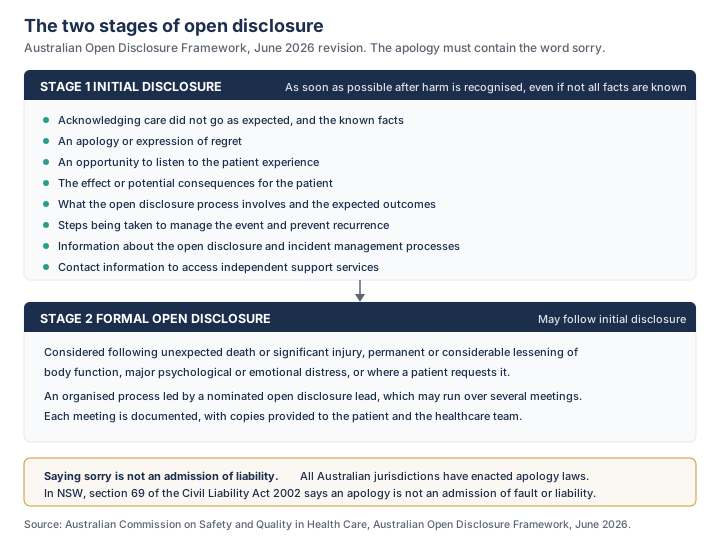
| Stage | When it applies | What it involves |
|---|---|---|
| Initial disclosure | As soon as possible after recognising harm or potential harm, even if not all the facts are known. It may be deferred because of the patient's health or at the patient's request. | Acknowledge care did not go as expected with the known facts, apologise or express regret, listen to the patient's experience, explain the effect or potential consequences, explain the process and the steps being taken to manage the event and prevent recurrence, and give contact information for independent support services. If the process ends here, it should still be documented. |
| Formal open disclosure | Considered following the unexpected death or significant injury to a patient, permanent or considerable lessening of body function following an incident or adverse event, major psychological or emotional distress, or where a patient requests a formal open disclosure process. | An organised process led by a nominated open disclosure lead, possibly over several meetings. Each meeting should be documented, with copies provided to the patient and the healthcare team, and the record stored securely. |
Is saying sorry an admission of liability?
No. The Commission's fact sheet states: "All Australian jurisdictions have their own apology laws that protect sincere apologies from being used against clinicians in legal proceedings." The Framework says the same, while noting that "each Australian jurisdiction has their own individual laws and regulatory requirements" and that organisations and professionals should seek legal advice for any concerns.
The NSW provision is the one set out here. The Civil Liability Act 2002 (NSW), Part 10 (sections 67 to 69), defines an apology in section 68 as "an expression of sympathy or regret, or of a general sense of benevolence or compassion, in connection with any matter whether or not the apology admits or implies an admission of fault in connection with the matter". Section 69(1) provides that an apology "(a) does not constitute an express or implied admission of fault or liability by the person in connection with that matter, and (b) is not relevant to the determination of fault or liability in connection with that matter". Section 69(2) adds that evidence of an apology "is not admissible in any civil proceedings as evidence of the fault or liability of the person in connection with that matter". Section 67(2) carves out civil liability excluded by section 3B and civil liability for defamation. The other states and territories have their own provisions and they differ.
The Framework addresses the fear directly: "Do not fear saying sorry. Providing healthcare professionals don't engage in unwarranted speculation about the incident or apportion blame to individuals, entities or institutions, there are no medico-legal grounds for avoiding the word 'sorry'."
What the regulator or assessor expects
The RACGP states the obligation plainly: "Health professionals have an obligation to: respectfully explain to patients when things go wrong; offer an expression of regret or genuine apology (if warranted); explain what steps have been taken to ensure that the mistake is not repeated."
As evidence for RACGP accreditation, the RACGP suggests a practice could maintain an open disclosure process and encourage all members of the practice team to follow it; develop and implement policies and guidelines that align with the Australian open disclosure framework, which is what an open disclosure policy is for; keep a record of any discussions and apologies; implement quality improvement initiatives; record any incidents in the patient's record; educate practitioners about the Australian open disclosure framework for small practices; and discuss open disclosure at practice team meetings. It notes that "Incidents and near misses can be recorded in the patient's record as per the Australian open disclosure framework", and advises practices to contact their medical defence organisation and insurers for guidance on when they may need to participate in open disclosure and what documentation those organisations would require.
The Framework requires each meeting discussion to be documented, with copies provided to the patient and the healthcare team, and the record stored securely. It also asks organisations to review open disclosure performance and integrate the outcomes into continuous quality improvement, clinical governance and performance monitoring, with both patients and staff given the opportunity to feed back on the process. The learning from an event feeds an improvement activity such as a significant event analysis.
The 6th edition carries this at PP7.A, which reads "The practice applies the Australian Open Disclosure Framework." Practices are assessed against the 5th edition today, and arrangements for the transition will be provided "in due course". One wrinkle: the RACGP criterion page was last revised 24 February 2023, so it quotes the earlier version of the Framework. The document to work from is the June 2026 revision. The Commission also still publishes Implementing the Australian Open Disclosure Framework in Small Practices, with a publication year of 2014, which the RACGP criterion points practices to.
Common mistakes
Avoiding the word "sorry" out of medico-legal fear. The Framework is explicit that there are no medico-legal grounds for avoiding the word, provided you do not speculate or apportion blame. An apology that circles the word is not an apology under the Framework.
Treating open disclosure as the same thing as complaints handling. Open disclosure is initiated by the practice after harm, or in response to a patient raising a concern. It is not the complaints register. The mechanics of handling a patient complaint are a separate process, and the 6th edition keeps the two distinct at PP7.A and PP7.B.
Speculating about cause or apportioning blame before the facts are established. The protection the Framework describes depends on not engaging in unwarranted speculation about the incident and not apportioning blame to individuals, entities or institutions. Say what is known, say what is not, and stop.
Holding the conversation and never documenting it. Each meeting discussion should be documented, with copies provided to the patient and the healthcare team. Even where the process ends after the initial discussion, it should still be documented appropriately, and a conversation nobody recorded is one of the failures that hold up accreditation.
Assuming near misses and no-harm events need no conversation. Near miss and no-harm incidents are within the scope of open disclosure. The approach should be proportionate, but no harm is not the same as no conversation.
Treating it as a single meeting that closes the matter. The process aims to conclude with mutual or shared agreement between the healthcare team and the patient, and in most cases closure occurs after internal investigations are complete.
Frequently asked questions
What is open disclosure?
The Australian Open Disclosure Framework defines it as "a principles-based approach to honest, empathetic and timely discussions with a person, and/or their support people, when actual or potential harm occurs while that person is receiving healthcare". In a general practice, it means telling the patient something went wrong, saying sorry, explaining the known facts, listening to their experience, and explaining what you are doing to prevent a recurrence.
Is an apology an admission of liability in Australia?
No. All Australian jurisdictions have enacted apology laws that protect statements of apology or regret from subsequent use in certain legal settings. In NSW, section 69 of the Civil Liability Act 2002 provides that an apology is neither an admission of fault or liability nor admissible as evidence of it. Each jurisdiction's law differs, so seek legal advice for any concerns.
Do I have to use the word sorry?
Yes. The Framework says an apology "must contain the word 'sorry'", and its principle of compassionate acknowledgement says "A sincere apology or expression of regret using the words, 'I am sorry' or 'we are sorry', is essential." An expression of regret may be preferred over an apology in special circumstances, such as when harm is deemed unpreventable, but the word itself is not optional.
Does open disclosure apply to a near miss?
Yes. The Framework states that "Near miss and no-harm incidents are within the scope of open disclosure; however, the approach should be proportionate, guided by the circumstances of the event and responsive to the needs of the patient." A near miss is "An incident or potential incident that was averted and did not cause harm but had the potential to do so".
What is the difference between initial disclosure and formal open disclosure?
Initial disclosure is the first discussion, held as soon as possible after recognising harm or potential harm, even if not all the facts are known. Formal open disclosure is an organised process led by a nominated open disclosure lead, considered after events such as unexpected death, significant injury, permanent or considerable lessening of body function, major psychological or emotional distress, or at the patient's request.
Which RACGP criterion covers open disclosure?
Criterion QI3.2, Open disclosure, in the 5th edition Standards, under QI Standard 3, Clinical risk management. The indicator reads "QI3.2 A Our practice follows an open disclosure process that is based on the Australian open disclosure framework." In the 6th edition, open disclosure sits at PP7.A, which reads "The practice applies the Australian Open Disclosure Framework."
Does open disclosure apply to telehealth and virtual care?
Yes. The Framework states that "The same open disclosure process and principles must be followed when harm occurs in a virtual care setting." Where open disclosure is held virtually, it recommends using video calls rather than audio-only where possible, to support verbal and body language cues.
Related terms
Go deeper
Last reviewed