Why this matters for your practice
Every GP telehealth item in the general attendance range carries the same legislative note on its MBS Online page: "It is a legislative requirement that this service must be performed by the patient's eligible telehealth practitioner (please see Note AN.1.1 for the definitions as some exemptions do apply)". Eligibility is a rolling requirement, checked at each service, not a gate you clear once. Where you rely on an exemption, explanatory note AN.1.1 requires the exemption and the clinical reasoning in the patient's clinical notes at the time of service, for post audit compliance. The Department's 23 October 2025 telehealth factsheet states the consequence: "Failure to meet the eligibility requirements or incorrect use of an exemption may result in incorrect MBS claiming or out-of-pockets costs for patients."
What are telehealth MBS items?
Telehealth MBS items are Medicare items for consultations delivered by video or phone instead of in person, and the arrangements are ongoing rather than temporary. The MBS Telehealth Services page on MBS Online states that "Ongoing MBS telehealth arrangements remain in place and provide for a wide range of telephone and video services by qualified health practitioners". The GP items sit in Group A40 of the Medicare Benefits Schedule, with general practice video services in Subgroup 1 and general practice phone services in Subgroup 2. The same page lists who can provide them: "medical practitioners in general practice, specialists, consultant physicians, nurse practitioners, participating midwives, allied health providers and dental practitioners in the practice of oral and maxillofacial surgery". The telehealth items have the same clinical requirements as the equivalent face-to-face consultation and the same fee and benefit values, and a service "may only be provided by telehealth where it is safe and clinically appropriate". Since 1 March 2025, the term "telehealth attendance" collectively covers both video and phone attendances; where an item is restricted to one format, it specifically states "phone attendance" or "video attendance".
Which telehealth item matches which face-to-face consultation?
The table below is the general practice rows of explanatory note AN.0.74, which sets out the general attendance items by level. The fees shown are the schedule fee for the video and phone items, which are the same at each level.
| Consultation level | Face-to-face item | Video item | Phone item | Schedule fee |
|---|---|---|---|---|
| Level A, straightforward | 3 | 91790 | 91890 (less than 6 minutes) | $20.55 |
| Level B, 6 to 20 minutes | 23 | 91800 | 91891 (at least 6 minutes) | $45.05 |
| Level C, 20+ minutes | 36 | 91801 | 91900 (MyMedicare patients only) | $87.10 |
| Level D, 40+ minutes | 44 | 91802 | 91910 (MyMedicare patients only) | $128.35 |
| Level E, 60+ minutes | 123 | 91920 | none | $207.90 |
There is no phone item at Level E, so a 60-minute GP attendance is video only. The Level C and Level D phone items require the patient to be "registered under MyMedicare with the billing practice", and that sits in the descriptor of item 91900 on MBS Online and its 40-minute equivalent, not just in the explanatory notes. Video is the preferred approach for substituting a face-to-face consultation, with phone available where clinically appropriate.
Telehealth attendances attract a bulk billing incentive as face-to-face attendances do, and which incentive item applies depends in part on whether the patient is registered in MyMedicare. Four new MBS phone items (92033, 92034, 92063 and 92064) also make preparing and reviewing a GP chronic condition management plan claimable by telephone from 1 November 2026: see the 1 November 2026 MBS changes.
What is MBS item 91891?
Item 91891 is the standard GP phone consultation: the Level B phone equivalent of face-to-face item 23 and video item 91800. It sits in Group A40, Subgroup 2, general practice phone services. The descriptor on item 91891 on MBS Online reads: "Phone attendance by a general practitioner lasting at least 6 minutes if the attendance includes any of the following that are clinically relevant: (a) taking a short patient history; (b) arranging any necessary investigation; (c) implementing a management plan; (d) providing appropriate preventative health care".
The schedule fee is $45.05, with the Medicare benefit at 100% of the fee. The fee was last updated on 1 July 2026, and the November 2026 MBS data file, effective 1 November 2026, marks no change to the item's descriptor or fee. A call under 6 minutes is item 91890 ($20.55), and a call of at least 20 minutes is item 91900, which needs MyMedicare registration.
Three rules apply to a 91891 claim from 1 November 2026:
- The patient's eligible telehealth practitioner. The item carries the note "It is a legislative requirement that this service must be performed by the patient's eligible telehealth practitioner". The patient needs a face-to-face service in the last 12 months, MyMedicare registration with your practice, or an AN.1.1 exemption, as the next section sets out.
- No MyMedicare condition in the descriptor. Unlike items 91900 and 91910, item 91891 can be billed for a patient who is not registered in MyMedicare, as long as the eligibility rule above is met.
- Not on the same day as a care plan. Clause 2.16.11 of the Health Insurance (General Medical Services Table) Regulations 2021 lists 91891 among the items that do not apply to a service given to the same patient on the same day as a GP chronic condition management plan service. From 1 November 2026, F2026L01359 adds the new phone plan items 92033, 92034, 92063 and 92064 to that clause, and F2026L01101 does the same in clause 1.1.05 of the telehealth determination. Book a 91891 call and a phone care plan for one patient on one day, and only the plan is claimable.
What is the 12-month rule for telehealth?
It is a legislative requirement that a telehealth service billed under the non-referred attendance items can only be performed where the patient is registered in MyMedicare with the billing practice, or the practitioner qualifies as the patient's eligible telehealth practitioner, or a listed exemption applies. Explanatory note AN.1.1 sets out all three pathways.
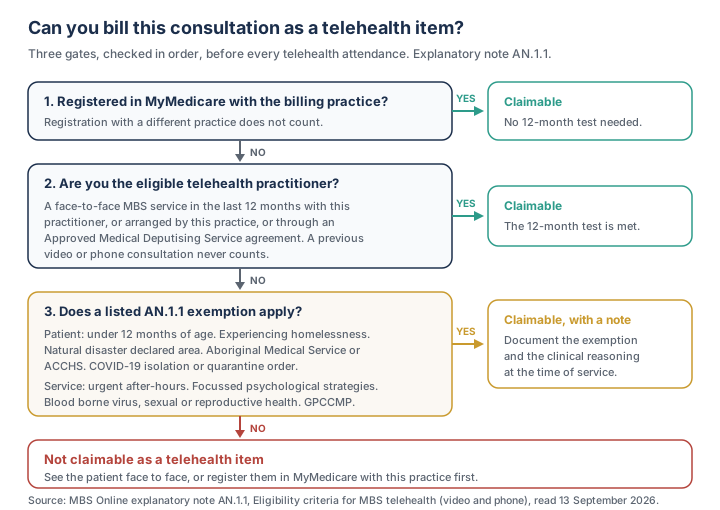
The MyMedicare pathway is met where "the patient is registered with MyMedicare and is receiving the telehealth service from the MyMedicare practice they are registered with". A patient registered in MyMedicare with your practice does not also need to meet the eligible telehealth practitioner test.
The eligible telehealth practitioner test has three limbs. Limb 1: "the medical practitioner who performs the service has provided a face-to-face service to the patient in the last 12 months". Limb 2: the practitioner is located at a medical or nurse practitioner practice, and the patient has had a face-to-face service arranged by that practice in the last 12 months and billed to the MBS. That service can have been performed by another medical or nurse practitioner there, or on their behalf by a practice nurse or an Aboriginal and Torres Strait Islander health practitioner or health worker. Limb 3: the practitioner participates in the Approved Medical Deputising Service (AMDS) program, and the AMDS provider employing them has a formal agreement with a practice that saw the patient face to face in the last 12 months.
Two hard edges catch practices out. AN.1.1 says "A patient's participation in a previous video or phone consultation does not constitute a face-to-face service for the purposes of ongoing telehealth eligibility." And the requirement is rolling, so it is checked before each telehealth attendance rather than satisfied once.
Which patients and services are exempt?
AN.1.1 lists five patient categories and four service categories where the eligible telehealth practitioner requirement does not apply.
A person under the age of 12 months. Age alone carries the exemption, so no face-to-face history is needed first.
A person experiencing homelessness. AN.1.1 defines this as a person without suitable accommodation alternatives whose living arrangement is inadequate, has no tenure or only short and non-extendable tenure, or does not allow them control of, and access to, space for social relations.
A person living in a natural disaster affected area. This means a State or Territory local government area currently declared a natural disaster area by a State or Territory Government, until that declaration expires. MBS Online adds that patients in those areas can access telehealth from any medical practitioner in general practice.
A person receiving the service from a medical practitioner located at an Aboriginal Medical Service or an Aboriginal Community Controlled Health Service. The practitioner's location decides this one, not the patient's history.
A person isolating or in COVID-19 quarantine under a State or Territory public health order. Both categories are still listed in AN.1.1 as at 13 September 2026. How long they remain in the note is not settled.
On the service side, the exemption covers an urgent after-hours service in unsociable hours, specific mental health treatment items, blood borne virus, sexual or reproductive health telehealth items, and preparing or reviewing a GP chronic condition management plan. The mental health exemption is narrow: it reaches focussed psychological strategies items claimed by an eligible GP or prescribed medical practitioner. From 1 November 2025 the GP and prescribed medical practitioner Mental Health Treatment Plan telehealth items are no longer exempt. See Better Access billing for the item detail.
What the regulator or assessor expects
The clinical notes must record the exemption and the clinical reasoning at the time of service, not after the fact. The factsheet states that "All Medicare claiming is subject to compliance checks and providers may be required to submit evidence about the services they bill", so those notes are what you produce in a Medicare compliance audit. Volume matters too. Under the 80/20 rule, a practitioner who renders or initiates 80 or more relevant services on each of 20 or more days in a 12-month period (cumulative, not consecutive) is referred to the Director of Professional Services Review, and telehealth items sit inside the prescribed pattern of services rules. A phone-specific trigger runs alongside it: under the 30/20 rule, 30 or more relevant phone services per day on 20 or more days in a 12-month period also results in referral. Providers need not be in the practice to provide telehealth, but must use the provider number relevant to the appropriate practice. No specific equipment is mandated, and the telecommunications solution must meet clinical requirements and satisfy privacy laws, which is what a telehealth policy records. AHPRA's telehealth and online prescribing expectations are a separate obligation from the MBS billing rules.
Common mistakes
Treating the last telehealth consultation as the qualifying visit. A previous video or phone consultation does not constitute a face-to-face service for eligibility purposes. Only a face-to-face attendance in the last 12 months satisfies the test.
Billing the longer phone items for a patient not registered in MyMedicare with the billing practice. Items 91900 and 91910 carry the requirement in the descriptor itself. Registration with a different practice, or no registration at all, means the item cannot be billed. MyMedicare compliance obligations covers what the practice has to keep current.
Relying on an exemption without writing it in the notes. AN.1.1 requires the exemption and the clinical reasoning in the clinical notes at the time of service. An exemption that applied but was never recorded will not survive a compliance check, which is where preparing for a Medicare compliance audit starts.
Assuming a Mental Health Treatment Plan telehealth item is still exempt. From 1 November 2025, the GP and prescribed medical practitioner MHTP telehealth items are no longer exempt from the eligibility criteria. Only focussed psychological strategies items retain the exemption.
Reaching for a phone item when video was available and clinically appropriate. Video is the preferred approach for substituting a face-to-face consultation, and phone items exist for where audio-only is clinically appropriate. The rest of the standing rules sit in our telehealth Medicare billing guide and the wider Medicare billing compliance pillar.
Frequently asked questions
What are the MBS telehealth item numbers for a GP consultation?
The GP video items are 91790 (Level A), 91800 (Level B), 91801 (Level C), 91802 (Level D) and 91920 (Level E). The GP phone items are 91890 (less than 6 minutes), 91891 (at least 6 minutes), 91900 (at least 20 minutes, MyMedicare patients only) and 91910 (at least 40 minutes, MyMedicare patients only). There is no phone item at Level E.
What is the 12-month rule for MBS telehealth?
The patient must have had a face-to-face service with the billing practitioner, or a face-to-face service arranged by the practitioner's practice, in the last 12 months before the telehealth attendance. The requirement is rolling, so it is checked before each service. A patient registered in MyMedicare with the billing practice does not need to meet this test, and neither does a patient who fits a listed exemption.
Can I bill a telehealth item if the patient has never been to the practice?
No, unless an exemption applies or the patient is registered in MyMedicare with your practice. The eligible telehealth practitioner requirement needs a face-to-face service in the last 12 months, and a previous telehealth consultation does not count. Exempt categories include patients under 12 months, patients experiencing homelessness, and patients in natural disaster declared areas.
Do telehealth items pay less than face-to-face consultations?
No. The MBS telehealth items have the same clinical requirements as the equivalent face-to-face consultation and the same fee and benefit values. At each level the video and phone schedule fees match: $45.05 for both item 91800 (video) and item 91891 (phone) at Level B, and $87.10 for both item 91801 and item 91900 at Level C.
Which telehealth phone items require MyMedicare registration?
Items 91900 and 91910, the longer phone attendances of at least 20 and at least 40 minutes. Both descriptors require the patient to be "registered under MyMedicare with the billing practice". The shorter phone items, 91890 and 91891, carry no such requirement, though the general eligibility rule in AN.1.1 still applies to them.
Does a previous telehealth appointment satisfy the 12-month rule?
No. AN.1.1 states that "A patient's participation in a previous video or phone consultation does not constitute a face-to-face service for the purposes of ongoing telehealth eligibility". Only a face-to-face service in the last 12 months qualifies, so a patient seen by telehealth only will need a face-to-face attendance, MyMedicare registration, or an exemption before the next telehealth claim.
Related terms
Go deeper
Last reviewed