Key Takeaways
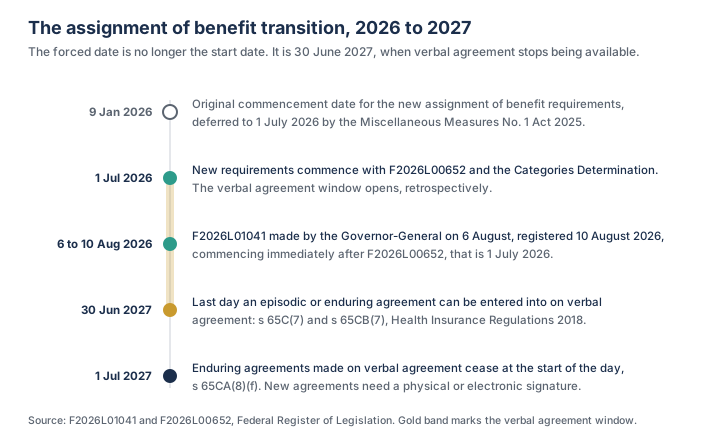
- The Health Insurance Amendment (Assignment of Medicare Benefits) Regulations 2026 (F2026L01041) were made by the Governor-General on 6 August 2026 and registered on 10 August 2026. They let a patient agree verbally to an episodic or enduring assignment entered into between 1 July 2026 and 30 June 2027.
- The instrument commences immediately after the Episodic Agreements regulations, so it takes effect from 1 July 2026 retrospectively under section 12 of the Legislation Act 2003. A verbal agreement taken in July 2026 is covered.
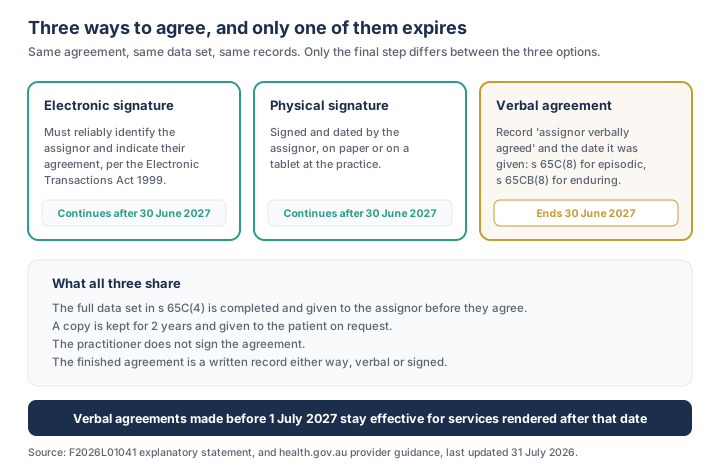
- The agreement must specify that verbal agreement was provided and the date it was provided (new subsections 65C(8) and 65CB(8) of the Health Insurance Regulations 2018). The Department's wording is "assignor verbally agreed" in place of a signature.
- An enduring agreement entered into on verbal agreement ceases at the start of 1 July 2027 under new paragraph 65CA(8)(f). It does not roll over. A signed replacement is needed before that date.
- Verbal agreements made before 1 July 2027 remain effective for claims for services rendered after that date, including episodic pre-agreements such as pathology and future consultations, where all other requirements are met.
- Nothing else moves: the 2-year retention rule, the data set in subsection 65C(4), the removal of the practitioner's signature and the simplified billing requirements from 1 July 2026 are unchanged by the transition.
- The Department will use the 12 months to "explore other regulatory and legislative options to further reduce the administrative burden", and says its compliance approach will "prioritise prevention and education" within a risk based approach.
Verbal agreement to bulk billing is now law rather than a promise. The Health Insurance Amendment (Assignment of Medicare Benefits) Regulations 2026 (F2026L01041), made on 6 August 2026, let a patient agree verbally to any episodic or enduring assignment of benefit entered into between 1 July 2026 and 30 June 2027. From 1 July 2027, a physical or electronic signature is required again.
How this post has changed: published 24 May 2026 ahead of the 1 July commencement, corrected 29 July 2026 when enduring agreements were confirmed for 1 July 2026 and the Department flagged a 12-month transition, and rewritten on 19 August 2026 once the transitional regulations were actually made. The forced date is no longer 1 July 2026. It is 30 June 2027.
What does the law actually say now?
The assignment of benefit rules are not one instrument. They are an Act, three sets of regulations made in 2026, a 2025 set that has already done its work, and a determination amended once. Practices get caught out because guidance pages summarise the package while the obligation sits in a specific subsection. The operative rules all live in Division 7A of the Health Insurance Regulations 2018 as amended, and the relief you are relying on right now is four items in Schedule 1 of F2026L01041.
The requirements commenced on 1 July 2026 for every bulk-billed and simplified billing service: since then an agreement has needed the full data set in subsection 65C(4), no practitioner signature, and a copy retained for 2 years. What F2026L01041 added, back-dated to the same day, is that the assignor's agreement can be verbal instead of signed until 30 June 2027.
| Instrument | Made and registered | Commenced | What it does |
|---|---|---|---|
| Health Insurance Legislation Amendment (Assignment of Medicare Benefits) Act 2024 | Passed 2 July 2024, assent 9 July 2024 | 1 July 2026 (deferred from 9 January 2026) | The enabling Act: modernises the assignment requirements for bulk billed and simplified billing services |
| Health Insurance Amendment (Assignment of Medicare Benefits and Other Measures) Regulations 2025 (F2025L00983) | Made 21 August 2025 | 1 July 2026 | The operational rules: the data set, episodic pre and post agreements, record keeping. Now shown as repealed on the Register, having amended the 2018 Regulations |
| Health Insurance Amendment (Episodic Agreements and Simplified Billing Assignments) Regulations 2026 (F2026L00652) | Made 28 May, registered 29 May 2026 | 1 July 2026 | Multiple services and MBS items per agreement, 6-month episodic pre-agreements, one document may hold multiple agreements, simplified billing notification and record-keeping changes |
| Health Insurance (Assignment of Medicare Benefits, Categories of Professional Services) Determination 2026 (F2026L00841) | Made 15 June, registered 29 June 2026 | 1 July 2026 | Sets 23 categories of professional services so a pre-service agreement can describe what it covers. Does not apply to diagnostic imaging or pathology outside Group P9 |
| Health Insurance Amendment (Enduring Agreements) Regulations 2026 (F2026L00824) | Made 25 June, registered 26 June 2026 | 1 July 2026 | Enduring agreements for MyMedicare, residential aged care and ACCHO or AMS patients |
| Health Insurance Amendment (Assignment of Medicare Benefits) Regulations 2026 (F2026L01041) | Made 6 August, registered 10 August 2026 | 1 July 2026, retrospectively | The 12-month verbal agreement transition to 30 June 2027 |
| Health Insurance (Assignment of Medicare Benefits, Categories of Professional Services) Amendment (July Updates 2026) Determination 2026 (F2026L01110) | Made 20 August, registered 25 August 2026 | 26 August 2026, the day after registration | Updates the MBS items and groups listed in 6 of the 23 categories, to reflect the services in scope as of 1 July 2026. Does not change the consent or verbal agreement rules |
Two details in that table matter more than the rest. First, F2026L01041 commences "immediately after the commencement of the Health Insurance Amendment (Episodic Agreements and Simplified Billing Assignments) Regulations 2026", which the commencement table records as 1 July 2026, and the explanatory statement confirms the retrospective application relies on section 12 of the Legislation Act 2003. Verbal agreements your clinicians took in July and early August are covered by an instrument that did not exist at the time. Second, the 2025 Regulations are spent: cite the Health Insurance Regulations 2018 as amended when you document an obligation, and keep F2025L00983 as history.
F2026L01110 amends only the Schedule 1 table of the Categories Determination, updating the MBS items listed in 6 of its 23 categories. It commenced on 26 August 2026, the day after registration, although its explanatory statement says it was "intended to take effect from 1 July 2026". The verbal agreement relief, the record wording and the 1 July 2027 cessation are unchanged.
How do you take a verbal assignment of benefit?
Verbal agreement replaces the signature and nothing else. The explanatory statement to F2026L01041 is explicit that agreements made verbally "have the same particulars and record keeping requirements as physically or electronically signed agreements". You still complete the agreement, give the patient the information that lets them consent, store the document and keep it for 2 years. What changes is the act at the end: instead of collecting a signature, you record that the assignor agreed verbally, and when.
The sequence the Department sets out is: present the assignor with the details that would go into a written agreement, so their consent is informed; if they agree, enter "assignor verbally agreed" in the assignor signature field; store the completed agreement; and send it to the patient electronically. The provider guidance page, last updated 31 July 2026, puts it as: "You can record verbal consent by noting the 'assignor verbally agreed' (or similar) in place of a signature. Use of verbal assignment is a 12-month temporary provision until 30 June 2027."
Add the date. Subsections 65C(8) and 65CB(8) require the agreement to specify both that verbal agreement was provided and the date it was provided, so a field that only says "assignor verbally agreed" satisfies half the requirement. Where an enduring agreement's patient declaration is also verbal, subsection 65CB(6) requires the agreement to say so.
There is one point where the guidance and the instrument do not line up, and it is worth being clear about which one governs. The Department's frequently asked questions, as at 16 July 2026, say "Verbal agreement is ok when other options are unavailable", framing it as a fallback. The explanatory statement to the instrument that was subsequently made says verbal agreement "may be used in any circumstances, including but not limited to" residential aged care homes, home visits and outreach services, Aboriginal Community Controlled Health Services and remote outreach programs, areas of technology infrastructure inequity, urgent or unplanned care settings, and settings with infection prevention, isolation or other restrictions on document handling. The instrument governs. The explanatory statement also confirms "There is no requirement to record why verbal agreement is used", although the record must identify that it was verbal.
Episodic or enduring: which agreement covers the service?
An episodic agreement covers a service or a set of services. An enduring agreement is made once and applies to future bulk-billed GP services until it is terminated. Both are available now, both can be entered into on verbal agreement until 30 June 2027, and they behave very differently at the end of the transition.
The episodic side is more flexible than the original 2025 rules. F2026L00652 amended subsection 65C(3) so a single agreement can cover one or multiple professional services, including different kinds, and so an episodic pre-agreement can cover more than one service rendered during a 6-month period: the Department's example is a patient receiving regular dialysis, cancer treatment or palliative care making one agreement that captures all known appointments. Each service must be specified, delivered by the same medical professional, on specified dates. Change the date, the service or the practitioner and the agreement is void for that claim.
| Episodic agreement | Enduring agreement | |
|---|---|---|
| Who can use it | Any patient being bulk billed | MyMedicare-registered patients, residents of residential aged care homes, patients of ACCHOs and AMSs |
| Who can offer it | Any provider bulk billing the service | GPs in those settings, excluding a consultant physician or a specialist in a speciality other than general practice |
| Scope | One or more services, including different kinds, and multiple MBS items | Any GP services, described at MBS Category, Group, Subgroup or Item level, or a combination |
| Timing | Before the service (pre-agreement) or after it (post-agreement), before the claim is lodged | Once, then applied to future in-scope services |
| Duration | A pre-agreement can cover services over a 6-month period | Until terminated, with automatic cessation events |
| Post-service notification | Not required | Required for MyMedicare patients: written notice to the assignor within 24 hours of the claim, with the practitioner's name, the patient's name, the service date and the benefit amount. Not required for aged care or ACCHO and AMS agreements |
| Verbal agreement | Available for agreements entered into between 1 July 2026 and 30 June 2027 | Available in the same window, but the agreement ceases at the start of 1 July 2027 |
Two operational traps sit in the enduring column. Once an enduring agreement is made, the provider must bulk bill that patient for any future in-scope service until it is terminated, so changing the scope means terminating and making a new one. And termination has timing: either party can terminate by written notice and the agreement ends 2 business days later, while a provider intending to terminate must notify the assignor at least 2 days beforehand. Agreements also cease automatically, for example if the patient is no longer registered with the MyMedicare practice, if the practitioner leaves the nominated location, if an aged care resident stops residing in the home, or when a patient covered by someone else's agreement turns 14.
What ends on 30 June 2027, and what does not?
Only the verbal option ends. Everything the 1 July 2026 package introduced is permanent, and a practice that has been running on verbal agreement for a year still has to satisfy all of it today.
Three things happen at the boundary. From 1 July 2027 no episodic or enduring agreement can be entered into on verbal agreement, because subsections 65C(7) and 65CB(7) only reach agreements entered into between 1 July 2026 and 30 June 2027. Enduring agreements made on verbal agreement cease at the start of 1 July 2027 under paragraph 65CA(8)(f), so each one has to be re-made with a signature before then or bulk billing for those patients stops being covered. Episodic agreements are treated differently: the explanatory statement confirms verbal agreements made before 1 July 2027 "are effective for claims for services rendered after this date, where all other requirements are met", and that this "includes episodic pre-agreements, for example in relation to pathology and future consultations". A 6-month pre-agreement taken verbally in May 2027 still supports a service in October 2027.
What does not change on that date: the completed agreement must still be retained for 2 years and given to the patient if requested; the data set in subsection 65C(4) still has to be complete and provided to the assignor; practitioners still do not sign; and the simplified billing requirements for privately insured hospital and hospital-substitute treatment are untouched, because the transition only ever applied to bulk billed services. The Department will use the 12 months to explore further options, so the rules from 1 July 2027 may not be the rules as they stand today. Plan for the signature returning and treat anything softer as a bonus.
Which forms and software changes do you need?
There is no approved form any more. Under the amended Health Insurance Regulations 2018 the "approved form" has been replaced by a mandatory information set, the data set, that must be provided to and agreed by the assignor. The provider guidance is direct: "No specific agreement form is required." An agreement may be paper or electronic, in any format, as long as it carries everything the regulations require. The Department publishes template episodic pre-agreements (all MBS services, and a diagnostic imaging version) and enduring templates for MyMedicare, residential aged care and ACCHO or AMS patients, and states it cannot review or approve provider-developed templates.
For manual and Webclaim scenarios, Services Australia has published updated DB4e (bulk bill voucher, electronically transmitted claims) and DB020 (assignment of benefit Medicare bulk bill Webclaim) forms, usable from 1 July 2026 for an episodic post-assignment. Prior versions of approved forms no longer meet the requirements, so stock printed before the changeover is dead paper. Pathology has a carve-out: a request form issued before 1 July 2026 stays valid for assignment purposes for up to 12 months from issue, while later requests must carry the new data set or have the missing fields added at the collection point.
The questions for your software vendor are narrow now that the transition is in force. Can the system record "assignor verbally agreed" plus the date in the assignor signature field, and store that as part of the retained agreement? Does it hold agreements for 2 years and retrieve them by patient, date or claim? Does it support enduring agreements, including the 24-hour post-service notification to MyMedicare assignors and a record of it? Where an electronic signature is offered it must reliably identify the assignor, reliably indicate agreement by requiring an action, and comply with the Electronic Transactions Act 1999: signing on a tablet, typing a name where that indicates agreement, or clicking "I accept" all qualify. Basic service descriptions for pre-service agreements sit on MBS Online as XML and CSV, not in the XML fee file, and are updated quarterly.
If you send assignment links or notifications by SMS, register your sender ID with the ACMA SMS Sender ID Register. It is not required by the assignment regulations, but unregistered sender IDs increasingly display as unverified on Australian phones, and a notification the patient never opens is a record you cannot evidence was delivered.
What should your practice do now?
The deadline has moved from a start date to an end date, which changes the work: you are no longer preparing for a commencement, you are auditing what you have been doing since 1 July 2026 and planning the exit from verbal agreement.
- Audit how consent has actually been captured since 1 July 2026. Sample bulk-billed claims from July and August: each needs a retained agreement with a complete data set, and verbal ones must name the verbal agreement and its date.
- Fix the wording in your system. If the assignor signature field is being filled with "verbal", "phone" or a staff initial, standardise it to "assignor verbally agreed" plus the date. This is the most likely defect in a compliance sample.
- Decide the default per setting. Signature at the front desk, electronic signature for booked telehealth, verbal for home visits, aged care rounds and outreach. Write it down so locums and new staff inherit it.
- List every enduring agreement made on verbal agreement. Those cease at the start of 1 July 2027. Diarise re-signing from about March 2027 so the work is spread, not crammed into the last fortnight.
- Diarise the switch off of verbal for new agreements. Target 1 June 2027 internally, so the signature workflow is proven before the regulatory date of 30 June 2027.
- Check the retention clock. Agreements made in July 2026 must still be retrievable in July 2028, including through a software migration.
- Review quarterly. Exception rates, unsigned or unrecorded agreements, resubmitted claims, and the post-service notification log for MyMedicare enduring agreements.
- Watch for further change. The Department is exploring more options during the 12 months, and the assignment of benefit project page is where a further instrument would appear first.
If you are also working through MyMedicare registration obligations, 80/20 rule and PSR scrutiny, or BBPIP record obligations, bundle the assignment audit into the same Medicare compliance review: the people, processes and records overlap heavily. Our Medicare changes 1 July 2026 guide covers the rest of what commenced on the same day.
Frequently Asked Questions
Can patients still agree verbally to be bulk billed?
Yes. F2026L01041, made on 6 August 2026, inserted transitional subsections into the Health Insurance Regulations 2018 allowing an episodic or enduring agreement entered into between 1 July 2026 and 30 June 2027 to be made on the assignor's verbal agreement instead of a signature. The explanatory statement says it may be used in any circumstances.
When does verbal assignment of benefit end?
On 30 June 2027. The Department's provider guidance states that "Use of verbal assignment is a 12-month temporary provision until 30 June 2027", and the instrument limits the relief to agreements entered into between 1 July 2026 and 30 June 2027. From 1 July 2027 a new agreement needs a physical or electronic signature that complies with the Electronic Transactions Act 1999.
What must the record say when a patient agrees verbally?
It must specify that verbal agreement was provided and the date it was provided, under subsections 65C(8) and 65CB(8). The Department's wording is "assignor verbally agreed", or similar, in the assignor signature field. There is no requirement to record why verbal agreement was used. The agreement is then stored and sent to the patient electronically.
Do verbal enduring agreements lapse?
Yes. Under new paragraph 65CA(8)(f), an enduring agreement entered into on the verbal agreement of the assignor ceases at the start of 1 July 2027. It does not continue and it does not roll over into a signed agreement. Any enduring arrangement you made verbally has to be re-made with a signature before that date to keep covering bulk-billed services.
Is the 2-year retention rule affected by the transition?
No. The Department states that "Use of verbal assignment will not negate the requirement of completed agreements to be retained for 2 years for record-keeping purposes", and the explanatory statement confirms verbal agreements carry the same particulars and record keeping requirements as signed ones. Keep the completed agreement for 2 years and give the patient a copy if requested.
Can I still use the DB4e and DB020 forms?
Yes, if they are the updated versions. Services Australia published updated DB4e and DB020 forms for use from 1 July 2026 to make an episodic post-assignment agreement, and prior versions of approved forms no longer meet the requirements for a valid agreement. You do not have to use them: any format works if it carries the full data set required by subsection 65C(4).
Do practitioners still sign the agreement?
No. From 1 July 2026 providers are no longer required to sign an assignment of benefit agreement. The signature sits with the patient or the assignor acting on their behalf, and during the transition it can be replaced by a recorded verbal agreement. The practitioner's details still appear in the agreement as part of the data set.
Does the transition cover simplified billing?
No. The verbal agreement transition applies to bulk billed services. The Department has stated that none of these changes affect the new requirements for simplified billing arrangements, and that the legislative requirements starting from 1 July 2026 for privately insured services claimed as part of hospital and hospital-substitute treatment remain unchanged.
What happens on 1 July 2027?
Three things. New episodic and enduring agreements can no longer be made on verbal agreement. Enduring agreements previously made verbally cease at the start of that day. Verbal agreements made before 1 July 2027, including 6-month episodic pre-agreements for pathology and future consultations, remain effective for services rendered after it where all other requirements are met.