Key Takeaways
- Most general medical services, diagnostic imaging items, and pathology items in Groups P1, P4, P5, P6, P8 and P12 are indexed by 2.6% from 1 July 2026, against general CPI running at 4.2% and health CPI at 4%.
- The new assignment of benefit process for all bulk-billed and simplified billing services commences 1 July 2026: digital SMS and web consent forms, no GP co-signature, and a 2-year retention rule for signed agreements.
- The My Health Record sharing-by-default mandate also starts 1 July 2026: pathology and diagnostic imaging reports must be uploaded unless an exception applies, with civil penalties for non-compliance.
- New MBS items commence the same day, including standalone colonoscopy item 32119, developmental breast abnormality items 45070 to 45072, HLA hypersensitivity testing item 73400, and two paediatric Level 2 sleep study items.
- Restrictions on claiming breast ultrasound (item 55812) or breast MRI (item 63464) together with chest or abdominal wall ultrasound are removed, and the multiple services rule for combined breast imaging is lifted.
- Outside the MBS, payday super begins for employers and DVA compensation assessment fees receive their first annual 1 July indexation, so the same payroll and billing teams are absorbing three reforms at once.
- The bulk billing incentive expansion and the new Bulk Billing Practice Incentive Program are not part of the 1 July 2026 changes; they have been in force since 1 November 2025.
On 1 July 2026, Medicare rebates for most general medical services rise by 2.6%, the paper-era assignment of benefit process is replaced with digital consent, and mandatory My Health Record uploading of pathology and imaging reports begins. New and amended MBS items commence the same day. Here is every change, who it affects, and what to action before the date.
Every change taking effect on 1 July 2026
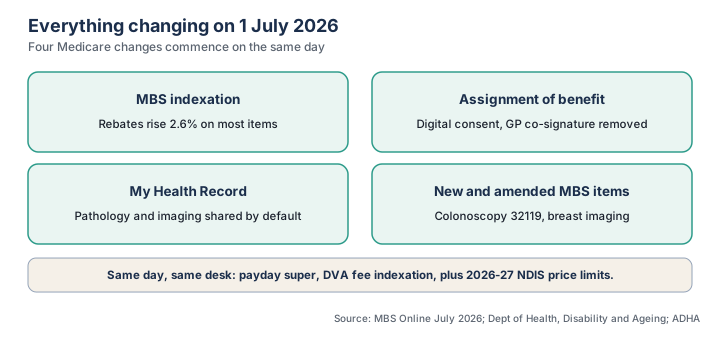
| Change | What it is | Who is affected | Action before 1 July |
|---|---|---|---|
| MBS indexation | 2.6% increase on most general medical services, diagnostic imaging, and pathology Groups P1, P4, P5, P6, P8, P12 | All practices billing Medicare | Update fee schedules and private billing gap calculations |
| Assignment of benefit | Digital SMS/email consent, GP co-signature removed, 2-year retention rule | Every practice that bulk bills | Confirm PMS readiness, train staff, register SMS sender ID |
| My Health Record sharing by default | Pathology and diagnostic imaging reports must be uploaded by default | Pathology and imaging providers; requesting practices indirectly | Confirm software conformance or apply for an extension |
| New MBS items | Colonoscopy 32119, breast items 45070 to 45072, HLA testing 73400, paediatric sleep studies | GPs, surgeons, pathology, sleep medicine | Map new items in billing software |
| Amended MBS items | Breast imaging restrictions removed, item 32222 amended, burn wound and cardiac monitoring changes | Imaging, endoscopy, relevant specialties | Review amended descriptors before claiming |
| DVA fee indexation | First annual 1 July indexation of compensation assessment fees; VETS Act commences | Practices seeing Veteran Card holders | Update DVA fee tables and quoting |
| Payday super | Superannuation payable at the same time as wages | Every employer | Confirm payroll software and cash flow readiness |
How much do Medicare rebates increase on 1 July 2026?
The indexation factor applied from 1 July 2026 is 2.6%, covering most general medical services items, most diagnostic imaging items (excluding PET and certain nuclear medicine modifier items), and, continuing the pathology indexation that began in July 2025, pathology items in Groups P1, P4, P5, P6, P8 and P12. The MBS Online July 2026 news page lists the full scope, and the standing Medicare indexation schedule explains which item groups are indexed each year.
For context, the RACGP's response called the 2.6% factor "better than a freeze" but inadequate: general CPI is running at 4.2%, health CPI at 4%, and approved private health insurance premium increases at 4.41%. Practices relying on indexation alone to cover rising wage and rent costs will go backwards in real terms, which is why the same announcement renewed calls for an independent body to set rebates. Attendance items for doctors without vocational registration are excluded from the uplift.
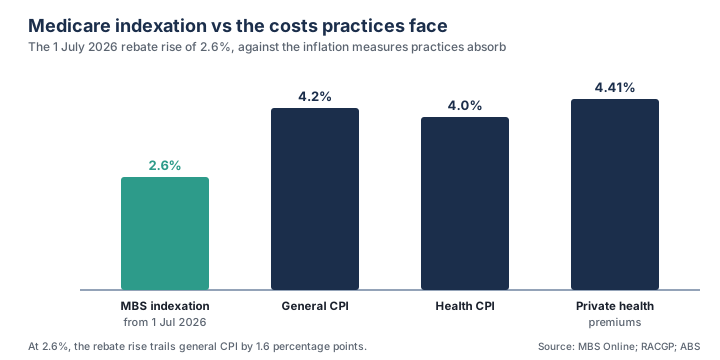
The operational task is simple but easy to miss: update your fee schedule, then re-check any standing gap calculations, informed financial consent scripts, and website fee pages that quote out-of-pocket amounts against the old rebate.
What happens to bulk billing consent on 1 July 2026?
The single biggest workflow change of the day. The new assignment of benefit (AoB) process for all Medicare bulk-billed and simplified billing services commences 1 July 2026: patients can assign their benefit through an SMS or email link to a PIN-protected web form, the GP co-signature requirement is removed, consent can be collected before or after the attendance, and practices must retain every signed agreement for 2 years. Paper remains a permanent fallback. The Department of Health, Disability and Ageing's assignment of benefit page carries the implementation guidance, and the AMA's summary confirms the commencement date.
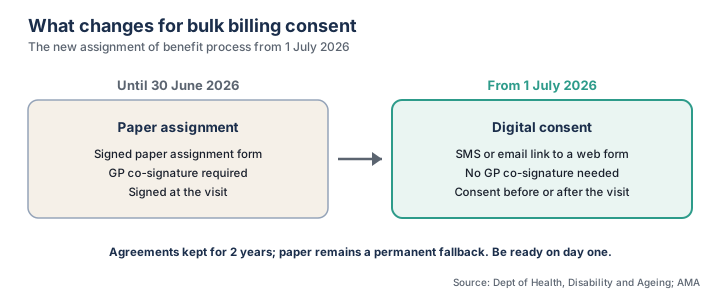
This change touches every bulk-billed visit, so it deserves its own preparation plan. Our dedicated guide to the assignment of benefit changes on 1 July 2026 covers the pre-assignment and post-assignment workflows, PMS vendor readiness, the ACMA SMS Sender ID Register, and a 10-step practice checklist. Note that enduring assignment agreements (one consent covering future visits) are not part of the 1 July commencement; the supporting regulations are still being developed.
Does My Health Record become mandatory on 1 July 2026?
Sharing by default begins 1 July 2026. Under the Modernising My Health Record (Sharing by Default) Act 2025, prescribed healthcare provider organisations must upload written pathology and diagnostic imaging reports to My Health Record by default, unless a specific exception applies (no My Health Record exists, the patient asks for a result not to be uploaded, or upload would create a safety risk). The Australian Digital Health Agency's program page sets out the scope: phase 1 covers written reports authored by a pathologist or radiologist, not the underlying images.
The legal duty in phase 1 sits primarily with pathology and diagnostic imaging providers, but general practices are affected operationally: patient questions about results appearing in their record, the interaction with delayed-release settings, and documenting patient requests not to upload. Non-compliance carries civil penalties, and the Commonwealth can recover Medicare benefits paid on non-compliant services. Providers whose software cannot comply can apply for an extension of time. Our guide to My Health Record sharing by default covers the four exceptions, penalties, and the practice preparation steps in full.
What new and amended MBS items start on 1 July 2026?
Beyond indexation, the July 2026 MBS update commences a batch of new and amended items. The headline additions:
- Item 32119: a new standalone colonoscopy item, created from item 32222, which is itself amended to remove the positive faecal occult blood test indication.
- Items 45070, 45071, 45072: new items for developmental breast abnormalities.
- Item 73400: human leukocyte antigen (HLA) testing to determine risk of hypersensitivity to carbamazepine or oxcarbazepine before prescribing.
- Item 73329: multi-gene panel testing for cholangiocarcinoma tumour tissue.
- Two new paediatric Level 2 polysomnography items for out-of-laboratory sleep studies, for children aged 3 to 11 and adolescents aged 12 to 18.
Significant amendments include removal of the restrictions that prevented claiming breast ultrasound (item 55812) or breast MRI (item 63464) with chest or abdominal wall ultrasound, removal of the multiple services rule for combined breast imaging, expansion of echocardiography item 55133 to cover monitoring of patients on cardiotoxic PBS medicines, and increased schedule fees for gallium-67 and thallium-201 nuclear imaging. Practices billing any affected specialty should review the amended descriptors on MBS Online before claiming from 1 July, since claiming against a superseded descriptor is a compliance exposure, not just a rejection. For how the Professional Services Review treats incorrect item use, see our guide to PSR enforcement trends in 2026.
What else lands on 1 July 2026 that is not strictly Medicare?
Three more changes share the date and usually land on the same practice manager's desk.
Payday super. From 1 July 2026 employers must pay superannuation at the same time as wages, rather than quarterly, with the Small Business Superannuation Clearing House closing the same day. The ATO's payday super guidance covers the mechanics. Our practice manager employment law guide covers the cash flow and payroll software implications for medical practices.
DVA fees and the VETS Act. DVA's compensation assessment fees, substantially increased on 9 February 2026, receive their first annual 1 July indexation in line with the MBS. The VETS Act also commences 1 July 2026, moving all new veteran compensation claims to a single improved MRCA. Rates, billing integrity rules, and the new item structure are in our DVA fee changes guide.
NDIS pricing. For practices that also deliver NDIS supports, the NDIA's 2026-27 Pricing Arrangements and Price Limits are expected to apply from 1 July 2026, but had not been published at the time of writing. Check the NDIA pricing arrangements page for the release, and budget time to update service agreements once the new price limits are out.
What is NOT changing on 1 July 2026
Several widely searched Medicare changes are often misattributed to this date:
- The bulk billing incentive expansion to all Medicare card holders and the Bulk Billing Practice Incentive Program (the additional 12.5% payment) commenced 1 November 2025. They are already in force. Our BBPIP compliance guide covers the eligibility and record-keeping rules.
- Medicare Safety Net thresholds index on 1 January each year, not 1 July.
- The GPCCMP transition (chronic condition management plans) has a grace period running to 30 June 2027; nothing additional changes on 1 July 2026.
- Enduring assignment of benefit agreements are flagged policy but not commencing; per-service consent still applies from 1 July 2026.
Practice readiness checklist before 1 July 2026
- Load the indexed MBS fees into your billing system and update any published fee or gap information.
- Confirm in writing that your PMS vendor's assignment of benefit module is production-ready, and complete staff training on the digital consent workflow.
- Register your practice SMS sender ID with the ACMA register if you will send AoB messages.
- If you are a pathology or imaging provider, confirm software conformance for sharing by default or lodge an extension application; if you are a requesting practice, brief clinicians on how uploaded results change patient conversations.
- Review new and amended MBS item descriptors relevant to your specialty mix before the first claim, not after the first rejection.
- Confirm payroll software is configured for payday super and model the cash flow impact of paying super every cycle.
- Update DVA fee tables for indexed compensation assessment rates if you see veteran patients.
- Diarise a post-commencement review for early August 2026: rejected claims, unsigned digital AoB rates, and any MHR upload exceptions logged.
Frequently Asked Questions
What is the Medicare indexation rate from 1 July 2026?
The indexation factor is 2.6%, applied to most general medical services items, most diagnostic imaging items, and pathology items in Groups P1, P4, P5, P6, P8 and P12. Certain attendance items for doctors without vocational registration, PET items, and specific nuclear medicine modifier items are excluded. The RACGP has criticised the factor as inadequate against general CPI of 4.2% and health CPI of 4%.
Do patient rebates go up on 1 July 2026?
Yes. Because schedule fees are indexed by 2.6%, the Medicare benefit paid against each indexed item rises proportionally from 1 July 2026. For bulk-billed services the practice receives the higher benefit directly. For privately billed services, the patient's rebate increases; whether out-of-pocket costs fall depends on whether the practice also raises its private fees.
What happens to bulk billing consent on 1 July 2026?
The new assignment of benefit process commences for all bulk-billed and simplified billing services. Patients can consent digitally via an SMS or email link, the GP co-signature is removed, consent can be collected before or after the visit, and signed agreements must be retained for 2 years. Paper forms remain available as a permanent fallback. Every practice that bulk bills needs its practice management software, staff training, and patient communication ready before the date.
Does My Health Record become mandatory for uploads on 1 July 2026?
For pathology and diagnostic imaging reports, yes. From 1 July 2026, prescribed providers must upload written pathology and diagnostic imaging reports by default under the Modernising My Health Record (Sharing by Default) Act 2025, unless an exception applies, such as a patient request or a safety risk. Civil penalties apply for non-compliance, and providers needing more time for software upgrades can apply for an extension.
What new MBS item numbers start on 1 July 2026?
New items include standalone colonoscopy item 32119, developmental breast abnormality items 45070, 45071 and 45072, HLA hypersensitivity testing item 73400, multi-gene panel testing item 73329 for cholangiocarcinoma, and two paediatric Level 2 out-of-laboratory sleep study items covering ages 3 to 11 and 12 to 18. Several existing items are amended on the same date, including item 32222 and the combined breast imaging items.
Is the bulk billing incentive expansion part of the 1 July 2026 changes?
No. The expanded bulk billing incentive for all Medicare card holders and the Bulk Billing Practice Incentive Program (the additional 12.5% payment for practices that bulk bill every MBS-rebated service) both commenced on 1 November 2025 and are already operating. The 1 July 2026 changes are the 2.6% indexation, the new assignment of benefit process, the My Health Record upload mandate, and the new and amended MBS items.
What should a practice manager prioritise first?
The assignment of benefit change carries the most operational risk because it touches every bulk-billed visit and depends on practice management software readiness, staff training, and patient communication all being in place on day one. Indexation is a fee table update. The My Health Record mandate mostly binds pathology and imaging providers in phase 1. Start with your PMS vendor's AoB go-live confirmation, then work down the checklist.