Key Takeaways
- The Health Insurance (Professional Services Review Scheme) Amendment (Prescribed Pattern of Services) Regulations 2026 (F2026L01049) were made by the Governor-General on 6 August 2026, registered on 12 August 2026 and commenced on 13 August 2026, the day after registration.
- DVA-funded attendances now count. New paragraphs 5A(1)(b) and 5B(1)(b) bring in any service rendered under a relevant DVA law that would have attracted a Medicare benefit under a listed item had it not been a DVA service.
- The DVA inclusion is not retrospective. New section 13 applies paragraphs 5A(1)(b) and 5B(1)(b) only to services rendered on or after 13 August 2026. DVA services before that date are not counted.
- The thresholds did not move. Section 8 of the Principal Regulations still sets 80 or more relevant services on each of 20 or more days in a 12-month period (80/20), and 30 or more relevant phone services on each of 20 or more days (30/20).
- The item lists were refreshed. All items in Group A48 (patient end support attendances by a GP providing clinical support, effective 1 March 2026) were added to the 80/20 list. No new items were added to the 30/20 list. Groups A18, A19, A39, A41, A42, A43 and A45, and Subgroups 20 and 41 of Group A40, were removed because they are no longer in the general medical services table.
- Referral is mandatory, not discretionary. A prescribed pattern of services is inappropriate practice under section 82(1A) of the Health Insurance Act 1973, and section 86(1A) requires the Chief Executive Medicare to refer the practitioner to the Director of the Professional Services Review. The only defence is exceptional circumstances under section 82(1B).
- In the PSR Director's update for September 2025, a GP who rendered 80 or more relevant services on each of 22 days agreed to repay $290,000 and be counselled; a GP who rendered 30 or more relevant phone services on each of 45 days agreed to repay $45,000 and be reprimanded.
The Medicare 80/20 rule is a prescribed pattern of services: 80 or more relevant services on each of 20 or more days in a 12-month period, which is deemed inappropriate practice and produces a mandatory PSR referral. From 13 August 2026, DVA-funded equivalents count toward that tally alongside Medicare services, under F2026L01049.
How this post has changed: published 24 March 2026 as an explainer of the rule mechanics and Medicare compliance enforcement, and rewritten on 19 August 2026 when the Prescribed Pattern of Services Regulations 2026 changed what actually counts. The thresholds are the same. The denominator is not.
What is the Medicare 80/20 rule?
The 80/20 rule is one of two circumstances prescribed in section 8 of the Health Insurance (Professional Services Review Scheme) Regulations 2019 (F2019L00180) that constitute a prescribed pattern of services. A practitioner meets it by rendering or initiating 80 or more relevant services on each of 20 or more days in a 12-month period. The second circumstance is the 30/20 rule: 30 or more relevant phone services on each of 20 or more days in the same period.
Three features are worth being precise about, because they are where practices misjudge their exposure.
It counts services, not patients. One consultation can generate more than one claimed service, so the daily tally rises faster than the appointment book suggests. The 20 days need not be consecutive: they are counted anywhere across a rolling 12-month period.
Meeting the threshold is the finding, not the start of an argument about it. Section 82(1A) of the Health Insurance Act 1973 provides that a practitioner engages in inappropriate practice if their provision of services constitutes a prescribed pattern of services, and section 86(1A) requires the Chief Executive Medicare to refer them to the Director of the Professional Services Review on becoming aware of that pattern. There is no discretion at the referral stage.
There is one statutory defence and it is narrow. Section 82(1B) provides that a prescribed pattern does not constitute inappropriate practice if a Committee could reasonably conclude that exceptional circumstances existed that affected the rendering or initiating of the services. That is a conclusion about the specific days, not a general plea about how busy the practice was. In the September 2025 PSR agreements the same sentence recurs case after case: exceptional circumstances did not exist that affected the rendering of services on those days.
What counts toward the 80/20 and 30/20 rules from 13 August 2026?
F2026L01049 repealed the old definitions of "relevant service" and "relevant phone service" and replaced them with new sections 5A and 5B. The explanatory statement gives two reasons: to make sure all relevant and up-to-date MBS items are included, and to clarify that equivalent services funded by the Department of Veterans' Affairs are also included.
| 80/20 rule (relevant services, section 5A) | 30/20 rule (relevant phone services, section 5B) | |
|---|---|---|
| Threshold | 80 or more on each of 20 or more days in a 12-month period | 30 or more on each of 20 or more days in a 12-month period |
| What counts | Most face to face, video and phone attendances by GPs and other practitioners in general practice, plus some specialist and consultant physician attendances: prolonged attendances, group therapy, public health physicians and emergency medicine specialists | Phone attendances by GPs and other practitioners in general practice, plus consultant physician phone services in Subgroup 8 of Group A40 |
| New from 13 August 2026 | All items in Group A48 (effective 1 March 2026); DVA-funded equivalents under paragraph 5A(1)(b) | No new MBS items; DVA-funded equivalents under paragraph 5B(1)(b) |
| Removed | Groups A18, A19, A39, A41, A42, A43, A45; Subgroups 20 and 41 of Group A40 | Subgroups 20 and 41 of Group A40; items 93302, 93305, 93308, 93311 (Group A41); items 93423, 93453 (Group A42); Subgroup 3 of Group A45 |
| Threshold changed? | No | No |
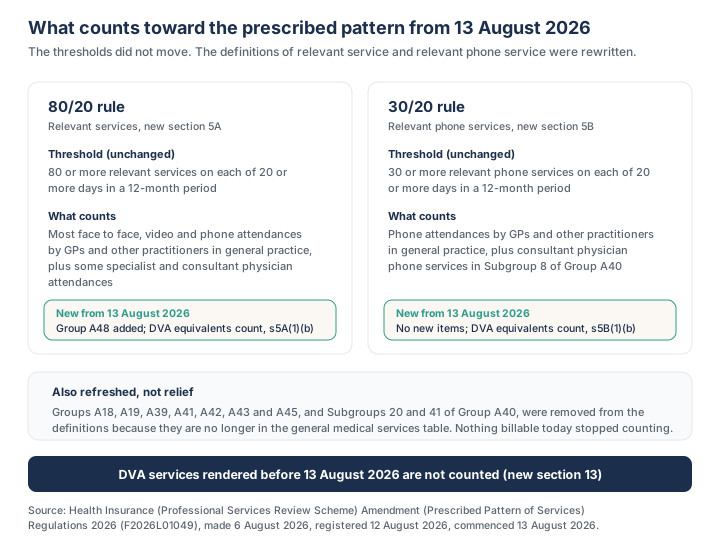
The removals are housekeeping rather than relief. The explanatory statement is explicit that those groups and subgroups "are no longer in the general medical services table", so nothing a practice can still bill today has stopped counting. The Principal Regulations had not been amended since 2022, and the MBS has moved on since.
The one genuine addition on the 80/20 side is Group A48, effective 1 March 2026 for patient end support professional attendances by a GP providing clinical support. If your practice took those items up in March, they have counted toward the 80/20 tally since 13 August.
Subsection 5A(2) lists the 80/20 items in four limbs.
| Limb of subsection 5A(2) | General medical services table items covered |
|---|---|
| Paragraph (a), whole groups | Groups A1, A2, A5, A6, A7, A9, A11, A13, A14, A15, A17, A20, A21, A22, A23, A27, A35 and A48 |
| Paragraph (b), Group A36 | Subgroups 1 and 4 |
| Paragraph (c), Group A40 | Subgroups 1, 2, 3, 10, 11, 13, 15, 16, 19, 21, 27, 28, 29, 39 and 40 |
| Paragraph (d), named items | 139 (Group A29); 90264 and 90265 (Group A36); 92142 (Subgroup 17 of Group A40); 92170 and 92171 (Subgroup 25); 92176 and 92177 (Subgroup 26) |
Subsection 5B(2) is much shorter: Subgroups 2, 8, 10, 16, 28 and 40 of Group A40, plus items 92176 and 92177 in Subgroup 26 of Group A40. Both sections carry a note that some services are specified in items set out in determinations under subsection 3C(1) of the Act, so the current MBS Online item descriptors remain the place to check any individual item.
How are DVA services counted toward the prescribed pattern?
This is the change that alters real numbers. The test in paragraph 5A(1)(b) has two parts. The service must be one to which paragraph (c) or (d) of the definition of "service" in subsection 81(1) of the Act applies, meaning it was rendered in connection with the provision of treatment under a relevant DVA law. And it must be of a kind for which a Medicare benefit would have been payable under one of the items listed in subsection 5A(2) had it not been a DVA service. Paragraph 5B(1)(b) applies the same test to the 30/20 phone list.
In practice it is a mirror test. Most DVA-funded health services mirror MBS-funded services, and DVA derives its GP fees from the MBS benefit, so the equivalence is usually obvious at item level. If you would have billed item 23 to Medicare for a non-veteran and billed the DVA equivalent instead, that service now counts.
The explanatory statement records that subsection 81(1) of the Act had already been amended to include services rendered under a relevant DVA law, but that a regulation change was "also necessary to effect this change in practice so DVA-funded services can be considered in investigations of potential inappropriate practice". F2026L01049 is that change. The PSR Agency and DVA both supported it, and feedback was sought from ACEM, AAPM, ACRRM, the AMA, RACP, the RACGP and the RDAA, with respondents generally supportive.
New section 13 sets the boundary. Paragraphs 5A(1)(b) and 5B(1)(b) apply only in relation to a service rendered on or after commencement, so DVA services rendered before 13 August 2026 do not enter the count. A 12-month review period spanning the change will therefore be mixed: Medicare services across the whole period, DVA services only from 13 August onward.
The exposed practices are those whose Medicare-only tallies already sit near the line and whose veteran caseload is significant: clinics in garrison towns and defence communities, practices doing residential aged care rounds with a high Gold Card population, and high-volume or after-hours models with a veteran-heavy book. Anyone told they were under the threshold on a Medicare-only report should treat that assessment as out of date from 13 August 2026.
How is a breach detected and what happens next?
The Department of Health, Disability and Ageing (DoHDA) sets this out in its fact sheet, Prescribed pattern of services (the 80/20 and 30/20 rules): how breaches are detected and what happens next. Detection is not complaint-driven: the department says it routinely monitors the Medicare claims of all medical practitioners to identify those approaching or exceeding the 80/20 or 30/20 level of servicing.
If you exceed either level you are reviewed under the Practitioner Review Program. Health Professional Advisers and senior departmental staff hold delegated powers of the Chief Executive Medicare, and one of those delegates handles the review. The delegate verifies that the servicing data indicates a breach, and may invite a written submission with further information. That submission is optional: the fact sheet states you are not required to make one.
Once the review is complete, a request is made to the Director of PSR with the reasons for it and the information behind it, which may include Medicare servicing data, prescribing data and anything you submitted. You are notified in writing. The department is careful to say a request to the Director "is not a final or determinative decision regarding whether inappropriate practice has occurred". From that point the PSR is an independent authority and further contact is directly between you and the PSR.
The PSR Director's updates publish the agreements reached under section 92 of the Act. In the September 2025 update, a GP reviewed for MBS items 23 and 5020 and for a prescribed pattern of services had rendered 80 or more relevant services on each of 22 days, and agreed to repay $290,000 and be counselled. In the same update, a GP who rendered 30 or more relevant phone services on each of 45 days agreed to repay $45,000 and be reprimanded, and two further GPs were found to have rendered 30 or more on each of 51 and 29 days. In each of those matters the Director's or Associate Director's persisting concerns included that exceptional circumstances did not exist that affected the rendering of services on those days. For what else the PSR has been targeting, including care plan documentation, see our PSR compliance trends analysis.
The wider posture sits in the department's Health Provider Compliance Strategy 2025-30, published 25 September 2025, which describes a risk and proportion-based approach aimed at preventing incorrect claiming.
What should practices do now?
The change is small on paper and operational in effect. Five actions cover it.
Add DVA to whatever servicing report you already run. If your daily service count per practitioner is built from Medicare data alone, it is now measuring the wrong thing. From 13 August 2026 it must combine Medicare and DVA attendances for each practitioner, each day. This is the action most likely to be missed, because nothing on the Medicare side changed.
Set a working threshold below the statutory one. Flag any day where a practitioner reaches 70 combined services, or 25 combined phone services, and review the pattern monthly rather than annually. Twenty days is not many across a rolling year.
Treat the 12-month window as rolling. Days do not reset in July. A practitioner who accumulated 14 qualifying days between September and December carries them into the following year until they age out.
Know your exception argument before you need it. Section 82(1B) is the only defence and it is assessed against the specific days. If a practitioner had genuinely exceptional circumstances (a disaster response, a sole remaining practitioner in a town, an outbreak surge), the contemporaneous record of those days is the evidence. Recreating it a year later is much weaker.
Keep the clinical record able to substantiate each item billed. The findings that carry the largest repayments combine the prescribed pattern with concerns that MBS item requirements were not met, or that record keeping relied on templates lacking personalisation. The count triggers the referral; the records decide what happens after it.
Practices working through the bulk billing assignment of benefit changes can fold both into one quarterly Medicare compliance review, since the evidence trail is the same.
Frequently Asked Questions
Do DVA services count toward the 80/20 rule?
Yes. From 13 August 2026, paragraph 5A(1)(b) of the Health Insurance (Professional Services Review Scheme) Regulations 2019 counts any service rendered under a relevant DVA law that would have attracted a Medicare benefit under a listed item had it not been a DVA service. Paragraph 5B(1)(b) does the same for the 30/20 phone rule.
Since when do DVA services count?
Only for services rendered on or after 13 August 2026. New section 13, inserted by F2026L01049, applies paragraphs 5A(1)(b) and 5B(1)(b) to services rendered on or after commencement. DVA services rendered before that date are not included in a prescribed pattern calculation, so a review period spanning the change will be mixed.
Does the 30/20 rule count DVA phone consultations?
Yes. Paragraph 5B(1)(b) mirrors the 80/20 test for phone services: a DVA-funded phone attendance counts if a Medicare benefit would have been payable for it under one of the items in subsection 5B(2). The same 13 August 2026 start date applies, and the 30 services on each of 20 days threshold is unchanged.
Did the 80/20 or 30/20 thresholds change on 13 August 2026?
No. Section 8 of the Principal Regulations was not amended. The 80/20 rule is still 80 or more relevant services on each of 20 or more days in a 12-month period, and the 30/20 rule is still 30 or more relevant phone services on the same day count. What changed is the definition of which services are relevant.
Is telehealth included in the 80/20 rule?
Yes. The explanatory statement states the 80/20 rule applies to most face to face, video and phone attendances by general practitioners and other medical practitioners in general practice. Phone attendances count toward both rules at once, so 30 phone consultations in a day also contribute 30 services to that day's 80/20 tally.
Which MBS items were added or removed on 13 August 2026?
All items in Group A48, effective 1 March 2026 for patient end support attendances by a GP providing clinical support, were added to the 80/20 list. No items were added to the 30/20 list. Groups A18, A19, A39, A41, A42, A43 and A45 and Subgroups 20 and 41 of Group A40 were removed because they are no longer in the general medical services table.
Is the referral to the PSR automatic?
Yes. Section 86(1A) of the Health Insurance Act 1973 requires the Chief Executive Medicare to refer a practitioner to the Director of the Professional Services Review on becoming aware of a prescribed pattern of services. A delegate first verifies the servicing data under the Practitioner Review Program, but there is no discretion to decline the referral once a breach is confirmed.
Can I explain a breach before it goes to the PSR?
Partly. The delegate may invite a written submission, and the department confirms you are not required to provide one. Anything you do submit goes to the Director with the request. The statutory defence is exceptional circumstances under section 82(1B), and it is a Committee, not the delegate, that assesses whether they existed.
Does a request to the Director mean inappropriate practice has been found?
No. The department states that a request to the Director is the initial step in reviewing the provision of professional services and "is not a final or determinative decision regarding whether inappropriate practice has occurred". The Director then proceeds under the statutory process, which includes opportunities to be informed and to make submissions.