Why this matters for your practice
Four of the five indicators in criterion GP2.2 carry the mandatory symbol: GP2.2 A, B, C and E. Indicators marked with that symbol must be met to achieve accreditation; those without it are aspirational, encouraged but not essential. GP2.2 D, patient reminders, is the criterion's only aspirational indicator.
The second consequence is medico-legal. The criterion puts it plainly: "Failure to recall a patient may result in an adverse outcome and the responsible practitioner may face medico-legal action."
What is a recall and reminder system?
A recall and reminder system is the process a general practice uses to bring patients back when follow-up is clinically needed, and to prompt preventive care when it is due. The Standards glossary defines a recall as "The process of requesting a patient to attend a consultation to receive further medical advice on matters of clinical significance", and has no entry for a reminder. The criterion supplies both: "A recall occurs when a GP decides that a patient needs to be reviewed within a specified period" and "A reminder occurs when a patient is added to a recommended preventive activity list that is managed on a periodic basis."
The system is the whole loop, not the software feature: the practice reviews incoming results and correspondence, decides what is clinically significant, contacts the patient, and records every attempt in the health record. In the RACGP Standards it is criterion GP2.2, "Follow-up systems", in the General practice module under GP Standard 2 "Comprehensive care". Where clinical triage is the front door, deciding who is seen first, recall is the back door, deciding who has to be brought back.
What is the difference between a recall and a reminder?
A recall is clinically driven and a reminder is preventive. The 6th edition uses the same split, describing recall as "the process of requesting a patient to attend a consultation to discuss significant clinical matter/s" and reminders as "proactive prompts given to patients to visit their practice for routine or important tasks related to their health".
The 5th edition criterion's recall examples run from a clinically significant test result to "after significant referrals (eg after a mental health assessment by a psychologist or psychiatrist)" and "after diagnosis of a significant condition, such as type 2 diabetes". Its reminder examples are patients "in the high-risk age bracket for influenza", those "due for immunisations", and those "due for a routine screen, such as a Pap smear or mammogram".
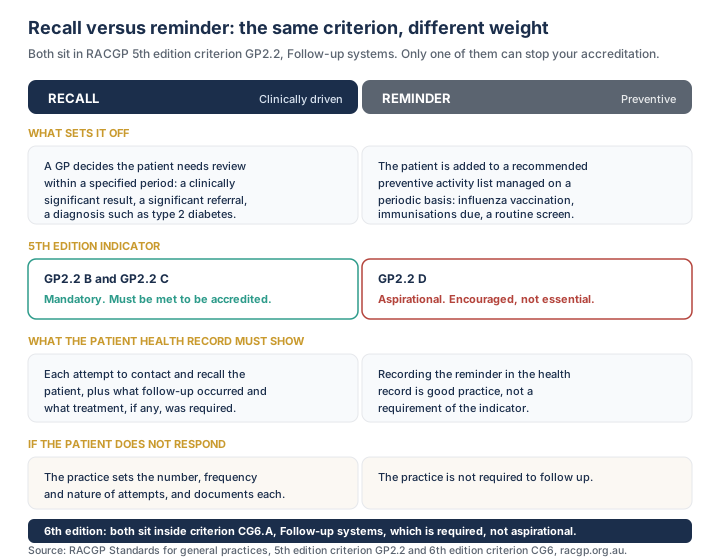
| Recall | Reminder | |
|---|---|---|
| What sets it off | A GP decides a patient needs review within a specified period, for example a clinically significant test result, a significant referral, or a diagnosis such as type 2 diabetes | The patient is added to a recommended preventive activity list managed on a periodic basis, for example influenza vaccination, immunisations due, or a routine screen |
| 5th edition indicator | GP2.2 B and GP2.2 C | GP2.2 D |
| Mandatory in the 5th edition | Yes | No, GP2.2 D is aspirational |
| 6th edition | Inside CG6.A, which is required | Inside CG6.A, which is required |
| What the record must show | Each attempt to contact and recall the patient, and what follow-up occurred and what treatment, if any, was required | Recording the reminder in the health record is good practice, not a requirement |
| If the patient does not respond | The practice determines the number, frequency and nature of further attempts and documents each one | The practice is not required to follow up |
Practices are assessed against the 5th edition today. The 6th edition consolidates results, recalls and reminders into criterion CG6, "Follow-up systems", in the Clinical governance standard, and the RACGP mapping document maps CG6.A "Managing results, recalls and reminders" to GP2.2A-D and classifies the change as "Expanded". Reminders stop being aspirational there: CG6.A requires a process "for the initiation, management and documentation of patient reminders", and CG6 carries no aspirational label, so the rule that "All criteria in the Standards need to be met to achieve accreditation, apart from Aspirational Criterion" catches it. The RACGP says transition arrangements, "including timing and accreditation requirements, will be communicated by the Australian Commission on Safety and Quality in Health Care". No date has been published; the Commission's dedicated page for the 6th edition says accreditation currently uses the 5th edition and that arrangements will be provided in due course.
What does a compliant recall and reminder system have to do?
Each mandatory indicator carries a "You must" list. GP2.2 A requires that pathology results, imaging reports, investigation reports and clinical correspondence the practice receives are reviewed, electronically notated (or signed or initialled if on paper), acted on where required, and incorporated into the patient health record.
GP2.2 B requires the practice to "have a process for recalling patients with clinically significant results" and to "document in the patient's health record each attempt to contact and recall patients about clinically significant results". The criterion states it directly: "You must have a process for recalling patients."
GP2.2 C requires the practice to "document in the patient's health record what follow-up has occurred and what treatment, if any, was required", to "educate the practice team members so they can tell patients about the process to receive results", and to "document conversations about test results in the patient's notes". GP2.2 E requires a documented policy for high-risk results identified outside normal opening hours, and the contact details of the ordering practitioner, a delegated practitioner or an after-hours service given to diagnostic services.
Two rules sit across all of them. The first is induction: "Your induction process must cover the recall system." The second is the meaning of the trigger. "'Clinically significant' does not necessarily mean only 'abnormal' results." The criterion's own example is that "a normal mammogram in a woman with a breast lump or a normal electrocardiogram in a patient with chest pain does not eliminate the need for further consultation, investigation and management", and the two factors it says to weigh are "The probability that the patient will be harmed" and "The seriousness of the harm".
The Standards set no figure for contact attempts. The practice determines the number, frequency and nature of them. The RACGP's example of good practice, and it is an example rather than a rule, is to "make up to three telephone calls at different times of the day and then attempt to contact the patient via mail and/or email. Document each attempt in the patient's health record." Our Recall and Reminder System Policy template sets that out as a written procedure.
Are recalls and reminders direct marketing under the Privacy Act?
Under the Australian Privacy Principles, direct marketing "involves the use and/or disclosure of personal information to communicate directly with an individual to promote goods and services". The OAIC's guide to health privacy says: "You can only use or disclose a patient's health information for direct marketing if the patient has provided consent. A patient's health information includes name and contact details." Under APP 7 that consent requirement holds "even if the individual and the organisation have a pre-existing relationship", and a patient can ask not to receive direct marketing, free of charge, within a period that "would be no more than 30 days".
The boundary to hold is between a clinical recall or preventive prompt and a message promoting a service. The OAIC has published no exception that settles where a recall sits, so keep the two message types, and their consent records, separate.
What the regulator or assessor expects
Retained evidence, not a description. Expect to produce the documented recall process and evidence that induction covers it; records in the health record of each contact attempt and its outcome, including what follow-up occurred and what treatment, if any, was required; and the high-risk after-hours policy with the contact details given to diagnostic services. The recall system is one of the clinical safety systems inside a practice's clinical governance framework, alongside significant event analysis, and it is one of the failures that stop practices at assessment.
Do not confuse your list with a national register's. The National Cancer Screening Register says it "supports these life-saving programs by inviting and reminding eligible people to screen, and creates a safety net by prompting participants to take the next steps on their screening journey", and practices reach it through the Healthcare Provider Portal or clinical software integration. Its prompts and your reminder list are two separate systems, and neither replaces the other.
The 6th edition adds an expectation about how patients are contacted: "For patients who may be at risk, the practice needs to use discreet or privacy-sensitive recall methods, including verifying preferred and safest contact channels before sending reminders or follow-up messages", documented "in a way that does not escalate any known or suspected risks".
Common mistakes
Treating reminders as the recall system. A practice that sends influenza vaccine texts but has no process for recalling patients with clinically significant results has answered the aspirational indicator and missed the two mandatory ones.
Recalling only abnormal results. "Clinically significant" is not the same as abnormal. A normal mammogram in a woman with a breast lump, or a normal electrocardiogram in a patient with chest pain, does not eliminate the need for further consultation, investigation and management.
Assuming a result ordered elsewhere is somebody else's problem. Responsibility rests with the health professional who ordered the test, unless they have made a prior agreement with the GP. That still includes results ordered by a specialist and copied back to a GP's inbox.
No record of the attempts. The practice must document in the health record each attempt to contact and recall patients about clinically significant results. An undocumented phone call is not evidence, at assessment or afterwards.
Leaving the recall system out of induction. "Your induction process must cover the recall system" is a must, not a could. A new staff member who cannot explain how results reach a GP and how a patient is recalled is a gap an assessor finds in a conversation. To map your own gaps, start with getting started with accreditation, the accreditation readiness quiz, or the RACGP accreditation knowledge base.
Frequently asked questions
What is the difference between a recall and a reminder?
A recall occurs when a GP decides a patient needs to be reviewed within a specified period, for example after a clinically significant test result. A reminder occurs when a patient is added to a recommended preventive activity list managed on a periodic basis, such as a prompt for an influenza vaccination. Recalls sit under GP2.2 B and GP2.2 C, which are mandatory. Reminders sit under GP2.2 D, which is aspirational.
Is a recall system mandatory for RACGP accreditation?
Yes. GP2.2 B and GP2.2 C both carry the mandatory symbol, so a practice must demonstrate it meets them to be accredited. The practice must have a process for recalling patients with clinically significant results, document each attempt to contact and recall the patient, and document what follow-up occurred and what treatment, if any, was required.
Are patient reminders mandatory for RACGP accreditation?
No. GP2.2 D, "Our practice initiates and manages patient reminders", does not carry the mandatory symbol and has only a "You could" list. Aspirational indicators are encouraged but are not essential to achieve accreditation. That changes in the 6th edition, where reminders move inside CG6.A, which is required.
Do I have to follow up a patient who ignores a reminder?
No. The criterion says: "If your practice sends a reminder to a patient and the patient does not make an appointment, the practice is not required to follow up, although it is good practice to record the reminder in the patient's health record." A recall is different. There, the practice determines the number, frequency and nature of contact attempts and documents each one.
How many times do I have to try to contact a patient for a recall?
There is no fixed number in the Standards. The practice determines the number, frequency and nature of the attempts. The RACGP's example of good practice is up to three telephone calls at different times of the day, then mail and/or email, documenting each attempt in the patient's health record. That is an example, not a rule.
Does the recall system cover results ordered by a specialist?
Yes. Responsibility for the timely review and action on tests and results ultimately rests with the health professional who ordered the test, unless they have made a prior agreement with the GP, and that includes pathology and diagnostic test results ordered by a specialist or other health professional that are sent back to the GP. The result still arrives at your practice and still has to be handled.
What is the recall and reminder criterion in the 6th edition?
Criterion CG6, "Follow-up systems", in the Clinical governance standard. It has two criteria: CG6.A, which covers acting on clinical information in a timely manner and folds results, recalls and reminders together, and CG6.B, which covers high-risk results identified outside normal opening hours. Neither is aspirational. Practices are assessed against the 5th edition today, and transition timing has not been published.
Related terms
Go deeper
Last reviewed