Run five checks on every NDIS therapy claim line with the Support Catalogue 2026-27 open: discipline item (by age band and budget), credential on the date of service, suffix, catalogue dates and service agreement. From 24 September 2026 Pricing Schedule prices become legal maximums for NDIA-managed and plan-managed funding, and 22 legacy items end on 30 September 2026.
This guide is the procedure. Who may claim each rate, and why, is in who can claim each NDIS therapy rate; the wider obligations sit under NDIS provider compliance.
Before you begin
Have these open:
- The NDIS Support Catalogue 2026-27, both sheets: Current Support Items (976 items) and Legacy Support Items (41 items), version 1.1 or later. The NDIA page (current as of 3 July 2026) shows no newer version; confirm yours against it.
- The NDIS Pricing Schedule 2026-27, version 1.2 (published 22 July 2026, effective 1 July 2026), from the NDIA pricing arrangements page.
- The NDIS Pricing Arrangements and Price Limits (PAPL) 2025-26, version 1.1, from the same page. The 2026-27 rules document was still unpublished on 23 September 2026, so this remains the working reference for credentials and claiming conditions (see the 2026-27 claiming rules gap).
- Your claims export, each practitioner's credential record, and the signed service agreements.
The National Disability Insurance Scheme (Pricing Arrangements) Determination 2026 (F2026L01268), made on 16 September 2026 under section 45C of the NDIS Act and registered on 23 September 2026, takes effect on 24 September 2026. It makes the Pricing Schedule 2026-27 the source of the maximum amount for each support. Under section 45C of the NDIS Act, that maximum applies only where the Agency or a registered plan management provider manages the funding, not to self-managed participants. A provider must not charge more; the Agency may refuse a claim above it or pay the maximum, and the excess is a debt due to the Agency. The determination is still subject to parliamentary disallowance.
The worked example: an occupational therapist, a participant aged 9 or older with an Improved Daily Living budget, a 50-minute home session, and 30 minutes of travel to the participant in an MMM1-3 area.
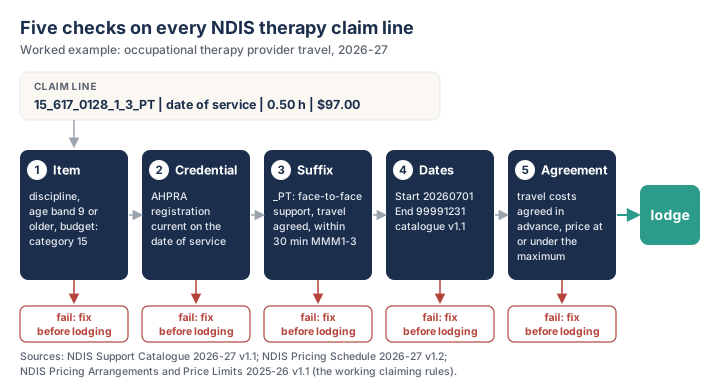
Step 1: Identify the discipline item
Choose the item in three passes: discipline, then the participant's age band, then the budget the funding sits in. The 2025-26 PAPL describes the Early Intervention Supports for Early Childhood items (registration group 0118) as for "a child (younger than 9)" and the Therapy Supports items (registration group 0128) as for "participants (9 or older)". The support category follows the participant's plan budget, not the support: 15 Improved Daily Living Skills, 1 Assistance with Daily Life, or 10 Finding and Keeping a Job. The five occupational therapy direct service items are all $193.99 national per hour in 2026-27:
15_617_0128_1_3Therapy - Occupational Therapist - Direct Service (group 0128, category 15)01_661_0128_1_3Therapy - Occupational Therapist - Direct Service (group 0128, category 1)10_617_0128_5_3Employment Therapy - Occupational Therapist - Direct Service (category 10)15_617_0118_1_3ECI Professional - Occupational Therapist - Direct Service (group 0118, category 15)01_650_0118_1_3ECI Professional - Occupational Therapist - Direct Service (group 0118, category 1)
The worked example lands on 15_617_0128_1_3.
The 2025-26 PAPL says "where a line item exists for a specific type of professional, supports of that type need to be made against that item", and gives the example: "Art Therapy must be claimed using the Art Therapist line item and Music Therapy must be claimed under the Music Therapist line item, not under 'Other Professional' or any other listed professional."
| Discipline | Item number | 2026-27 national rate per hour | Credential that gates it (2025-26 PAPL) |
|---|---|---|---|
| Occupational therapist | 15_617_0128_1_3 | $193.99 | "a current Australian Health Practitioner Regulation Agency (AHPRA) Registration as an Occupational Therapist" |
| Physiotherapist | 15_055_0128_1_3 | $183.99 | "a current AHPRA Registration as a Physiotherapist" |
| Speech pathologist | 15_622_0128_1_3 | $193.99 | "a Certified Practising Speech Pathologist (CPSP) as approved by Speech Pathology Australia" |
| Psychologist | 15_054_0128_1_3 (also 01_701_0128_1_3) | $252.99 | "a current AHPRA Registration as a Psychologist", including paid provisionally registered psychologists operating under supervision |
| Counsellor | 15_043_0128_1_3 | $156.16 | A member of the Australian Counselling Association, an accredited Registrant with the Psychotherapy and Counselling Federation of Australia, or an AHPRA provisionally registered psychologist "operating as a paid unsupervised practitioner" |
| Other Professional | 15_056_0128_1_3 (also 01_741_0128_1_3) | $156.16 | Not one of the listed professionals, but someone the provider considers "an appropriate professional to deliver therapeutic supports" in line with the NDIS Commission's requirements for the Therapeutic Supports Registration Group |
| Other Early Childhood Professional (under 9) | 15_005_0118_1_3 (also 01_740_0118_1_3) | $193.99 | Does not meet the other definitions but "has a bachelor's degree or higher in their relevant area and holds current registration or membership with their relevant registration and or professional body" |
| Therapy Assistant Level 1 | 15_052_0128_1_3 | $56.16 | Works "under the delegation and direct supervision at all times of a therapist" |
| Therapy Assistant Level 2 | 15_053_0128_1_3 | $86.79 | Works under a therapist's delegation and supervision, where the therapist "is satisfied that the therapy assistant is able to work independently without direct supervision at all times" |
Therapy items have no weekend, evening or public holiday rates. The full discipline list, including dietetics, exercise physiology, social work and audiology, is in the eligibility article linked above.
Step 2: Check the credential gate
Test the credential that was current on the date of service, not the one held today. A lapsed credential makes the claim incorrect regardless of the clinical work. Use primary evidence (the registration number or membership certificate), never a CV. Every 2025-26 PAPL definition names an external body or registration, and most are not AHPRA: among the therapy disciplines, only occupational therapists, physiotherapists, podiatrists and psychologists are gated by AHPRA registration. The NDIS Commission's verification module assesses the same records. Its Human Resource Management outcome requires that "Records of worker identity, right to work, pre-employment checks, qualifications and/ or experience are maintained" (NDIS Practice Standards). In the worked example, the occupational therapist's AHPRA registration must have been current on the session date, and how to verify AHPRA registration covers that lookup.
Provisional psychologists. Two Pricing Schedule notes decide the item. The Psychologist direct service items include "paid provisionally registered Psychologists operating under supervision". The Counsellor item 15_043_0128_1_3 says "Paid unsupervised provisionally registered psychologists can claim using this line item." The gap is $96.83 an hour, calculated from the two rates and not published by the NDIA.
Therapy assistants. Level 1 needs "direct supervision at all times"; Level 2 applies once the therapist is satisfied the assistant can work without it. That gap is $30.63 an hour, also calculated. At both levels, "the therapy assistant must be covered by the professional indemnity insurance of the supervising therapist (or the therapist's or therapy assistant's employing provider)".
Other Professional. Therapists outside the named definitions "but who have been accepted by an approved quality auditor of the NDIS Commission as having the relevant qualifications, expertise and experience should use the 'Other Professional' support item". No credential definition was found for the Orientation and Mobility Specialist item (15_626_0128_1_3, $156.16) in the PAPL or the Pricing Schedule.
Step 3: Check the suffix
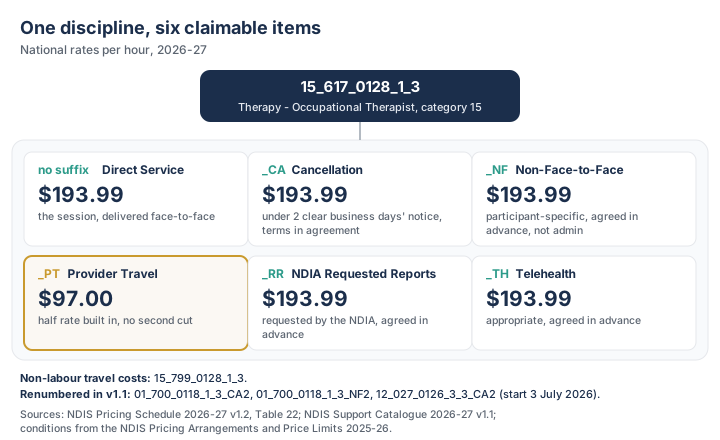
The suffix must match what was done, and each activity is its own claim line. In 2026-27 every therapy item has six variants: no suffix (Direct Service), _CA (Cancellation), _NF (Non-Face-to-Face), _PT (Provider Travel), _RR (NDIA Requested Reports) and _TH (Telehealth). Catalogue v1.1 shows N in all five claim-type columns for every therapy item, so the suffix is what tells the activities apart. Claim by time: "Where a provider delivers less than a full unit of support, they should claim according to the time spent delivering the support", and "Claims must be made by either claiming a quantity of units or of hours, not both." The conditions for each suffix are still the 2025-26 PAPL conditions, because the 2026-27 rules document has not been published.
| Suffix | What it claims | When it may be used (2025-26 PAPL) | Worked item and national rate |
|---|---|---|---|
| (none) | Direct service, face-to-face | Delivered to the participant | 15_617_0128_1_3, $193.99 |
_CA | Short notice cancellation | Less than 2 clear business days' notice or a no-show, no alternative billable work found, terms in the service agreement | 15_617_0128_1_3_CA, $193.99 |
_NF | Participant-specific work away from the participant | Part of delivering a specific support to that participant, agreed in advance, not administration | 15_617_0128_1_3_NF, $193.99 |
_PT | Travel to deliver a face-to-face support | Travel costs agreed in advance, within the MMM time limit | 15_617_0128_1_3_PT, $97.00 |
_RR | A report the NDIA requested | Requested by the NDIA, agreed in advance | 15_617_0128_1_3_RR, $193.99 |
_TH | Telehealth delivery | Telehealth is appropriate, agreed in advance | 15_617_0128_1_3_TH, $193.99 |
Non-face-to-face (_NF). The work must be "part of delivering a specific disability support item to that participant", not "a general activity such as enrolment, administration or staff rostering". Bookings, payment claims and service agreement drafting are administration, not billable.
Provider travel (_PT). The primary support must be delivered face-to-face and the travel costs agreed in advance. The limit is "up to 30 minutes of travel to and from each participant in MMM1-3 areas and up to 60 minutes in MMM4-5 areas for each eligible worker", classified by where the participant is, with no limit in Remote (MMM6) and Very Remote (MMM7) areas. The _PT rate is already half the direct rate, so apply no second cut. Tolls, parking and vehicle costs go on 15_799_0128_1_3; the NDIA considers up to $0.99 a kilometre reasonable.
Short notice cancellation (_CA). Less than two clear business days' notice, or a no-show, and only where the provider "was not able to find alternative billable work for the relevant worker". It "can claim up to 100% of the agreed fee", and "The NDIA will monitor claims for cancellations".
NDIA requested report (_RR). Only where "The report is requested by the NDIA": a report at the start of a plan or at plan review, or one "stipulated as being required in a participant's plan". Other participant-specific report writing goes on _NF.
The worked example gives two lines. The session is 0.83 hours on 15_617_0128_1_3 at $193.99, which is $161.66, the PAPL's own figure. The travel goes on 15_617_0128_1_3_PT, per the PAPL's own example: "where an Occupational Therapist travelled 30 minutes to a participant, the price limit for this travel time would be $48.50, not $97.00". Any kilometres make a third line.
Three items carry a "2" on the suffix after renumbering in version 1.1 on 3 July 2026: 01_700_0118_1_3_CA2 and 01_700_0118_1_3_NF2 (ECI Professional - Psychologist) and 12_027_0126_3_3_CA2 (Therapy - Exercise Physiologist - Cancellation). What they replaced is not confirmed. The 2025-26 PAPL also tells providers to claim these activities through a myplace portal option against the same item; the NDIA has not said how that fits the suffixed items, so claim the suffixed item.
Step 4: Check the catalogue end date
Open the Current Support Items sheet, find the exact item string including its suffix, and read the Start date and End Date columns. Dates are eight-digit numbers: 20260701 is 1 July 2026, and 99991231 is the open-ended date every current item carries. The service date must sit between the two. Then search the Legacy Support Items sheet. For therapy lines this is mostly about loading the current file: no legacy item is a therapy item, and every current therapy item ends 99991231. Most therapy items start 20260701, but the three renumbered items start 20260703, and 15_626_0118_1_3 (ECI Professional - Orientation Mobility Specialist - Direct Service) starts 20260702. The NDIA has not said whether a service date before the start date is rejected, so keep every date inside the range.
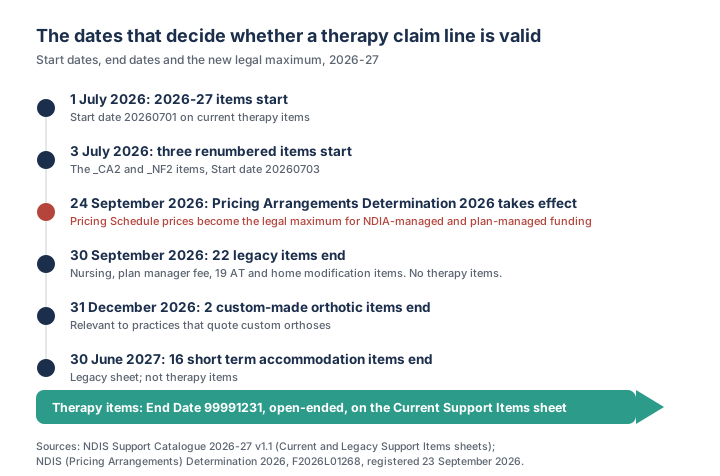
The legacy sheet matters if you quote assistive technology, as occupational therapists and physiotherapists often do. The 22 items ending on 30 September 2026 include 19 assistive technology and home modification items, such as 05_091203111_0103_1_2 Shower Commode - Wheeled; whether those dates will be extended is unknown. Two custom-made orthotic items end on 31 December 2026. After an end date the claim fails, and because the support has usually been delivered by then, the rejection is lost revenue rather than a correctable error. The 22 items retiring on 30 September 2026 lists each one with its replacement.
A payment request carries the dates of support and the support item reference number and price (NDIA guide to getting paid). A line that fails the NDIA's claim validation check shows as "rejected". The listed reasons include "administrative errors like wrong dates", a duplicate claim, and "the claim includes a unit price that is more than the maximum price" (how to troubleshoot claims and payments).
Step 5: Check the service agreement
For each suffix on the line, the service agreement must already have agreed that activity. The 2025-26 PAPL makes prior agreement in the service agreement a condition of claiming non-face-to-face time, provider travel, NDIA requested reports and telehealth, and says cancellation terms should be documented there. The price claimed must match the agreed price and sit at or under the Pricing Schedule maximum. A changed price needs agreement first: "Participants must agree to the changes before they are made." An agreement that names only the old single item number does not cover the suffixed travel, report or non-face-to-face items. Written agreements are only mandatory for specialist disability accommodation supports, but the conditions above still need the participant's agreement in advance.
In the worked example, the agreement must set out the travel costs, cancellation terms and session price. The NDIA's participant guidance says a good agreement includes "the price you will pay", "the cost of travel for your provider" and "your provider's cancellation policy" (what a service agreement is).
Providers audited against the Core Module of the Practice Standards also need an agreement that "specifies any conditions attached to the delivery of supports, including why these conditions are attached", and, where it is written, a copy "signed by the participant and the provider". Drafting and the price-change process are in updating service agreements for price changes.
What good looks like
A clean batch has a practitioner mapping behind it, one line per activity, and agreements that cover each suffix. These mistakes turn into rejections, or debts.
No practitioner mapping. Keep one row per practitioner: discipline, credential, expiry date, item number, age band and budget. A lapsed credential fails the line however good the clinical note is.
Travel over the MMM limit. Travel beyond 30 minutes in MMM1-3 areas or 60 minutes in MMM4-5 areas does not meet the condition, even on the right item.
Travel or report time bundled into the direct service item. The session, the travel and any report are separate lines.
Reports on the wrong suffix. An NDIA requested report belongs on _RR; a progress report the NDIA did not ask for belongs on _NF. Check who asked before you pick.
Other Professional as a fallback. Where a named item exists for the professional, the claim goes on it.
Software on a catalogue older than version 1.1. The three renumbered items start on 3 July 2026, and software loaded with an earlier file may not hold them.
A price above the Pricing Schedule from 24 September 2026. For NDIA-managed and plan-managed funding, the Agency may refuse the claim or pay the maximum, and the excess is a debt due to the Agency. The explanatory statement adds that the maximum "is not an amount that a provider is automatically entitled to charge or receive".
Next, run the five checks over every therapy line lodged since 1 July 2026, before 30 September 2026. If the review turns up gaps in worker records, the NDIS compliance quiz checks the wider registration picture.
Frequently asked questions
How do I check an NDIS therapy line item before I claim?
Run five checks with the NDIS Support Catalogue 2026-27 open. The discipline item fits the participant's age band and plan budget. The credential was current on the date of service. The suffix matches what was done. The service date sits between the item's Start date and End Date. The service agreement agreed that activity and price in advance.
Can I claim a higher-paying NDIS therapy item if my practitioner holds two credentials?
No. The 2025-26 PAPL says that where a line item exists for a specific type of professional, supports of that type are claimed against that item. The support delivered decides the item, not the best-paid credential. A paid provisional psychologist claims the Psychologist item under supervision and the Counsellor item 15_043_0128_1_3 without it.
Which item do I use for therapy travel under the NDIS in 2026-27?
Use the _PT variant of the discipline item, for example 15_617_0128_1_3_PT for occupational therapy at $97.00 national per hour, already half the direct rate. The travel costs must be agreed in advance and the time kept within 30 minutes in MMM1-3 areas or 60 minutes in MMM4-5 areas. Tolls and parking go on 15_799_0128_1_3.
Are any NDIS therapy line items retiring on 30 September 2026?
No. None of the 41 items on the Legacy Support Items sheet is a therapy item, and every current therapy item carries End Date 99991231. The 22 items ending that day are two community nursing items, the plan manager item and 19 assistive technology and home modification items.
What happens if I claim above the NDIS Pricing Schedule price?
From 24 September 2026 the Pricing Schedule 2026-27 sets the legal maximum for NDIA-managed and plan-managed funding under section 45C of the NDIS Act. The Agency may refuse a claim above it or pay only the maximum, and the excess is a debt due to the Agency.
Do NDIS maximum prices apply to self-managed participants?
No. Under section 45C of the NDIS Act, the maximum applies only where the funding is managed by a registered plan management provider or by the Agency. Where it does apply it is a ceiling, and the explanatory statement says providers and participants "may agree to a lower amount".
Does the service agreement have to mention travel and non-face-to-face time?
Yes. Under the 2025-26 PAPL, still the working rules, non-face-to-face supports, provider travel, NDIA requested reports and telehealth can be claimed only where the participant agreed in advance in the service agreement. An agreement that names only the base item number does not cover the suffixed items.
How long do I have to submit an NDIS payment request?
Payment requests must be submitted "within 2 years after an NDIS support has been delivered", and for NDIA-managed funding "within 90 days from the end of a service booking". A claim submitted more than 6 months after delivery may be held for review, which "can take up to 28 days".
Do it automatically
NDIS Provider Compliance Health Check
10 questions, audit-ready score
Open the toolKey terms
Part of
NDIS Provider ComplianceLast reviewed