Key Takeaways
- The NDIS therapy rate you can claim is gated by a credential, not a qualification. Each discipline's line item names a specific AHPRA registration or professional body membership, and you can only claim that item where the practitioner holds it.
- You do not get to choose the higher-paying item. The claiming rules are explicit: where a line item exists for a specific type of professional, supports of that type must be claimed against that item.
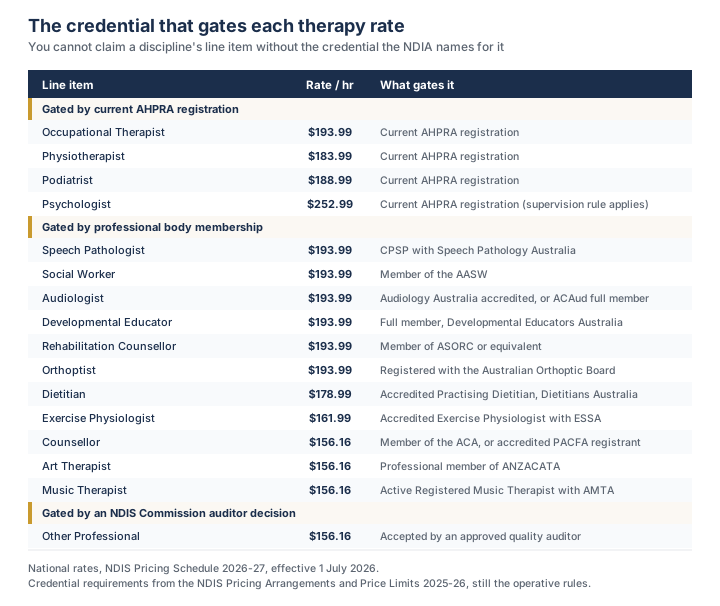
- Four disciplines are gated by AHPRA: occupational therapy, physiotherapy, podiatry and psychology. Eleven are gated by a professional body membership that has nothing to do with AHPRA, including speech pathology (CPSP), dietetics (APD), exercise physiology (AEP with ESSA), social work (AASW), art therapy (ANZACATA) and music therapy (AMTA).
- A paid provisionally registered psychologist working under supervision claims $252.99 an hour. The same person working unsupervised claims $156.16. That is a $96.83 difference turning on supervision status alone.
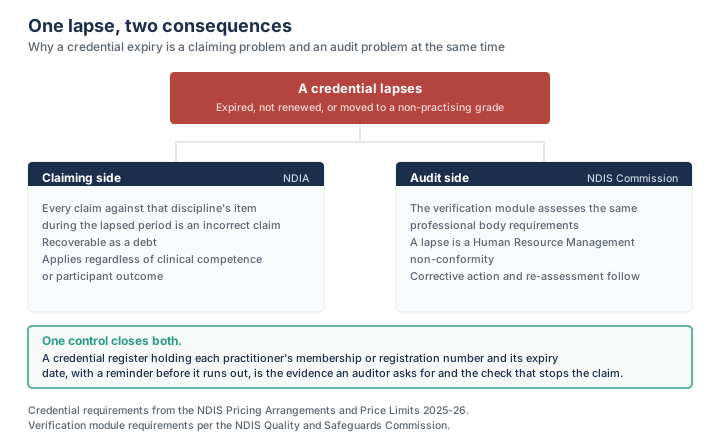
- These credentials expire. A lapsed AASW membership, an unrenewed CPSP certification or an AHPRA registration moved to non-practising makes every claim against that item during the lapsed period an incorrect claim, recoverable as a debt, regardless of clinical competence.
- The same tests appear at audit. The NDIS Commission's verification module assesses the same professional body requirements, so one lapse is simultaneously a claiming problem and a Human Resource Management non-conformity.
- The rules are in a document the NDIA has not reissued. The credential requirements sit in the NDIS Pricing Arrangements and Price Limits 2025-26, which remains the operative claiming rules document because the 2026-27 edition has not been published.
Most of what has been written about NDIS pricing since 1 July 2026 answers one question: what is the rate. That is the easy half. The harder half, and the one that actually decides whether a claim stands up, is whether you were entitled to claim that rate at all.
The NDIS does not let you claim a therapy line item because you delivered therapy. It lets you claim it because a specific person, holding a specific credential, delivered it. Those credentials are named individually in the pricing rules, most of them are professional body memberships rather than registrations, and almost all of them have an expiry date. This guide sets out which credential gates which item, what happens when one lapses, and what an auditor asks to see.
For the rates themselves, see our NDIS pricing 2026-27 guide. For what activities you can bill for and against which item, see NDIS billing for allied health.
Why the rate depends on a membership rather than a degree
The NDIA's approach to therapy pricing rests on a definition list. For each therapy line item, the pricing rules define the "type of professional" who may deliver it, and every definition points at an external body rather than at a qualification.
That distinction matters more than it sounds. A dietitian with an accredited degree who is not an Accredited Practising Dietitian does not meet the definition. A speech pathologist who is a member of Speech Pathology Australia but has not maintained Certified Practising status does not meet it either. A social worker with a Master of Social Work who has let their AASW membership lapse does not meet it. In each case the person is qualified, competent and probably delivering excellent therapy. They are still not eligible to claim that line item.
The reason the NDIA works this way is that most of these professions are not regulated under the National Law. Only occupational therapists, physiotherapists, podiatrists and psychologists are AHPRA-registered among the therapy disciplines. For everyone else there is no register the NDIA can check, so it borrowed the profession's own credentialing body as the test. The practical effect is that the credential the NDIS cares about is often not the one the practitioner thinks of as their qualification.
The rule that removes your discretion
Sitting above the definitions is a claiming rule that is easy to skim past:
Where a line item exists for a specific type of professional, supports of that type need to be made against that item.
In other words, an occupational therapist claims the occupational therapy item. Not "Other Professional", not another discipline's item, not whichever item happens to pay best. Before 2026-27 this rule was mostly academic, because so many therapy disciplines shared the same $193.99 rate that the choice rarely changed the money.
That is no longer true. In 2026-27 the therapy items carry six different price points, from $156.16 to $252.99. Choosing the wrong item is now a pricing decision as well as a compliance one, and it fails in both directions. Claim an item you are not entitled to and you have made an incorrect claim. Claim a lower one out of caution and you have left money on the table you were entitled to.
The full list: which credential gates which NDIS therapy rate
The table below is the complete set for 2026-27. Rates are national, per hour, from the NDIS Pricing Schedule 2026-27. Credential requirements are from the NDIS Pricing Arrangements and Price Limits 2025-26, which is still the operative claiming rules document.
| Line item | 2026-27 rate | The credential that gates it |
|---|---|---|
| Psychologist | $252.99 | Current AHPRA registration as a psychologist. Includes paid provisionally registered psychologists operating under supervision |
| Occupational Therapist | $193.99 | Current AHPRA registration as an occupational therapist |
| Speech Pathologist | $193.99 | Certified Practising Speech Pathologist (CPSP) as approved by Speech Pathology Australia |
| Social Worker | $193.99 | Member of the Australian Association of Social Workers (AASW) |
| Audiologist | $193.99 | Certified as an Audiology Australia Accredited Audiologist, or a Full Member as an audiologist with the Australian College of Audiology |
| Developmental Educator | $193.99 | Full Member of Developmental Educators Australia Inc |
| Rehabilitation Counsellor | $193.99 | Member of the Australian Society of Rehabilitation Counsellors (ASORC) or equivalent |
| Orthoptist | $193.99 | Current registration with the Australian Orthoptic Board |
| Podiatrist | $188.99 | Current AHPRA registration as a podiatrist |
| Physiotherapist | $183.99 | Current AHPRA registration as a physiotherapist |
| Dietitian | $178.99 | Accredited Practising Dietitian with Dietitians Australia |
| Audiometrist | $166.83 | Current Full Member of the Hearing Aid Audiometrist Society of Australia, or Full Member as an audiometrist of the Australian College of Audiology |
| Exercise Physiologist | $161.99 | Accredited Exercise Physiologist with Exercise and Sports Science Australia (ESSA) |
| Counsellor | $156.16 | Member of the Australian Counselling Association, or an accredited Registrant with the Psychotherapy and Counselling Federation of Australia (PACFA). Also the item for a provisionally registered psychologist working unsupervised |
| Art Therapist | $156.16 | Professional Member with the Australian, New Zealand and Asian Creative Arts Therapy Association (ANZACATA) |
| Music Therapist | $156.16 | Active "Registered Music Therapist" with the Australian Music Therapy Association (AMTA) |
| Other Professional | $156.16 | Accepted by an approved quality auditor of the NDIS Commission as having the relevant qualifications, expertise and experience |
| Therapy Assistant Level 1 | $56.16 | Working under the delegation and direct supervision at all times of a therapist |
| Therapy Assistant Level 2 | $86.79 | Working under delegation and supervision, where the therapist is satisfied they can work independently without direct supervision |
Two additions for 2026-27 are worth flagging. Orientation and Mobility Specialist is a new named item at $156.16; practitioners who previously claimed under "Other Professional" now have their own line. And the Other Professional rate itself fell from $193.99 to $156.16, a 19.5% cut and the largest single movement in the schedule.
The $96.83 question: supervised or unsupervised?
Read the psychologist and counsellor rows together and you find the most expensive detail in allied health claiming.
The psychologist item carries the note "This includes paid provisionally registered Psychologists operating under supervision." The counsellor item carries the note "Paid unsupervised provisionally registered psychologists can claim using this line item."
Same practitioner. Same session. Same participant. Same clinical service. The only variable is supervision status, and it moves the claim from $252.99 to $156.16.
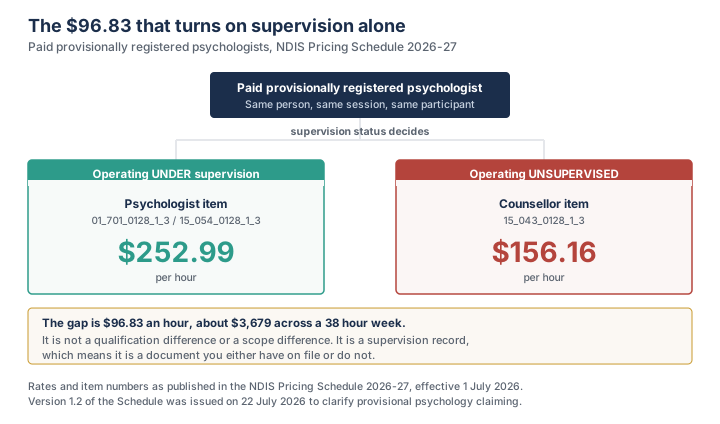
Across a 38 hour week that gap is roughly $3,679. Across a year of a provisional psychologist's caseload it is the difference between a viable supervision arrangement and one that costs the practice money.
The NDIA appears to know this is being got wrong. Version 1.1 of the Pricing Schedule corrected the item numbers for the new psychology items. Version 1.2, issued on 22 July 2026, was published specifically to add clarifying text on provisional psychology claiming. A document does not get reissued three weeks into the financial year over a detail nobody is tripping on.
If your practice employs or contracts provisional psychologists, three things follow:
Decide which arrangement you are actually running, and document it. "Under supervision" is a factual state, not a label you apply to the invoice. It should be traceable to a supervision agreement, a supervisor, a schedule, and records of supervision actually occurring.
Make the supervision records part of the claim evidence, not just the HR file. If a claim at $252.99 is queried, the supervision record is what supports it. It needs to be findable by date and by practitioner.
Back-check. If provisional psychologists have been claiming at $252.99 while working unsupervised, that is an overpayment on every session since. It is far cheaper to identify and address that yourself than to have it identified for you.
What happens when a credential lapses
This is the part that turns a pricing question into a compliance one, and it is the reason credentialing belongs in your claiming controls rather than only in your HR folder.
A membership or registration lapse is rarely dramatic. Nobody decides to stop being an Accredited Practising Dietitian. What happens is that a renewal invoice arrives during leave, or a CPD requirement is not completed in time, or a practitioner moves to a non-practising registration during a career break and comes back without reinstating it. The credential quietly stops being current while the clinical work carries on unchanged.
The claiming consequence does not care why. Every claim made against that discipline's line item while the credential was not current is an incorrect claim. It is recoverable as a debt. It does not matter that the practitioner was competent, that the participant was well served, or that the lapse was administrative.
The same lapse is also an audit finding
Here is what makes this worth building a control around rather than checking once a year. The NDIS Commission's verification module uses the same professional body tests to decide whether a provider can be registered against a support category. The required documentation for verification sets out the qualification requirements each profession must hold, and for the non-AHPRA disciplines those requirements are the same memberships the pricing rules name.
The Commission confirmed this framing in its response to the independent review into art and music therapy, published on 10 September 2025, which set out the verification requirements for those two professions: professional membership with ANZACATA for art therapists and active Registered Music Therapist status with AMTA for music therapists, in each case with evidence of clinical supervision and ongoing professional development as the professional body requires.
So a lapsed membership is not one problem. It is a claiming problem with the NDIA and a Human Resource Management non-conformity with the Commission, arising from the same fact, discoverable through two separate processes.
The upside is that one control closes both. A register that records each practitioner's discipline, their membership or registration number, and its expiry date, with a reminder that fires before the date rather than after it, is simultaneously the evidence an auditor asks for and the check that stops the incorrect claim. Our NDIS human resource management policy template covers the documentation side, and the same principle applies to worker screening expiry, which practices are generally much better at tracking than professional memberships.
"Other Professional" is not a fallback you can choose
The "Other Professional" item is widely misunderstood as a catch-all you can fall back on when the fit is not obvious. It is not. It has its own gate, and the gate is unusual: the practitioner must have been accepted by an approved quality auditor of the NDIS Commission as having the relevant qualifications, expertise and experience for the Therapeutic Supports registration group.
That means eligibility for this item is established through your audit, not by your own assessment. If you cannot point to an auditor's decision covering that practitioner, you do not have the basis for the item.
Two things changed for 2026-27 that make this worth revisiting:
The rate fell 19.5%, from $193.99 to $156.16. Anyone parked in this item took the largest cut in the schedule without any change to what they do.
Some of them should not be in it any more. If a named item now exists for the discipline, the correct-item rule requires moving to it. Orientation and mobility specialists have a named item for the first time. Audiometrists, developmental educators, rehabilitation counsellors and orthoptists all have their own items, several of which sit at $193.99. A practitioner sitting in "Other Professional" who actually fits a named discipline is both non-compliant and underpaid.
There is also an oddity in the 2026-27 schedule worth knowing about if you deliver early childhood supports. The equivalent item for participants under 9, "Other Early Childhood Professional", remained at $193.99 while "Other Professional" for participants 9 and over fell to $156.16. The same practitioner delivering the same service is priced $37.83 an hour apart depending on the participant's age. Whether that is deliberate or a drafting artefact the NDIA corrects in a later version, check the current Schedule before you rely on it.
What an auditor actually asks for
The verification and certification audit evidence for credentialing is consistent and short. Expect to be asked for:
A current list of every practitioner delivering therapy supports, with their discipline mapped to the line item you claim for them. Auditors look for the mapping, not just the list, because the mapping is where the correct-item rule is either satisfied or not.
Primary evidence of each credential. A registration number and an AHPRA lookup, or a membership certificate or letter from the professional body. A statement in a CV or a position description is not evidence of a current credential.
The expiry date, and what happens before it. The question auditors return to is not whether the credential is current today, which is easy to demonstrate on the day. It is what your process is for noticing before it expires. A reminder with an owner is a control. An annual spreadsheet review is not.
For therapy assistants, the delegation and supervision arrangement. Level 1 requires direct supervision at all times; Level 2 requires the supervising therapist to be satisfied the assistant can work independently. That satisfaction should be a recorded decision by a named therapist, not an assumption. The assistant must also be covered by the professional indemnity insurance of the supervising therapist or the employing provider.
For provisional psychologists, the supervision records. As above, this is what supports the $252.99 claim.
What to do now
- List every practitioner who delivers therapy supports and write next to each one the exact line item you claim for them.
- Check the mapping against the table above. Anyone sitting in "Other Professional" who fits a named discipline needs to move, and the move is usually upward in rate.
- Get primary evidence of each credential and record the number and the expiry date, not just a yes or no.
- Set a reminder before each expiry, with a named owner. Sixty days is a reasonable default for memberships with a CPD requirement attached.
- Resolve the supervision status of every provisional psychologist, document it, and back-check claims made since 1 July 2026.
- Update your service agreements where a discipline's rate has changed, since the NDIA requires you to discuss the change with the participant and for the participant to agree before it applies.
- Diarise the annual re-check for late June, when the next Pricing Schedule lands and the definitions can move.
Frequently Asked Questions
Can I claim the occupational therapy rate if my therapist's AHPRA registration has lapsed?
No. The occupational therapy line item can only be claimed where the practitioner holds current AHPRA registration as an occupational therapist. Claims made against that item during a lapsed period are incorrect claims and may be recovered as a debt, regardless of the practitioner's competence or the participant's outcome. The same lapse is separately assessable as a Human Resource Management non-conformity at audit.
Which NDIS therapy disciplines are not regulated by AHPRA?
Most of them. Only occupational therapists, physiotherapists, podiatrists and psychologists hold AHPRA registration among the therapy disciplines. Speech pathology, dietetics, exercise physiology, social work, audiology, audiometry, developmental education, rehabilitation counselling, orthoptics, counselling, art therapy and music therapy are each gated by a named professional body instead, such as Speech Pathology Australia, Dietitians Australia, ESSA, the AASW, ANZACATA and AMTA.
What rate does a provisional psychologist claim under the NDIS in 2026-27?
A paid provisionally registered psychologist operating under supervision claims the Psychologist line item at $252.99 per hour nationally. A paid provisionally registered psychologist operating unsupervised claims the Counsellor line item at $156.16 per hour. The difference is $96.83 an hour and turns on supervision status, so the supervision arrangement needs to be documented and traceable.
Can I claim a higher-paying line item if my practitioner is qualified in more than one discipline?
No. The claiming rules state that where a line item exists for a specific type of professional, supports of that type must be claimed against that item. The item follows the support actually delivered and the credential under which it was delivered, not the highest credential the practitioner happens to hold.
Who can claim the NDIS "Other Professional" line item?
Only a practitioner who has been accepted by an approved quality auditor of the NDIS Commission as having the relevant qualifications, expertise and experience for the Therapeutic Supports registration group, and only where no named line item exists for their discipline. The rate fell from $193.99 to $156.16 for 2026-27, so practitioners who now have a named item available are both non-compliant and underpaid if they remain in it.
Is there a weekend or after-hours loading for NDIS therapy?
No. Disability support worker items carry Saturday, Sunday, public holiday, evening and night rates, but therapy items do not. Every allied health item in the 2026-27 Support Catalogue is priced National, Remote and Very Remote only. Any "Saturday therapy rate" you have seen quoted does not exist in the Pricing Schedule.
What evidence do NDIS auditors want for professional credentials?
Primary evidence of the credential itself (a registration number and lookup, or a membership certificate or letter from the professional body), the expiry date, a mapping of each practitioner to the line item claimed for them, and a documented process for noticing an expiry before it happens rather than after. For therapy assistants, auditors also look for the recorded delegation and supervision decision and confirmation of professional indemnity insurance cover.
Where are the NDIS therapy credential requirements published?
They are in the NDIS Pricing Arrangements and Price Limits 2025-26, in the Therapy Supports sections. The NDIA has not republished that rules document for 2026-27, so it remains the operative claiming rules alongside the NDIS Pricing Schedule 2026-27, which carries the prices. See our note on the 2026-27 claiming rules gap for what that means in practice.
Part of
NDIS Provider Compliance