Key Takeaways
- The 2026-27 Federal Budget, handed down by Treasurer Jim Chalmers on 12 May 2026, committed $146.8 million over four years (and $17.6 million per year ongoing) to establish enhanced and ongoing Medicare integrity capabilities to detect, disrupt and prevent fraud and non-compliance across the Medicare Benefits Schedule (MBS) and the Pharmaceutical Benefits Scheme (PBS).
- The measure commences 1 July 2026 and is projected to save $674.1 million over four years (and $230.8 million per year ongoing) by reducing fraud and non-compliance.
- A separate $146.3 million over two years is expected from reduced MBS expenditure by avoiding duplicate diagnostic imaging and pathology tests, so imaging and pathology referral patterns are an explicit target.
- The Budget also caps Extended Medicare Safety Net (EMSN) benefits for a limited number of MBS items at 80% of the schedule fee, saving $43.4 million over four years. This trims the safety-net top-up on selected items, which raises patient out-of-pocket costs at practices that charge above the schedule fee.
- The Practice Incentives Program Quality Improvement (PIP QI) Incentive was extended with $119.3 million over three years, funding it to 30 June 2028.
- Up to six fully bulk-billed general practices will be funded in the Central Coast, Newcastle, Lake Macquarie and Hunter regions at a cost of $25.3 million over three years.
- For a compliant practice the risk is not prosecution but a benefit clawback on inadvertent errors. The defence is documentation: billing what the record can prove.
The 2026-27 Federal Budget put $146.8 million over four years into Medicare integrity, funding expanded fraud and non-compliance detection across the MBS and PBS from 1 July 2026, with a projected $674.1 million in savings. Duplicate imaging and pathology tests are named targets, and a new EMSN benefit cap trims the safety net on selected items. Here is what it means for your practice.
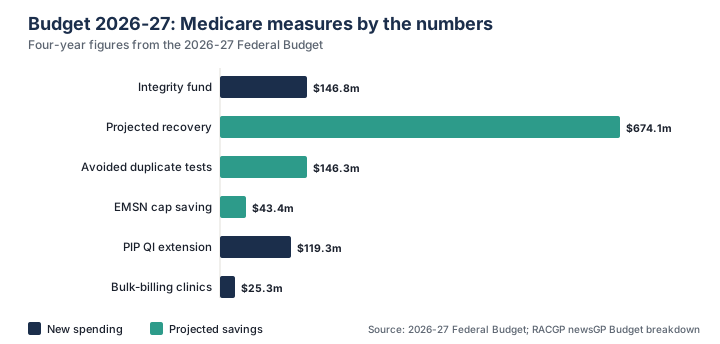
What did the 2026-27 Budget fund for Medicare integrity?
The centrepiece for billing compliance is a $146.8 million investment over four years from 2026-27, plus $17.6 million per year ongoing, to establish enhanced, expanded and ongoing Medicare integrity capabilities. The stated purpose is to improve the detection, disruption and prevention of fraud and non-compliance in the Medicare Benefits Schedule and the Pharmaceutical Benefits Scheme. The work is shared across the Department of Health, Disability and Ageing and Services Australia, and the measure starts on 1 July 2026.
The government expects the spend to more than pay for itself. It projects $674.1 million in savings over four years, and $230.8 million per year on an ongoing basis, from reducing fraud and non-compliance. On top of that, it forecasts a further $146.3 million over two years in reduced MBS expenditure by avoiding duplicate diagnostic imaging and pathology tests. That second figure matters because it tells you where some of the analytical effort is pointed: at ordering patterns, not just at obviously fraudulent claims. The Royal Australian College of General Practitioners set out the detail in its Budget breakdown, and the measures sit alongside the government's broader Strengthening Medicare agenda described in the Health Minister's Budget release.
| Budget 2026-27 measure | Amount | Timeframe | What it does |
|---|---|---|---|
| Enhanced Medicare integrity capabilities | $146.8m (+ $17.6m p.a. ongoing) | Four years from 2026-27 | Detect, disrupt and prevent MBS and PBS fraud and non-compliance |
| Projected integrity savings | $674.1m (+ $230.8m p.a. ongoing) | Four years | Recovered through reduced fraud and non-compliance |
| Duplicate imaging and pathology saving | $146.3m | Two years | Reduced MBS spend by avoiding duplicate tests |
| EMSN benefit cap at 80% of schedule fee | $43.4m saving | Four years from 2026-27 | Caps the safety-net benefit on a limited set of MBS items |
| PIP QI Incentive extension | $119.3m | Three years, funded to 30 June 2028 | Continues the quality-improvement incentive payment |
| Fully bulk-billed GP clinics | $25.3m | Three years | Up to six clinics in Central Coast, Newcastle, Lake Macquarie and Hunter |
This is separate infrastructure from the schemes practices already know. It funds the data-matching, analytics and compliance staff that flag a claim for review in the first place. Where a review escalates, the existing machinery takes over: a Services Australia audit, and at the serious end the Professional Services Review. The Budget did not change those bodies. It funded the front end that feeds them more referrals.
Why does the integrity fund matter for a compliant practice?
The instinct at most practices is that a fraud crackdown is someone else's problem. That is the wrong read. The government has repeatedly framed the bulk of Medicare leakage as non-compliance rather than deliberate fraud, and non-compliance is overwhelmingly inadvertent: an item billed against a descriptor that was not fully met, a time tier misread, a templated note that does not support the level of service, or a test reordered because the earlier result was not visible. More analytical capability means more of these ordinary errors surface, and each one is a recoverable benefit.
The duplicate-test target is the clearest example. A $146.3 million line item for avoiding duplicate diagnostic imaging and pathology signals that Services Australia will be comparing ordering across providers and time. A practice that reorders bloods because a recent result was not on the patient's record, or refers for imaging already performed elsewhere, is exactly the pattern this is built to catch. None of that is fraud. All of it is now visible, and some of it is claimable back.
For the mechanics of how a pattern becomes a referral, and how the 80/20 rule and audits sit alongside the PSR, see our Medicare compliance audit and 80/20 rule guide. For what the PSR has actually been acting on this year, including non-individualised care plan templates and six-figure repayments, see our PSR compliance trends guide. This Budget measure is the funding that makes both of those more likely to reach a given practice.
What is the Extended Medicare Safety Net cap and who does it hit?
The Extended Medicare Safety Net is the arrangement that, once a patient's out-of-pocket costs for out-of-hospital services pass an annual threshold, pays back 80% of further out-of-pocket costs for the rest of the calendar year. To contain the cost, many MBS items already carry an EMSN benefit cap: an upper limit on the safety-net benefit for that item. When the cap applies, the patient receives the lower of 80% of their out-of-pocket cost or the capped amount. The rules and thresholds are set out on the Department of Health, Disability and Ageing safety nets page and on the Services Australia EMSN page.
The 2026-27 Budget tightens this by capping EMSN benefits for a limited number of MBS items at 80% of the schedule fee, a measure the government values at $43.4 million over four years. In plain terms, for the affected items the safety-net benefit can no longer exceed 80% of the schedule fee, so a patient who is charged well above the schedule fee gets less back once they are over the threshold. The out-of-pocket gap on those items rises.
For practices, the exposure is indirect but real. If you run a mixed-billing model and charge above the schedule fee for the items caught by the change, patients who rely on the safety net later in the year will face a larger gap than before. That affects the fee conversation, the estimate you give, and the informed financial consent you should be recording. Two practical cautions apply. First, the Budget did not publish the specific list of affected MBS items, so you cannot yet tell whether your high-fee items are caught. Second, EMSN cap changes are administered through the MBS and have historically taken effect at the start of a calendar year, so confirm both the item list and the commencement date on MBS Online rather than assuming they land on 1 July. Watch for the update, then check it against your fee schedule.
What else in the Budget affects Medicare billing?
Two other measures are worth flagging because they touch practice income directly.
The PIP Quality Improvement Incentive received $119.3 million over three years, extending it to 30 June 2028. For accredited practices that submit their PIP QI data, this removes the near-term uncertainty about whether the payment continues. It does not change the underlying obligation: you still need to be accredited, still need to submit the ten Quality Improvement Measures each quarter, and still need the data governance behind them. The extension is a reason to keep that pipeline clean, not to relax it.
The Budget also funds up to six fully bulk-billed general practices in the Central Coast, Newcastle, Lake Macquarie and Hunter regions, at $25.3 million over three years. This is a targeted regional access measure rather than a compliance change, but it matters competitively for practices in those catchments and reflects the government's continued push on bulk billing that sits behind the broader integrity agenda.
For the full set of dated changes landing this financial year, including the 1 July indexation, the digital bulk-billing consent change and the My Health Record upload mandate, start with our Medicare changes 1 July 2026 practice guide, which links each deep-dive spoke.
What should your practice do now?
Treat the integrity fund as a prompt to tidy the ordinary billing habits that a data-matching program is built to find. None of the steps below is exotic. All of them are the difference between a claim you can defend and a benefit you have to repay.
- Close the loop on imaging and pathology. Make sure prior results are visible before a test is reordered, and record the clinical reason when a repeat is genuinely needed. This is the single pattern the $146.3 million duplicate-test line is aimed at.
- Bill to the descriptor, not the habit. For your highest-volume MBS items, confirm the record supports every element of the descriptor, including any time tier. Templated notes that do not reflect the actual service are the most common non-compliance finding.
- Self-audit your own claiming patterns. Look at where any single provider sits against the 80/20 threshold and at items billed at unusual volumes. Finding a drift yourself is far cheaper than having it flagged for you.
- Update patient fee estimates once the EMSN list is published. When the capped items and start date appear on MBS Online, check them against your fee schedule and adjust the out-of-pocket estimates and informed financial consent for patients who use the safety net.
- Keep the PIP QI data pipeline current. With the incentive funded to 30 June 2028, make sure accreditation, the ten QI Measures and your data submission stay in order so the payment is not interrupted.
- Assign it and keep the evidence. Give one person the review, record the checks and decisions, and store the supporting documents so a claim can be defended if it is ever audited.
How is this different from a PSR review or an 80/20 audit?
It helps to be precise, because these are often blurred together. The 2026-27 integrity fund is detection capability: the analytics, data-matching and staff that identify a questionable claim or pattern in the first place. A Services Australia compliance audit is the next step, where the department examines specific claims and can recover incorrectly paid benefits. The Professional Services Review is the serious end, a separate statutory scheme that judges whether a practitioner engaged in inappropriate practice and can impose repayments and disqualifications. The 80/20 rule is one specific automatic trigger that refers a practitioner to the PSR when they render 80 or more professional attendances on each of 20 or more days in a year.
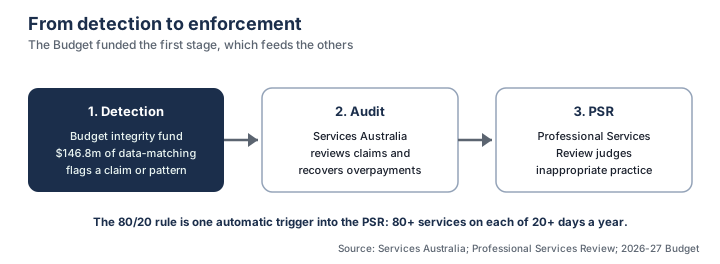
The Budget funded the first of these, not the others. It did not create a new offence or change the PSR. What it changes is the odds: more capability at the detection stage means more claims and patterns reach an audit, and more audits mean more of them escalate. For a practice, the response is the same regardless of which door a problem comes through. Bill what the record proves, keep the evidence, and fix drift before someone else finds it.
Frequently Asked Questions
What did the 2026-27 Budget commit to Medicare integrity?
The Budget committed $146.8 million over four years from 2026-27, plus $17.6 million per year ongoing, to establish enhanced and ongoing Medicare integrity capabilities that detect, disrupt and prevent fraud and non-compliance across the MBS and PBS. The measure commences on 1 July 2026 and is projected to save $674.1 million over four years.
Does the Medicare integrity crackdown target ordinary GP practices?
Yes, indirectly. The government frames most Medicare leakage as inadvertent non-compliance rather than deliberate fraud, so the extra detection capability surfaces ordinary billing errors as well as fraud. The named $146.3 million saving from avoiding duplicate imaging and pathology tests shows that everyday ordering patterns are within scope, not just criminal schemes.
What is the Extended Medicare Safety Net cap in the 2026-27 Budget?
The Budget caps EMSN benefits for a limited number of MBS items at 80% of the schedule fee, saving $43.4 million over four years. For the affected items, the safety-net benefit can no longer exceed 80% of the schedule fee, so patients who are charged above the schedule fee receive a smaller safety-net top-up once over the threshold, increasing their out-of-pocket cost.
Which MBS items are affected by the new EMSN cap and when does it start?
The Budget did not publish the specific list of affected items. EMSN benefit cap changes are administered through the MBS and have historically taken effect at the start of a calendar year, so confirm both the item list and the commencement date on MBS Online rather than assuming they align with 1 July 2026. Check them against your own fee schedule when they are released.
Was the PIP Quality Improvement Incentive extended?
Yes. The 2026-27 Budget provided $119.3 million over three years to extend the Practice Incentives Program Quality Improvement Incentive to 30 June 2028. The underlying obligations are unchanged: the practice must be accredited and submit the ten Quality Improvement Measures each quarter to receive the payment.
How is the Budget integrity fund different from the PSR?
The integrity fund is detection capability that flags questionable claims and patterns. The Professional Services Review is a separate statutory body that judges inappropriate practice and can impose repayments. The Budget funded the front end that identifies problems, which feeds more matters into Services Australia audits and, at the serious end, the PSR. It did not change the PSR itself.
Key terms