Key Takeaways
- The NDIS price limits have legal force from 24 September 2026. Determination F2026L01268 was registered on 23 September 2026 and takes effect the day after registration.
- It incorporates the NDIS Pricing Schedule 2026-27 and the SDA schedule "as in force or existing from time to time". A new Schedule version moves the legal maximum with it.
- It applies only to agency-managed and plan-managed funding. Under s 45C(2) of the NDIS Act, self-managed funding is outside it.
- An over-limit claim can be refused or paid at the maximum, and any excess paid is a debt. Refusal or capping is s 45C(5); the debt is s 45C(6) with s 182.
- A provider must not charge more than the maximum. Section 45C(7) binds any NDIS provider paid from those funds, registered or unregistered (s 10C).
- The maximum is a ceiling, with no entitlement to charge it. Providers and participants may agree to a lower amount.
- It does not settle the claiming rules. The full 2026-27 Pricing Arrangements and Price Limits (PAPL) has still not been republished as at 23 September 2026, and the determination does not incorporate it.
Yes. From 24 September 2026 the prices in the NDIS Pricing Schedule 2026-27 are the legal maximum under s 45C of the NDIS Act 2013, through the pricing determination registered on 23 September as F2026L01268. The maximum applies to supports paid from agency-managed or plan-managed funding. Self-managed funding is not covered.
What did the Minister make, and what was registered on 23 September 2026?
The instrument is the National Disability Insurance Scheme (Pricing Arrangements) Determination 2026, register ID F2026L01268. Mark Butler, Minister for Disability and the National Disability Insurance Scheme, made it on 16 September 2026. It was registered on 23 September and takes effect on 24 September 2026, under section 45C, the pricing power inserted by the Securing the NDIS for Future Generations Act 2026.
There are five sections: Name, Commencement, Authority, Definitions, and Maximum amounts for NDIS supports. Section 4 defines an NDIS pricing document as either of two documents "published on the National Disability Insurance Agency's website, as in force or existing from time to time": the NDIS Pricing Schedule 2026-27 and the NDIS Pricing Schedule for Specialist Disability Accommodation 2026-27. Section 5(1) makes the maximum amount for a support the amount a pricing document specifies for it, or, where the document specifies a method, "the maximum amount worked out using that method."
The instrument prescribes no exception circumstances under s 45C(4) and sets no quote or process requirements under s 45C(8). The explanatory statement calls it "the first Determination to be made under subsection 45C(1) since the commencement of the Amending Act", and says it "gives legislative effect to the price limits applying from 1 July 2026".
A companion instrument, F2026L01269, registered the same day, amends the NDIS (Old Framework Plans) Determination 2024 so that "pricing document means any instrument made under subsection 45C(1) of the Act and any document incorporated by reference into that instrument as in force from time to time." We have not analysed what that does to old framework plan budgets.
The part most providers have been getting wrong
Providers and plan managers have treated the NDIS price limits as law for years. Until 24 September 2026 they were NDIA policy, set out in an NDIA document and applied through the PAPL and the NDIA's claiming rules.
The NDIA's documents said so. The Pricing Schedule 2026-27, version 1.2, describes itself as "providing guidance on appropriate prices for those supports" and still describes the pricing power as a proposal in a Bill introduced on 14 May 2026. As at 23 September 2026 the NDIA pricing updates page says the same: "The Bill proposes to provide the Minister for the NDIS with the power to make a pricing determination."
We said it too. On 3 September 2026 our claiming-rules gap post said the pricing power had started on 27 August but no pricing determination had been made under it, so the Schedule remained guidance for now. That matched the public record when we wrote it. The Minister made the determination on 16 September, it reached the register on 23 September, and we corrected that post and our other NDIS pricing pages on 23 September.
The prices themselves have not moved. They are the ones that have applied since 1 July 2026, now in Schedule version 1.2, and the Schedule's text is unchanged, the word "guidance" included. What changed is legal force: from 24 September those prices are the maximum amount determined under s 45C(1), and the consequences of exceeding them are written into the Act.
What changes on 24 September 2026, by who manages the funding?
Who manages the funding decides whether the determination applies. Section 45C(2) of the NDIS Act says a determination does not apply to a support under a participant's plan "unless the funding for the support or class of supports is managed by: (a) a registered plan management provider; or (b) the Agency." From 24 September the Schedule price is the statutory maximum for every support paid from agency-managed or plan-managed funds. Self-managed funding is outside, and the explanatory statement says so: "The maximum amounts do not apply to self-managed participants." Specialist Disability Accommodation comes in through the second incorporated document under s 5(1)(b), because the SDA schedule specifies a method, "applying a location factor". The ceiling binds the provider too, registered or not (s 10C, s 45C(7)).
| Funding managed by | Before 24 September 2026 | From 24 September 2026 | Source |
|---|---|---|---|
| Agency-managed (the NDIA pays the provider's claim) | Price limits applied under the PAPL and NDIA claiming rules | Schedule price is the statutory maximum; a claim over it may be refused or capped; the excess is a debt | s 45C(2)(b), (5), (6) |
| Plan-managed (a registered plan management provider) | The PAPL required plan managers to keep prices within the limits, whether the provider was registered or unregistered | The statutory maximum applies; s 45C(7) binds any NDIS provider paid from these funds, registered or not | s 45C(2)(a), (7); s 10C |
| Self-managed | The PAPL said self-managing participants "are not subject to the price limits" | Still outside, under s 45C(2) and as the explanatory statement confirms | s 45C(2) |
| Specialist Disability Accommodation | SDA pricing arrangements | The SDA schedule is incorporated; the maximum is worked out with the location factor method | s 5(1)(b) |
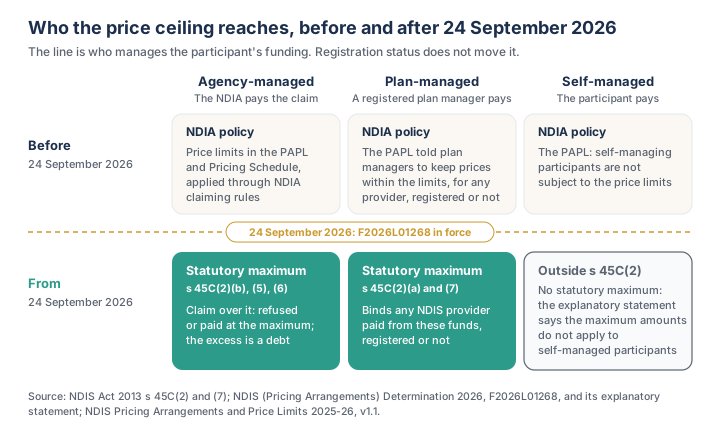
The old rulebook drew the same line. The 2025-26 PAPL, still listed on the NDIA pricing arrangements page, told plan managers to ensure "the prices charged by providers do not exceed the price limits". Now s 45C(2) draws it.
What happens to a claim above the limit?
The Act now sets out every step, from the price charged to the recovery of a debt. Under s 45C(7) an NDIS provider "must not charge more than the maximum amount" where the determination applies. Under s 45C(3) the Agency must not pay an amount that exceeds the maximum, and this determination prescribes no exceptions under s 45C(4). When a claim arrives above the maximum, s 45C(5) gives the Agency two options: refuse to pay, or pay the maximum. A refusal "does not, by itself, prevent a person from making a subsequent claim" at or below the maximum. If an excess is paid anyway, s 45C(6) says the person was never entitled to it, and its note points to s 182: the excess is a debt due to the Agency, arising when the payment is received. Under s 183 it is recoverable by legal proceedings, within 6 years of an Agency officer becoming aware of the circumstances, subject to extensions.
| Step | What the Act says | Provision |
|---|---|---|
| The charge | An NDIS provider must not charge more than the maximum amount determined under subsection (1) in circumstances where the determination applies | s 45C(7) |
| The payment rule | The Agency must not pay an amount that exceeds the maximum; the determination prescribes no exception circumstances | s 45C(3), (4) |
| The claim | The Agency may refuse to pay the amount, or pay the maximum amount; a refusal does not by itself prevent a subsequent claim that does not exceed the maximum | s 45C(5) |
| The excess | A person is not entitled to payment of so much of an amount as exceeds the maximum | s 45C(6) |
| The debt | The excess is a debt due to the Agency, taken to arise when the person receives the payment; a payment made as a result of a contravention of the Act is one the person was not entitled to | s 182(1), s 182(2)(b)(i) |
| Recovery | Recoverable by legal proceedings, brought within 6 years starting on the first day an Agency officer becomes aware, or could reasonably be expected to have become aware, of the circumstances, subject to the extensions in s 183(3) to (5) | s 183(2) |
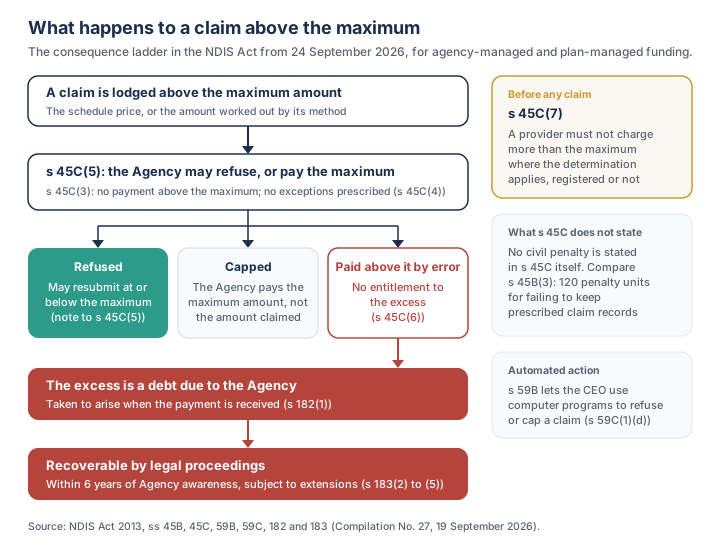
Section 45C itself states no civil penalty for charging above the maximum; compare s 45B(3), which attaches "Civil penalty: 120 penalty units" to a failure to keep claim records. The exposure s 45C spells out is refusal, capping and debt. Because s 45C is a designated provision (s 59C(1)(d)), s 59B also lets the CEO use computer programs to refuse or cap a claim.
The determination has no transitional or application provision, so it does not say how a claim lodged on or after 24 September for a support delivered between 1 July and 23 September is treated. The instrument is silent, and we will not guess.
Is the maximum price now the price I am entitled to charge?
No. The explanatory statement: "The maximum amount is a limit on the amount that may be charged and paid from NDIS funding in the circumstances in which the determination applies; it is not an amount that a provider is automatically entitled to charge or receive. Providers and participants may agree to a lower amount."
The 2025-26 PAPL said the same from the NDIA's side: "The NDIA does not set the prices that providers charge participants. Each provider must agree the price for each support with each participant, subject to the price limits and pricing arrangements that are imposed by the NDIA."
Changes still need agreement. As at 23 September 2026 the NDIA pricing arrangements page says: "You must discuss proposed changes to existing service agreements with participants. Participants must agree to the changes before they are made."
What does the determination not do?
It does not decide who gets funding or for what: the explanatory statement says it is "not relevant to whether a participant is eligible for the NDIS, what supports are reasonable and necessary, or whether a particular support may be purchased using that funding", and that a maximum amount "does not guarantee that the participant's plan contains sufficient funding to acquire a particular quantity of the support."
It does not settle the claiming rules. The full 2026-27 PAPL, covering provider travel, non-face-to-face supports, short-notice cancellations and NDIA-requested reports, has not been republished as at 23 September 2026, and the determination incorporates the pricing schedules alone.
It does not raise plan budgets. On making a pricing determination the Minister must consider an indexation determination under s 34B for old framework plans and may consider determinations under ss 32KA and 32KB for new framework plans, but no such instrument is on the register as at 23 September 2026.
It does not cut budgets either. The NDIA said on 17 September 2026 that "Starting from 1 October, some NDIS support budgets will be reduced over the coming 12 months", and the Department said the same on 22 September. Those resets rest on the s 34A support determination power, which starts on 1 October 2026, and no support determination is on the register as at 23 September. Our 1 October 2026 changes guide covers them.
It does not yet contain the 1 January 2027 unregistered-provider cut. The Annual Pricing Review recommended a 10 per cent cut to Social, Community and Civic Participation prices for unregistered providers, and Schedule version 1.2 has no registration split. Because the Schedule is incorporated as in force from time to time, and s 45C(9)(b)(ii) allows different provision by registration status, the vehicle now exists; our unregistered provider price cut post has the detail.
Can Parliament still overturn it, and how often will it change?
Yes. The explanatory statement confirms it "remains subject to parliamentary disallowance." A copy must be laid before each House within 6 sitting days of registration or the instrument is repealed (Legislation Act 2003, s 38). Under section 42 of the Legislation Act 2003, notice of a disallowance motion may be given within 15 sitting days after tabling, and a disallowing resolution repeals the instrument immediately. No end date can be given until tabling and the sitting days after it are known. Separately, s 45C(16B) requires a summary of the NDIA's pricing advice to be tabled within 5 sitting days after the determination was made on 16 September.
The faster route to change is the Schedule itself. Because it is incorporated "as in force or existing from time to time", as s 45C(11) allows, a new Schedule version changes the legal maximum without a new instrument. The explanatory statement says incorporated documents "may be updated to reflect changing market conditions, such as decisions of the Fair Work Commission that impact wages of NDIS workers". The Schedule has already been revised twice since 22 June, most recently to version 1.2 on 22 July 2026.
The determination is exempt from sunsetting, but pricing determinations are intended to be "made or reviewed at least annually". This one names the 2026-27 documents, so 2027-28 prices will need an updated determination or new incorporated documents, and nothing yet says which. The 2027-28 Annual Pricing Review consultation opened on 17 September 2026 and closes on 1 November 2026.
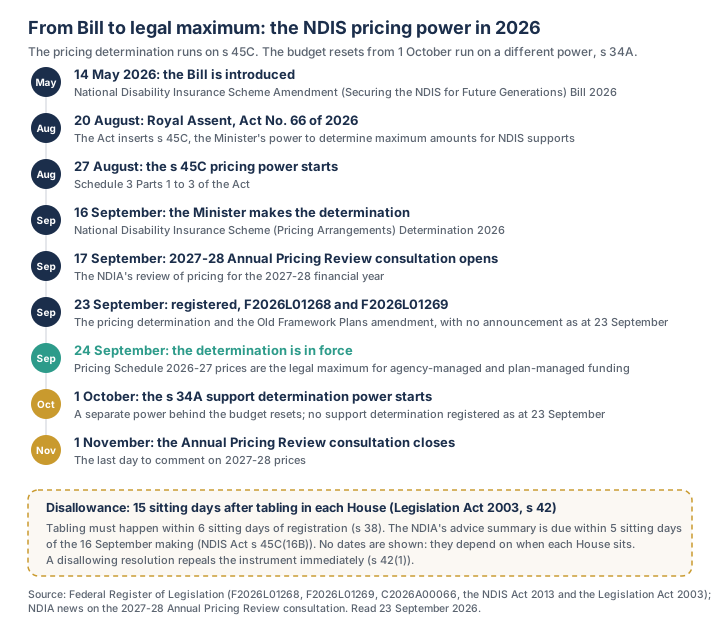
As at 23 September 2026 no announcement of the determination had appeared on the Minister's media page, the NDIA's latest news page or the NDIS Commission's news page. The instrument reached the register first.
What should NDIS providers do this week?
- Check every price you charge agency-managed and plan-managed participants against Schedule version 1.2, including remote and very remote rates and any item worked out by a method; our 2026-27 pricing guide sets out the structure.
- Confirm every service agreement quotes a price at or below the maximum, and that any change to an existing agreement has the participant's agreement, as the NDIA still requires.
- Expect plan managers to refuse or query any invoice above the maximum, since the excess can no longer be paid from plan-managed funding, and unregistered providers are bound too (s 10C, s 45C(7)).
- For self-managed participants the determination does not apply, but put your price in writing, and do not assume it will stand if the participant later moves to plan management.
- Keep the records showing the price charged and the support delivered: s 45B requires claim records "of a kind prescribed by the National Disability Insurance Scheme rules" to be kept for 7 years (civil penalty 120 penalty units), though we have not confirmed which kinds are prescribed.
- Watch the NDIA pricing arrangements page for a new Schedule version, because a new version now changes the legal maximum.
- If you want a say on 2027-28 prices, respond to the Annual Pricing Review consultation before it closes on 1 November 2026.
Frequently Asked Questions
Is the NDIS price guide now legally binding?
Yes. From 24 September 2026 the NDIS Pricing Schedule 2026-27 is incorporated into F2026L01268, made under s 45C of the NDIS Act 2013, so its prices are the legal maximum for agency-managed and plan-managed funding. Before that date the Schedule was, in its own words, guidance on appropriate prices.
When does the NDIS pricing determination start?
On 24 September 2026. The Minister made F2026L01268 on 16 September 2026 and it was registered on 23 September 2026, and its commencement clause makes it operative the day after registration. It gives legal force to the prices that have applied since 1 July 2026.
Does the pricing determination apply to self-managed participants?
No. Section 45C(2) confines the determination to supports whose funding is managed by a registered plan management provider or the Agency, and the explanatory statement says "The maximum amounts do not apply to self-managed participants." The 2025-26 PAPL drew the same line; now the Act draws it.
Does it apply to unregistered providers paid through a plan manager?
Yes. Section 10C defines an NDIS provider by whether it receives funding under the Chapter 2 arrangements or NDIS amounts, with no reference to registration. Section 45C(2)(a) brings plan-managed funding within the determination, and s 45C(7) says an NDIS provider must not charge more than the maximum.
What happens if I claim more than the maximum price?
The Agency may refuse the claim or pay only the maximum amount (s 45C(5)), and a refusal does not by itself stop a new claim at or below the maximum. There is no entitlement to any excess (s 45C(6)); if paid, it is a debt due to the Agency (s 182(1)), recoverable by legal proceedings within 6 years of Agency awareness (s 183(2)).
Did the NDIS prices change on 24 September 2026?
No. The explanatory statement says the determination "gives legislative effect to the price limits applying from 1 July 2026". The figures are those in Pricing Schedule version 1.2. Their status changed: they are now the maximum amount determined under s 45C(1), with refusal, capping and debt consequences in the Act.
Can the NDIA change the maximum prices without a new determination?
Yes. The determination incorporates the Schedule "as in force or existing from time to time", which s 45C(11) permits, so a new Schedule version changes the legal maximum without a new instrument. The explanatory statement says this allows the documents "to be updated at short notice to respond to changes in market conditions."
Does the determination settle the NDIS claiming rules for travel and cancellations?
No. It incorporates the two 2026-27 pricing schedules, not the Pricing Arrangements and Price Limits rules document. The full 2026-27 PAPL, covering provider travel, non-face-to-face supports, short-notice cancellations and NDIA-requested reports, has not been republished as at 23 September 2026.
Part of
NDIS Provider Compliance