Key Takeaways
- 1 October 2026 is the application cut-off for SIL and NDIS digital platform providers. Mandatory registration commenced 1 July 2026. A provider still unregistered who has not lodged an application by 1 October 2026 must stop providing those supports.
- Delivering supported independent living without registration on or after 1 July 2026 is a serious offence: the maximum penalty is 2 years' imprisonment, 120 penalty units, or both.
- The Commission no longer gives 30 September 2026 as the end of PRODA. Its PRODA to myID page, last updated 28 August 2026, gives no end date, and its guidance for the new NDIS Commission portal, which launches on 12 October 2026, says you can sign in to either portal with a PRODA account or a myID with RAM authorisation.
- 22 support item numbers also retire on 30 September 2026, including two flat-rate community nursing items at $124.05 an hour and the $65.09 plan manager setup fee, which has no replacement. A claim against a retired item after its end date is rejected.
- The budget resets now have their instrument. The Minister made the National Disability Insurance Scheme (Support) Determination 2026 on 28 September 2026. It was registered on 29 September as F2026L01332 and takes effect on 1 October 2026, cutting funding for social, economic and community participation by 50 per cent and improved daily living skills (capacity-building daily activities) by 10 per cent.
- The Securing the NDIS for Future Generations Bill is now law. It passed the House on 2 July 2026, passed the Senate on 18 August 2026 with 32 government amendments, and the House agreed those amendments on 19 August 2026. It received Royal Assent on 20 August 2026 as Act No. 66 of 2026. Under the Act, the support determination power commences 1 October 2026, the same day the determination takes effect.
- The resets apply progressively: to new and reassessed old framework plans that take effect on or after 1 October 2026, and to renewed plans from 1 February 2027, with every affected participant intended to be reset by 30 September 2027. Six subgroups are excluded, including supports in employment, high intensity supports and disability-related health supports, and supports outside the two groups (core daily living, home and vehicle modifications, mobility equipment, continence consumables, Specialist Disability Accommodation) are not reduced.
- Thriving Kids state-delivered services also begin rolling out from 1 October 2026, reaching full scale by 1 January 2028.
Three things land on or around 1 October 2026 for NDIS providers, and all three are now set in law or published rules. The SIL and platform registration application cut-off (1 October) and the retirement of 22 support item numbers (30 September) are in force. The 50 per cent budget reset now has its instrument: the Minister made the support determination on 28 September 2026 and it takes effect on 1 October. The date many providers were planning around, a 30 September end to PRODA for the NDIS Commission portals, no longer appears in the Commission's guidance.
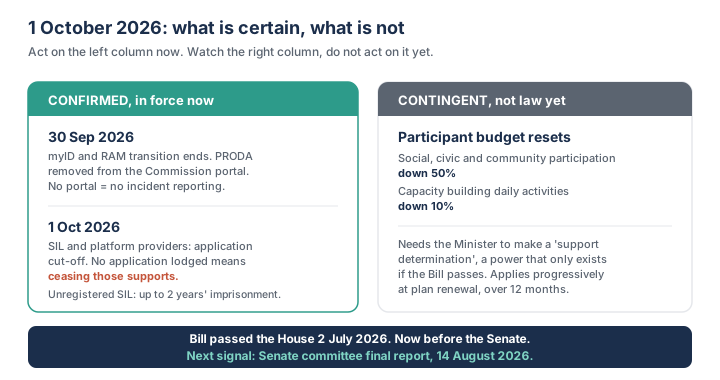
What is the 1 October 2026 SIL registration deadline?
This is the deadline most likely to shut a business down, and it is the least discussed.
Mandatory registration for supported independent living (SIL) and NDIS digital platform providers commenced on 1 July 2026. Two new classes of support were added to the Provider Registration Rules to make it work: 0138 (assistance with supported independent living) and 0137 (providing an NDIS digital platform service).
The part that catches people is the transitional arrangement. Providers were not required to be fully registered on 1 July. They were required to be in the system. The NDIS Commission's transitional pathways set a hard cut-off: a provider who has not applied for registration by 1 October 2026 must stop providing supported independent living supports. The same cut-off applies to platform providers.
And the exposure is criminal, not just commercial. The Commission states plainly that providing supported independent living without registration on or after 1 July 2026 may breach the NDIS Act, with a maximum penalty of 2 years' imprisonment, a fine of 120 penalty units, or both.
If you deliver SIL and did not lodge an application before 1 October 2026, the Commission's answer is that you must stop providing SIL supports and follow its process for stopping services. Our SIL mandatory registration checklist covers who is captured by the definition and what a certification audit involves.
Am I actually a SIL or platform provider?
Worth checking rather than assuming, because both definitions are narrower than people expect.
SIL is a package of home and living support for people with higher support needs. The Commission's test is that the person requires support at all times of the day or for most of the day, and that the assistance helps them live in their home as autonomously as possible by assisting with or supervising daily life tasks, with the provider managing and delivering the package.
It is not SIL if a person only receives a few hours of support a day or a week, or if the person chooses and manages their own support workers, including directing, planning and rostering them.
An NDIS digital platform is an online application, website or system that acts as an intermediary between participants seeking supports and the people providing them, where payments are processed through the platform using funds from participants' plans. It only counts if its main purpose is connecting participants with supports from their plan.
Note also that mandatory registration for support coordination has been paused while the Commission considers further reform. If you were preparing for that, it is not coming on this timetable.
What happened to the 30 September 2026 myID and RAM deadline?
PRODA is being retired as the login method for NDIS systems in favour of the Australian Government Digital ID, using the myID app and Relationship Authorisation Manager (RAM). The myplace provider portal already moved: PRODA stopped working there on 10 November 2025. The NDIS Commission portal is the remaining piece.
The Commission's October 2025 announcement said the transition period was "scheduled to end by 30 September 2026", after which "the option to access the portals using PRODA will be removed". That date has since been taken out of its portal guidance. The PRODA to myID and RAM page, last updated 28 August 2026, gives no end date and still offers a "continue with PRODA" link to anyone having trouble setting up myID. The Commission's guidance on the new NDIS Commission portal, which launches on 12 October 2026, says: "To sign in to either portal, you need a PRODA account or a myID, with RAM authorisation (if you are accessing the portal on behalf of an organisation)".
So, as at 30 September 2026, the Commission's own guidance says PRODA still signs in to its portals. Finish the move to myID and RAM anyway. The Commission still describes itself as changing to them, and portal access is what registration management, reportable incident notifications and complaints run through. Reportable incidents have statutory deadlines, and missing one because nobody could log in is not a defence anyone wants to run. Separately, before 12 October, submit anything left in draft in the existing portal: applications for registration and behaviour support plans still in draft on 12 October are removed (re-registration applications are not).
The setup has a trap worth planning around: the principal authority who links the business in RAM needs Strong identity strength, while staff need at least Standard. Strong identity verification takes longer than people expect, so this is not a task to leave to the last week. Our guide on how to set up myID and RAM for the NDIS walks the procedure.
Which support items stop working on 30 September 2026?
22 NDIS support items carry an end date of 30 September 2026. A claim against any of them after that date is rejected. The list is not in the NDIS Pricing Schedule 2026-27. It is published in one place only: the Legacy Support Items sheet, the second tab of the NDIS Support Catalogue 2026-27 spreadsheet, on the support catalogue page.
Version 1.2 of the Pricing Schedule does not mention the retirements at all. The words "legacy", "end date", "expire" and "cease" do not appear in it, so checking that document alone will not surface the risk.
Community nursing. Two flat-rate items stop: 15_036_0114_1_3, Individual Assessment and Support by a Nurse, and 15_051_0114_1_3, Community Nursing Care for Continence Aid, both at $124.05 an hour. Nursing must then be claimed against the classification-based series. The item depends on the classification of the nurse who attended and the day and time. An enrolled nurse on a weekday daytime is $103.44; a registered nurse is $128.05.
Plan manager setup fee. Item 14_031_0127_8_3, at $65.09, has no replacement. From 1 October 2026 the Improved Life Choices category holds only the $104.45 monthly fee and the bereavement payment.
Assistive technology and home modifications. The other 19 items are priced by quote. Most replacements follow a renumbering pattern, with the seventh to ninth digits changing, usually 111 to 811. Some items split into variants and at least one replacement narrows scope, so a blind find-and-replace puts claims against the wrong item.
Extensions have been common, but they are not safe to plan around. Twenty-one of the 22 items have had an earlier end date extended before: 13 were due to end 31 March 2026 and 8 were due 31 December 2025. On the 2025-26 legacy sheet, 7 items were deleted on schedule rather than rolled forward, roughly one in four. As at 30 September 2026 no extension had been published: the catalogue file linked from the NDIA's support catalogue page is unchanged, and its Legacy Support Items sheet still ends all 22 items on 30 September 2026.
AT and home modification lead times routinely cross the date. A quote or service booking against a retired number will not pay from October.
The action now is to export twelve months of claims, filter on the 22 numbers, confirm the replacement for each item, and reissue any quote or service booking that crosses the date. The full list of the 22 items and each replacement maps every retired number to its successor.
Are the NDIS budget cuts actually happening on 1 October 2026?
Yes. The instrument that does the cutting was made on 28 September 2026 and takes effect on 1 October. What it does not do is cut every budget on that day.
The Government's stated intention, published on the Department of Health, Disability and Ageing's Securing the NDIS page, is that from 1 October 2026 participant budgets will be reset so that spending returns on average to 2023 levels. Allocations for social, economic and community participation supports are reduced by 50 per cent, and improved daily living skills (capacity-building daily activity) allocations by 10 per cent.
The mechanism is a "support determination", a power that lets the Minister reduce funding for particular groups of supports in plans. That power is created by the National Disability Insurance Scheme Amendment (Securing the NDIS for Future Generations) Act 2026, Act No. 66 of 2026, and Schedule 1 Part 4 of that Act commences on 1 October 2026. Jenny McAllister, Minister for the National Disability Insurance Scheme, made the National Disability Insurance Scheme (Support) Determination 2026 under section 34A on 28 September 2026. It was registered on 29 September 2026 as F2026L01332, and the whole instrument takes effect on 1 October 2026. Section 5 sets the percentages: 50 per cent for assistance with social, economic and community participation, and 10 per cent for improved daily living skills.
Two limits are easy to miss. The determination applies only to old framework plans, which is what participants have now: section 6 applies it to "all old framework plans that come into effect on or after 1 October 2026". Everyone transitions to new framework plans progressively between 1 April 2027 and 31 December 2030, and the explanatory statement says the determination ceases to apply once a participant moves to a new framework plan. And it applies progressively: to new and reassessed plans from 1 October 2026, and to renewed plans from 1 February 2027. The explanatory statement's stated intent is that all participants funded for these supports "will have their funding reset by 30 September 2027". It does not hit every participant on 1 October.
Some supports inside the two groups are protected. Sections 7 and 8 exclude six subgroups from the reduction: supports in employment, high intensity supports, and intensive and complex behaviour supports within social, economic and community participation; and disability-related health supports (the nursing items), customised and wearable technology, and hearing services within improved daily living skills. Supports outside the two groups are not touched at all: the explanatory statement says there will be no changes to funding for core daily living functional supports, home and vehicle modifications, personal mobility equipment, continence and menstruation consumables, and Specialist Disability Accommodation.
A companion instrument made the same day, the National Disability Insurance Scheme (High Support Needs Participants) Determination 2026, requires the NDIA CEO to vary the plan of a participant funded for continuous 24-hour care (at least $215,030 across the daily living, home and living, and community participation groups) where the reset leaves the funding insufficient to maintain that care. It also takes effect on 1 October 2026.
For the full 2026 to 2030 reform roadmap and what each stage means commercially, see our Securing the NDIS Bill provider timeline. This post does not re-tell it.
Where is the Bill up to right now?
It is finished, and the instrument it enabled has now been made.
According to the Parliament of Australia bill record, the Bill was introduced and read a first time on 14 May 2026, and the third reading was agreed to in the House of Representatives on 2 July 2026. It was introduced to the Senate on 12 August 2026, and the third reading was agreed to there on 18 August 2026, after 32 government amendments were made in the Committee of the Whole.
It was referred to the Senate Community Affairs Legislation Committee on 14 May 2026. That committee delivered an interim report on 23 June 2026 and tabled its final report on 14 August 2026, with a single recommendation: that the Bill be passed. The House of Representatives agreed to the Senate amendments on 19 August 2026, which is the day the bill page records as finally passed both Houses, and Royal Assent followed on 20 August 2026. It is now Act No. 66 of 2026, registered on the Federal Register of Legislation as C2026A00066, status In force, and the department confirmed passage in its news item the NDIS Amendment (Securing the NDIS for Future Generations) Bill 2026 has passed Parliament.
Assent did not, on its own, reset a single budget. That took the support determination, registered on 29 September 2026 as F2026L01332, which takes effect with the power in Schedule 1 Part 4 on 1 October 2026.
Some other changes in the Act were pegged to assent rather than to a calendar date, and those dates are now published in column 3 of the clause 2 commencement table. Tighter criteria for unscheduled plan reassessments, and a duty on providers to keep records relating to a claim for seven years from the day the claim is made (participants and plan managers keep theirs for three years), carrying a civil penalty of 120 penalty units, both commence on 27 August 2026, the seventh day after assent.
The dates at a glance
| Date | What happens | Status |
|---|---|---|
| 30 September 2026 | The end of PRODA for the NDIS Commission portals, as first scheduled | No longer in the Commission's guidance; PRODA and myID with RAM both still sign in |
| 30 September 2026 | 22 legacy support items reach their end date; later claims against them are rejected | Confirmed, published in the Support Catalogue |
| 1 October 2026 | Application cut-off for unregistered SIL and platform providers; no application means ceasing those supports | Confirmed, in force |
| 1 October 2026 | Thriving Kids state-delivered services begin rolling out (at scale by 1 January 2028) | Confirmed |
| 1 October 2026 | Participant budget resets: social, economic and community participation down 50 per cent, improved daily living skills down 10 per cent, for new and reassessed old framework plans from 1 October 2026 and renewed plans from 1 February 2027 | Support determination F2026L01332 made 28 September, registered 29 September, takes effect 1 October |
| 1 October 2026 | Last day to review and change your team's user list in the existing Commission portal; accounts are copied to the new portal, and changes made after this date may not carry across | Confirmed by the Commission |
| 12 October 2026 | New NDIS Commission portal launches; applications for registration and behaviour support plans left in draft in the existing portal are removed | Confirmed by the Commission |
| 14 August 2026 | Senate Community Affairs Legislation Committee tabled its final report, recommending the Bill be passed | Completed |
| 18 August 2026 | Senate passed the Bill with 32 government amendments | Completed |
| 19 August 2026 | House agreed the Senate amendments; finally passed both Houses | Completed |
| 20 August 2026 | Royal Assent. Act No. 66 of 2026, registered as C2026A00066 | Completed, in force |
| 27 August 2026 | Tighter unscheduled plan reassessment criteria; 7-year provider record-keeping duty for claims (3 years for participants and plan managers) | Confirmed: the seventh day after assent |
| 1 February 2027 | Clearer "reasonable and necessary" criteria apply in planning | Confirmed in the Act |
| 1 April 2027 | New framework planning and support needs assessments begin transitioning participants | Policy, expected start |
| 1 July 2027 | Registration required for providers of higher-risk supports (rollout finalised by December 2030) | Policy and rules |
What should a provider do now?
Sequence the certain things first.
- If you deliver SIL or run a platform, confirm your registration application went in before 1 October 2026. If it did, you can keep delivering while it is assessed, so engage an auditor now: the certification audit is the long part. If it did not, the Commission's position is that you must stop providing those supports. Use our NDIS audit cost calculator to scope what the audit will involve.
- Complete myID and RAM setup anyway, starting with the principal authority, who needs Strong identity strength. PRODA still signs in to the Commission portals as at 30 September 2026, but the Commission is moving to myID and RAM, and the new portal launches on 12 October. Review the existing portal's user list by 1 October 2026: the Commission says changes made after that date "may not be reflected in the new portal".
- Run the item retirement check. Export twelve months of claims, filter on the 22 retired item numbers, and remap each hit to its replacement, choosing variants deliberately where an item has split.
- Model your exposure to the budget reset now. Work out what share of your revenue comes from social and community participation and from improved daily living skills, and when each participant's next new, reassessed or renewed plan takes effect. The reset reaches new and reassessed plans from 1 October 2026 and renewed plans from 1 February 2027, and the stated intent is that every affected participant is reset by 30 September 2027.
- Review your service agreements so that scope can be reset when a participant's plan is reassessed, without that being a breach. This is the practical protection against a mid-agreement budget change. Our service agreement requirements checklist covers what must be in there.
- Read the determination and its explanatory statement. F2026L01332 lists every support in the six excluded subgroups and sets out how renewed plans are treated. It is a disallowable instrument, so the Register is still the place to watch.
- Tell participants what actually happens to their plan. The reset applies when their next plan takes effect on or after 1 October 2026 (or, for a renewed plan, from 1 February 2027), not to the plan they hold today. The Department notes that the change "will not necessarily result in a 50 or 10 per cent reduction in how much you spend" where a participant does not use their whole allocation.
Frequently Asked Questions
What is the NDIS deadline on 1 October 2026?
It is the application cut-off for mandatory registration of supported independent living (SIL) and NDIS digital platform providers. Mandatory registration commenced on 1 July 2026, and a provider who has not lodged a registration application by 1 October 2026 must stop providing those supports. Delivering SIL unregistered risks up to 2 years' imprisonment, 120 penalty units, or both.
Are NDIS budgets really being cut by 50 per cent in October 2026?
Yes, from 1 October 2026, as each plan is made, reassessed or renewed. The Minister made the National Disability Insurance Scheme (Support) Determination 2026 under s 34A on 28 September 2026; it was registered on 29 September as F2026L01332 and takes effect on 1 October 2026. It cuts funding for social, economic and community participation by 50 per cent and for improved daily living skills by 10 per cent in old framework plans that take effect on or after 1 October 2026, with renewed plans caught from 1 February 2027. Six subgroups, including supports in employment and disability-related health supports, are excluded.
When does the budget reset reach a participant's plan?
When their next old framework plan takes effect. New plans and plans made after a reassessment are caught from 1 October 2026; plans renewed under s 50A of the NDIS Act are caught from 1 February 2027. The explanatory statement says the intent is that every participant funded for these supports has their funding reset by 30 September 2027. The determination stops applying once a participant moves to a new framework plan.
Does PRODA stop working for the NDIS Commission portals on 30 September 2026?
Not as at 30 September 2026. The Commission's October 2025 announcement scheduled the end of the transition for 30 September 2026, but its current guidance gives no end date, and its guidance for the new portal launching on 12 October 2026 says you can sign in to either portal with a PRODA account or a myID with RAM authorisation. Set up myID and RAM anyway, starting with the principal authority, who requires Strong identity strength, as that verification takes the longest.
What happens if I claim a retired NDIS item number after 30 September 2026?
The claim is rejected. The support has usually already been delivered by the time the claim is submitted, so a rejection at that point is unrecoverable revenue rather than a correctable error. Check the Legacy Support Items sheet before you invoice, and remap any claim against one of the 22 retired numbers. The full list of the 22 items and each replacement covers every retired number.
Does the budget reset affect every participant on 1 October?
No. The reset applies progressively: to new and reassessed old framework plans that take effect on or after 1 October 2026, and to renewed plans from 1 February 2027. It applies only to old framework plans, and it excludes six subgroups (supports in employment, high intensity supports, intensive and complex behaviour supports, disability-related health supports, customised and wearable technology, and hearing services). Supports outside the two affected groups, such as core daily living assistance, home and vehicle modifications, mobility equipment and Specialist Disability Accommodation, are not reduced.
Is support coordination still becoming a registered-only support?
No, that reform is paused. The NDIS Commission identified support coordination as an area for mandatory registration but has paused it while considering further reform. The 1 July 2026 commencement and the 1 October 2026 application deadline apply to supported independent living and NDIS digital platforms only.
Part of
Key terms