Key Takeaways
- The NDIS Pricing Schedule 2026-27 applies from 1 July 2026. It replaces the old "NDIS Pricing Arrangements and Price Limits" (PAPL) document, and the NDIA frames its numbers as "appropriate and reasonable maximum prices". From 24 September 2026 a Ministerial pricing determination makes those prices the legal maximum for agency-managed and plan-managed supports.
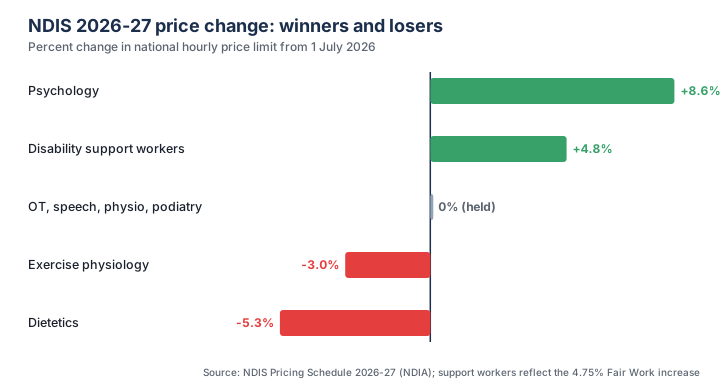
- Therapy pricing is now profession-specific. Psychology rose to $252.99 per hour (up from $232.99). Occupational therapy, speech pathology, physiotherapy and podiatry were held. Dietetics fell to $178.99 (down from $188.99) and exercise physiology fell to $161.99 (down from $166.99).
- Each therapy discipline now has six separate line items: direct service, cancellation, non-face-to-face, provider travel, NDIA requested reports, and telehealth. Telehealth therapy items did not exist in 2025-26; in 2026-27 they are claimable in their own right.
- Provider travel for therapy is now claimed at half the hourly rate through a distinct item (for example, $92.00 per hour for physiotherapy and $126.50 for psychology), so travel, reports and non-face-to-face time are each identifiable in claim data.
- Disability support worker prices rose about 4.8% (standard weekday daytime from $70.23 to $73.58 per hour), reflecting the Fair Work Commission's 4.75% Annual Wage Review increase flowing through the NDIA cost model.
- You cannot raise your prices unilaterally. Where a current service agreement quotes a price, you must discuss the change with the participant and the participant must agree before you charge the new amount.
- The establishment fee rose to $735.80, and support coordination prices were held (Support Connection $80.06, Coordination of Supports $100.14, Specialist Support Coordination $190.54 per hour).
- Nursing supports rose about 3.6% across all levels (a registered nurse moves from $123.65 to $128.05 per hour), and the niche allied health disciplines not listed above, including art and music therapy at $156.16, were largely held.
From 1 July 2026, the NDIS price guide for 2026-27, now formally the NDIS Pricing Schedule and previously the Pricing Arrangements and Price Limits, changes under the NDIA's Annual Pricing Review. For 2026-27 this is not a routine indexation: the document has been renamed and reframed, therapy is now priced profession by profession, and therapy billing has been split into separate line items. Here is exactly what changed, who wins and loses, and what every provider and allied health practice must do before the date. This is the pricing piece of the wider 1 July 2026 NDIS changes.
What is the NDIS Annual Pricing Review, and what applies from 1 July 2026?
The Annual Pricing Review (APR) is the NDIA's yearly assessment of what it considers appropriate prices for NDIS supports, informed by cost data, market conditions and the Fair Work Commission's Annual Wage Review. The outcomes take effect on 1 July each year. On 23 June 2026 the NDIA released the 2026-27 APR report and the new pricing document.
Two structural changes sit above the individual numbers:
The document was renamed. What providers knew for years as the "NDIS Pricing Arrangements and Price Limits" (PAPL) is now the NDIS Pricing Schedule 2026-27. This is not cosmetic. The NDIA now describes the figures as "appropriate and reasonable maximum prices" and positions the schedule as guidance providers "can use to inform their prices."
The prices are now set by law. The Securing the NDIS for Future Generations Act 2026 (Act No. 66 of 2026, assented 20 August 2026) gives the Minister for the NDIS the power to make a binding pricing determination under s 45C, with the NDIA advising; that power commenced on 27 August 2026. The first pricing determination was registered on 23 September 2026 and applies from 24 September. It incorporates the Pricing Schedule 2026-27 as in force from time to time, so the Schedule's prices are the legal maximum for NDIA-managed and plan-managed supports. Self-managed funding is outside it.
For 2026-27, treat the schedule the way you always treated the PAPL: the prices in it are the maximum amounts you can claim for price-controlled supports from NDIA-managed and plan-managed budgets. You can charge less, but not more. The NDIA pricing page hosts the current document and its support catalogue.
How did therapy prices change in 2026-27?
This is the headline. In previous years most therapies shared a single uniform rate. In 2026-27 the NDIA set profession-specific prices, producing clear winners and losers. The table below shows the national hourly rate for the standard therapy (direct service) item for each profession.
| Therapy support (per hour, national) | 2025-26 | 2026-27 | Change |
|---|---|---|---|
| Psychologist | $232.99 | $252.99 | up $20.00 (+8.6%) |
| Occupational Therapist | $193.99 | $193.99 | no change |
| Speech Pathologist | $193.99 | $193.99 | no change |
| Physiotherapist | $183.99 | $183.99 | no change |
| Podiatrist | $188.99 | $188.99 | no change |
| Dietitian | $188.99 | $178.99 | down $10.00 (-5.3%) |
| Exercise Physiologist | $166.99 | $161.99 | down $5.00 (-3.0%) |
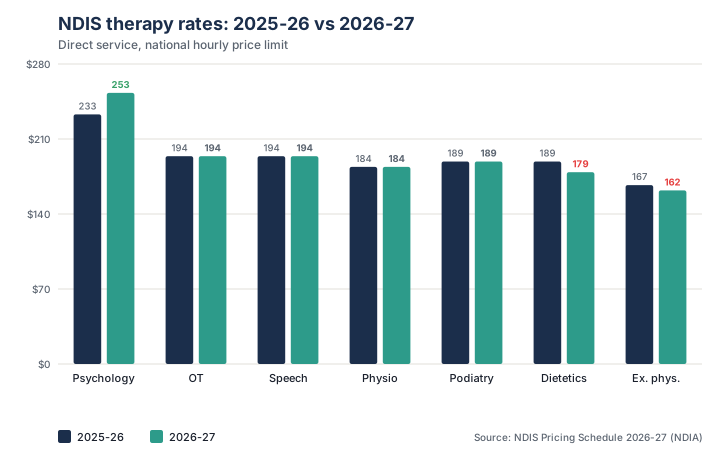
Remote and very remote loadings continue to apply on top of the national rate. For psychology, for example, the remote rate is $354.19 and the very remote rate is $379.49 per hour.
Allied Health Professions Australia (AHPA) criticised the outcome, warning that cuts to some disciplines and a continued freeze for the rest risk the viability of allied health businesses and participants' access to therapy. If you deliver therapy supports, the practical message is that your discipline's economics for 2026-27 depend entirely on which profession you sit in.
Did NDIS psychology prices go up?
Yes. The psychology direct-service rate rose from $232.99 to $252.99 per hour, a $20.00 (8.6%) increase, and is the only therapy discipline to receive a rise in 2026-27. The NDIA's rationale is access: NDIS psychology rates had fallen below what Medicare and private health funds pay, making it harder for participants to find a psychologist willing to take NDIS work. The increase is intended to close that gap. If you are a psychology provider, this is the year to update your service agreements upward, but only with participant agreement (see below).
Why did dietetics and exercise physiology prices drop, and what does a freeze really mean?
Dietetics fell from $188.99 to $178.99 and exercise physiology from $166.99 to $161.99. These are the only two disciplines with an outright cut. Every other therapy (OT, speech, physiotherapy, podiatry) was held flat, which is the more common outcome and the one that affects the most providers.
A freeze is not neutral. With the Fair Work Annual Wage Review lifting award wages 4.75% from 1 July 2026, and rent, insurance and software costs rising, a held price is a real-terms cut. Providers in the frozen disciplines should model their 2026-27 cost base now rather than assume last year's margins hold. The same wage decision is why support worker prices went up while therapy did not, a divergence that reflects the NDIA pricing the two cost structures separately.
What are the new therapy line items for travel, non-face-to-face, reports and telehealth?
This is the operational change that will catch providers out, because it changes how you build a claim. In 2025-26, a therapy support was largely a single item. In 2026-27, each therapy discipline carries six distinct line items:
- Direct service (the face-to-face hourly rate in the table above).
- Cancellation (short-notice cancellations, claimed against a dedicated item).
- Non-face-to-face (NF2F) (clinically required activity away from the participant, such as preparing a program).
- Provider travel (claimed at half the hourly rate: $92.00 per hour for physiotherapy, $126.50 for psychology).
- NDIA requested reports (report writing the NDIA specifically asks for).
- Telehealth (delivered remotely, at the same rate as the in-person service).
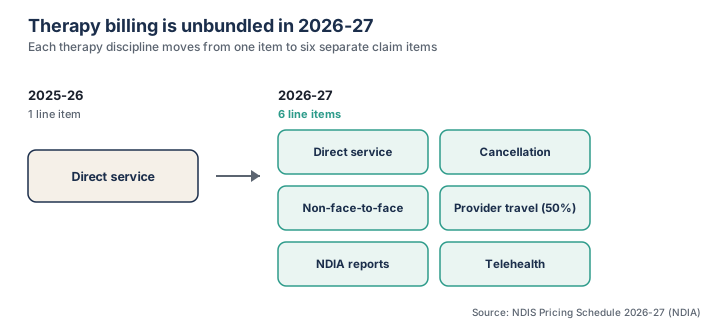
The non-obvious detail: telehealth therapy items did not exist in the 2025-26 schedule. Where therapy delivered by video previously had to be claimed against the standard item, 2026-27 gives telehealth its own item line for every discipline. Combined with the separate travel, NF2F and report items, the effect is that each activity is now identifiable in your claim data, which is exactly what the NDIA wants for its market analysis and what an auditor will expect to see itemised correctly.
What this means in practice: your practice management or claiming software must be reconfigured so staff select the correct item for travel, NF2F, reports and telehealth, instead of bundling everything into the direct-service line. Claiming travel or report time against the direct-service item is now an incorrect claim. For the underlying rules on what allied health can and cannot claim, see our guide to non-face-to-face and travel billing for NDIS allied health.
Did NDIS support worker prices increase on 1 July 2026?
Yes. Core supports delivered by disability support workers rose about 4.8%, driven by the Fair Work Commission's 4.75% wage increase. The standard weekday daytime rate for assistance with self-care and similar supports moved from $70.23 to $73.58 per hour. High-intensity (Level 2) self-care moved from $75.98 to $79.60, and the personal care and participation establishment fee rose from $702.30 to $735.80. Evening, weekend, public holiday, sleepover and SIL rates moved by the same factor.
Support coordination prices were held: Support Connection at $80.06, Coordination of Supports at $100.14, and Specialist Support Coordination at $190.54 per hour. For the registration and conduct rules that sit alongside these prices, see our support coordination compliance guide.
What about nursing and the other support categories?
Therapy and support work are the headline changes, but they are not the only ones. The 2026-27 schedule also indexed community nursing supports by about 3.6%: an enrolled nurse moves from $99.88 to $103.44, a registered nurse from $123.65 to $128.05, a clinical nurse from $143.04 to $148.13, and a nurse practitioner from $176.85 to $183.15 per hour (national weekday rate). If you deliver high-intensity daily supports or SIL, check your nursing line items as well as your support-worker rates.
The wider allied health disciplines that are not among the seven above, including art therapy and music therapy (held at $156.16), audiology, counselling, developmental education, social work and orthoptics, were largely held. Specialist disability accommodation, assistive technology, home modifications, transport and plan management each sit in their own schedule of the pricing document; this guide focuses on the therapy and support-work changes that affect the most providers, so check the relevant schedule for any item-level movement in those categories before you claim.
Can I just raise my prices on 1 July 2026?
No. The Pricing Schedule sets the maximum you may charge, but your service agreement with each participant is a contract. Where a current agreement quotes a price, the NDIA is explicit: you must discuss the proposed change with the participant, and the participant must agree, before you charge the new amount. You cannot apply a price rise (or, for psychology, the higher maximum) by issuing an invoice at the new rate.
This makes the price change a service-agreement task, not just a fee-table update. Our NDIS service agreement requirements checklist covers the inclusions and the participant-notification step in detail.
What NDIS providers must do before 1 July 2026
- Identify which prices moved for you. Map your delivered supports to the new schedule: note whether your therapy discipline rose, was held, or was cut, and apply the 4.8% support worker uplift to any core-support rates.
- Update your price list and quoting tools to the 2026-27 maximums, including the separate travel, NF2F, report and telehealth items for each therapy discipline.
- Reconfigure your claiming software so staff select the correct line item for travel (at half rate), telehealth, NF2F and NDIA-requested reports, rather than the direct-service item.
- List every participant on a current service agreement whose price needs to change, in either direction.
- Draft service-agreement variations for those participants and obtain their agreement in writing before charging the new price. Do not back-date.
- Brief your team on the new item structure and the travel and telehealth rules so claims are correct from day one.
- Diarise a mid-July review of rejected claims and any items billed against the wrong line, and fix the configuration before the errors compound.
What is NOT changing on 1 July 2026
- The 50% provider travel cap is not new. Therapy travel was already limited; what changed is that it is now its own line item rather than a rule applied to the main item.
- Support coordination prices were held, not cut.
- Price regulation status. Despite the rename, the schedule's numbers remain the maximum claimable prices for 2026-27. Since 24 September 2026 they are the legal maximum under a pricing determination made with the s 45C power in the Securing the NDIS Act.
- Plan management and assistive technology pricing were not part of the therapy and support-worker headlines; check the relevant schedule for any item-level movements before claiming.
Frequently Asked Questions
When do the new NDIS prices start?
The NDIS Pricing Schedule 2026-27 takes effect on 1 July 2026 and applies to supports delivered from that date. The NDIA published the schedule and the Annual Pricing Review report on 23 June 2026. Supports delivered up to 30 June 2026 are claimed at 2025-26 prices.
What is the difference between the Pricing Arrangements and the new Pricing Schedule?
They are the same kind of document under a new name. The "NDIS Pricing Arrangements and Price Limits" (PAPL) is now the "NDIS Pricing Schedule 2026-27." The NDIA reframed the figures as "appropriate and reasonable maximum prices," and since 24 September 2026 a Ministerial pricing determination makes them the legal maximum for agency-managed and plan-managed supports. For 2026-27, the prices remain the maximum you can claim.
How much did NDIS psychology increase in 2026-27?
The psychology direct-service rate increased from $232.99 to $252.99 per hour nationally, a rise of $20.00 or 8.6%. Remote and very remote loadings apply on top, at $354.19 and $379.49 per hour. Psychology was the only therapy discipline to receive an increase in the 2026-27 review.
Which NDIS therapy prices were cut in 2026-27?
Dietetics fell from $188.99 to $178.99 per hour and exercise physiology from $166.99 to $161.99 per hour. Occupational therapy, speech pathology, physiotherapy and podiatry were held flat. Because award wages rose 4.75% from 1 July 2026, a held price is effectively a real-terms reduction.
Do I have to update my NDIS service agreements when prices change?
Yes, where a current service agreement quotes a price you intend to change. The NDIA requires you to discuss the change with the participant and obtain the participant's agreement before charging the new amount. You cannot apply a new price by invoicing at the higher rate. Plan the variation as a documented step for every affected participant.
How is therapy travel claimed under the 2026-27 schedule?
Provider travel for therapy is claimed against a dedicated line item at half the discipline's hourly rate, for example $92.00 per hour for physiotherapy and $126.50 for psychology. It is no longer part of the direct-service item. The same applies to non-face-to-face time, NDIA-requested reports and telehealth, which each now have their own item.
Did NDIS support worker rates go up on 1 July 2026?
Yes. Disability support worker prices rose about 4.8%, with the standard weekday daytime rate moving from $70.23 to $73.58 per hour, reflecting the Fair Work Commission's 4.75% Annual Wage Review increase. Evening, weekend, public holiday and SIL rates moved by the same factor, and the personal care establishment fee rose to $735.80.
Did NDIS nursing prices change in 2026-27?
Yes. Community nursing supports rose about 3.6% across all levels. The national weekday rate for an enrolled nurse moved from $99.88 to $103.44, a registered nurse from $123.65 to $128.05, a clinical nurse from $143.04 to $148.13, and a nurse practitioner from $176.85 to $183.15 per hour. The increase is smaller than the 4.8% support-worker rise because the two supports are priced on separate cost models.
Part of
NDIS Provider Compliance