Key Takeaways
- The NDIA's Annual Pricing Review for 2026-27 recommends reducing prices for Social, Community and Civic Participation (SCCP) supports delivered by unregistered providers by 10 per cent from 1 January 2027, and stopping annual indexation for those items. Registered provider prices are maintained and keep indexing.
- It is not in the NDIS Pricing Schedule. We checked the published Pricing Schedule 2026-27 in full. It contains one price per support item, split only by National, Remote and Very Remote. There is no split by registration status anywhere in it, and nothing in it is dated 1 January 2027.
- The Pricing Schedule became binding on 24 September 2026, exactly as written. A s 45C pricing determination (F2026L01268, registered 23 September 2026) makes its prices, as in force from time to time, the legal maximum for agency-managed and plan-managed funding. The Schedule itself still calls them "guidance on appropriate prices".
- The mechanism now exists; the cut is still not in it. Schedule 3 Parts 1 to 3 of the NDIS Amendment (Securing the NDIS for Future Generations) Act 2026, Act No. 66 of 2026, inserted s 45C from 27 August 2026, and the first determination under it took effect on 24 September 2026. As at 27 October 2026 the Schedule in force is the one effective 24 September 2026, and it contains no 10 per cent cut and no split by registration status. The signal that bites is a later Schedule that does.
- If it does land, a standard weekday daytime community participation hour falls from $73.58 to $66.22, a loss of $7.36 per hour. Saturday falls from $103.54 to $93.19, and Sunday from $133.50 to $120.15.
- The indexation change matters more than the 10 per cent. The cut is a single step down; losing annual indexation compounds the gap against registered providers every year afterwards.
- Registration takes three to six months from application to Commission decision. A provider who waits for confirmation and then registers cannot be registered before 1 January 2027.
If you deliver community participation supports as an unregistered NDIS provider, you have probably seen a version of this headline: prices are being cut 10 per cent from 1 January 2027. The recommendation is real, and the number is right. But almost every account circulating treats it as settled, and it is not. The cut is a recommendation sitting in a review document, not a price in the schedule that sets 2026-27 prices, and while a pricing determination now gives the Schedule legal force, the Schedule still contains no such cut. This guide separates what has actually been published from what has only been proposed, puts real dollar figures against it, and works through the decision that does need making now regardless of how the legislation lands.
What the NDIA actually recommended
The NDIA's Annual Pricing Review (APR) for 2026-27 prices recommends a first for the scheme: an explicit, separate price for the same support depending on whether the provider delivering it is registered.
The recommendation covers Social, Community and Civic Participation supports. For unregistered providers delivering those supports, the recommended maximum prices reduce by 10 per cent from 1 January 2027, and annual indexation for those items ceases. For registered providers delivering exactly the same support, prices are maintained and continue to index each year.
The NDIA's stated reasoning is that registered providers carry obligations unregistered providers do not: governance requirements, the NDIS Practice Standards, audit cycles, workforce and quality conditions, and reporting duties. The price difference is intended to reflect that difference in compliance load.
The scope is broader than the headline rate. It reaches the standard SCCP items and their high intensity variants, and the related claiming that attaches to them, including non-face-to-face support, provider travel, short-notice cancellations and activity-based transport.
The part almost everyone is getting wrong
Here is where the reporting and the source documents diverge.
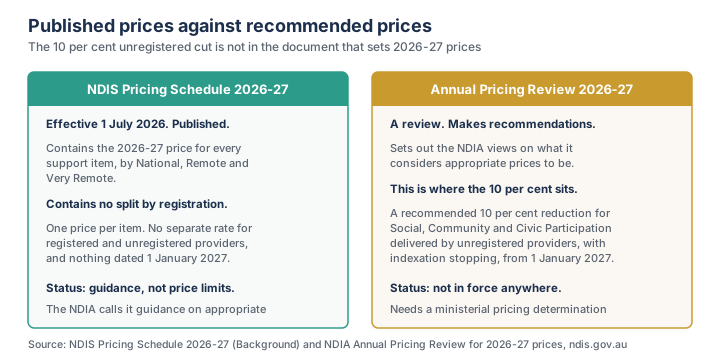
We read the published NDIS Pricing Schedule 2026-27 in full. It is the document that sets out 2026-27 prices, effective 1 July 2026. Three things are true of it:
- Every price table carries the same four columns: support item number, support item name, unit, then National, Remote and Very Remote prices. There is no registered column and no unregistered column. One price per item.
- Nothing in it is dated 1 January 2027. The document is effective 1 July 2026 and does not schedule a future price movement based on registration status.
- Its own Background section is explicit about status. The Schedule "is intended to help participants receive value for money when they purchase the supports that they need by providing guidance on appropriate prices for those supports", and it "sets out information from the NDIA regarding what it considers to be the appropriate and reasonable maximum prices for all NDIS supports". Providers "can use" it to inform their prices.
That last point has now changed. Until 24 September 2026 the Pricing Schedule was guidance on appropriate prices, not a legally binding price cap. From that date a s 45C pricing determination incorporates it, so its prices are the legal maximum for agency-managed and plan-managed funding, as our guide to the 2026-27 pricing arrangements now records. The Schedule's text did not change: one price per item, no registration split.
So the 10 per cent cut is a recommendation, in a review, that has not been written into the Schedule the determination now enforces. It is one document away from an enforceable price: a Schedule version that contains it.
What would have to happen for it to bite
The mechanism the Pricing Schedule points to is a pricing determination power, and its own Background section says so directly.
The Schedule is published, in its words, "against the background of the National Disability Insurance Scheme Amendment (Securing the NDIS for Future Generations) Bill 2026". That Bill proposes to amend the National Disability Insurance Scheme Act 2013 to give the Minister for the NDIS "the power to make a pricing determination, that sets out the maximum amount, or the method for determining the maximum amount, for a NDIS support", and to give the NDIA a specific function of advising the Minister for that purpose.
The NDIA then states the sequence plainly: if the Bill passes, it is anticipated that the NDIA's views on appropriate prices, as set out in the Pricing Schedule, will be used to inform advice to the Minister for the purposes of making a determination. The Bill passed, and on 23 September 2026 the determination followed.
Where did the Bill end up? Checked against the Parliament of Australia bills register for bill r7487:
| Stage | Date |
|---|---|
| Introduced to the House | 14 May 2026 |
| Referred to Senate Community Affairs Legislation Committee | 14 May 2026 |
| Committee interim report | 23 June 2026 |
| Third reading agreed to (House) | 2 July 2026 |
| Committee final report tabled, recommending passage | 14 August 2026 |
| Second reading agreed to (Senate) | 18 August 2026 |
| Third reading agreed to (Senate), 32 government amendments | 18 August 2026 |
| House agreement to Senate amendments, finally passed both Houses | 19 August 2026 |
| Royal Assent, Act No. 66 of 2026 | 20 August 2026 |
| Registered as C2026A00066, status In force | 21 August 2026 |
| Sch 3 Pts 1 to 3 commence, inserting the s 45C pricing power | 27 August 2026 |
| First s 45C pricing determination registered as F2026L01268; in force the next day | 23 September 2026 |
The Bill is now an Act. The House of Representatives agreed the Senate's 32 amendments on 19 August 2026, and Royal Assent followed on 20 August 2026, giving the National Disability Insurance Scheme Amendment (Securing the NDIS for Future Generations) Act 2026, Act No. 66 of 2026, registered on the Federal Register of Legislation as C2026A00066. The Community Affairs Legislation Committee inquiry had tabled its final report on 14 August 2026 recommending that the Bill be passed. Our Securing the NDIS Bill provider timeline tracks the wider reform roadmap the Act carries, of which the pricing determination power is one part.
The power itself is inserted into the National Disability Insurance Scheme Act 2013 by Schedule 3 Parts 1 to 3, which commence on 27 August 2026. That matters because it means the maximum price for an NDIS support can move from an agency guidance document into a legislative instrument. It is a change in kind, not just in number: guidance you can price against commercially becomes a cap you cannot exceed.
But the caveat has shifted again, not disappeared. What was missing in July was the power. What was missing in August was the instrument. On 23 September 2026 the National Disability Insurance Scheme (Pricing Arrangements) Determination 2026 was registered, in force from 24 September. It incorporates the Pricing Schedule 2026-27 "as in force or existing from time to time", so what is missing now is a Schedule with the cut in it. The one in force since 24 September 2026 has none. The vehicle exists: s 45C(9)(b)(ii) lets a determination make different provision depending on whether providers are registered. Treat a confident "from 1 January 2027" with caution until the NDIA pricing page carries a Schedule version that says so.
Status at 8 October 2026: the NDIA's Annual Pricing Review for 2027-28 prices is open for consultation until 1 November 2026. Its provider consultation paper (September 2026) lists, among the reforms Minister Butler outlined on 22 April 2026, "expanded differentiated pricing for unregistered providers delivering" assisted daily living, capacity-building daily activities and Social and Community Participation, and its timeline has implementation starting "From 1 July 2027". On our reading, that would widen the registered and unregistered price gap beyond the Social, Community and Civic Participation items this post describes, though the paper itself sets no prices.
What the cut would cost, in dollars
Recommendation or not, the number is worth modelling, because the decision it forces has a longer lead time than the legislation does.
These are the national rates for community participation as published in the Pricing Schedule 2026-27, with the recommended 10 per cent applied. The reduced figures are calculated, not published anywhere by the NDIA.
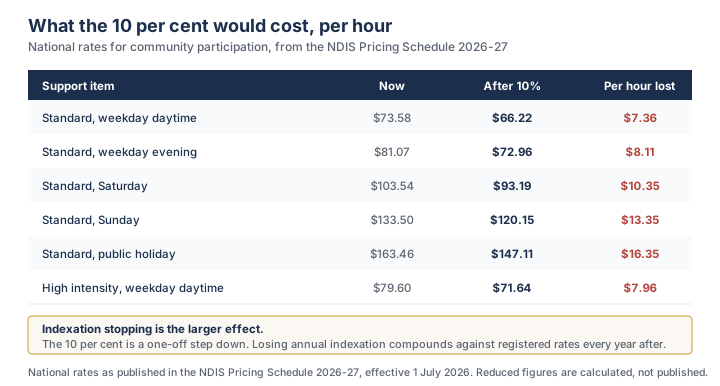
| Support item | Item number | National now | After 10% | Lost per hour |
|---|---|---|---|---|
| Access Community Social and Rec Activ, Standard, weekday daytime | 04_104_0125_6_1 | $73.58 | $66.22 | $7.36 |
| Access Community Social and Rec Activ, Standard, weekday evening | 04_103_0125_6_1 | $81.07 | $72.96 | $8.11 |
| Access Community Social and Rec Activ, Standard, Saturday | 04_105_0125_6_1 | $103.54 | $93.19 | $10.35 |
| Access Community Social and Rec Activ, Standard, Sunday | 04_106_0125_6_1 | $133.50 | $120.15 | $13.35 |
| Access Community Social and Rec Activ, Standard, public holiday | 04_102_0125_6_1 | $163.46 | $147.11 | $16.35 |
| Access Community Social and Rec Activ, High Intensity, weekday daytime | 04_400_0104_1_1 | $79.60 | $71.64 | $7.96 |
To put a shape on it: a sole trader billing 30 standard weekday daytime hours a week loses $220.80 a week at the reduced rate. Across 48 working weeks that is roughly $10,600 a year of revenue, before considering the effect on remote and very remote work, where the same 10 per cent applies to a larger base.
The indexation change is the more serious half. A 10 per cent reduction is a one-off step down that a provider can price around or absorb. Losing annual indexation is structural: registered rates keep rising with the annual review and the Fair Work wage decision, unregistered rates stand still, and the gap widens every year. Over five years the compounding difference is larger than the initial cut.
That interacts badly with a cost base that is going the other way. Support worker wages under the SCHADS Award are rising on a fixed Fair Work timetable, including the interim increase for home care disability workers from 1 December 2026 (deferred from 1 October 2026 by the Fair Work Commission's final decision of 11 September 2026), while NDIS revenue is set separately by the NDIA. The Fair Work Commission's annual wage review lifted award minimums by 4.75 per cent from the first full pay period on or after 1 July 2026, and that flows through the SCHADS classifications an SCCP provider staffs from. An unregistered SCCP provider would face rising award costs against a frozen, reduced price.
Who this actually affects
The recommendation is narrow in scope and wide in population.
Narrow in scope, because it applies to Social, Community and Civic Participation supports. It is not a general cut to all unregistered pricing. Personal care, therapy, support coordination and other categories are untouched by this particular recommendation.
Wide in population, because unregistered providers account for more than 90 per cent of the NDIS market by provider count, and community participation is one of the most commonly delivered support types among small unregistered operators and sole traders. That combination is why the NDIA chose it as the place to establish the principle.
That last point deserves emphasis. The NDIA has signalled this is a starting point rather than an endpoint, and that a registered against unregistered pricing split could extend to other support categories in future reviews. The precedent matters more than the 10 per cent. A provider reading this as a one-off hit to one support category is reading it too narrowly; the more useful question is whether the business model assumes staying unregistered indefinitely.
Being unregistered has never been a compliance-free position, as our guide to unregistered provider obligations sets out: the Code of Conduct binds every provider, and breaches carry civil penalties up to $91,000 per incident for an individual. What is new is that the position may now carry a direct price penalty as well as a compliance one.
The decision you have to make before the certainty arrives
Here is the uncomfortable timing problem.
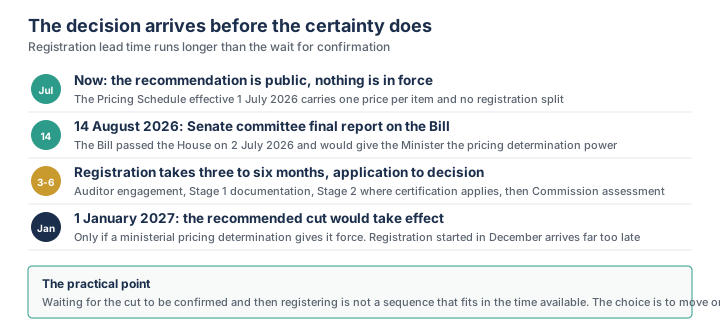
Registration is not a fast process. From engaging an approved quality auditor to receiving a Commission decision, it typically runs three to six months, as our audit pathways guide sets out stage by stage. Community participation registration groups sit on different pathways depending on what else you deliver: group 0125 (Participation in Community, Social and Civic Activities) is a verification group, but the contamination rule means that if any group in your application requires certification, the whole application is assessed at certification level. The NDIS Quality and Safeguards Commission sets out the application steps and the audit requirement for each pathway.
Now line the dates up. The s 45C power commenced on 27 August 2026 and the first pricing determination took effect on 24 September 2026, so the only step left is a Schedule version carrying the cut, which could be published at any time. A provider who waits for that version before starting registration is beginning the process in the last quarter of 2026 at the earliest, and will not hold registration on 1 January 2027.
So the choice is not "wait and see, then decide". The choice is between committing to registration on incomplete information, or planning to absorb the reduced rate if it arrives. Both are legitimate. Pretending there is a third option where you wait for certainty and still act in time is not.
Three things make the decision easier:
Work out your actual exposure first. Pull your last twelve months of claims and isolate the SCCP items. If community participation is 15 per cent of your billings, a 10 per cent cut on that slice is a 1.5 per cent revenue hit, which is an absorbable pricing problem. If it is 80 per cent of your billings, it is an existential one. The answer to "should I register" is mostly determined by that ratio, and most providers have never calculated it.
Price the registration itself, not just the audit fee. The audit is the visible cost. The real cost is the documentation, the policy set, the evidence trail and the internal time to build a Practice Standards system that survives Stage 1. Our NDIS audit cost estimator gives a realistic figure for your provider profile.
Separate the pricing reason from the other reasons. Registration also opens access to agency-managed participants, which is the largest segment of the market and one unregistered providers cannot serve at all. If you were already losing work because participants moved to agency management, the pricing recommendation is not the reason to register; it is the thing that finally makes the arithmetic obvious.
What to do now
- Quantify the SCCP share of your revenue. Twelve months of claims, isolate the 04_ series community participation items, and express them as a percentage of total billings. This single number drives everything else.
- Do not reprice yet. Nothing has changed for 2026-27. The current Pricing Schedule rates apply, and changing a participant's rate requires their agreement in an updated service agreement regardless.
- Watch the NDIA pricing arrangements page for a new Pricing Schedule version. The pricing determination took effect on 24 September 2026 and incorporates the Schedule as in force from time to time, so a Schedule version containing the cut is the signal that bites. The one in force, effective 24 September 2026, has none.
- If your exposure is material, start the registration conversation now. Not the application necessarily, but the scoping: which registration groups, which pathway, which auditor, what documentation gap you are starting from.
- Do not let the 10 per cent distract from indexation. Model the five-year gap, not the January step. That is where the real decision lies.
- Check your service agreements. If the cut does land, every affected participant needs an updated agreement before you can bill a changed rate, as our service agreement requirements checklist sets out. That is a slow administrative job worth scoping early rather than doing in December.
Frequently Asked Questions
Is the NDIS 10% price cut for unregistered providers confirmed?
No. It is a recommendation in the NDIA's Annual Pricing Review for 2026-27 prices. It does not appear in the published NDIS Pricing Schedule 2026-27, which sets out the prices effective 1 July 2026 and contains one price per support item with no split by registration status. Since 24 September 2026 a s 45C pricing determination (F2026L01268) makes the Schedule's prices, as in force from time to time, the legal maximum for agency-managed and plan-managed funding. The Schedule in force, effective 24 September 2026, still has no registration split, so the cut would become enforceable only through a later Schedule containing it or a new determination. Neither exists as at 27 October 2026.
Which NDIS supports would the 10% reduction apply to?
Social, Community and Civic Participation (SCCP) supports. That covers the standard community participation items such as Access Community Social and Rec Activities, their high intensity variants, and the related claiming that attaches to them including non-face-to-face support, provider travel, short-notice cancellations and activity-based transport. It does not apply to personal care, therapy supports, support coordination or other categories. The NDIA has indicated a registered against unregistered split could be extended to other categories in future pricing reviews.
How much would an unregistered provider lose per hour?
Using the national rates in the Pricing Schedule 2026-27, a standard weekday daytime community participation hour would fall from $73.58 to $66.22, a loss of $7.36. Weekday evening falls from $81.07 to $72.96. Saturday falls from $103.54 to $93.19. Sunday falls from $133.50 to $120.15. Public holiday falls from $163.46 to $147.11. High intensity weekday daytime falls from $79.60 to $71.64. The reduced figures are calculated by applying 10 per cent to the published rates and are not published by the NDIA.
Why does stopping indexation matter more than the 10 per cent cut?
Because a 10 per cent reduction happens once, and the loss of indexation happens every year. Registered provider prices continue to rise with the annual pricing review and the Fair Work Commission's annual wage decision. If unregistered SCCP prices stop indexing, the gap between registered and unregistered rates widens each year, so the cumulative difference after several years exceeds the initial cut. Meanwhile, support worker wages under the SCHADS Award continue rising on a Fair Work timetable, so an unregistered provider faces increasing costs against a frozen price.
Should I register my NDIS business because of this?
That depends almost entirely on what share of your revenue comes from SCCP supports, which most providers have never calculated. If community participation is a small share of billings, a 10 per cent cut on that slice is an absorbable pricing problem. If it is most of your billings, it is a threat to the business. Registration also carries benefits beyond pricing, most significantly access to agency-managed participants, which unregistered providers cannot serve. Weigh the pricing recommendation alongside those factors rather than treating it as the sole trigger.
Can I wait until the pricing determination is made before deciding whether to register?
Not if you want to be registered before 1 January 2027. Registration takes three to six months from engaging an approved quality auditor to receiving a Commission decision. The pricing determination has applied since 24 September 2026 and incorporates the Schedule as updated from time to time, so a Schedule version carrying the cut could arrive at short notice. A provider who waits for it and then begins the registration process will not hold registration by January. The realistic choice is to commit on incomplete information or to plan to absorb the reduced rate.
Does this change anything about my prices right now?
No. The current NDIS Pricing Schedule 2026-27 took effect on 1 July 2026 and contains a single price per support item regardless of registration status. Nothing about your current pricing changes because of the recommendation. Separately, remember that whenever a price does change, you cannot bill a new rate until the affected participant has agreed to it in an updated, signed service agreement. Applying a new price before the agreement is updated breaches the NDIS Terms of Business.
Where can I check the status of the Securing the NDIS Bill myself?
The Parliament of Australia bills register carries the authoritative passage record for the National Disability Insurance Scheme Amendment (Securing the NDIS for Future Generations) Bill 2026 under bill identifier r7487. It records the introduction on 14 May 2026, referral to the Senate Community Affairs Legislation Committee, the interim report of 23 June 2026, the House third reading agreed on 2 July 2026, the final committee report tabled on 14 August 2026, the Senate third reading agreed on 18 August 2026 with 32 government amendments, finally passed both Houses on 19 August 2026, and Royal Assent on 20 August 2026 as Act no. 66 of 2026. The Act text and its commencement dates are on the Federal Register of Legislation as C2026A00066. Check the primary record before acting on any secondary account, since reporting on this Bill repeatedly ran ahead of its actual progress.
Part of
Key terms