Key Takeaways
- Card surcharges end on 1 October 2026 across the designated eftpos, Mastercard and Visa networks, and American Express, UnionPay and JCB have removed them voluntarily from the same date. PayPal's no-surcharge rule follows on 5 October 2026. Debit, prepaid and credit cards are all covered.
- This is not an Act of Parliament. The RBA varied its own Standard No. 3 of 2016 through legislative instrument F2026L00434, repealing the clauses that stopped card schemes imposing 'no-surcharge' rules. The schemes now ban surcharges through their merchant contracts.
- The ACCC does not enforce the ban. Enforcement sits with the card networks and payment service providers. The ACCC keeps the consumer law, including misleading pricing claims.
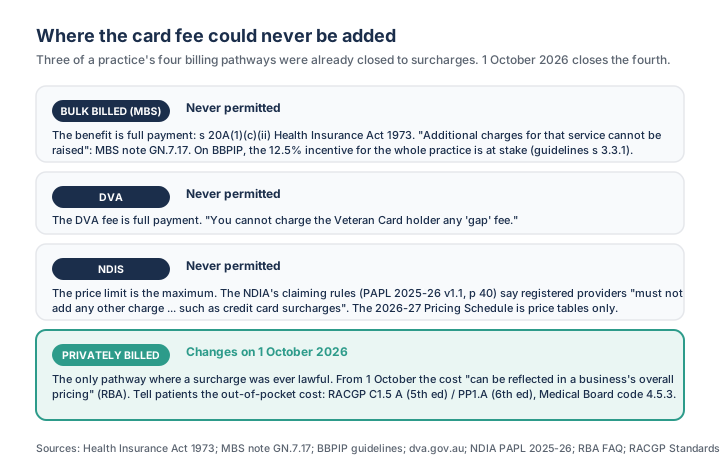
- A bulk billed service could never carry a card surcharge. Section 20A(1)(c)(ii) of the Health Insurance Act 1973 and MBS Explanatory Note GN.7.17 bar additional charges of any kind. For a Bulk Billing Practice Incentive Program practice, a breach is a 12.5 per cent incentive problem across the whole practice.
- The NDIA's published claiming rules name credit card surcharges. The NDIS Pricing Arrangements and Price Limits 2025-26, version 1.1, page 40, prohibits them for registered providers.
- Card acceptance costs a small merchant 1.4 per cent of transaction value on a single-rate plan and 0.9 per cent on an unblended plan. Interchange caps on domestic consumer credit cards fall from 0.8 per cent to 0.3 per cent on 1 October 2026, worth about $910 million a year to merchants.
- The payment date governs, not the invoice date. A card payment made on or after 1 October 2026 cannot carry a surcharge even if the invoice was issued earlier.
From 1 October 2026 a practice cannot add a surcharge to any eftpos, Mastercard, Visa or American Express card payment. The rule comes from the RBA's removal of its prohibition on 'no-surcharge' rules via legislative instrument F2026L00434, with the schemes then banning surcharges in their merchant contracts. For a bulk billed, DVA or NDIS service, a card surcharge was never permitted in the first place.
What changes on 1 October 2026?
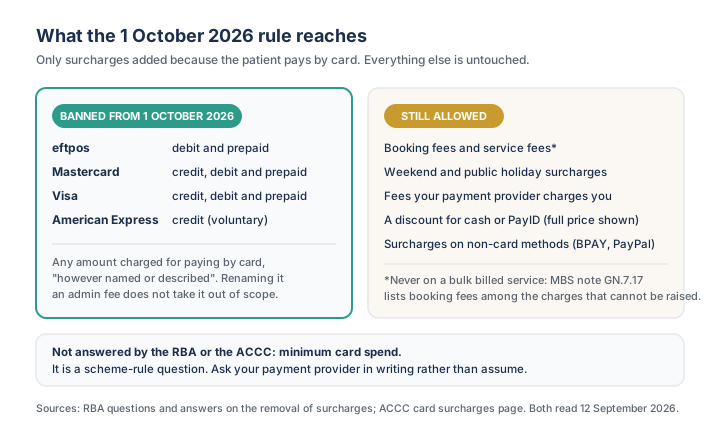
Surcharging is removed on 1 October 2026 on debit, prepaid and credit cards across the designated eftpos, Mastercard and Visa networks, as set out in the RBA's media release on the conclusions of its Review of Merchant Card Payment Costs and Surcharging. American Express, which the RBA does not regulate, has decided to remove surcharging from the same date voluntarily, and so have UnionPay and JCB; PayPal's no-surcharge rule takes effect from 5 October 2026 (the RBA FAQ and the card networks' cardsurcharge.com.au FAQ, read 30 September 2026). The three designated networks each introduce 'no-surcharge' rules from 1 October 2026, so the four schemes most practice terminals accept share one date.
The mechanism matters because it decides who enforces. This is not an Act of Parliament. The RBA varied Standard No. 3 of 2016 through the Payment Systems (Regulation) Standards (Merchant Card Payment Costs and Surcharging) Variation 2026, registered as F2026L00434 (made 10 April 2026, registered 14 April 2026, commencing 1 October 2026) under subsection 18(1) of the Payment Systems (Regulation) Act 1998. Schedule 3 repeals clauses 3, 4 and 5 of the Standard, the "Merchant Pricing", "Permitted Surcharge" and "Cost of Acceptance" clauses. That repeal removes the RBA's prohibition on card schemes imposing 'no-surcharge' rules, and the schemes then impose those rules through their merchant contracts. The Treasurer described it the same way. As the RBA puts it in its questions and answers, "The RBA does not directly regulate merchants." Legislation is held in reserve only, for the case where surcharging continues.
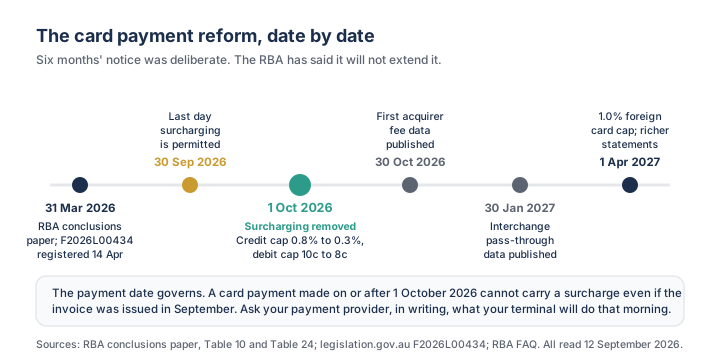
There are no exemptions for practices. The RBA received over a dozen requests for carveouts and refused them all; not-for-profit organisations and business-to-business card payments are not exempt, and whether any exemption exists is a decision for each card network. The networks' own FAQ names one kind of exception, where applicable law or regulation expressly permits surcharging, and gives taxi fares, regulated by the states and territories, as its example; nothing in it reaches a medical practice. The Payments System Board gave six months' notice deliberately, noting that "the industry has been on notice that such changes were being seriously considered since October 2024". Up to and including 30 September 2026 the previous surcharging laws applied, as the ACCC card surcharges page confirms.
| Scheme | Card types | Surcharging permitted until 30 September 2026 | From 1 October 2026 |
|---|---|---|---|
| eftpos | Debit and prepaid | Yes | No |
| Mastercard | Credit, debit and prepaid | Yes | No |
| Visa | Credit, debit and prepaid | Yes | No |
| American Express | Credit | Yes | No |
| UnionPay and JCB | Cards (voluntary) | Yes | No |
| PayPal | PayPal payments | Yes | No, from 5 October 2026 |
Who enforces the ban, and what counts as a surcharge?
The card networks and payment service providers enforce the ban. The ACCC states it plainly: "The card networks or payment service providers will be responsible for enforcing these rules, not the ACCC. The ACCC and state and territory consumer protection agencies will continue to be responsible for enforcing the consumer law, including requirements that businesses do not make misleading claims about prices or the reasons for price changes." A patient who sees a surcharge after 1 October is directed to the business, the card network or the payment service provider.
What counts as a surcharge is substance over form. The varied Standard defines it as "any of the following, however named or described: an amount charged, in addition to the price of goods or services, for the relevant Merchant accepting payment through the Card Transaction; or an amount charged for making payment through the Card Transaction." On that definition, a "payment processing levy" or an "administration fee" applied only to card payments is a surcharge. Both regulators have said renaming it does not work. The ACCC: businesses that describe a card payment surcharge as another type of fee "may be engaging in misleading conduct." The RBA, in its card payments regulation Q and A: merchants "cannot avoid the rules by calling their payment surcharges something else while still applying them to some payment methods and not others."
The ACCC's to-do list for businesses is short: remove card payment surcharge notices from menus, signage, websites and apps, update advertising and price lists, and make sure surcharging is disabled on payment terminals and other payment systems. The practice version of that list is at the end of this page.
Which fees can a practice still charge?
The ban reaches surcharges added because a customer pays by card, and nothing else. The RBA's FAQ: "They do not apply to weekend surcharges, public holiday surcharges, or booking fees or service fees."
- Payment provider fees charged to the practice (terminal rental, transaction processing) are fees for services, not surcharges. The provider can keep charging them; the practice can no longer pass them on as a card surcharge.
- Discounts for a payment method remain allowed. The ACCC confirms a business can offer a discount for paying by cash or PayID, with one display rule: the displayed price must be the full price a patient pays without the discount. A $90 fee with a cash discount is displayed as $90.
- Non-card methods are outside the RBA's rules. The surcharge rules never applied to cash, BPAY, PayPal or Diners Club, and the RBA does not currently regulate surcharges on non-card payment methods. American Express, UnionPay and JCB have removed surcharging voluntarily, so they sit with the banned schemes, and PayPal's own no-surcharge rule takes effect from 5 October 2026. Neither the RBA nor the networks' FAQ names BPAY or Diners Club.
- Buy now pay later, mobile wallets and three-party networks go to a separate Review into Payments System Regulation that opened on 25 June 2026; the RBA intends to publish its regulatory priorities by the end of 2026.
One unknown: whether a practice may still set a minimum card transaction amount after 1 October 2026. No RBA or ACCC page addresses it. It is a scheme-rule question, so ask your payment provider rather than assume.
One qualification for health practices: the "still allowed" list applies to privately billed services only. A booking fee remains unchargeable on a bulk billed service, because MBS Explanatory Note GN.7.17 lists "a booking fee to be paid before each service" among the additional charges that cannot be raised.
Could a bulk billed service ever carry a card surcharge?
No. A card surcharge is an additional charge, and additional charges cannot be raised on a bulk billed service. No Commonwealth health source uses the words "card surcharge" about bulk billing; the prohibition is a catch-all on additional charges, and it catches a card surcharge like everything else.
The statute is section 20A(1)(c)(ii) of the Health Insurance Act 1973, which requires that "the professional accepts the assignment in full payment of the medical expenses that have been or will be incurred in respect of the professional service by the assignor". MBS Explanatory Note GN.7.17 spells it out: "If a practitioner bulk bills for a service the practitioner undertakes to accept the relevant Medicare benefit as full payment for the service. Additional charges for that service cannot be raised." Services Australia allows one exception, a charge to cover the supply of a vaccine. The Department's October 2025 resource, Medicare bulk billing and additional charges, closes the drafting loophole: "No matter how the arrangement is described, if the practical effect is that the patient is required to pay additional charges, then the professional service cannot be bulk billed." The consequence follows: "If the reality is that the patient is charged an extra fee, then the Medicare benefit for the bulk billed service provided is not payable."
The Bulk Billing Practice Incentive Program raises the stakes. The BBPIP program guidelines pay "an additional 12.5% incentive payment on every $1 of the MBS benefits paid from eligible services" to practices that "bulk bill every eligible MBS service for all their Medicare-eligible patients". Section 3.3.1 says charging additional fees for a bulk billed service "is not permitted under section 20A (1) of the Health Insurance Act 1973, with one exception for un-funded vaccines", and lists "Any additional payment for the bulk billed service" as not permitted. Our reading of the two together: for a BBPIP practice, a surcharge on a bulk billed service puts the 12.5 per cent incentive for the whole practice at risk, well beyond the single consultation it was added to. The consent mechanics are in our assignment of benefit and bulk billing consent guide and the program rules in our BBPIP compliance guide.
DVA is in the same position. The DVA allied health provider pages state that by accepting a Veteran Card "you agree to accept the DVA fee as full payment. You cannot charge the Veteran Card holder any 'gap' fee", and the GP page says "You cannot charge gap fees with Veteran Card payments." On that wording, a card surcharge on a DVA service is an amount above the DVA fee, which is what a gap fee is. See our DVA fee changes 2026 guide.
What does the ban mean for NDIS providers?
For NDIS supports, nothing changes on 1 October, because a credit card surcharge was never permitted. The NDIA is the one regulator that names them. The NDIS Pricing Arrangements and Price Limits 2025-26, version 1.1, published 14 October 2025, says on page 40 under "General Claiming Rules": "All registered providers must not add any other charge to the cost of the supports they provide to any participant, such as credit card surcharges, or any additional fees including any 'gap' fees, late payment fees or cancellation fees, unless otherwise permitted by the NDIS Pricing Arrangements and Price Limits."
One currency caveat. The 2026-27 document has been renamed the NDIS Pricing Schedule 2026-27 (the file in force is effective 24 September 2026; it replaced version 1.2 of 22 July 2026 with prices unchanged) and is price tables only: it has no "Other Fees and Charges" section and does not mention surcharges anywhere. The 2025-26 sentence is still published by the NDIA on its pricing arrangements page. The accurate statement is therefore narrower than "the 2026-27 rules ban credit card surcharges": the NDIA's published claiming rules prohibit them, and whether the NDIA restates that in a 2026-27 rules document is unknown.
Price limits are maximums. The 2026-27 Pricing Schedule "sets out information from the NDIA regarding what it considers to be the appropriate and reasonable maximum prices for all NDIS supports", so a provider at the limit cannot recover card costs by raising the price, the same position a bulk billed MBS service is in. Providers "must discuss proposed changes to existing service agreements with participants and participants must agree to the changes"; our NDIS service agreement requirements checklist covers that process and our NDIS pricing arrangements 2026-27 provider guide covers the price tables. The Code of Conduct reaches unregistered providers too: the NDIS Code of Conduct requires providers to "Not charge or represent higher prices for the supply of goods for NDIS participants without a reasonable justification", and the Commission's fair pricing guidance adds that "Penalties apply if the Commission believes a provider is breaching the Code of Conduct."
How much does card acceptance actually cost a practice?
The RBA puts the cost in the open in its chapter on competition in card acquiring: "On average, it costs a small merchant on a single-rate plan 1.4 per cent of their transaction value to accept card payments, while a small merchant on an unblended plan would be charged a lower fee on average at 0.9 per cent. Despite the differences in fees, only 19 per cent of small merchants are on unblended plans." Large merchants pay around 0.6 per cent. A "small merchant" under Standard No. 3 has under $1 million a year in card transactions with its acquirer, which covers nearly every practice. The ACCC's cost-of-acceptance ranges, drawn from 2023-24 RBA data, are wider:
| Business size (annual card transactions) | Debit and eftpos range | Credit range |
|---|---|---|
| Small (under $1m) | 0.85% to 2% | 1% to 2% |
| Medium ($1m to $100m) | 0.25% to 1% | 0.75% to 1.5% |
| Large (over $100m) | 0.25% to 0.5% | 0.5% to 1% |
Source: the ACCC card surcharges page.
The wholesale side of those fees also falls. From 1 October 2026 the interchange caps on domestic-issued cards drop:
| Interchange category | Cap until 30 September 2026 | Cap from 1 October 2026 |
|---|---|---|
| Domestic consumer credit | 0.8 per cent (0.5 per cent weighted-average benchmark) | 0.3 per cent (benchmark abolished) |
| Domestic debit and prepaid | 10 cents or 0.2 per cent (benchmark 8 cents) | 8 cents or 0.16 per cent (benchmark stays 8 cents) |
| Domestic commercial credit | 0.8 per cent (0.5 per cent weighted-average benchmark) | 0.8 per cent (benchmark abolished) |
| Foreign-issued cards | No cap | 1.0 per cent cap from 1 April 2027 |
Source: the interchange fees chapter of the conclusions paper. The RBA values the package at around $910 million per year in lower wholesale card costs for merchants. For scale, the conclusions paper put surcharges at about $1.8 billion a year, $1.6 billion of it paid by consumers, with 16 per cent of merchants surcharging.
Two cautions. Pass-through is not guaranteed: the RBA cites overseas experience in which merchants received around 90 per cent of an equivalent interchange cut in New Zealand and 45 per cent in the EU. And "fee free" plans that rely on automatically surcharging the customer disappear, because PSPs "will no longer be able to offer 'fee free' payment plans that rely on automatically surcharging consumers" (impact and implementation chapter).
On a $90 privately billed consultation, the acceptance cost is $1.26 at the 1.4 per cent single-rate average and $0.81 at the 0.9 per cent unblended average. These are our figures, calculated by multiplying the RBA averages by $90; the RBA publishes no per-consultation number. The interchange cut is worth at most 45 cents on that consultation (0.8 to 0.3 per cent of $90, also our arithmetic), and only if the acquirer passes it on.
Can a practice raise its fees to cover card costs?
Yes, for privately billed services. The RBA's answer is explicit: "Businesses will still incur costs when accepting card payments after surcharging is removed. Those costs can be reflected in a business's overall pricing, rather than charged as a separate surcharge." The Payments System Board "anticipates that the 16 per cent of merchants that currently surcharge may increase their advertised prices to cover the cost of accepting card payments" (executive summary). Its advice to businesses is to review the payment plan and shop around, to use the statement to understand what drives the cost, and to steer customers with a discount rather than a surcharge. In the RBA's September 2025 survey of 3,000 consumers, reported in the surcharging chapter, 76 per cent said surcharging "is unnecessary and should stop".
Blame the right costs. The ACCC's worked example: a business charging $60 plus a 1 per cent surcharge can move to $60.60 and say why. If it moves to $65 for other reasons, it "must not tell consumers that the price increase is due to the changes to card payment surcharging. This will be misleading because the price increase also reflects other business costs." The consumer-law limb the ACCC keeps carries the misleading-pricing maximums listed on its fines and penalties page (for a corporation, the greater of $100,000,000, three times the benefit, or 30 per cent of adjusted turnover), which are ceilings for misleading conduct generally.
Regulated prices are the exception the RBA named, citing pharmacies and lottery agencies, whose prices are set elsewhere and cannot absorb the change; the RBA's response is to tell the price regulators. Our reading: a bulk billed MBS service and an NDIS support at its price limit are in the same position, so on those pathways the cost of card acceptance stays with the practice.
Then update the accreditation evidence. RACGP 5th edition Criterion C1.5 A requires that "Our patients are informed about out-of-pocket costs for healthcare they receive from our practice", evidenced by billing policy on the website, in the waiting area and in person. The 6th edition folds this into PP1.A, requiring "the practice's billing principles" with the same three surfaces, and the Medical Board code of conduct at 4.5.3 requires patients to be informed about fees "in a timely manner to enable them to make an informed decision about whether they want to proceed with consultations and treatment." Our reading of the two together: the surfaces the ACCC says to update are the same artefacts a surveyor reads as evidence of C1.5 A or PP1.A, so a fee board that still says "1.5% card surcharge" in November 2026 is out-of-date practice information in a surveyor's hands as well as a stale sign. Our RACGP 6th edition standards guide covers the criteria in full.
What about invoices issued before 1 October but paid after?
The payment date governs. The RBA's FAQ: "If a card payment is made on or after 1 October 2026, surcharging may no longer be available even if the invoice was issued earlier. Businesses should check with their payment service provider, as some providers have indicated they may disable surcharging functionality from that date." Note the hedge: "may disable" is a prediction, and the only reliable answer about your terminal comes from your own provider, in writing. A September invoice that carries a surcharge line and is settled by card on or after 1 October cannot carry the surcharge; treat month-end statements and delayed telehealth payments the same way.
What should a practice do for 1 October 2026?
- List every place the surcharge is disclosed: the website, the fee board, waiting-room signage, online booking and SMS payment links, invoices and statements, telehealth payment pages, and the practice software payment module.
- Ask the acquirer or payment provider in writing what happens to the terminal on 1 October, and whether it will disable surcharging automatically.
- Disable surcharging on every terminal and payment system, and test a transaction on 1 October.
- Decide the fee response for privately billed services and update the fee schedule and billing policy.
- Brief reception on the price question using ACCC-compliant wording: a rise that only covers card costs can be explained that way, one that includes other costs cannot.
- Confirm no bulk billed, DVA or NDIS service has ever had a surcharge applied at the terminal. If one has, treat it as a billing compliance issue rather than a pricing one.
- Review the payment plan, ask about least-cost routing, and get quotes, using the RBA's published acquirer fee data when it first appears on 30 October 2026.
- Update the billing-policy evidence for accreditation: website, waiting area, and the in-person explanation script.
- Diarise 30 October 2026 (first acquirer fee publications), 30 January 2027 (interchange pass-through data) and 1 April 2027 (foreign card cap and richer merchant statements).
Frequently Asked Questions
Are card surcharges banned in Australia from 1 October 2026?
Yes. From 1 October 2026 surcharging is removed on debit, prepaid and credit cards across the designated eftpos, Mastercard and Visa networks, and American Express, UnionPay and JCB have removed it voluntarily from the same date. PayPal's no-surcharge rule follows on 5 October 2026. The previous laws applied up to and including 30 September 2026.
Does the card surcharge ban apply to medical practices?
Yes. There are no exemptions, including for not-for-profit organisations, and the RBA refused over a dozen requests for carveouts. Any practice that adds a percentage or fixed fee to card payments is caught, whatever the fee is called.
Can a medical practice charge a card surcharge on a bulk billed consultation?
No. A bulk billed service accepts the Medicare benefit as full payment under section 20A(1)(c)(ii) of the Health Insurance Act 1973, and MBS Explanatory Note GN.7.17 bars additional charges of any kind. A card surcharge is an additional charge, so the service cannot be bulk billed if one is applied.
Can an NDIS provider add a credit card surcharge?
No. The NDIA's published claiming rules, the NDIS Pricing Arrangements and Price Limits 2025-26, page 40, prohibit registered providers from adding "credit card surcharges" or any additional fee. The NDIS Commission's Code of Conduct also requires justified pricing of goods supplied to participants.
Can a practice still charge a booking fee or a cancellation fee after 1 October 2026?
Yes, for privately billed services. The RBA's changes "do not apply to weekend surcharges, public holiday surcharges, or booking fees or service fees". On a bulk billed service, a booking fee remains prohibited under GN.7.17. For NDIS supports, cancellation fees are prohibited unless the pricing rules permit them.
Who enforces the surcharge ban?
The card networks and payment service providers. The ACCC states that "The card networks or payment service providers will be responsible for enforcing these rules, not the ACCC". The ACCC continues to enforce the consumer law, including misleading claims about prices or the reasons for price changes.
Can a practice put its prices up to cover card fees?
Yes, for privately billed services. The RBA says the costs of accepting card payments "can be reflected in a business's overall pricing, rather than charged as a separate surcharge". A bulk billed MBS service or an NDIS support at its price limit is different: the price is set elsewhere and cannot be raised.
What if a patient pays a September invoice in October?
The surcharge cannot be applied. The RBA confirms that if a card payment is made on or after 1 October 2026, "surcharging may no longer be available even if the invoice was issued earlier". Some providers may disable surcharging functionality from that date, so check with yours in writing.