Key Takeaways
- The NDIS claim window falls from 2 years to 90 days on 1 December 2026. Item 89 of Schedule 2 to Act No. 66 of 2026 swaps "2 years" for "90 days" in s 45A(5)(a) of the NDIS Act 2013, and clause 2 item 8 fixes the date.
- Part 5 has no transitional or saving provision. On our reading, every claim lodged on or after 1 December faces the 90-day test whatever the support date, so supports delivered on or before 2 September 2026 must be lodged by 30 November 2026.
- From 15 October 2026 the NDIA runs extra checks on claims submitted more than 90 days after delivery. Those claims "may be held for up to 28 days", and the NDIA may ask for more information or evidence before paying.
- A hold is not a refusal, but a resubmission is a new claim. A claim rejected after 30 November and lodged again would, on our reading, be tested against the 90-day limit, so by our calculation aged claims are safest lodged by 2 November.
- The person who lodges depends on the funding type. Under s 45A(2) it is the provider for agency-managed funding, the plan manager for plan-managed funding and the participant for self-managed funding.
- After 1 December, a late claim survives only under s 45A(6). The CEO must accept both exceptional circumstances and a reasonable delay.
- Funding periods "will usually be 3 months". A claim deferred into the next funding period can cross the 90-day line before that period opens.
From 1 December 2026 an NDIS claim must be made within 90 days of the day the support is provided, down from 2 years, under amended s 45A(5)(a) of the NDIS Act. On our reading the new limit applies to every claim lodged from that day, so supports delivered on or before 2 September 2026 must be lodged by 30 November 2026.
What changes on 1 December 2026?
Part 5 of Schedule 2 to the National Disability Insurance Scheme Amendment (Securing the NDIS for Future Generations) Act 2026 is headed "Reducing claim times", and it holds a single item. Item 89, headed "Paragraph 45A(5)(a)", reads: Omit "2 years", substitute "90 days". Item 8 of the commencement table in clause 2 gives it one date, 1 December 2026. The Act received Royal Assent on 20 August 2026, so the date is fixed. Part 5 commences on 1 December 2026.
The provision it changes sits in the NDIS Act 2013 (Compilation No. 27, C2026C00401, compiled to 19 September 2026). Under s 45A(1) nothing is payable for a support without a claim that meets s 45A(5), which sets the time: "A claim must be made in accordance with subsection (3) before the end of the following period starting on the day the support is provided to the participant". Until 30 November that period is 2 years. From 1 December it is 90 days.
Two things stay the same. The clock still starts on the day the support is provided, not on the day it is invoiced, and not when a service booking or funding period ends. And s 45A(6), the late-claim discretion, is untouched.
The revised explanatory memorandum, published with the Bill on the Parliament's page for r7487, gives the reason. Claims made more than 90 days after delivery "are disproportionately associated with higher rates of claims that are not payable under the NDIS, a higher proportion of cases where the claim cannot be verified with the participant, and greater integrity risks, including opportunistic claiming." On the date it says: "Delaying commencement until this date is intended to allow sufficient time for claims older than 90 days to be made before the new timeframe takes effect."
Our timeline of the Act holds every other date it sets.
Which existing claims does the new clock catch?
On our reading, all of them. Part 5 is one amending item with no application, saving or transitional provision attached. That silence stands out because the drafters wrote such provisions where they wanted them: Part 4 of the same Schedule, the 7-year records duty, ends with item 88, which applies new s 45B only to claims "made on or after the commencement of this item." Part 5 has nothing like it. Nor does it repeat what Parliament did in 2024. When s 45A first arrived with its 2-year limit on 3 October 2024, item 132A of Schedule 1 to the Getting the NDIS Back on Track No. 1 Act 2024 gave claims for supports provided before 3 October 2024 a window of 12 months from that date. The 2026 Act gives older supports no equivalent.
So we read the amended s 45A(5)(a) as a test applied on the day a claim is lodged. A claim lodged on or after 1 December 2026 must fall within 90 days of the support date, however old the support. The last support date that clears that test on 1 December is 3 September 2026, because the 90-day period starting on 3 September ends on 1 December. Anything delivered on or before 2 September 2026 has to be lodged by 30 November 2026 under the old 2-year rule, or it needs the CEO's discretion.
That reading has two limits. It is ours, and the NDIA has published no transition note. Its Guide to getting paid ("This page current as of 14 July 2026") still says "You need to submit payment requests within 2 years after an NDIS support has been delivered." Schedule 5 of the Act also lets the Minister make transitional rules, including saving provisions, within 6 months of 20 August 2026. No transitional rules made under the Act appear on the Federal Register of Legislation as at 8 October 2026. A provider should not plan on a transition note or rule arriving.
We count the day of delivery as day 1, because s 45A(5) says the period starts "on the day the support is provided". The table applies that count.
| Support delivered on | Last day to claim under the 2-year rule | Last day to claim from 1 December 2026 (our reading) |
|---|---|---|
| Before 1 December 2024 | 2 years after delivery, which falls before 30 November 2026 | Unchanged: the 2-year date, already passed for many |
| 1 December 2024 | 30 November 2026 | 30 November 2026 |
| 1 July 2025 | 30 June 2027 | 30 November 2026 |
| 1 July 2026 | 30 June 2028 | 30 November 2026 |
| 2 September 2026 | 1 September 2028 | 30 November 2026 |
| 3 September 2026 | 2 September 2028 | 1 December 2026, day 90 |
| 1 October 2026 | 30 September 2028 | 29 December 2026 |
| 30 November 2026 | 29 November 2028 | 27 February 2027 |
| 1 December 2026 onward | Not applicable | 90 days from delivery, so 28 February 2027 for a 1 December support |
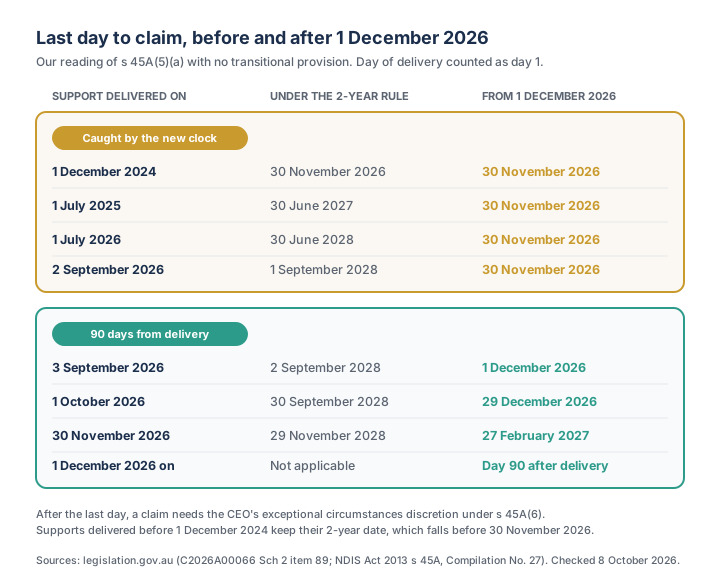
The rows from 1 December 2024 to 2 September 2026 carry the risk. Under the 2-year rule those claims had until late 2026, 2027 or 2028. Read our way, they all share one last day, 30 November 2026.
What starts on 15 October 2026?
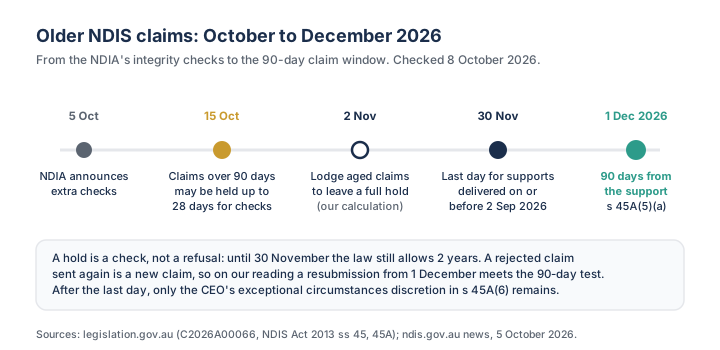
The NDIA acts before the law does. Its notice of 5 October 2026, Increasing integrity checks on older claims, says: "From 15 October 2026, we'll do extra checks on claims submitted more than 90 days after a support is delivered." Older claims "may be held for up to 28 days", and the NDIA says: "We may ask for more information or evidence before an older claim can be paid." It adds: "If your claim is rejected, we'll tell you the reason why."
This is an administrative change. From 15 October to 30 November the law still allows 2 years, so a claim held for checks is still within time and can still be paid. The notice sits on top of a review line the NDIA already ran. The Guide to getting paid says: "We may hold the claim for review if you submit a claim more than 6 months after delivering a service. The review can take up to 28 days." In effect, the 5 October notice brings that line forward from 6 months to 90 days, about seven weeks before the law changes.
The power to ask for evidence is in s 45 of the NDIS Act. Under s 45(3B) the CEO may, by written notice, require a claimant to give "such further information or documents in relation to the claim as the CEO reasonably requires", and under s 45(3C) the notice must allow at least 14 days. The Guide to getting paid says "You'll have at least 14 business days to provide this information." If nothing arrives in time, s 45(3A) stops payment, and its note says the person "may resubmit a claim for the amount in accordance with section 45A".
That note matters after 30 November. In our view a resubmission is a new claim, and a new claim lodged after 30 November for a support delivered on or before 2 September fails the 90-day test. A claim lodged on 20 November that is held for 28 days and then rejected leaves no time to fix it. Working back 28 days from 30 November gives 2 November 2026, our own calculation, as the last day to lodge an aged claim with a full hold still to run before the old rule ends.
The NDIA does not list the evidence it will ask for. For each older claim we would have the signed service agreement, the session or shift record, the worker's timesheet or roster entry, and the invoice with the support item number, date and price. Section 45B already requires providers to keep prescribed claim records for 7 years from the day the claim is made.
Who has to lodge, and for which funding type?
Section 45A(2) gives the claim to the person who manages the funding under the plan's statement of supports or, where that is the Agency, to "the person who provides the support to the participant."
| Funding type | Who makes the claim under s 45A(2) | How it is lodged | Where the 90 days can be lost |
|---|---|---|---|
| Agency-managed | The provider, s 45A(2)(b) | Payment request through the myplace provider portal | Unbilled sessions, rejected bulk upload lines, service bookings closed without a claim |
| Plan-managed | The plan manager, s 45A(2)(a) | The provider invoices the plan manager, who claims through the provider portal | Provider invoices sent late, invoices queried and reissued, plan manager processing backlogs |
| Self-managed | The participant, or whoever the plan names to manage the funding, s 45A(2)(a) | The participant pays the invoice and claims through the participant portal | Late invoices from providers, receipts never uploaded |
For agency-managed funding the Guide to getting paid adds an NDIA rule: "You need to submit a payment request within 90 days from the end of a service booking." That is a separate administrative limit. We do not read it as extra time: a service booking that ends months after a support was delivered does not extend the statutory 90 days from delivery that applies from 1 December.
Plan managers carry the most exposure, because their window opens when the provider delivers, not when the invoice arrives. A provider who sends October's invoices in January has handed the plan manager a claim that is already late. The same applies to self-managed participants. A participant reimbursed for a support delivered in August who uploads the receipt in December may be left with a claim the NDIA cannot pay.
Our 2026-27 claiming rules gap post covers the rules under all three funding types, and our pricing determination post covers the price ceiling in force since 24 September.
Can a claim be pushed into the next funding period?
Yes, by agreement, but from 1 December only inside the 90 days. The NDIA's page What is NDIS funding? ("This page current as of 11 September 2026") says "Funding periods will usually be 3 months." A participant can claim in the next funding period if "you and your providers agree to claim in the next funding period", there is enough funding for the rest of the plan, and "your provider agrees to wait for their payment until your next funding period."
Ninety days and 3 months are close to the same length, which is where the trap lies. Take an illustrative plan whose funding period runs from 1 December 2026 to 28 February 2027. A support delivered on 1 December, with the period's funding already used, is deferred by agreement into the next period. That period opens on 1 March 2027. The 90 days for the 1 December support ended on 28 February. The deferred claim is late on the first day it can be paid.
The NDIS Act backs the funding-period limit. Section 45(4) bars a payment that would take the funding provided during a funding period above the amount for that period, subject to the narrow exceptions in s 45(5). So from 1 December a provider agreeing to wait needs two dates: when the next period opens, and day 90 for each deferred support. If the first falls after the second, the deferral does not work, and the service agreement or delivery schedule should change instead.
What does the CEO's exceptional-circumstances power actually cover?
Section 45A(6) is narrow. The CEO "may" treat a late claim as made in time only if satisfied of two things: "(a) there are exceptional circumstances applying to the claim that justify the claim being made after the end of the applicable period; and (b) the claim was made within a reasonable period having regard to those circumstances." Both limbs must be met, and even then the power is a discretion.
The explanatory memorandum says the subsection "will continue to operate without change", and that this "ensures flexibility is maintained for those with genuine barriers to timely claiming." It does not define exceptional circumstances, and neither the Guide to getting paid nor the 5 October notice mentions s 45A(6). In our view a billing backlog, a staff vacancy in accounts or a software migration is unlikely to count, because each is within the provider's control and was foreseeable from 20 August 2026. Limb (b) also works against a provider who knew of the circumstance and waited.
The first decision on a late claim may be made by software. Section 59C(1)(c) makes s 45A a designated provision, so under s 59B the CEO can arrange for a computer program to take administrative action under it. The explanatory memorandum says a check of whether "the claim is made within the timeframe required by section 45A(5)" would be "suitable for automation", so a late claim could be rejected before a person reads it.
What should providers and plan managers do in October and November?
There are 53 days from 8 October to 30 November. Our suggested order, built on the dates above:
- Run an aged unclaimed report this week. List every support delivered on or before 2 September 2026 that has not been claimed, paid or written off, by participant and funding type.
- Lodge the aged list by 2 November. Our derived date leaves room for a 28-day hold, a request for evidence and a rejection to be fixed before 30 November.
- Build an evidence pack for every claim older than 90 days before the NDIA asks for one.
- Check service bookings. For agency-managed participants, find bookings that have ended with unclaimed lines, and do not treat the 90-day-from-booking-end rule as extra time.
- Plan managers: tell every provider in writing that invoices for supports delivered on or before 2 September must arrive by early November, and process those first.
- Providers serving self-managed participants: send every outstanding invoice now. Tell each participant that receipts for older supports need to be lodged by 30 November.
- Shorten the billing cycle before 1 December. Bill fortnightly or monthly, with an internal flag at day 60.
- Rewrite deferral clauses. Any service agreement that lets claims wait for the next funding period needs a day-90 limit written in.
The therapy line items guide covers checking the item numbers on the claims you lodge, and the 1 October 2026 changes guide has the other dates landing this quarter.
Frequently Asked Questions
When does the NDIS 90-day claim window start?
On 1 December 2026. Item 89 of Schedule 2 to the Securing the NDIS for Future Generations Act 2026 replaces "2 years" with "90 days" in s 45A(5)(a) of the NDIS Act 2013, and item 8 of the clause 2 commencement table fixes that date. The Act received Royal Assent on 20 August 2026.
Do supports delivered before 1 December 2026 still get 2 years?
No, on our reading. Part 5 has no transitional or saving provision, so a claim lodged on or after 1 December 2026 must be within 90 days of the support whatever the support date. Supports delivered on or before 2 September 2026 need lodging by 30 November 2026.
What is the last day to claim a support delivered in July 2026?
30 November 2026, on our reading, because a July support is more than 90 days old by 1 December. From 15 October it may also be held for up to 28 days of checks, so lodging it by 2 November leaves time to answer a request for evidence.
Will the NDIA reject a claim lodged more than 90 days after delivery before 1 December?
No, not for its age alone. From 15 October 2026 the NDIA may hold such a claim for up to 28 days and ask for more information or evidence, and it will give reasons if it rejects one. Until 30 November the statutory limit is still 2 years, so a held claim can still be paid.
Who lodges the claim for plan-managed supports?
The plan manager. Section 45A(2)(a) gives the claim to the person who manages the funding under the plan's statement of supports. The 90 days still run from the day the support was delivered, so a provider's late invoice can make the plan manager's claim late before it is lodged.
Can a provider still be paid for a late claim after 1 December 2026?
Only if the CEO accepts it under s 45A(6), which needs exceptional circumstances that justify the delay and a claim made within a reasonable period having regard to them. It is a discretion, not a fallback, and a computer program can reject a late claim before anyone reviews it.
Does the 90-day clock start at the end of the service booking or the funding period?
No. Section 45A(5) runs the period from the day the support is provided. The NDIA's rule to submit agency-managed payment requests within 90 days of the end of a service booking does not, on our reading, extend it, and a claim deferred into the next funding period can cross day 90 first.
Part of