Key Takeaways
- The Fair Work Commission's Expert Panel handed down its SCHADS Award decision, [2026] FWCFB 137, on 1 June 2026, the disability and community-services piece of the same gender-based undervaluation review that produced the Health Professionals Award changes.
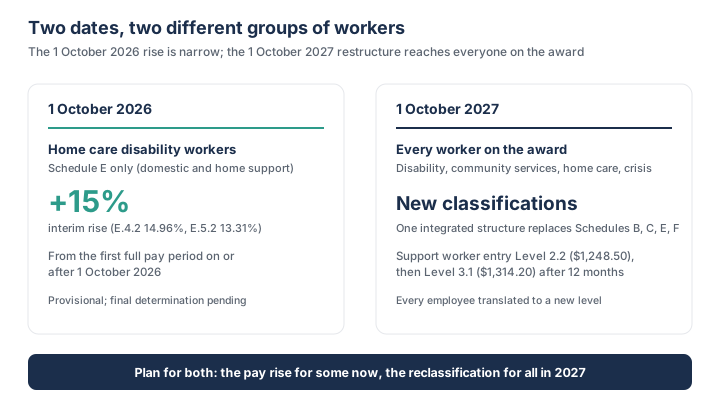
- 1 December 2026: an interim 15% increase for home care disability workers engaged under Schedule E, from the first full pay period on or after that date. The Commission had proposed 1 October 2026 and deferred it to 1 December in its final decision of 11 September 2026. Two classifications are slightly lower (14.96% for Level E.4.2 and 13.31% for Level E.5.2).
- 1 October 2027: a new single integrated classification structure replaces Schedules B, C, E and F for the whole award. Every SCHADS employee, including disability support workers, is translated into a new level, with any remaining rate changes applying then.
- The interim increase is now final. Decision [2026] FWCFB 232 (11 September 2026) confirmed it, moved it to 1 December 2026 because there was no Commonwealth funding commitment and NDIS providers need time to change arrangements with clients, and published determination PR814259 with the new Schedule E rates, revised for the Annual Wage Review 2026. The final determination for the 2027 structure will be published closer to 1 October 2027.
- Under the new structure, a disability support worker starts at Level 2.2 ($1,248.50 per week in the June decision) for the first 12 months of relevant experience, then moves to Level 3.1 ($1,314.20). That $1,314.20 is the rate the unions argued for because it is the NDIS minimum funding point for the work. The version attached to the September decision, updated for the Annual Wage Review 2026, shows $1,307.80 and $1,376.70.
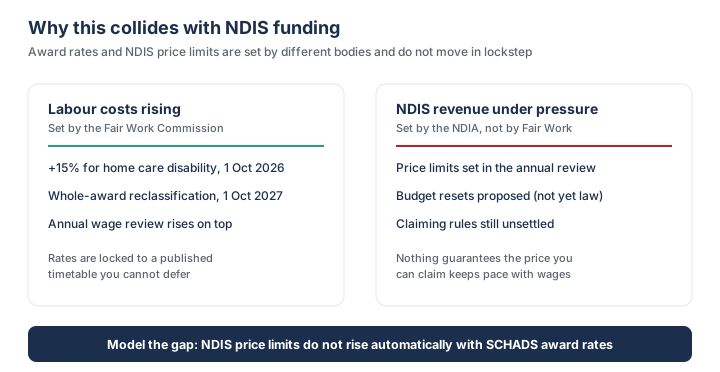
- The commercial risk is a squeeze: award labour costs are rising on a fixed Fair Work timetable while NDIS price limits are set separately by the NDIA and do not move automatically with them. On 19 October 2026 the NDIA announced that the maximum prices for four support items rise for supports delivered on or after 1 December 2026 (House Cleaning and Other Household Activities, for example, goes from $60.10 to $64.59 an hour at the national rate). By our calculation each of the four rises 7.47%, against the 15% wage rise. Model the gap across your participant book now.
- Like the Health Professionals Award change, the 2027 restructure is a reclassification project, not a payroll parameter change. The slow part is translating every worker into the new structure, and that work does not depend on the final dollar figures.
The SCHADS Award, which covers most disability, community-services and home-care workers, is being rebuilt. A 15% pay rise reaches home care disability workers first, from 1 December 2026, and a completely new classification structure follows for everyone on the award on 1 October 2027. For an NDIS or disability provider, the real exposure is not one pay run. It is a rising, legislated wage bill landing while the funding that pays for it is decided somewhere else.
![Timeline of the SCHADS Award gender-undervaluation changes: the Fair Work review begins on 7 June 2024, the decision [2026] FWCFB 137 is handed down on 1 June 2026, submissions on the provisional view close on 29 June 2026, the final decision [2026] FWCFB 232 on 11 September 2026 sets the interim 15 per cent increase for home care disability workers from 1 December 2026, and a new integrated classification structure for the whole award commences on 1 October 2027.](/images/blog/schads-award-timeline-2026-2027.svg)
What did the Fair Work Commission actually decide?
On 1 June 2026 the Expert Panel issued decision [2026] FWCFB 137, finalising the Social, Community, Home Care and Disability Services Industry Award 2010 (the SCHADS Award, MA000100) under the gender-based undervaluation priority awards review. It is the same review, begun on 7 June 2024 across five female-dominated awards, that reshaped the Health Professionals and Support Services Award.
The Panel found that the award's existing classification structures, spread across separate schedules for social and community services, crisis accommodation and home care, were not fit for purpose and had undervalued the work. Its answer has two moving parts on two different dates:
- A new single integrated classification structure that replaces the old Schedules B, C, E and F, commencing on 1 October 2027. Every employee on the award is translated into the new structure, and any rate changes take effect at commencement with no phasing.
- An interim 15% increase for the group the Panel considered could not fairly wait until 2027, home care disability workers under Schedule E. The June decision proposed the first full pay period on or after 1 October 2026; the final decision of 11 September 2026 set it at 1 December 2026.
The reasoning for bringing the Schedule E group forward matters, because it is why the Panel kept an interim increase even when it moved the date. Home care workers in the aged care sector have had a 15% interim uplift since 30 June 2023 under the Stage 1 Aged Care decision. The Panel said it was "plainly anomalous" that home care workers servicing disability clients had been left behind, and decided their rectification should begin earlier rather than waiting for the full restructure.
Is it final, and why did the date move?
This is the detail most sector summaries skip, and it changes how you should act. In the June decision, the interim increase was the Panel's provisional view, with 1 October 2026 as its start. Alongside the decision, the Commission published two draft determinations (one for the interim Schedule E increase, one for the 1 October 2027 changes) and a draft order revoking the old Equal Remuneration Order, then gave parties 28 days to file submissions. That window closed around 29 June 2026, and the Panel said it did not expect a further hearing would be needed.
On 11 September 2026 the Panel issued its final decision, [2026] FWCFB 232. It kept the interim 15% increase but deferred it from 1 October 2026 to 1 December 2026, "given the absence of any commitment by the Commonwealth Government regarding funding and consequently, the steps needed to be taken by NDIS providers to alter arrangements including with clients". Employer groups had asked for 1 January 2027 (ABLA) or no earlier than 1 July 2027 (Ai Group). Determination PR814259 sets the new Schedule E weekly rates, revised for the Annual Wage Review 2026, from the first full pay period starting on or after 1 December 2026. The 1 October 2027 structure is settled, but its final determination will be published closer to that date, updated for the Annual Wage Review 2027. Load payroll from PR814259, not from the June draft.
Who actually gets the 15% from 1 December 2026?
Only home care disability workers, and only those engaged under Schedule E of the award. This is narrower than "disability workers get a pay rise", and getting the scope right matters, because applying the increase to the wrong staff is its own compliance problem.
Schedule E covers home care disability work, which the decision defines as domestic assistance or home maintenance performed for a person with disability in their home. The Panel was explicit that this is distinct from disability support work, which is the core NDIS support role and sits under the social and community services stream. If your workers deliver disability support in the community or a participant's home, they are most likely not the Schedule E cohort, and their change comes with the 2027 restructure, not the 2026 increase.
For the Schedule E group, most classifications rise by 15% from the first full pay period on or after 1 December 2026. Two do not: Level E.4.2 rises 14.96% and Level E.5.2 rises 13.31%, because their translated rate under the new structure is closer. After this interim step, the remaining increases (between about 2% and 7%) are folded in when the new structure commences in 2027, so there is no second interim rise to track.
What changes for disability support workers in 2027?
The bigger event for most NDIS providers is the new structure on 1 October 2027, because it reaches the disability support workforce that Schedule E does not. The Commission is collapsing the award's separate schedules into one integrated structure and translating every employee into it.
Two anchor points from the decision give the shape of it:
- A disability support worker with less than 12 months of relevant industry experience, who does not otherwise sit at a higher level, enters at Level 2.2 on $1,248.50 per week. After 12 months of relevant experience they move to Level 3.1 on $1,314.20 per week. (These are the June decision's figures. The version of the final determination attached to the September decision, updated for the Annual Wage Review 2026, shows $1,307.80 and $1,376.70; the published figures will also carry the Annual Wage Review 2027.)
- A social and community services employee enters at Level 3 on $1,314.20 per week.
That $1,314.20 figure is not arbitrary. The unions argued for it as the disability support worker entry rate precisely because it is the minimum funding point for the work under the NDIS, and it is the Certificate III caring-skills benchmark rate. The Commission set the entry level a step below that for a worker's first 12 months, then lifts them to it. The practical message for providers is that the new structure ties pay progression to experience and qualifications in a defined way, and every current worker has to be mapped onto it.
The timetable at a glance
| Date | What happens | Who it affects |
|---|---|---|
| 7 June 2024 | Fair Work Commission opens the gender-based undervaluation priority awards review across five awards | Sector-wide |
| 1 June 2026 | Decision [2026] FWCFB 137 finalises the SCHADS Award; sets the interim increase and the new structure | All SCHADS employers |
| ~29 June 2026 | Submissions on the provisional view close | All SCHADS employers |
| 11 September 2026 | Final decision [2026] FWCFB 232 defers the interim increase to 1 December 2026; determination PR814259 published | All SCHADS employers |
| 1 December 2026 | Interim increase (15%, with E.4.2 at 14.96% and E.5.2 at 13.31%), from the first full pay period on or after this date | Home care disability workers (Schedule E) |
| 1 October 2027 | New single integrated classification structure commences; every worker translated; remaining rate changes apply | Every worker on the award |
Why this collides with NDIS funding
For a general employer, a phased award rise is a budgeting exercise. For an NDIS provider it is more than that, because the price you can charge is not set by the same body that sets your wages.
Award rates are set by the Fair Work Commission on the timetable above. Your NDIS revenue, the price limits you can claim against, is set separately by the NDIA through its annual pricing review, and there is no automatic mechanism that lifts price limits in step with a SCHADS increase. The two can, and historically do, move at different speeds. That is the gap to model: what your labour cost per hour becomes on 1 December 2026 and again in 2027, against what the relevant NDIS price limit actually is.
The timing makes it sharper. The wage rises are landing in the same window as two other NDIS money questions. The 2026-27 pricing arrangements are in force, but the claiming rules that decide what you can actually bill for travel, non-face-to-face time and cancellations are still not fully republished. And the participant budget resets (community participation down 50%, capacity-building daily activities down 10%) cut the funding pool further; the enabling legislation became law on 20 August 2026, and the Minister's support determination, made on 28 September 2026, applies the cuts to old framework plans that come into effect on or after 1 October 2026, with some subgroups of supports excluded. Rising costs, uncertain prices and a revenue cut, all around the same dates, is a real viability question, not a theoretical one.
What has the NDIA done about prices for 1 December 2026?
On 19 October 2026 the NDIA announced that "From 1 December 2026, the maximum prices for four NDIS support items will increase." It links the change to the Fair Work Commission's decision on Schedule E wages. The four items, at the national rate per hour:
| Support item | Item number | Current price limit | From 1 December 2026 |
|---|---|---|---|
| House or Yard Maintenance | 01_019_0120_1_1 | $59.01 | $63.42 |
| House Cleaning and Other Household Activities | 01_020_0120_1_1 | $60.10 | $64.59 |
| Assistance with Personal Domestic Activities | 01_004_0107_1_1 | $61.16 | $65.73 |
| Specialised Home-Based Assistance for a Child | 01_016_0104_1_1 | $61.16 | $65.73 |
The current figures are the ones in the Pricing Schedule in force, effective 24 September 2026. The announcement gives national rates only and states no remote or very remote figures. By our calculation, each of the four limits rises 7.47%. The Schedule E wage rise they respond to is 15%, from the first full pay period on or after 1 December 2026 ([2026] FWCFB 232, determination PR814259). Put your own cost per hour at the new award rates against the new limits before you assume the gap has closed.
The NDIA's rules for the change are short:
- The delivery date decides the price. "The new maximum prices apply to eligible supports delivered on or after 1 December 2026." A support delivered in November is claimed at the old limit even if the claim goes in later: "Providers should use the maximum price that applied on the date the support was delivered."
- Nothing changes in how you claim. "The claiming process and support item numbers are not changing."
- Existing service agreements need the participant's agreement. "Providers must discuss any proposed changes to existing service agreements as a result of these price changes with participants and participants must agree before those changes are made." On our reading, a higher limit does not lift the price in an existing agreement by itself; see our service agreement checklist.
- The new Schedule arrives on the day. "We will publish a NDIS Pricing Schedule and claiming guidance that reflects this change on our website on 1 December 2026." Until then, the Schedule effective 24 September 2026 still shows the old figures.
The announcement covers these four items only. It does not deal with the 1 October 2027 restructure, which is the change that reaches disability support workers in the social and community services stream.
What should a provider do now?
Treat this the way you would treat the Health Professionals Award change: as a project with a deadline, staged across two dates. A workable sequence:
- Identify which schedule and stream each worker sits in. Separate your home care disability (Schedule E) staff, who are in scope for the 1 December 2026 increase, from your disability support and community-services staff, who change with the 2027 restructure. This single step tells you what lands when.
- Cost the 1 December 2026 increase now. For Schedule E staff, model the 15% (and the 14.96% and 13.31% exceptions for Levels E.4.2 and E.5.2) from your first full pay period on or after that date, and check your payroll system will apply it on the right date. On the revenue side, put the four new price limits (7.47% higher on each item, by our calculation) against the same hours, using the delivery date to decide which limit applies. Raise any change to an existing service agreement with the participant before you make it, because the participant must agree first.
- Load the final rates. The interim increase is final: take the Schedule E rates from determination PR814259 and check them against the award before you change pay. The Fair Work Ombudsman's SCHADS pay guide effective 1 December 2026, published 18 September 2026, already carries the Schedule E rates.
- Start the 2027 translation early. The whole-of-award reclassification is the big job. Begin collecting, for each worker, their qualifications, relevant experience and the duties they actually perform, because that is what the new structure classifies on. A current position description that matches real duties is the anchor for a defensible classification.
- Model the funding gap. Put your projected cost per hour at each date against the relevant NDIS price limit, and identify where the margin is thin. Revisit service agreements and rostering where the numbers do not work.
- Diarise the dates. 1 December 2026 for the Schedule E increase, 1 October 2027 for the new structure, and the Annual Wage Review each year on top.
For the classification mechanics themselves, our guide on how to audit your award classifications walks the step-by-step, and the NDIS provider compliance pillar covers the wider registration and pricing picture this sits inside.
What happens if you get a classification wrong?
The same rules that make the Health Professionals Award reclassification risky apply here. Underpayments are recoverable by employees for up to six years, so a translation error made in 2027 reaches back years by the time anyone checks. Since 1 January 2025, intentional underpayment has been a criminal offence under the Fair Work Act, and a misclassification that sits a worker one level too low is a permanent discount on every hour they work, not a one-off error.
The enforcement risk is not abstract for care employers, and the newest case is a disability provider. On 14 October 2026 the Fair Work Ombudsman announced an enforceable undertaking with Sunnyfield, "a National Disability Insurance Scheme-registered organisation and charity offering supported independent living, specialist disability accommodation and lifestyle programs across NSW", after "underpayments of about $5.43 million, including superannuation and interest, for more than 1,700 workers". The cause was progression: "A total of 1,767 current and former employees were underpaid between 2018 and 2024, as a result of failures to progress employees to their correct pay points." Its review found that pay point progression requirements under the SCHADS Award and an enterprise agreement "had been applied inconsistently". Sunnyfield reported the underpayments itself in October 2024, after an external payroll audit. Progression is also what the 2027 structure turns on, since a disability support worker moves from Level 2.2 to Level 3.1 after 12 months of relevant experience. The Ombudsman's message reads as a warning to every SCHADS employer: "Employers should not assume long-standing payroll practices, including on pay point progression, are compliant." It added that "the disability support services sector is a priority for the FWO". The Ombudsman said an undertaking was appropriate because Sunnyfield had self-reported, "fully cooperated with the investigation" and "back-paid all employees it was able to find to date".
Ignoring the regulator ends in court instead. In February 2026 the Federal Circuit and Family Court penalised the former operators of a Sydney medical centre $36,000, including $6,000 against the director personally, for deliberately ignoring a Fair Work compliance notice over an underpaid nurse. The lesson generalises: treating an award obligation as optional paperwork is exactly what turns a fixable shortfall into a penalty. For how award misconfiguration compounds into a large liability, see our analysis of the 2026 payroll underpayment cases.
Frequently asked questions
When do the SCHADS Award changes take effect?
There are two dates. A 15% interim increase for home care disability workers under Schedule E applies from the first full pay period on or after 1 December 2026 (the June decision proposed 1 October 2026; the final decision of 11 September 2026 deferred it). A new single classification structure for the whole award, with every worker translated to a new level, commences on 1 October 2027. Both come from Fair Work Commission decision [2026] FWCFB 137 (1 June 2026), finalised by [2026] FWCFB 232 (11 September 2026).
Do all disability support workers get the 15% increase on 1 December 2026?
No. The 1 December 2026 increase applies only to home care disability workers engaged under Schedule E, which covers domestic assistance and home maintenance for people with disability. Disability support workers who deliver core support work sit in the social and community services stream, and their pay changes come with the new classification structure on 1 October 2027, not the 2026 increase.
Is the 15% increase final?
Yes. The June decision expressed it as a provisional view with 1 October 2026 as the start date. The final decision of 11 September 2026 ([2026] FWCFB 232) confirmed the 15% but deferred it to 1 December 2026, and determination PR814259 sets the new Schedule E rates, revised for the Annual Wage Review 2026, from the first full pay period starting on or after that date.
What is the new SCHADS classification structure?
From 1 October 2027 the award's separate schedules (Schedules B, C, E and F) are replaced by one integrated classification structure covering disability support, community services, home care and crisis accommodation work. Every employee is translated into the new structure. For example, a disability support worker enters at Level 2.2 ($1,248.50 per week in the June decision) for their first 12 months, then moves to Level 3.1 ($1,314.20); the final figures will carry the 2026 and 2027 Annual Wage Review increases.
How does this affect NDIS providers financially?
It raises your wage costs on a fixed timetable, while NDIS price limits are set separately by the NDIA and do not automatically rise with award rates. For the 1 December 2026 Schedule E increase, the NDIA announced on 19 October 2026 that four support items rise for supports delivered on or after 1 December 2026: House or Yard Maintenance to $63.42 an hour, House Cleaning and Other Household Activities to $64.59, and Assistance with Personal Domestic Activities and Specialised Home-Based Assistance for a Child to $65.73 (national rates). By our calculation that is 7.47% on each item, against the 15% wage rise, and participants must agree before any change to an existing service agreement. Providers should model the cost per hour at each date against the relevant NDIS price limit, especially as the increases land alongside unsettled claiming rules and participant budget cuts, to find where margins are thin before the dates arrive.
Which award covers disability support workers?
Most disability, community-services and home-care staff are covered by the Social, Community, Home Care and Disability Services Industry Award 2010 (SCHADS, MA000100). It is a different award from the Health Professionals and Support Services Award (MA000027), which covers allied health and practice support staff, and from the Nurses Award 2020. Confirm which award each worker is on before applying any change.
Part of