Why this matters for your practice
Any note an AI scribe drafts becomes the clinician's own the moment it reaches the record. MDA National: once entered, notes "are deemed to have been reviewed and approved by the clinician, regardless of whether the clinician has checked them or not." Avant: "It will not be a defence to say an error was due to the use of an AI scribe." Consent is also a legal question, since state recording law can require it, and the RACGP's F11 criterion says a practice using a vendor's tool "remain[s] responsible for their safe and appropriate use."
Adoption is rising fast. A newsGP poll found AI scribe use in general practice rose from 22% in August 2024 to almost 40% by November 2025. A separate Healthed survey of 1,535 GPs found only 18.7% personally use one, with just 25.0% of practices holding an AI governance policy: a practice-level figure and a personal-use figure, not a contradiction. The ANAO added, on 21 September 2026, that "approximately one-fifth" of listed practice software "refer to using AI, particularly AI scribes."
What is an AI scribe?
An AI scribe listens to a consultation and turns it into a draft for the patient's record. The glossary of the RACGP's Standards for general practices, 6th edition defines it as "A tool that can automate parts of the clinical documentation process for a medical practitioner. AI scribes can convert a conversation with a patient into a clinical note, summary, or letter that can be incorporated into the patient's health record." Other names in use, per the RACGP fact sheet: "digital scribes, virtual scribes, ambient AI scribes, AI documentation assistants, and digital/virtual/smart clinical assistants."
It is not autofill. The RACGP's fact sheet says "'autofill' functionality, which allows clinical information system users to take advantage of shortcuts for frequently used text, does not fall under the classification of AI scribe functionality, despite it being a form of AI."
Mechanically, it "uses a microphone to capture any speech that occurs during a clinical encounter. The technology then converts this captured audio data into text." The output is a summary, not a transcript: the ACSQHC says ambient scribes "are intended to record and then use generative AI to summarise a consultation," and Avant tells practices to make clear the tool "will provide a summary of the consultation not a word-for-word transcription."
Is an AI scribe a medical device?
No, unless it crosses a specific line. The TGA's test, updated 30 January 2026: scribes "intended only to transcribe and translate clinical conversations into written records without performing analysis or interpretation are not considered medical devices," but one that "analyses or interprets clinical conversations, for example by generating a diagnosis, differential diagnosis or treatment recommendation not explicitly stated by the healthcare practitioner, is considered a medical device" and must be in the ARTG before supply. Unlisted devices "are being supplied illegally," and the TGA "may take compliance action" against the supplier.
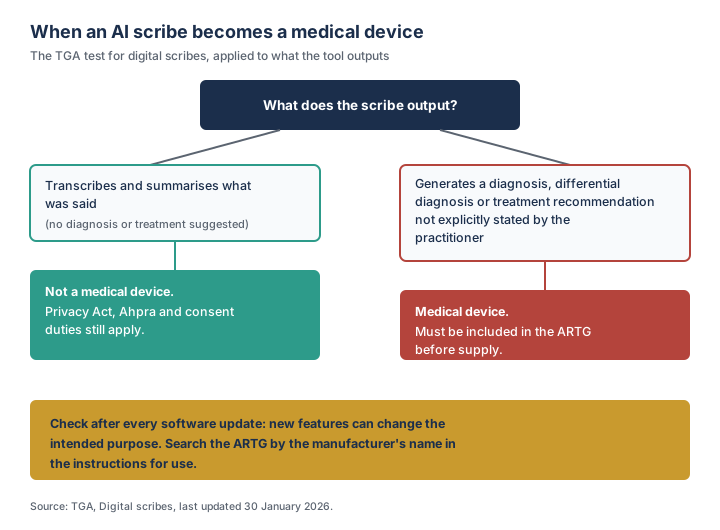
The RACGP's own two documents disagree: its 6th edition Standards (26 August 2026) list some AI tools, "for example, diagnostic aids, clinical decision support systems, transcription tools," as possibly meeting the medical device definition, while its fact sheet (October 2025) says scribes specifically "do not require regulation by the TGA as they do not have a therapeutic use." Apply the TGA's own test.
Scope creep is the practical risk. ACSQHC warns that "an ambient AI scribe suggesting a diagnosis or further treatment that was not mentioned to the patient" may trigger ARTG inclusion, and MDA National says to "beware AI scope creep", since diagnosis or treatment software "should not be used until there is TGA approval." A tool compliant at purchase can stop being compliant, since "software updates have introduced new functionality that may change the intended purpose." Search the ARTG "using the manufacturer's name as listed in the instructions for use."
A TGA review of digital scribes is ongoing: a TGA spokesperson told newsGP on 9 July 2026 that it was prioritising products "more widely used in Australia", with a summary promised "in coming months", and nothing had been published by 24 September 2026. The TGA's clinical decision support software exemption also changes on 1 November 2026, and a scribe proposing diagnoses may bring a practice within the privacy policy duty for automated decision-making.
What consent does an AI scribe need?
Every professional body says something different, and the gap is not academic: whether a practice needs written consent, verbal consent recorded in the notes, or an opt-out covered in a collection notice depends on which body regulates the clinician, and the practice's medical defence organisation decides between them where they diverge. Most of them expect consent to be sought before the scribe starts listening and recorded somewhere; they differ on whether it must be written, whether a notice with an opt-out can do the job, and how often it is repeated.
| Body and document | What it says | Date |
|---|---|---|
| RACGP, 6th edition F11.A | The practice "facilitates processes for members of the clinical team to obtain and document informed consent from patients when aspects of care will be delivered using AI" | Published 26 August 2026 |
| RACGP, AI scribes fact sheet | "Obtain patient consent to use an AI scribe at the beginning of each consultation." Ask your MDO whether written consent is required; if not, verbal consent recorded in the notes is enough | Last updated October 2025 |
| Ahpra and the National Boards | "Make sure you obtain informed consent from your patient, and ideally note the patient's response in the health record" | Reviewed 22 August 2024 |
| ACRRM, AI scribing checklist | "Obtain explicit consent before using the AI scribe before each consultation." "Avoid relying on implied consent, always seek active patient agreement." | June 2025 |
| Australian Psychological Society | "Psychologists are required to obtain written informed consent before using AI or emerging technologies that involve client data, influence clinical decision-making, or contribute to client records" | Described 11 February 2026 |
| Australian Physiotherapy Association | Patients "must consent to this use without coercion and that this is documented appropriately"; Ahpra's guidance "takes precedence" if the two conflict | August 2026 |
| ACSQHC, ambient scribe scenario | Consent may be documented "on registration forms (paper or electronic), as part of online booking terms and conditions, through privacy collection notices with opt out options or in the healthcare record" | August 2025 |
MDA National is blunt: "A sign in the waiting room or a note on the website or appointment booking platform will not protect you." Avant's position on frequency (8 January 2025): after a detailed first explanation, "it is sufficient for you to seek the patient's verbal confirmation that they consent to the use of the tool at the start of each subsequent consultation."
Consent has a recording-law leg too. NSW's Surveillance Devices Act 2007 s 7(1)(b) makes it an offence to knowingly record "a private conversation to which the person is a party", up to 500 penalty units for a corporation or 100 penalty units or 5 years imprisonment otherwise; s 7(3) excepts cases where all the principal parties consent, expressly or impliedly, or one principal party consents and the recording is reasonably necessary to protect that party's lawful interests or is not made to communicate the conversation to non-parties. Avant reads all-party consent as required in the ACT, NSW, South Australia, Tasmania and Western Australia, and merely "prudent" elsewhere; a scribe "may be considered a listening device ... (although this has not been considered by the courts to our knowledge)." MIPS says consent "needs to be obtained (and recorded) prior to each consultation" because it "may be a separate offence."
The wording is in our AI scribe patient consent form template; the full vendor assessment is in our guide to assessing an AI scribe for privacy compliance.
Which privacy rules apply to an AI scribe?
The OAIC's guidance on commercially available AI products maps onto several Australian Privacy Principles.
APP 3, collection. Using AI "to generate or infer personal information, including images, this is a collection of personal information and must comply with APP 3." A scribe generates new personal information every time it runs.
APP 5 and APP 1, notification. Where the vendor's developer can see patient data, that "is a disclosure that should be included in an APP 5 notice", reflected in the privacy policy too.
APP 6, use and disclosure. Feeding audio or a transcript into the scribe is a use if the data stays in the practice's control, or a disclosure if it does not, and either way must comply with APP 6. Training the vendor's model on that data is a separate secondary use the OAIC says often falls outside "reasonable expectations", so seek consent or offer "a meaningful and informed ability to opt-out."
APP 8 and section 16C, overseas disclosure. A practice "must take such steps as are reasonable in the circumstances to ensure that the overseas recipient does not breach the Australian Privacy Principles", and under s 16C the recipient's own breach is "taken ... to have been done, or engaged in, by" the practice. Guideline 8.14 allows one exception for storage-only overseas hosting: it counts as a use, not a disclosure, only where a binding contract limits the provider to that storage purpose, binds its subcontractors the same way, and gives the practice "effective control."
State health records laws. NSW's HPP 14 catches interstate transfer, not just offshore, unless an exception applies. Victoria's HPP 9, per the Health Complaints Commissioner: "When health information travels outside Victoria, the holder has a responsibility to ensure that the privacy of the information is safeguarded."
Public AI tools. The OAIC recommends organisations "do not enter personal information, and particularly sensitive information, into publicly available generative AI tools."
ACSQHC and RACGP differ in strength on data location: ACSQHC says data "must be stored and processed in Australia unless the patient has provided explicit consent" otherwise; RACGP says only "Ideally" it will be. Small practices are covered too: under s 6D(4)(b), a practice providing a health service is not a small business operator regardless of turnover. This sits inside the wider healthcare privacy and cyber security picture.
How long is the recording and transcript kept?
Retention of the audio and transcript is set by the vendor and varies widely. Terms read on 24 September 2026 ranged from audio never permanently stored to audio kept up to a week, with transcripts and draft notes kept from 24 hours to 6 months. Read the vendor's own privacy policy, not its marketing page. The RACGP's fact sheet says "Most AI scribe providers do not store captured audio content, meaning that it cannot be accessed by anyone, including the medical practitioner or the patient."
The note itself is a different question, governed by health records law rather than the vendor's terms. MIPS: "In Victoria, ACT and NSW, health information must be retained for at least seven years from when a patient was last consulted or until a child reaches the age of 25 years, whichever occurs later", applying "only" to identifiable information. The APS treats the AI's own output as part of the file: it "form[s] part of the clinical record." Our medical record retention calculator works out the date for your state.
Unresolved: whether a transcript the vendor still holds is part of the health record, and what must be produced on an APP 12 access request or a subpoena. No regulator has settled it, and the APS is the only body to have taken a view on AI outputs specifically.
What the regulator or assessor expects
The Medicare record standard does not mention AI. Section 6 of the PSR Scheme Regulations 2019 requires every entry to record the date of service, give "sufficient clinical information to explain the service", and be completed "at the time, or as soon as practicable after", and the record must be "sufficiently comprehensible to enable another practitioner to effectively undertake the patient's ongoing care." No PSR statement on AI scribes has been found.
Ahpra puts accuracy on the clinician: "the practitioner is responsible for checking the accuracy and relevance of records created using generative AI." The bodies split on labelling: ACSQHC says to "Label records indicating AI was involved in its creation"; ACRRM treats it as optional, "if desired"; the RACGP says nothing.
The RACGP's 6th edition Standards reach a scribe through five criteria: F11.A (the consent processes above), F11.B (assess before implementation, monitor after), F4 (training on safe use, purpose, limitations and clinical oversight, updated regularly), F9.A (the privacy policy must address overseas disclosure of health information), and CG7 (the incident process must cover AI issues, not relying only on complaints). None applies until a practice adopts AI, and accreditation still runs on the 5th edition, with no transition date set. On withdrawal, F11 expects the practice to record it in the health record, stop using AI in that patient's care unless clinically necessary and re-authorised, and offer an alternative pathway where feasible.
Common mistakes
Relying on a waiting-room sign as consent. MDA National: "A sign in the waiting room or a note on the website or appointment booking platform will not protect you." ACRRM agrees: "Avoid relying on implied consent." ACSQHC, though, accepts an opt-out collection notice as one valid way to document consent, so the bodies differ and the MDO decides.
Pasting consultation content into a public chatbot. The OAIC's rule is direct: do not put sensitive information "into publicly available generative AI tools." A free chatbot has no contract and no effective control behind it.
Letting the scribe pick the MBS items. The RACGP says a suggested item still needs verifying against Medicare's requirements, and Avant's factsheet (27 March 2026) states: "Responsibility for MBS billing remains with you, irrespective of whether an AI scribe is used." Our post on the ANAO's AI billing audit covers the wider finding.
Leaving vendor suggestion features on without checking TGA status. The test is whether the tool generates something "not explicitly stated by the healthcare practitioner", and an update can change a tool's intended purpose unnoticed, so watch for scope creep before it becomes an unregistered medical device.
Importing the draft without reading it. MDA National leaves no room to move: once entered, a note is "deemed to have been reviewed and approved by the clinician, regardless of whether the clinician has checked them or not." The RACGP's answer is to review notes "as soon as possible after consultations."
Frequently asked questions
Is an AI scribe a medical device in Australia?
No, not unless it analyses or interprets what was said. A scribe that only transcribes and summarises is not a medical device. One that generates a diagnosis, differential diagnosis or treatment recommendation the practitioner did not explicitly state is, and must be in the ARTG before supply. The TGA's review of digital scribes is ongoing, with no summary published yet.
Do I need written consent to use an AI scribe?
Not always. The RACGP says to ask your medical defence organisation; if written consent is not required, verbal consent recorded in the notes is enough. Psychologists are the exception: the Australian Psychological Society requires written, tool-specific consent, and blanket consent for "AI use" is not sufficient.
Does an AI scribe store the recording?
It depends on the vendor. Terms read on 24 September 2026 ranged from audio never permanently stored to audio kept up to a week, with transcripts and notes kept from 24 hours to 6 months. Check the vendor's own privacy policy, not its marketing page.
Can an AI scribe suggest MBS item numbers?
Yes, some do. The RACGP says any suggested item still needs verifying against Medicare's requirements before it is billed. Avant's factsheet (27 March 2026) states: "Responsibility for MBS billing remains with you, irrespective of whether an AI scribe is used." Treat a suggested item as a starting point, not a decision.
Who is responsible for an error in an AI-drafted note?
The clinician. MDA National treats an entered note as reviewed and approved by the clinician regardless of whether they checked it, Avant says it is no defence to blame the tool, and Ahpra puts the duty to check accuracy on the practitioner.
Do AI scribes use patient data to train their models?
It depends on the vendor's terms. The OAIC treats training as a secondary use that often falls outside what a patient reasonably expected, so the practice should seek consent or a meaningful opt-out. The ACSQHC goes further and requires explicit consent. Read the vendor's terms for a training clause first.
Which RACGP standard covers AI scribes?
F11, in the 6th edition of the Standards for general practices, supported by F4 on training, F9.A on the privacy policy and CG7 on incident handling. F11 only applies where the practice uses AI tools, and accreditation still runs on the 5th edition, with no transition date set.
Related terms
Go deeper
Last reviewed