Key Takeaways
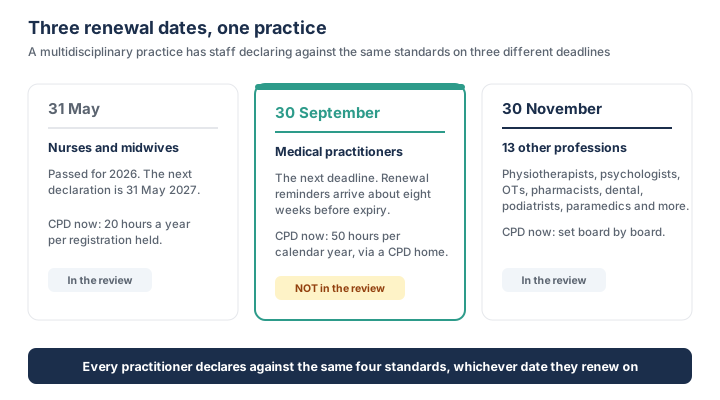
- Medical practitioners must renew registration by 30 September each year. Nurses and midwives renew by 31 May, and thirteen other professions, including physiotherapists, psychologists, occupational therapists, pharmacists and dental practitioners, renew by 30 November. Ahpra sends the renewal reminder about eight weeks before expiry.
- At renewal you declare that you meet four mandatory registration standards: professional indemnity insurance, recency of practice, continuing professional development, and criminal history.
- Ahpra states plainly that National Boards routinely audit a randomly selected number of practitioners each year, and that a false or misleading declaration can be grounds to refuse renewal, impose conditions on registration, or take disciplinary action. The declaration is not a formality.
- Doctors: 50 hours of CPD per calendar year, not per registration year, through an AMC-accredited CPD home, split as 25 hours reviewing performance and measuring outcomes (minimum 5 hours of each type), 12.5 hours educational activities, and 12.5 hours from any category. A written professional development plan must be prepared before starting CPD each year.
- Nurses and midwives: 20 hours per registration held, so 40 hours for someone registered as both, and 30 hours for a nurse practitioner (20 plus 10 endorsement hours).
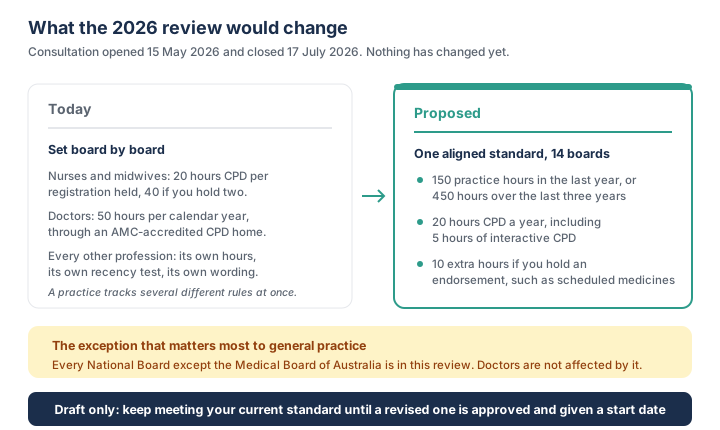
- A national realignment is in draft. On 15 May 2026 Ahpra and 14 National Boards opened consultation on revised recency of practice and CPD standards proposing 150 practice hours in the last year or 450 over three years, 20 hours of CPD annually including 5 interactive hours, and 10 extra hours for practitioners holding an endorsement. Consultation closed 17 July 2026.
- Every National Board except the Medical Board of Australia is in that review. Doctors are unaffected by the proposed changes and keep the 50-hour CPD home model.
Medical practitioners must renew their AHPRA registration by 30 September 2026. At renewal, each practitioner personally declares they have met four mandatory registration standards, including CPD and recency of practice. National Boards audit a random sample of those declarations each year, and the practitioner, not the practice, must produce the evidence.
Status check, 30 September 2026: the standard medical renewal deadline is today. From 1 October a one-month late period runs to 31 October; a doctor who has not renewed by then has their name removed from the Register, their registration lapses, and they "cannot practise" until a fast-track application is assessed and the Register is updated (Medical Board renewal page). The Medical Board's 6 August 2026 renewal notice restates the requirement as an AMC-accredited CPD home, a professional development plan written before the year's CPD starts, and 50 hours per calendar year. No outcome has been published from the 14-board recency and CPD consultation that closed on 17 July 2026, so the existing board-specific standards are the ones every practitioner declares against this cycle.
For a practice, this matters for a reason that is easy to miss. Registration renewal looks like an individual administrative task, so it usually sits entirely with the practitioner. But a lapsed registration stops a clinician working, an audit that a clinician cannot answer can put conditions on their registration, and both outcomes land on the practice roster with no notice. The practices that handle this well treat CPD and recency evidence as workforce records they help maintain, not as somebody else's paperwork.
This post covers what the renewal declaration actually commits a practitioner to, what CPD and recency require right now for each profession, what Ahpra has proposed to change, and what a practice should have in place before 30 September.
What do you declare when you renew your AHPRA registration?
When a registered health practitioner renews, they declare that they meet their National Board's registration standards. Ahpra's registration renewal page lists four: professional indemnity insurance, recency of practice, continuing professional development, and criminal history, where a revised common standard took effect on 15 July 2026. Practitioners must also disclose any health impairment that may affect their ability to practise safely, along with other disclosures relevant to their practice.
The important sentence on that page is the one most people skim past. Ahpra warns that National Boards routinely audit a randomly selected number of practitioners each year, that you must be able to substantiate your declarations if audited, and that making a declaration that is false or misleading can be grounds for the Board to refuse to renew registration, impose conditions on registration, or take disciplinary action.
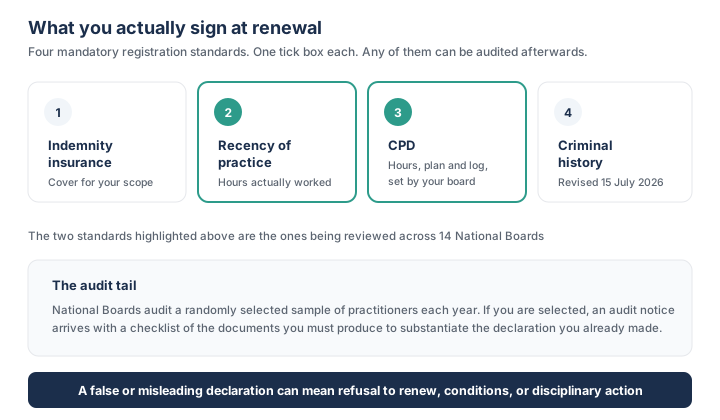
So the declaration creates an evidence obligation that survives the renewal itself. A practitioner who ticks the CPD box in September and is audited in March needs the logs, the plan and the certificates from the period they were declaring about. That is the practical failure point: the declaration is made honestly, and the supporting records were never assembled.
When is AHPRA registration renewal due for each profession?
Renewal dates are fixed by profession, not by the individual. Practitioners holding general, specialist or non-practising registration renew at the same time every year, while those with provisional or limited registration renew on the anniversary of the date registration was first granted.
| Renewal deadline | Professions | In the 2026 standards review? |
|---|---|---|
| 31 May each year | Nurses and midwives | Yes |
| 30 September each year | Medical practitioners | No |
| 30 November each year | Aboriginal and Torres Strait Islander Health Practitioners, Chinese medicine practitioners, chiropractors, dental practitioners, medical radiation practitioners, occupational therapists, optometrists, osteopaths, paramedics, pharmacists, physiotherapists, podiatrists, psychologists | Yes |
For a multidisciplinary practice this is the operational headache. A general practice with GPs, a practice nurse and a visiting physiotherapist has three separate renewal cycles running against the same four standards, on three different dates, with three different CPD rules underneath them. Nothing in the AHPRA process tells the employer when any of it happens.
That is also why the renewal date and the CPD year do not line up for doctors, which trips people up every year. See the next section.
How much CPD do doctors need, and over what period?
Doctors must complete 50 hours of CPD each calendar year, not each registration year. This is the single most misunderstood point in medical CPD, because registration renews on 30 September while the CPD period runs 1 January to 31 December.
The Medical Board's requirements are specific. Every doctor must:
- join an AMC-accredited CPD home suitable for their scope of practice, which can be a college or a non-college home, unless exempt
- write a professional development plan before starting CPD each year
- complete 50 hours split across categories: 25 hours reviewing performance and measuring outcomes, with a minimum of 5 hours of each of those two types; 12.5 hours of educational activities such as reading, lectures and conferences; and 12.5 hours from any category
- include any specialist high-level requirements and CAPE requirements within the 50 hours
- log activities with their CPD home
- declare which CPD home they were with in the previous calendar year when renewing registration
So the September 2026 renewal asks about the CPD home for the 2025 calendar year, while the 2026 CPD year is still running and closes on 31 December. A doctor who has done nothing by late September is not yet in breach, but has roughly three months to complete a full year of CPD.
Some doctors are exempt: medical students, doctors with non-practising registration, doctors with short-term limited registration of less than four weeks, doctors granted an exemption by their CPD home (for illness or parental leave, for example), and interns and PGY2 doctors in a structured program that leads to a certificate of completion. Doctors working overseas still need an Australian CPD home and still complete the requirements.
How much CPD do nurses and other professions need?
The Nursing and Midwifery Board sets CPD by registration held rather than by hours worked, and the totals stack when a practitioner holds more than one registration or an endorsement.
| Registration held | Minimum CPD hours |
|---|---|
| Registered nurse or enrolled nurse | 20 hours |
| Midwife | 20 hours |
| Registered nurse and midwife | 40 hours (20 plus 20) |
| Nurse practitioner | 30 hours (20 plus 10 endorsement hours) |
| Midwife with scheduled medicines endorsement | 30 hours (20 plus 10 endorsement hours) |
| Nurse and midwife with scheduled medicines endorsement | 50 hours |
The endorsement hours are not generic. For a nurse practitioner they must relate to prescribing and administration of medicines, diagnostic investigations, consultation and referral. Nurses and midwives who cannot meet their minimum hours can apply to the NMBA for an exemption in exceptional circumstances, which may then be referred to the Board for consideration.
The remaining professions each set their own hours and their own definitions through their board's CPD registration standard, which is exactly the fragmentation the 2026 review is trying to fix.
What is the recency of practice standard?
Recency of practice is the requirement that a practitioner has actually practised recently in the scope in which they intend to work, and maintains an adequate connection with their profession. Ahpra's position is that the specific requirements depend on the profession, the practitioner's level of experience and, where relevant, the length of any absence from practice.
In day-to-day practice, recency is the standard that catches people returning from extended parental leave, moving back from overseas, shifting from a purely administrative or academic role into clinical work, or changing scope late in a career. A practitioner can hold current registration, meet CPD in full, and still fail recency because the hours in their actual scope are not there.
It is also the standard the 2026 review targets most directly, because the professions currently express it in very different ways.
What is changing under the 2026 review of CPD and recency standards?
On 15 May 2026, Ahpra and 14 National Boards opened public consultation on proposed changes to their recency of practice and CPD registration standards. The stated aim is to align requirements across professions so the standards support both safe healthcare and a sustainable health workforce.
The draft revised standards propose that practitioners must complete:
- 150 hours of practice in the last year, or 450 hours of practice in the last three years
- 20 hours of CPD every year, including 5 hours of interactive CPD
- 10 extra hours of CPD for practitioners with additional technical or profession-specific skills, such as a scheduled medicines endorsement
- CPD that helps improve patient outcomes and draws on available evidence
Public consultation closed on 17 July 2026. As at 30 September 2026 the review sits under Ahpra's past consultations with no decision, no revised standard and no commencement date.
Two qualifications matter, and both are easy to get wrong.
First, this is a draft. Consultation has closed but no revised standard has been approved or given a commencement date. Registration standards must be approved by the Ministerial Council before they take effect, and previous reviews of these same standards have run well over a year from consultation to commencement. Until a revised standard is published with a date, the existing board-specific standard is the one that applies, and it is the one you declare against.
Second, doctors are not in it. Ahpra's announcement states that all National Boards except the Medical Board of Australia are taking part. The proposed 20-hour CPD figure has been widely reported without that carve-out, and a GP who reads it as a reduction from 50 hours to 20 would be badly wrong. The Medical Board's 50-hour calendar-year CPD home model is unchanged.
For nurses and midwives, the proposed model looks familiar, because 20 hours plus 10 endorsement hours is close to the NMBA structure already in force. The professions facing the most change are those whose current standards differ most from that shape.
What happens if you are audited?
Ahpra and the National Boards run a nationally consistent audit programme covering compliance with the mandatory registration standards. Audits of random samples of practitioners from all professions occur periodically throughout the year.
If selected, a practitioner receives an audit notice in the mail from Ahpra. It includes a checklist setting out the supporting documentation required to demonstrate they meet the standard or standards being audited. The notice identifies which of the four mandatory standards are in scope; it may be one or more of them.
The practical consequence is straightforward. The audit tests a declaration already made, so there is no opportunity to build the record afterwards. A CPD log reconstructed from memory in response to an audit notice is exactly the situation the standard is designed to expose.
What should a practice do before 30 September 2026?
The practitioner owns the declaration. The practice owns the roster, and therefore owns the consequences of a lapse. A sensible division of labour looks like this.
- Build one register of every registered practitioner you employ or contract, with profession, registration number, registration type, expiry date and renewal month. Include contractors, locums and visiting allied health, who are the most commonly missed.
- Set reminders against the three renewal dates, not one. Trigger at 8 weeks and 2 weeks before 31 May, 30 September and 30 November.
- Ask for evidence of renewal, not confirmation of it. Check the public register after the deadline rather than relying on the practitioner saying it is done.
- Store CPD evidence as it accrues. Where the practice funds or delivers training, keep the certificate, the date and the hours in the practitioner's file at the time, not at renewal.
- Flag the doctors early. Because the medical CPD year closes on 31 December, a doctor who is behind in September has one quarter left. Asking in September is useful; asking in November is not.
- Watch for the revised standards. When the 14-board standards are approved, they will carry a commencement date and a transition. Diarise a check rather than assuming the current rules persist.
- Do not collect more than you need. CPD records and registration details are personal information. Keep them in the workforce file under your privacy policy, not in a shared drive.
Points 1 to 3 are the same discipline covered in our guide to tracking AHPRA registration expiry as an employer, which deals with verifying someone else's registration status and conditions. This post is the other half: what that person has to be able to prove about themselves.
What are the most common mistakes?
- Assuming the CPD year matches the registration year. For doctors it does not. Registration renews 30 September; CPD runs the calendar year.
- Writing the professional development plan retrospectively. The Medical Board requires the plan to be written before starting CPD for the year.
- Reading the proposed 20-hour CPD figure as current, or as applying to doctors. It is a draft, and the Medical Board is not part of the review.
- Treating recency as automatic. A practitioner can meet CPD in full and still fail recency after an extended absence or a change of scope.
- Keeping no evidence because the declaration was honest. The audit tests documentation, not intent.
- Missing contractors and locums from the practice's registration register entirely.
Frequently Asked Questions
When do I need to renew my AHPRA registration in 2026?
It depends on your profession. Medical practitioners renew by 30 September each year. Nurses and midwives renew by 31 May. Thirteen other professions, including physiotherapists, psychologists, occupational therapists, pharmacists, dental practitioners and paramedics, renew by 30 November. Practitioners with provisional or limited registration renew on the anniversary of when registration was first granted.
How many CPD hours do doctors need in Australia?
Doctors need 50 hours of CPD each calendar year, completed through an AMC-accredited CPD home. The 50 hours split into 25 hours of reviewing performance and measuring outcomes (with at least 5 hours of each type), 12.5 hours of educational activities, and 12.5 hours from any category. A professional development plan must be written before starting CPD for the year.
Is AHPRA reducing CPD to 20 hours a year?
No, not for doctors. Ahpra and 14 National Boards consulted on a proposed common standard of 20 hours a year plus 5 interactive hours, but every board except the Medical Board of Australia is in that review. The proposal is also still a draft: consultation closed on 17 July 2026 and, as at 30 September 2026, no revised standard has been approved or given a start date.
What is recency of practice and how is it measured?
Recency of practice requires that you have practised recently in the scope you intend to work in and maintain an adequate connection with your profession. Requirements currently vary by profession, experience level and the length of any absence. The draft 2026 standard proposes a common test of 150 hours of practice in the last year or 450 hours over the last three years.
What happens if AHPRA audits my registration declaration?
You receive an audit notice by mail, with a checklist of the documentation needed to demonstrate you meet the standard or standards being audited. Audits take random samples of practitioners from all professions periodically throughout the year. You must be able to substantiate the declaration you already made, so the evidence needs to exist before the notice arrives.
What are the consequences of a false CPD declaration?
Ahpra states that making a declaration that is false or misleading can be grounds for the National Board to refuse to renew your registration, to impose conditions on your registration, or to take disciplinary action. This applies whether the declaration was deliberately false or simply unsupported by any records when audited.
Does an employer have to track a practitioner's CPD?
There is no statutory duty on an employer to complete or track a practitioner's CPD, because the declaration is personal to the practitioner. But an employer does have obligations around registration itself, and a lapsed or conditioned registration has immediate rostering consequences, so most practices keep a workforce register covering renewal dates and hold CPD evidence for training the practice delivers or funds.
Do contractors and locums need to be in our registration register?
Yes, in practical terms. The obligation to make sure a person is registered to do the work they are doing does not change because they are engaged as a contractor or for a single shift. Contractors, locums and visiting allied health practitioners are the group most often missing from a practice register, and they are the group whose renewal dates a practice is least likely to know.
Part of