Key Takeaways
- General registration rises to $1,102 nationally. The fee is up $44, a 4.2% increase on the 2025-26 fee of $1,058, and it covers the registration period 1 October 2026 to 30 September 2027.
- NSW registrants pay $925. The $177 rebate applies where the principal place of practice is NSW, not where the practitioner lives.
- The standard medical renewal deadline is 30 September 2026. General, specialist and non-practising registration all renew on that date.
- After 31 October 2026 registration lapses. A one-month late period to 31 October carries a $50 late fee ($10 for non-practising). After that the practitioner's name is removed from the Register and the registration ends.
- A lapsed practitioner pays $200 to return via fast track. The form appears in the Ahpra portal during November, and registration does not continue in the gap.
- The 30% rebate must be claimed inside the renewal application. It is worth about $331 on the national fee and about $278 on the NSW fee. Ahpra will not consider a claim made after the renewal is submitted.
- Allied health 2026-27 fees are still unpublished. Re-checked 30 September 2026: the nursing and midwifery, physiotherapy, psychology and occupational therapy schedules all still show fees effective 18 September 2025, even though most allied health registration renews on 30 November 2026.
A doctor with general registration pays $1,102 to renew with the Medical Board of Australia for the 2026-27 period, which runs 1 October 2026 to 30 September 2027. Where the principal place of practice is NSW the fee is $925 after a $177 rebate. The standard deadline is 30 September 2026; late renewal, with a $50 late fee, runs from 1 to 31 October 2026.
Status check, 30 September 2026: the standard medical renewal deadline is today. From 1 October the one-month late period runs to 31 October with the late fee; after that the Medical Board's renewal page says the name "will be removed from the Register of practitioners" and the registration "will lapse". Every figure below was re-verified against the Medical Board fee schedule (effective 1 August 2026) on this date. The nursing and midwifery, physiotherapy, psychology and occupational therapy boards still show schedules effective 18 September 2025. Ahpra's fee deferral pilot announced on 9 September applies only to graduates applying for provisional registration for the first time; it does not touch renewals.
What does AHPRA registration cost in 2026-27?
The schedule of fees effective 1 August 2026 sets general, specialist and limited registration at $1,102 nationally. NSW registrants receive a $177 rebate and pay $925. Provisional registration costs $543 nationally, or $477 in NSW after a $66 rebate. Non-practising registration costs $213, or $206 in NSW. The fee covers the registration period 1 October 2026 to 30 September 2027.
| Item | National | NSW rebate | NSW fee |
|---|---|---|---|
| Registration fee, general registration | $1,102 | $177 | $925 |
| Registration fee, specialist registration (for practitioners who do not hold general) | $1,102 | $177 | $925 |
| Registration fee, limited registration | $1,102 | $177 | $925 |
| Registration fee, provisional registration | $543 | $66 | $477 |
| Registration fee, non-practising registration | $213 | $7 | $206 |
| Registration fee, general registration (teaching and assessing) | $213 | $7 | $206 |
| Application fee, general registration | $1,661 | 0 | $1,661 |
| Application fee, specialist registration | $1,661 | 0 | $1,661 |
| Application fee, limited registration | $1,131 | 0 | $1,131 |
| Application fee, provisional registration, Australian and New Zealand graduates | $332 | 0 | $332 |
| Application fee, provisional registration, international medical graduates | $773 | 0 | $773 |
| Application fee, general registration after converting from provisional | $543 | 0 | $543 |
| Application fee, non-practising registration | $332 | 0 | $332 |
| Application fee, endorsement of registration | $332 | 0 | $332 |
| Application fee, fast track application | $200 | 0 | $200 |
| Application fee to add specialist to current general registration | $543 | 0 | $543 |
| Late renewal fee (general, specialist, limited, provisional) | $50 | 0 | $50 |
| Late renewal fee, non-practising | $10 | 0 | $10 |
| Certificate of Registration Status | $50 | 0 | $50 |
| Copy of the register (where assessed as in the public interest) | $2,000 | 0 | $2,000 |
The $1,102 general fee is $44 higher than the $1,058 charged for the previous period, a 4.2% rise. It is the fourth consecutive annual increase: $994, then $1,027, then $1,058, now $1,102. The Board states the National Scheme is self-funded and each Board must meet the full cost of regulating its profession, with no government subsidy.
The fee funds the full regulatory workload: managing applications, developing professional standards, accrediting programs of study, investigating notifications, criminal prosecutions for advertising and title breaches, funding the Health Ombudsman in Queensland, maintaining the public register, funding practitioner health services, and funding the National Health Practitioner Ombudsman.
Two items in the schedule of fees are routinely missed.
Application fees are separate and additional. Payment of both an application fee and a registration fee is required at the time of application. A first-time general registration therefore costs $1,661 plus $1,102, a total of $2,763.
Non-practising registration costs $213. For a doctor stepping back from clinical work but wanting to keep registration, that is a decision point rather than an administrative footnote. The NSW rebate on it is $7, making the NSW amount $206. There are no fees for student registration.
Why do NSW doctors pay $925?
NSW is a co-regulatory jurisdiction. The registration fee for NSW registrants carries a rebate because the state's co-regulatory scheme means the Medical Council of NSW handles the notification function that the national fee otherwise funds. That arrangement is reflected in the lower NSW fee for every registration type.
The rebate follows the principal place of practice, not where the practitioner lives. A doctor who lives in NSW but practises in another state does not get the NSW rebate. A doctor who lives in another state but practises in NSW does. If you have moved your main site of work across a border in the past year and have not updated your details with Ahpra, the fee you are charged may be wrong in either direction.
When is the deadline, and what happens if you miss it?
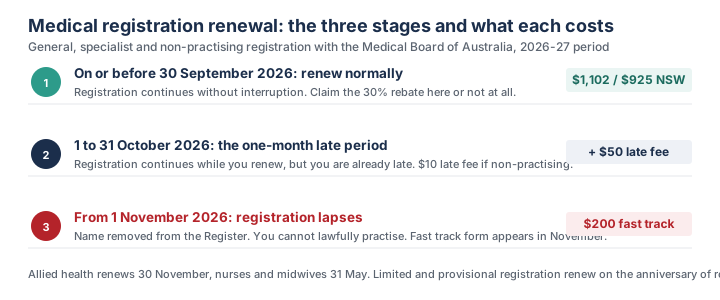
Medical registration renewal falls on 30 September for general, specialist and non-practising registration. The application for the period beginning 1 October 2026 must be lodged by 30 September 2026. Limited and provisional registration renew on the anniversary of registration instead.
| Stage | Timing | What happens | Fee |
|---|---|---|---|
| On time | By 30 September 2026 | Registration continues for the 2026-27 period | Standard registration fee |
| Late period | 1 to 31 October 2026 | Registration continues while the practitioner renews | Standard fee plus $50 late fee ($10 non-practising) |
| After the late period | From 1 November 2026 | Name removed from the Register and registration lapses | $200 fast track application |
The one-month late period is not an extension of the deadline by another name. Registration continues during it, but the practitioner is already late and the $50 late renewal fee applies. For non-practising registration the late fee is $10.
If the practitioner has not renewed by 31 October, the name is removed from the Register of practitioners and the registration lapses. To keep practising after that, the practitioner must submit a fast track application. The Board states the fast track form becomes available in the Ahpra portal during November. It costs $200. Registration does not continue in the gap between lapse and restoration.
The Medical Board's renewal page carries the current instructions for each cycle.
One September announcement is easy to misread. On 9 September 2026 Ahpra launched a fee deferral pilot for Australian and New Zealand medical school graduates applying for provisional registration for the first time. Between 9 October 2026 and 4 January 2027 those graduates pay the $332 application fee upfront and have until 31 March 2027 to pay the $543 registration fee. It does not apply to renewals. A practitioner renewing by 30 September pays the full fee at the time of application, as before. Ahpra says the pilot will help inform "future consideration of flexible payment options across other professions", which is a watch item for the 2027 cycle, not a change to this one.
Who can claim the 30% rebate, and how?
The 30% fee relief rebate applies to renewal fees for practitioners who have taken at least six continuous months of leave on the grounds of a protected attribute. Protected attributes include parental leave, disability and status as a carer. On $1,102 general registration the rebate is worth about $331. On the NSW fee of $925 it is worth about $278.
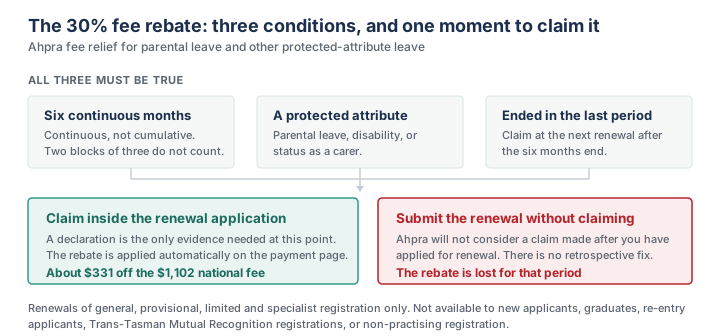
The eligibility conditions operate together, not separately.
Six continuous months. The leave must be continuous, not cumulative. Six months assembled from separate blocks does not satisfy the test.
The leave must have ended during the previous full registration period. The qualifying leave has to sit inside the prior period. Leave that is ongoing at the renewal date does not qualify at that renewal.
Claim at the next renewal after the leave. A practitioner claims when they renew for the period after the six continuous months ended. They cannot apply before the six-month period has started, and cannot apply before they have taken six continuous months.
Eligible registration types only. General, provisional, limited and specialist registration are eligible. The rebate applies to renewals only.
Who is not eligible. Applicants for registration, graduates, re-entry applicants, international practitioners including those under the Trans-Tasman Mutual Recognition (TTMR) Act, and non-practising registrants are excluded. Non-practising registration already attracts a reduced or pro-rata fee. The reason the rebate is confined to renewals is that it is calculated against the previous registration period, so one has to exist.
The critical rule is the timing of the claim. The fee relief policy states:
You must apply for this form of fee relief while completing your renewal application. If you meet the eligibility criteria, then the rebate will automatically be applied on the payment page. We can't consider an application for fee relief for parental leave and certain other forms of leave after you have applied for renewal.
The practical consequence is that a practitioner who submits the renewal without claiming loses the rebate. About $331 is not recoverable afterwards, because the application window closes when the renewal is submitted.
At the time of claiming, the evidence is a declaration only: the practitioner declares that they took at least six continuous months of leave ending in the previous registration period on protected-attribute grounds. Ahpra may ask for more information later to demonstrate eligibility. If the declaration is made, the rebate is applied automatically on the payment page.
The rebate is an interim measure ahead of wider work on a pro rata approach to fees, following a review into Ahpra's fee-setting policy.
One caveat sits over the whole section. The fee relief page was last reviewed 14 July 2025 and its worked-example table still runs on 2025 dates. The policy is current, but the mechanics should be checked inside your own renewal application rather than assuming the published examples have rolled forward.
What does registration cost in other professions?
As at 30 September 2026 the medical schedule is still the only one updated for the coming period. The nursing and midwifery, physiotherapy, psychology and occupational therapy schedules currently published are all still the ones effective 18 September 2025.
| Profession | Renewal date | Current published fee | Schedule effective |
|---|---|---|---|
| Medical (general registration) | 30 September | $1,102 national, $925 NSW | 1 August 2026 |
| Nursing and midwifery (general registration) | 31 May | $193 national, $189 NSW | 18 September 2025 |
| Physiotherapy (general registration) | 30 November | $211 national, $185 NSW | 18 September 2025 |
| Psychology (general registration) | 30 November | $473 national, $435 NSW | 18 September 2025 |
| Occupational therapy (general registration) | 30 November | $132 national, $126 NSW | 18 September 2025 |
The current nursing and midwifery schedule also lists non-practising registration at $39. The current physiotherapy schedule lists limited registration at $211 and non-practising registration at $39.
The consequence for allied health practitioners is that renewal falls on 30 November 2026, but as at 30 September 2026 the 2026-27 fee has not been published. The current schedules took effect on 18 September 2025, so this year's are already later than last year's; this post will be updated when they appear. If you are budgeting a practice's registration costs, the medical number is fixed and the allied health numbers are an estimate until then.
The NSW rebate is not uniform across professions. It is $177 for medical, $38 for psychology, $26 for physiotherapy, $6 for occupational therapy and $4 for nursing and midwifery. That difference is deliberate: it reflects the cost of the notification function for that profession in that jurisdiction.
What practices need to do, not just practitioners
Registration is personal to the practitioner, but the exposure is not. Employing a person in a role requiring registration when they are not registered breaches the National Law, and that obligation sits with the practice. A lapsed practitioner cannot be rostered or billed under, and indemnity arrangements become uncertain from the moment of lapse.
The renewal cycle makes this harder than a single annual check. Renewal dates are staggered by profession: medical on 30 September, most allied health on 30 November, nurses and midwives on 31 May. Limited and provisional registration renew on the anniversary of registration. A one-off check in any given month misses most of the calendar.
Three concrete actions follow.
Hold a list with renewal dates by profession. The list should record each practitioner's profession, registration type and renewal date, not just a single expiry date for the practice.
Verify status on Ahpra's public register. The register is the authoritative source for verifying status. A verbal assurance is not evidence and is not what an accreditation surveyor accepts.
Diarise checks for early October and early November. The first catches medical practitioners who missed 30 September and are inside the late period. The second catches anyone who lapsed on 31 October.
Paying the fee is only half of renewal. The declarations signed at the same time cover continuing professional development and recency of practice, which generate their own audit tail. For the step-by-step employer verification process, see AHPRA registration expiry for employers. The CPD and recency declarations are covered separately in AHPRA CPD and recency rules. A centralised view of dates across professions is available on the compliance calendar, and the wider registration picture sits in our AHPRA registration compliance guide.
Frequently Asked Questions
How much is AHPRA registration in 2026?
General registration with the Medical Board of Australia costs $1,102 nationally for the 2026-27 period, which runs 1 October 2026 to 30 September 2027. Where the principal place of practice is NSW the fee is $925 after a $177 rebate. Provisional registration costs $543 nationally and $477 in NSW.
Did AHPRA registration fees go up in 2026?
Yes. The general registration fee rose $44, from $1,058 to $1,102, a 4.2% increase effective 1 August 2026. It is the fourth consecutive annual increase, following $994, $1,027 and $1,058. The new fee applies to the registration period beginning 1 October 2026.
When is AHPRA registration renewal due?
For most doctors the renewal date is 30 September. That covers general, specialist and non-practising registration with the Medical Board of Australia. Limited and provisional registration renew on the anniversary of registration. Nurses and midwives renew on 31 May, and most allied health practitioners renew on 30 November.
What happens if I miss the 30 September AHPRA deadline?
A one-month late period runs to 31 October. Registration continues during that period, but a $50 late renewal fee applies ($10 for non-practising registration). If you have not renewed by 31 October, your name is removed from the Register and your registration lapses. You then need a $200 fast track application, which becomes available in the Ahpra portal during November.
Can I get a discount on my AHPRA registration fee?
Yes, if you took at least six continuous months of leave on protected attribute grounds and that leave ended during the previous registration period. The 30% rebate is worth about $331 on general registration and about $278 on the NSW fee. You must claim it inside the renewal application. It is not available afterwards.
Does the 30% rebate apply to new registrations?
No. The rebate applies to renewals of general, provisional, limited and specialist registration only. Applicants for registration, graduates, re-entry applicants, international practitioners including those under the Trans-Tasman Mutual Recognition (TTMR) Act, and non-practising registrants are not eligible. The rebate is calculated against the previous registration period, so a prior period must exist.
Why is my AHPRA fee different from a colleague's?
The most common reason is principal place of practice. NSW co-regulatory registrants receive a rebate on the national fee because NSW handles the notification function separately. For example, general registration costs $1,102 nationally and $925 where the principal place of practice is NSW. Registration type also affects the fee, and the NSW rebate differs across professions.
What do allied health practitioners pay in 2026-27?
As at 30 September 2026 the 2026-27 fees for most allied health professions have not been published. The physiotherapy schedule, effective 18 September 2025, still shows $211 for general registration nationally and $185 in NSW, and the psychology and occupational therapy schedules carry the same effective date. Allied health registration renews on 30 November 2026. Last year's schedules took effect on 18 September 2025.
Is the AHPRA registration fee tax deductible?
Registration fees required to earn income are generally deductible, but the position depends on individual circumstances and employment arrangements. Confirm your situation with an accountant or against current ATO guidance rather than treating a general statement as advice.
Who pays the registration fee, the practitioner or the practice?
There is no legal default. Registration is personal to the practitioner, but many employment and contractor agreements make the practice responsible for reimbursement. Check the agreement. The obligation to ensure a person is registered sits with the practice, not only the practitioner.
Part of
AHPRA & Registration