Key Takeaways
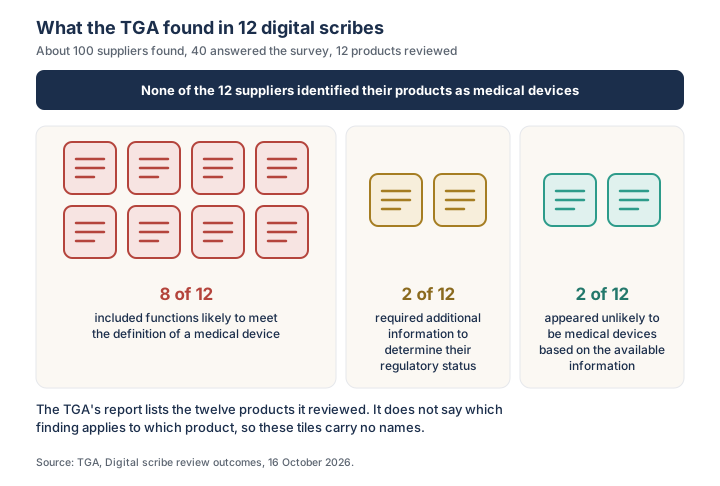
- The TGA reviewed 12 digital scribes and found eight with functions likely to be medical devices. Its report of 16 October 2026 says two "required additional information to determine their regulatory status" and two "appeared unlikely to be medical devices"; none of the 12 suppliers had identified its product as a device.
- The report names the twelve products and does not match the findings to them. A practice cannot look its own scribe up.
- A scribe's status turns on what each feature does. The TGA says a scribe "is likely to be a medical device" if it suggests diagnoses, treatments or investigations, prioritises or triages patients, or generates clinical conclusions, and "Statements or disclaimers are not sufficient".
- The TGA set no deadline and named no enforcement action. It will use the findings to "guide targeted compliance activities" under "a proportionate and risk-based approach".
- 1 November 2026 is the date that moves. The CDSS exemption gains limbs (d) and (e) under F2026L01167, and regulation 11.90 applies them to software already in use.
Status check, 20 October 2026: no TGA deadline has been set, the CDSS guidance has been "under review" since 16 October, and the legal change is 1 November 2026.
The TGA's digital scribe review, published 16 October 2026, found eight of the 12 AI scribes it examined had functions likely to make them medical devices, without saying which eight. That leaves a practice to check its own scribe feature by feature against the TGA's function table, and to get the vendor's regulatory basis in writing, before 1 November 2026.
What did the TGA find on 16 October 2026?
The TGA announced the outcome of its digital scribe review on 16 October 2026 and published the full report the same day. An environmental scan "identified approximately 100 suppliers of digital scribes available in Australia", and a voluntary survey followed: "While we received responses from 40 suppliers, we focused our review on 12 products."
"Of the 12 scribes we reviewed, none of the suppliers identified their products as medical devices." On the TGA's own review, "eight included functions likely to meet the definition of a medical device", "two required additional information to determine their regulatory status" and "two appeared unlikely to be medical devices based on the available information".
We read the review outcome in full: it names the twelve products it looked at and does not say which eight included device functions. newsGP's report of 19 October 2026 read it the same way: "The regulator did not name which finding applied to which scribes." We do not name the twelve here; the list is in the TGA's report. Use is widespread: newsGP adds that "40% of those surveyed in a newsGP poll last November" (November 2025) said they used an AI scribe.
The report states its limits: "We did not test any digital scribe products, check the safety and performance, or assess compliance with detailed medical device regulatory requirements as part of this review. We also did not assess the privacy or data protections associated with these products."
The TGA will use the findings to inform its regulatory approach, "including how some functions of these products may fit within the existing conditional exemption for CDSS software", to support education, and to "guide targeted compliance activities where digital scribe functionality meets the definition of a medical device". It gives no date, no transition period and no named enforcement action.
What makes an AI scribe a medical device now?
The TGA rewrote its Digital scribes page on 16 October 2026, replacing the version of 30 January 2026, and the test now has two sides. Scribes "that only record, transcribe and translate clinical conversations into written records, without adding new clinical content or suggestions that were not explicitly stated by the health professional, are not considered medical devices."
On the other side, a scribe "is likely to be a medical device if, for example, it" does any of four things: "identifies, recommends or suggests diagnoses", "identifies, recommends or suggests treatments or investigations", "prioritises, triages or monitors patients" or "generates clinical conclusions or assessments". The review report draws the line at features that "analyse information, determine what is clinically relevant, or generate clinical conclusions, recommendations or other outputs that may influence diagnosis, monitoring, prognosis or treatment".
"Supplying a medical device that is not included in the ARTG is a breach of the Therapeutic Goods Act 1989, unless it is exempt." That duty sits with the supplier, and our post on the 1 November CDSS changes covers the offence provisions.
The page judges functions one at a time ("A digital scribe may contain both medical device and non-medical device functions"), and its function table is the part a practice can use directly.
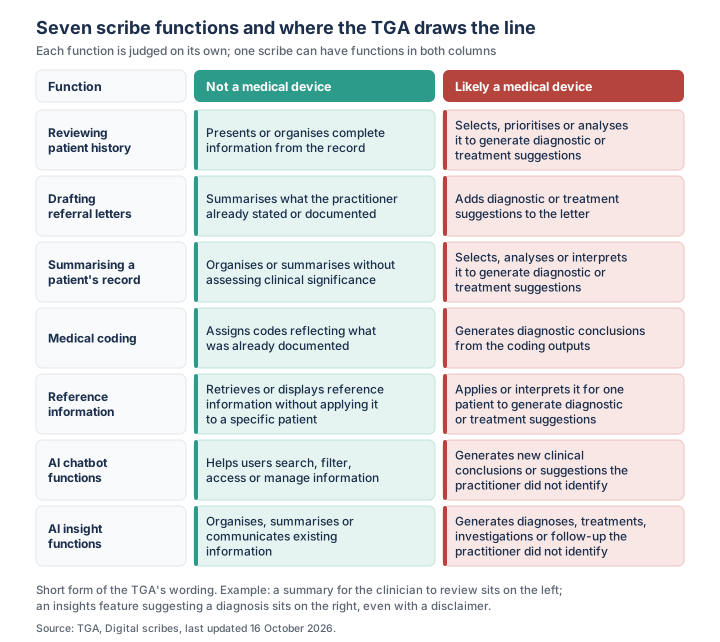
The cells below are the TGA's words as published on 16 October 2026.
| Function | Non-medical device | Medical device |
|---|---|---|
| Reviewing patient history | Presents or organises complete information from the patient record. | Identifies, selectively displays, prioritises or analyses information to generate diagnostic or treatment suggestions. |
| Drafting referral letters | Summarises or communicates information already stated or documented by the healthcare practitioner. | Supplements information to include [sic] generate diagnostic or treatment suggestions. |
| Summarising a patient's record | Organises or summarises information without assessing its clinical significance. | Selects, prioritises, analyses or interprets information to generate diagnostic or treatment suggestions. |
| Medical coding | Assigns codes that reflect information already documented during the clinical encounter. | Generates diagnostic conclusions or recommendations based on coding outputs. |
| Reference information | Retrieves or displays reference information without applying it to a specific patient. | Selectively applies or interprets reference information to generate diagnostic or treatment suggestions relating to an individual patient's circumstances. |
| AI chatbot functions | Helps users search, filter, access, navigate or manage information. | Generates new clinically relevant conclusions, suggestions or recommendations not identified by the health practitioner. |
| AI insight functions | Organises, summarises or communicates existing information. | Generates diagnoses, prognoses, investigations, treatment options, follow-up recommendations or other clinically relevant conclusions not identified by the health practitioner. |
The page's eight worked examples fall either side of that line:
- Not devices (Examples 1 to 5). A transcript, a consult summary, structured notes, codes matched only to "explicitly mentioned clinical terms", and a drafted discharge summary or letter, each for the clinician to review.
- Devices (Examples 6 to 8). An "insights" feature suggesting diagnoses, follow-up or treatment, even with a disclaimer; a summariser marketed to guide "diagnosis and treatment planning"; and an agent that finalises notes and orders tests "without clinician input or confirmation".
On disclaimers the page says: "General disclaimers (for example 'this product is not for diagnosis') are not acceptable to demonstrate a digital scribe is not a medical device if medical claims are made or the product includes features consistent with a medical device." Example 7 shows that marketing claims alone can make a scribe a device.
Which features in your practice's scribe are the ones that matter?
The features that matter are the ones that add something the clinician did not say. Transcripts, consult summaries, structured note fields, drafted letters and codes matched to conditions named in the consult sit on the TGA's non-device side. Insight panels, suggested diagnoses or investigations, follow-up prompts, risk ranking, history summaries that select what is clinically relevant, and chat answers about a patient sit on the device side. One product can carry both, so the check runs per feature. Sit with a clinician who uses the scribe daily, open the settings, and list every feature that is switched on, including anything enabled by default in a recent release. Then place each against the table below. The mapping and the handling column are ours, a suggestion while you wait for the vendor's written answer; for advice on your own position, go to your medical defence organisation.
| What you may see in your scribe | Closest TGA row or example | Our suggested handling until the vendor answers in writing |
|---|---|---|
| Transcript, consult summary or structured note fields for you to review | Examples 1 to 3, not devices | Leave on, and keep reviewing every note before it is saved |
| Referral letter or discharge summary drafted from what was said | Example 5; drafting referral letters, non-device column | Leave on, and check the letter adds nothing you did not say |
| Codes matched to conditions named in the consult | Example 4; medical coding, non-device column | Leave on; switch off any code inferred from things not said |
| An "insights" panel, or an option to regenerate the note with insights | Example 6; AI insight functions, device column | Switch off where the settings allow |
| Suggested diagnoses, differentials, investigations, follow-up or treatment | The TGA's likely-device list | Switch off where the settings allow |
| A pre-consult history summary that picks out what matters | Reviewing patient history and summarising a record, device column | Ask the vendor first; switch off if it selects or ranks |
| A chat box that answers clinical questions about this patient | AI chatbot functions, device column | Limit to search and retrieval, or switch off |
| Patient lists ranked or flagged by risk or urgency | "prioritises, triages or monitors patients" | Switch off where the settings allow |
| Notes finalised, or tests ordered, without your review | Example 8, a device | Switch off |
Every non-device example assumes a clinician reviews the output, and Example 8, which saves and orders without review, is a device. Check the vendor's website and sales material too: under Example 7, a claim that the product supports or guides diagnosis and treatment planning can make it a device by itself. Where a device-side feature cannot be switched off, write to the vendor and record that you asked.
What should you ask your scribe vendor this month?
The TGA gives a supplier whose scribe is a device four routes: meet the conditions of exempt CDSS ("You must notify us using the CDSS exemption notification form"), cease supply, remove the functions that have a therapeutic purpose, or "apply to include it in the ARTG". Ask for these in writing:
- Its regulatory basis, in one of four forms.
- On the ARTG: the ARTG number, and which features the entry covers.
- Exempt CDSS: the date it lodged the TGA's CDSS exemption notification form, and how each recommending feature meets limbs (d) and (e) from 1 November 2026.
- Functions removed: which features, from which version and date.
- Not a device: a statement, feature by feature, that no function adds clinical content not explicitly stated by the health professional.
- The manufacturer's name as it appears in the instructions for use. The TGA says to search the ARTG "using the manufacturer's name as listed in the instructions for use", which may differ from the brand.
- The update history. Which releases added clinical features, whether they were on by default, and whether you will be told before the next one. The TGA asks health professionals to consider whether "software updates have introduced new functionality that may change the intended purpose".
- Whether a disclaimer is the only basis. The TGA has said that is not enough.
- Which features can be switched off for every clinician in the practice.
The form asks for the sponsor, manufacturer and product name, "a brief description of the device and its intended functionality", and a declaration. The deadline for lodging it differs between two sources. Condition (i) of item 2.15 in the Medical Devices Regulations says "The sponsor of the device must notify the Secretary, using a form approved in writing by the Secretary" of any importation or supply "within 20 working days (or such longer period as is agreed to by the Secretary)". The TGA's CDSS guidance says "within 30 working days". The Regulations are the law and prevail; either way, a vendor relying on the exemption should be able to give you a date. Our AI scribe governance pack has a vendor questionnaire with a clause-and-date column for each answer.
What does 1 November 2026 change?
From 1 November 2026 the Therapeutic Goods Legislation Amendment (2026 Measures No. 1) Regulations 2026 (F2026L01167) rewrites the exempt CDSS description in item 2.15 of Schedule 4 to the Medical Devices Regulations. New limb (d) requires software that "is not intended by its manufacturer to make a clinical diagnosis or decision about the treatment of patients, including where the software is in vitro diagnostic software". New limb (e) requires that it "displays details of the clinical practice guidelines, calculations or logic used by the software, in a way that enables a health professional to readily interpret and verify any recommendations while using the software in a clinical context intended by the manufacturer". Regulation 11.90 applies the new item to a device "manufactured before that commencement and is intended by its manufacturer to be used on or after that commencement", so an installed scribe is tested against it.
The CDSS guidance changed on 16 October too. Its page history records "Removed mention of AI in the exemption criteria section"; the line "an AI-enabled CDSS will not meet the exemption criteria" is gone, while "Opaque CDSS do not meet exemption criterion (c) and are not exempt" remains. For a scribe, the TGA's scribes page says an exempt one "must display details of how the recommendation was generated". The full limb comparison is in our 1 November post.
What do the RACGP and the TGA each say?
The two bodies currently differ, so we set out both. The RACGP's AI scribes page (page last updated 29 June 2026, read on 20 October 2026) says: "AI scribes used in general practice do not require regulation by the TGA as they do not have a therapeutic use and therefore do not meet the definition of a medical device." The TGA's review of 16 October 2026 found eight of 12 scribes "included functions likely to meet the definition of a medical device".
The RACP's position statement Using artificial intelligence in clinical practice (launched 17 July 2026), college guidance for physicians, says: "Use only AI tools that have been reviewed by the TGA (or equivalent) when they influence clinical decisions."
We do not reconcile these. Where the TGA's material and the RACGP's page point different ways for your scribe, take the question to your medical defence organisation, with the vendor's written answer and your feature list in hand.
What should a practice do now?
- Search the ARTG. Use the ARTG search with the manufacturer's name from the instructions for use, and record the result and the date.
- Send the vendor letter. Put the five questions above in writing and ask for a dated reply.
- Run the feature audit. With a clinician, place every switched-on feature against the TGA's table and record what you switched off and why.
- Check the consent form for an alternative. The 16 October page adds an item to the clinician's list, whether "there are alternative recording methods available for patients who request it", and tells patients: "You can withdraw your consent at any time and if you ask, the health professional should provide another method for recording your consultation." Our AI scribe patient consent form carries decline and withdrawal blocks; make sure yours says how the consult is recorded if the patient declines.
- Make the governance entry. Record the vendor's answer, the ARTG search and each feature decision in your AI register, and repeat the check after every update.
- Diary two dates. 1 November 2026, when limbs (d) and (e) apply, and a recurring check of the CDSS guidance, whose review has no end date.
- Report concerns. The TGA takes reports about non-compliant scribes through its perceived breach form.
The review did not look at privacy, which stays a separate job: see how to assess an AI scribe for privacy compliance and our AI privacy guide. The glossary defines an AI scribe and a clinical decision support system, and the AI in healthcare compliance pillar links the rest.
Frequently Asked Questions
Is my AI scribe one of the eight?
Nobody can tell from what has been published. The TGA's report lists the twelve products without saying which finding applied to which, and a scribe outside the twelve faces the same test. Ask your vendor for its regulatory basis in writing, and check its features against the TGA's table.
Does my practice have to do anything by 1 November 2026?
No, not as a legal deadline of its own. The TGA has set no deadline for practices, and the 1 November changes apply to the exemption a supplier relies on. The TGA does ask health professionals to consider whether a product is on the ARTG or exempt, so a written vendor answer before 1 November is our suggested timing.
Can a vendor's disclaimer settle it?
No. The review says "Statements or disclaimers are not sufficient in determining if a product is, or is not, a medical device", and the TGA's Example 6 is an insights feature that remains a device despite a disclaimer in the interface.
What is an exempt CDSS and how would I know my scribe is one?
It is a medical device that need not be on the ARTG because its only purpose is to give a health professional a recommendation, it does not replace clinical judgement, it does not analyse information from another medical device and it shows how each recommendation was generated. The sponsor must still notify the TGA. Ask the vendor for its notification date and how each feature meets limbs (d) and (e).
Does the review change patient consent?
No. The review did not assess privacy or data protections and changes no consent rule. The TGA's rewritten scribes page does now ask health professionals to consider whether alternative recording methods are available for patients who request them, so check that your consent form covers a patient who declines.
Does the TGA say we must stop using our scribe?
No. The review matches no product to a finding, sets no deadline and says compliance "requires a proportionate and risk-based approach". Our suggestion is to keep the administrative features and switch off device-side features until the vendor answers in writing.
How do I check whether my scribe is on the ARTG?
Search the ARTG using the manufacturer's name as listed in the instructions for use, the method the TGA gives, and record the result and the date. An exempt CDSS need not be on the ARTG, so a vendor relying on the exemption should give you its notification date instead.