Key Takeaways
- Schedule 1, Parts 5 and 6 of Act No. 66 of 2026 (C2026A00066) take effect on 1 February 2027 (item 4 of the table in section 2). Part 6 rewrites section 34 of the NDIS Act, the reasonable and necessary test.
- New s 34(1E) sets an "order of importance" for evidence of effect and benefit: published, peer reviewed and generalisable research first, then effectiveness in the participant's circumstances, then previous-plan outcomes, then other matters.
- New s 34(1F) says the CEO "may decide" a support is not effective and beneficial where published research is limited or absent, even if other evidence exists.
- Item 75 applies Part 6 to powers exercised from 1 February 2027, including for "plans in effect immediately before that day". Item 76 covers review decisions made from that day.
- The same day brings value for money comparisons (s 34(1A) to (1D)), a limb for supports better funded by "another scheme" (s 34(1)(g)) and a parental care presumption for children (s 34(1G) to (1J)).
- Plan renewal under s 50A needs no new statement of participant supports; on 18 November 2026 the NDIA said participants "don't need to ask for any new reports or assessments ahead of their plan being renewed".
- As at 26 November 2026, the NDIA's Reasonable and necessary supports guideline is dated 1 October 2026 and does not describe the evidence order.
From 1 February 2027, section 34 of the NDIS Act ranks published, peer reviewed and generalisable research as the most important evidence when the NDIA decides whether a support is effective and beneficial. Item 75 of the amending Act applies the new test to decisions made from that day, including decisions about plans already in effect.
What changes to NDIS reasonable and necessary on 1 February 2027?
Section 34(1) of the National Disability Insurance Scheme Act 2013 lists what the CEO must be satisfied of before a support goes into a statement of participant supports. Part 6 of Schedule 1 to the amending Act keeps limbs (aa) to (f), adds a limb (g), and inserts ten subsections, (1A) to (1K), on how to apply three of the limbs.
The revised explanatory memorandum says the current criteria have "resulted in a high degree of discretion, subjectivity and lack of consistency in decision making by delegates of the CEO, tribunals and courts". The new considerations "are currently factors in the Supports for Participants rules but will be strengthened by inclusion in the primary legislation".
The table compares compilation No. 29 of the NDIS Act (20 November 2026) with the text from 1 February 2027.
| Limb of s 34(1) | Today | From 1 February 2027 |
|---|---|---|
| (aa) needs arising directly from an impairment | "Directly" added from 27 August 2026 | Unchanged |
| (a) assists the participant's goals | In force | Unchanged |
| (b) assists social and economic participation | In force | Unchanged |
| (c) value for money | Costs "reasonable, relative to both the benefits achieved and the cost of alternative support" | Plus s 34(1A) to (1D): cheaper comparable supports, buying against leasing |
| (d) effective and beneficial, "having regard to current good practice" | No ranking in the Act; rule 3.2 lists kinds of evidence | Plus the order of importance, s 34(1E), and s 34(1F) |
| (e) what it is reasonable to expect families, carers, informal networks and the community to provide | In force | Plus s 34(1G) to (1J) for children, s 34(1K) for all |
| (f) the support is an NDIS support | In force | Unchanged, plus a note on s 10(4) |
| (g) another scheme or government service system | Not in the Act | New: not "more appropriately provided or funded by" another scheme or existing government service systems |
What is the new evidence order in section 34(1E)?
New s 34(1E) says that in deciding whether a support "will be, or is likely to be, effective and beneficial for the participant, the CEO must, if considering 2 or more of the following matters, consider them in the following order of importance". The right-hand column is our reading: the Act does not regulate report content.
| Order | The Act's words, s 34(1E) | What that looks like in a report (our reading) |
|---|---|---|
| (a) | "research and evidence in relation to the support that is published, peer reviewed and generalisable" | A citation for each published study relied on for the support itself, with a line on whether its population resembles this person |
| (b) | "evidence as to the effectiveness of the support, having regard to the participant's circumstances (including age and impairment)" | The clinician's assessment of why the support suits someone of this age with this impairment, with the measures used |
| (c) | "evidence as to outcomes for the participant, arising from their use of the support in their previous plan, in improving, maintaining, or reducing a decline in, the participant's functional capacity" in an activity in s 24(1)(c) or s 25(1)(c)(i), "or capacity for social and economic participation" | Baseline and repeat outcome measures across the previous plan, tied to those activities |
| (d) | "other matters the CEO considers appropriate" | Anything else, such as the participant's own account, which rule 3.2(b) of today's rules calls lived experience |
The memorandum says the subsections "provide clarity on how differing, and potentially inconsistent, material is to be considered", and describes generalisable research as research that "can be applied to a cohort of people beyond the subjects of the study". The Act defines none of generalisable, peer reviewed or limited.
New s 34(1F) is permissive: "To avoid doubt, the CEO may decide that the CEO is not satisfied as required by paragraph (1)(d) if: (a) there is limited or no research or evidence of the kind mentioned in paragraph (1E)(a) (even if there is evidence of the kind mentioned in paragraph (1E)(b) or (c), or both)". Paragraph (b) does the same for limited evidence of the (1E)(b) kind. Nothing in it requires a refusal.
Today, rule 3.2 of the Supports for Participants Rules lists the evidence that "may" be considered, starting with "published and refereed literature and any consensus of expert opinion", with no ranking. From 1 February 2027 the Act ranks it.
What else changes in section 34 on the same day?
Under s 34(1A) the CEO "must consider whether comparable supports are available at a lower cost than the support" and, if so, whether one "would represent better value for money than the support". For equipment or modifications, s 34(1B) requires a comparison of buying and leasing, and s 34(1C) says that if the participant's circumstances are likely to change in the short term, the CEO must, "unless satisfied by evidence to the contrary", presume only leasing is value for money.
For a child, s 34(1G) requires the CEO to "take into account the presumption that parents are responsible for providing substantial care and support for their children". Under s 34(1H) that care "includes supervision, personal care, transport, emotional support and behavioural support" and excludes the additional care a child needs because their needs are "substantially greater than those of other children of a similar age because of the child's disability". Section 34(1J) bars a support whose primary or substantial purpose is to reduce parental time below what is reasonably expected, improve household efficiency or follow a parent's preference.
For every participant, s 34(1K) requires the CEO to consider the risk of harm in relying on family or community, the desirability of keeping informal supports, and the capacity of family or carers. Item 74 adds that a plan variation must not duplicate a support already in the plan (new s 47A(1)(aa)).
Who does the new test reach, and from when?
Item 75 says: "The amendments made by this Part apply in relation to the performance of functions and the exercise of powers on or after the day this item commences (including functions performed and powers exercised in relation to plans in effect immediately before that day)." Under item 76, if "a decision is made on review of an earlier decision" on or after that day, the new text applies to it.
The test bites when the NDIA approves a statement of participant supports (s 33(5)(c)) or varies an old framework plan's statement (s 47A(3)(c)). Both require the CEO to "be satisfied as mentioned in section 34". On our reading, the date of the decision governs, whatever the date of the report.
The Department's Securing the NDIS hub says tighter assessment "for new entrants, plan reassessment for existing participants and plan renewal changes will be progressively implemented from 1 February 2027". The NDIA's legislation page (current as of 1 October 2026) says the criteria apply to "new participants' plans" and "will be progressively applied to current participants when it is time for their plan to be reassessed". On our reading, both describe the order in which the NDIA expects to reach participants. Neither narrows item 75, which also covers variations and reviews.
Part 5 changes what happens at a plan's reassessment date. Under item 58, a reassessment date on or before 1 October 2027 "is taken to be the plan's end date", and the plan renews under s 50A, which "does not require a new statement of participant supports". On our reading, a renewal applies no s 34 test. The NDIA's plan renewals notice of 18 November 2026 says "All NDIS plans, except new framework plans, will be renewed or reassessed by 30 September 2027."
Section 34 governs old framework plans, which participants hold today; the supplementary memorandum on amendment sheet ST128 describes Part 6 in those terms. New framework planning starts from 1 April 2027, according to the Department; see our new framework planning guide.
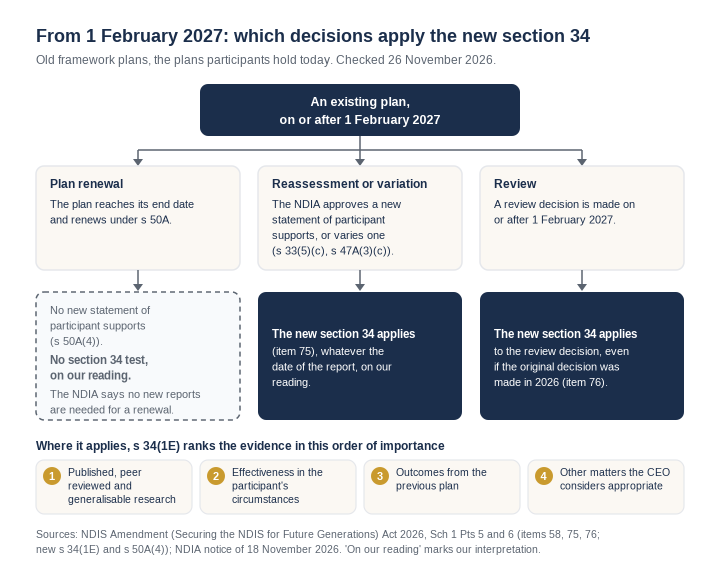
Three situations, in general terms:
- A report written in December 2026 for a reassessment decided in February 2027. If the NDIA approves a new statement on or after 1 February, the new s 34 applies. If it renews the plan instead, no statement is approved, and the NDIA says no new reports are needed.
- A plan in effect today with no change requested. On our reading, Part 6 does not reopen approved supports. It governs the next variation, reassessment or review.
- An internal review decided after 1 February 2027. Item 76 applies the new text to the review decision, even if the original decision was made in 2026.
What does this mean for a therapy report or functional capacity assessment?
This whole section is our reading. The Act orders what the CEO considers. It sets no rule for what a report contains or how much weight a delegate gives it, and the NDIA has not published how delegates will apply the new text. A report that answers each kind of evidence in s 34(1E), in the Act's order, gives the decision maker material at every level the Act names. In practice that might mean:
- Cite the published research for the support itself, and say whether the people studied resemble this person.
- Name the gap where published research is limited. Section 34(1F) lets the NDIA rely on that gap whatever else the report says, so a report gains nothing by blurring it.
- Report effectiveness in this person's circumstances, with age and impairment named, as s 34(1E)(b) does.
- Carry outcome measures from the previous plan where the support was funded before, against the s 24(1)(c) activities: communication, social interaction, learning, mobility, self-care and self-management. Section 9B, in force since 27 August 2026, measures functional capacity "in a context that excludes, as far as possible, the impact of the person's environmental and personal circumstances".
- Address cost where it arises: why a lower cost comparable support does or does not suit (s 34(1A)), and for equipment, buying against leasing (s 34(1B) and (1C)).
- For children, separate ordinary parental care from disability-related care, the line s 34(1H)(b) draws.
None of this directs clinical practice, and no structure guarantees funding. The NDIA's Reasonable and necessary supports guideline (dated 1 October 2026) still says "We won't need an expert opinion or report for every support, because we can often rely on other evidence."
What we read, and what is not published yet
On 26 November 2026 we read the Act as made, the current compilation of the NDIS Act, the memoranda on the Bill's page on aph.gov.au, the Supports for Participants Rules, the NDIA pages linked here (its Our guidelines page is current as of 25 November 2026) and the Department's hub.
The NDIA has not published guidance on how delegates will apply s 34(1E) or (1F). Its guideline predates the new text, and none of its news items from 16 October to 25 November 2026 is about it. A title search of the Federal Register of Legislation that day found no transitional rules under item 1 of Schedule 5, and rule 3.2 is unchanged.
Where the memorandum and the Act differ, we follow the Act. The memorandum summarises item 76 as applying to "a review of a decision that begins on, or after" the date; the Act looks to when the review decision is made. The revised memorandum also describes drafts of s 34(1H) and (1K) that later amendments replaced.
Three things would change this picture: transitional rules, which item 1(5) of Schedule 5 allows for Parts 5 and 6 until 19 August 2027 (our calculation) and which may modify application provisions; rules under s 34(2); or an NDIA guideline on the evidence order. Our timeline of the Act tracks every date.
What should providers do before 1 February 2027?
A practice manager can assign each of these:
- Name who writes NDIS reports and functional capacity assessments, and who reviews them before they go out.
- List upcoming decisions in your own practice management system: reassessment requests, variation requests and reviews likely to be decided on or after 1 February 2027. The NDIA gives 60 days' notice of a renewal, or 70 where an end date is brought forward.
- Check the report template's evidence section against s 34(1E): published research on the support, effectiveness given age and impairment, previous-plan outcomes, and a line for where research is limited.
- Confirm where outcome measures are kept, so previous-plan outcomes can be reported.
- Brief clinicians on s 34(1A) to (1C) and s 34(1G) to (1K), and record the briefing.
- Watch for an updated NDIA guideline and any transitional rules, and review the template again when either appears.
The budget reductions that reach renewed plans from 1 February 2027 are in our 1 October 2026 changes guide.
Frequently Asked Questions
What changes to NDIS reasonable and necessary on 1 February 2027?
Schedule 1 Part 6 of Act No. 66 of 2026 amends section 34 of the NDIS Act. It adds an order of importance for evidence (s 34(1E) and (1F)), value for money tests (s 34(1A) to (1D)), rules on family and parental support (s 34(1G) to (1K)) and a limb for supports better funded by another scheme (s 34(1)(g)).
Does the new evidence order apply to existing NDIS plans?
Yes. Item 75 applies the changes to functions and powers exercised from 1 February 2027, "including functions performed and powers exercised in relation to plans in effect immediately before that day". On our reading, it governs the next reassessment, variation or review decision about an existing plan. It does not reopen supports already approved.
What is the NDIS evidence hierarchy?
It is the order in new s 34(1E): published, peer reviewed and generalisable research first; evidence of effectiveness in the participant's circumstances second; outcomes from the previous plan third; other matters fourth. The Act's own term is "order of importance" and it does not use the word hierarchy. The order applies when the CEO considers 2 or more of those matters.
Do functional capacity assessments need peer-reviewed research from 2027?
No. Section 34(1E) orders what the NDIA considers; it does not regulate what a report contains. But s 34(1F) lets the NDIA decide a support is not effective and beneficial where published research is limited or absent. On our reading, a report that names the research it relies on, or says plainly that little exists, speaks to the first matter in the Act's order.
What does generalisable mean in section 34(1E)?
The Act does not define it. The revised explanatory memorandum describes generalisable research as research that "can be applied to a cohort of people beyond the subjects of the study". A memorandum explains intent and is not law, so watch for NDIA guidance or rules on the meaning.
Does the new test apply when a plan is renewed?
No, on our reading. Section 50A(4) says a renewed plan "does not require a new statement of participant supports to be prepared with the participant and approved by the CEO", so no s 34 decision is made. The NDIA says participants do not need new reports or assessments before a renewal.
Is this the same as new framework planning?
No. Section 34 governs old framework plans, the plans participants hold today, from 1 February 2027. New framework planning starts from 1 April 2027, according to the Department, with its own assessment and budget method under separate rules.
Part of