Key Takeaways
- The 36 to 18 change is a consultation draft, not law. No exposure draft of the amended NDIS Supports Transitional Rules exists.
- The only live deadline is 11.59 pm AEDT on 14 October 2026, which is 10.59 pm in Queensland. The consultation opened on 19 August 2026.
- The 18 proposed categories split 8 flexible and 10 stated. Therapy and in-home and community supports are flexible. Support co-ordination, behaviour support and assistive technology assets are stated.
- The supports themselves are not being cut. The paper says the changes "are not intended to remove broad types of supports currently funded through the NDIS".
- The replacement supports process would be scrapped entirely. It had taken 11,051 requests as at 17 July 2026, of which 5,545 were approved and 1,995 refused.
- Five items are proposed for the exclusion list: electronic noise-cancelling headphones, fencing and gates, hair styling tools, hydrogen fuel and electric vehicle charging costs, and scuba therapy.
- No commencement date has been published for the amended Rules. The only published date is the expected start of new framework planning from 1 April 2027, introduced gradually.
The Department of Health, Disability and Ageing has proposed cutting the 36 support categories in the NDIS Supports Transitional Rules to 18, removing the replacement supports process and adding five items to the exclusion list. It is a consultation draft, not law. Submissions close at 11.59 pm AEDT on 14 October 2026.
What are the 18 proposed NDIS support categories?
They are listed in Attachment 3 of the New Framework Planning consultation paper, titled "List of categories of NDIS supports", each designated flexible or stated. The paper puts the split plainly: funding "will be grouped into 18 categories of NDIS supports", of which "8 are in the flexible budget" and "10 in the stated supports budget". The proposed categories are broader than the current 36 and, in the department's words, "focus on the purpose of the support rather than provider registration groups".
The naming matters for allied health. Therapy becomes one flexible category: "Evidence-based allied health supports that improve or maintain a participant's functional capacity across daily living, communication and community participation". Disability related health supports splits in two, nursing and consumables, both flexible, with nursing covering supports "delivered by or under clinical supervision" that "may be delivered by nurse or allied health professional as required".
| # | Proposed category | Flexible or Stated |
|---|---|---|
| 1 | Assistance animals | Stated |
| 2 | Assistive technology - assets | Stated |
| 3 | Assistive technology - other | Flexible |
| 4 | Behaviour support | Stated |
| 5 | Disability related health supports - Nursing | Flexible |
| 6 | Disability related health supports - Consumables | Flexible |
| 7 | Employment supports | Flexible |
| 8 | Home modifications | Stated |
| 9 | In-home and community supports (IHCS) | Flexible |
| 10 | Interpreting and translation supports | Flexible |
| 11 | Medium term accommodation | Stated |
| 12 | Plan management | Stated |
| 13 | Private vehicle transport | Stated |
| 14 | Short term accommodation | Stated |
| 15 | Specialised driver training | Flexible |
| 16 | Specialist disability accommodation | Stated |
| 17 | Support co-ordination | Stated |
| 18 | Therapy | Flexible |
Flexible and stated are not cosmetic labels. Flexible funding can be moved "across supports within a category"; stated funding is "set aside for a specific support or support category" and "cannot be used for other supports".
Are these the same as NDIS registration groups?
No. Three different things in the NDIS are called categories or groups, and only one of them is changing here.
NDIS registration groups. There are 36 of them across 7 categories, administered by the NDIS Quality and Safeguards Commission. They set what you are registered to deliver and whether your audit is verification or certification. They are not mentioned anywhere in this consultation material. We cover them separately in our guide to all 36 NDIS registration groups.
Support categories in the Rules. The 36 categories in Schedule 1 of the NDIS Supports Transitional Rules 2024, register ID F2024L01257: the legal list of what NDIS funding can buy, and what this consultation collapses to 18. The NDIS supports consultation paper explains why both lists happen to number 36: "The current Rules contain 36 support categories based on provider registration groups."
Support budgets in a participant's plan. The NDIA says there are "4 different kinds of NDIS support budgets you can have in your plan": core supports, capacity building, capital and recurring. Each of those support budgets has support categories of its own. They are not the subject of this consultation either.
Where does my current support category land in the new 18?
The mapping is Attachment 1 of the NDIS supports consultation paper, titled "Mapping of old and new framework supports categories". Its shape is consolidation, not deletion. Counting its rows, and these counts are calculated rather than published by the department, in-home and community supports absorbs 9 of the current 36 categories (items 3, 5, 14, 15, 19, 21, 23, 24 and 27). Assistive technology, assets or other, is the destination for 10 of the 36 (items 7, 8, 9, 11, 13, 20, 28, 31, 35 and 36). Support coordination takes 3 (items 1, 3 and 33). The department asks providers to engage with the table directly: "Participants and providers are encouraged to review the mapping table and ask questions or provide feedback."
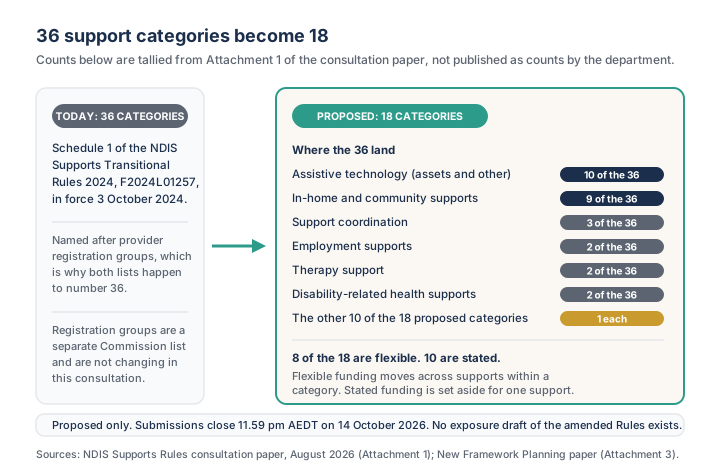
One inconsistency is worth flagging before you rely on the table. Attachment 1 numbers its destination categories from 1 to 20, no destination numbered 11 appears anywhere in it, and one destination it uses, "Early intervention supports for early childhood" numbered 7, appears on no published list of the 18: not in the consultation paper's own list, not on the fact sheet, and not in Attachment 3 of the New Framework Planning paper. The attachment also calls one destination "Short term respite" where every list of 18 calls it "Short term accommodation". That is unresolved. If you deliver early childhood supports, raise it in your submission rather than assuming what the final rules will do.
| Current category (all 36) | Proposed category it maps to |
|---|---|
| 1 Accommodation assistance or tenancy assistance | Medium term accommodation; Support coordination |
| 2 Assistance animals | Assistance animals |
| 3 Assistance in coordinating or managing life stages, transitions and supports | Support coordination; In-home and community supports |
| 4 Assistance to access and maintain employment or higher education | Employment supports |
| 5 Assistance with daily life tasks in a group or shared living arrangement | In-home and community supports; Short term respite |
| 6 Assistance with travel or transport arrangements | Private vehicle transport |
| 7 Assistive equipment for recreation | Assistive technology - Assets |
| 8 Assistive products for household tasks | Assistive technology - Assets; Assistive technology - Other; Disability-related health supports - Consumables |
| 9 Assistive products for personal care and safety | Assistive technology - Assets; Assistive technology - Other; Disability-related health supports - Consumables |
| 10 Specialist positive behaviour support | Behaviour support |
| 11 Communication and information equipment | Assistive technology - Assets; Assistive technology - Other |
| 12 Community nursing care | Disability-related health supports |
| 13 Prostheses and orthoses | Assistive technology - Assets |
| 14 Daily personal activities | In-home and community supports |
| 15 Development of daily care and life skills | In-home and community supports |
| 16 Disability-related health supports | Disability-related health supports |
| 17 Early intervention supports for early childhood | Early intervention supports for early childhood |
| 18 Exercise physiology and personal well-being activities | Therapy support |
| 19 Group and centre based activities | In-home and community supports |
| 20 Hearing equipment | Assistive technology - Assets; Assistive technology - Other |
| 21 High intensity daily personal activities | In-home and community supports |
| 22 Home modification design and construction | Home modifications |
| 23 Household tasks | In-home and community supports |
| 24 Innovative community participation | In-home and community supports |
| 25 Interpreting and translation | Interpreting and translation supports |
| 26 Management of funding for supports | Plan management |
| 27 Participation in community, social and civic activities | In-home and community supports |
| 28 Personal mobility equipment | Assistive technology - Assets; Assistive technology - Other |
| 29 Specialist disability accommodation | Specialist disability accommodation |
| 30 Specialised driver training | Specialised driver training |
| 31 Specialised hearing services | Assistive technology - Assets |
| 32 Specialised supported employment | Employment supports |
| 33 Support coordination | Support coordination |
| 34 Therapeutic supports | Therapy support |
| 35 Vehicle modifications | Assistive technology - Assets |
| 36 Vision equipment | Assistive technology - Assets; Assistive technology - Other |
What does removing replacement supports mean for providers?
The consultation paper states the proposal flatly: "It is proposed that no items, including standard commercially available household items, would be available through a replacement supports process." The scale explains the department's interest. Verbatim from page 9: "As at 17 July 2026, 11,051 replacement support requests had been received, with 1,951 requests in progress. The most requested replacement supports were tablets, apps for accessibility and communication, smart watches and smart phones. Overall, 5,545 requests had been approved, 2,072 were pending, 1,439 were invalid applications and 1,995 had been refused." Those four outcome figures account for every request received, and on them the approval rate is 50.2 per cent and the refusal rate 18.1 per cent. Both percentages are calculated, not published.
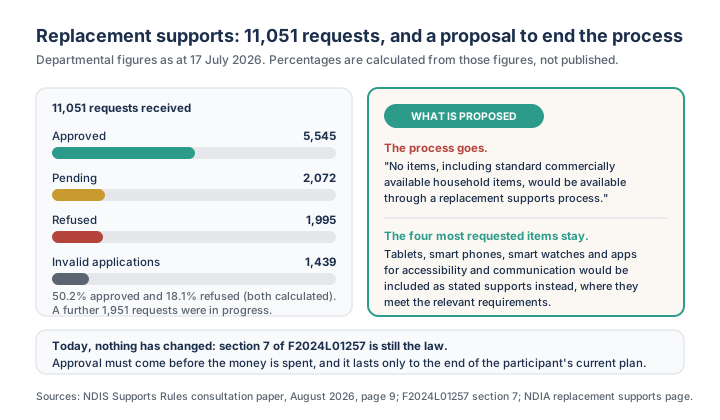
The process today runs on section 7 of F2024L01257, and the table in section 7(3) has only two items: "Standard commercially available household items", and "smart watches; (b) tablets; (c) smartphones; (d) an app used for accessibility or communication purposes". Before approving, the CEO must be satisfied under subsection 10(6)(d) of the NDIS Act 2013 that the support would replace one or more NDIS supports, that its cost is "the same or lower than the total of the costs of the supports it would replace", and that it "would provide the same or a better outcome for the participant". The NDIA's replacement supports page adds that the item must be on the pre-approved list, that approval must come before the money is spent, and that approval "will last the length of your current plan".
What is proposed instead is a change of channel, not a removal of the goods. Tablets, smart phones, smart watches and accessibility or communication apps would "be included as stated supports where they meet the relevant requirements", sitting in a plan "where they have been determined reasonable and necessary under old framework planning, or where a participant has an assessed need in new framework planning". The department is asking whether that would cause problems: "We want feedback on whether removing the replacement supports process for old framework planning would create any practical issues for participants."
Which five items would be added to the exclusion list?
The paper names five goods and services that have attracted "confusion and disputes about whether" they are NDIS supports, and proposes adding them to Schedule 2. Feedback is sought on "whether these proposed exclusions are clear and whether further explanation is needed".
Electronic noise-cancelling headphones. Proposed for Schedule 2 because disputes have already arisen. The paper carves out no therapeutic or sensory use.
Fencing and gates. This one restates an existing exclusion rather than creating a new one. Schedule 2, item 1, paragraph (c) of F2024L01257 already excludes "standard home security and maintenance costs, fencing, gates, and building repairs". The department lists them among the disputed items anyway.
Hair styling tools. Brushes, hair dryers and straighteners are the named items, on the same disputed-item basis as the headphones.
Hydrogen fuel and electric vehicle charging costs. Proposed for Schedule 2 with no condition or exception attached.
Scuba therapy. The fifth. The paper does not say where the confusion arose, only that it has.
Two clarifications sit alongside them. The proposed Rules "would make it clear that assistive technology and consumables may be purchased from retail stores, pharmacies, hardware stores and similar outlets where appropriate", and would confirm animal-assisted therapy can be funded "where it forms part of a therapeutic intervention delivered by an appropriately qualified allied health professional". Read the list against one more fact: smart phones and tablets are already excluded by Schedule 2, item 4, paragraph (d), and standard household items by item 1, paragraph (i). The replacement supports process is what lifts those items into funding today, which is why its removal and the exclusion list travel together.
What is proposed and what is settled?
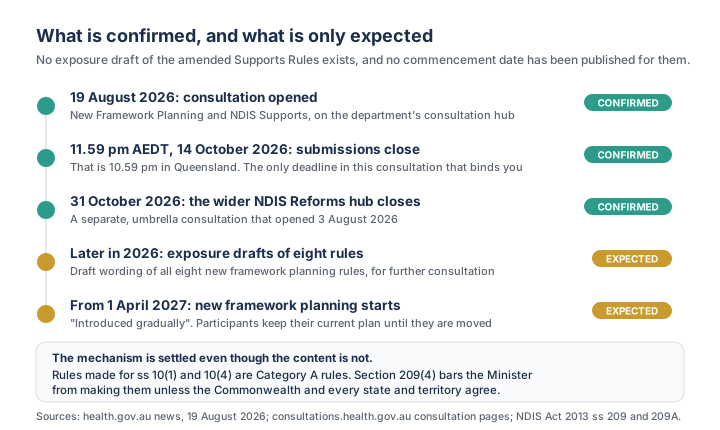
Nothing in this consultation is law. There is no exposure draft of the amended Supports Rules, and the consultation page says only that "the exposure drafts of all eight new framework planning rules will be available for information and further consultation later this year". No commencement date has been published for the amended Rules. The only published date is in the department's news item of 19 August 2026: new framework planning "is expected to start from 1 April 2027 and will be introduced gradually. Participants will keep using their current plan until they move to the new way of planning." Budget settings are unsettled too: "some aspects of new framework planning, including detailed budget settings, are still being developed and tested".
| Date | What happens | Status |
|---|---|---|
| 19 August 2026 | NDIS supports consultation opens | Confirmed |
| 11.59 pm AEDT, 14 October 2026 | NDIS supports consultation closes (10.59 pm in Queensland) | Confirmed |
| 31 October 2026 | NDIS Reforms Consultation Hub closes (opened 3 August 2026) | Confirmed |
| Later in 2026 | Exposure drafts of the eight new framework planning rules released | Expected |
| From 1 April 2027 | New framework planning expected to start, introduced gradually | Expected |
The mechanism that would make the change bite is settled, even though the content is not. Subsection 10(1) of the NDIS Act 2013 provides that a support is an NDIS support if it "is declared by National Disability Insurance Scheme rules made for the purposes of this subsection to be an NDIS support", and subsection 10(4) lets the rules declare that a support is not one. Rules made for those two subsections are Category A rules under the table in section 209, and subsection 209(4) reads: "The Minister must not make Category A National Disability Insurance Scheme rules unless the Commonwealth and each host jurisdiction have agreed to the making of the rules." Section 209A sets the clock at 14 days from the Minister's notice, a refusal must set out reasons, and subsection 209A(6) treats silence as agreement. Every state and territory has a say, and a short window in which to use it.
The instrument being amended is itself transitional, made under item 138 of Schedule 1 to the Getting the NDIS Back on Track No. 1 Act 2024 and started on 3 October 2024. The later Securing the NDIS for Future Generations Act carries its own commencement dates.
What should a provider do before 14 October 2026?
Work through Attachment 1, find every current category you deliver against, then work out which of the 18 each service sits in and whether that category is flexible or stated. A move from stated to flexible changes how easily a participant can shift funding away from you mid-plan; a move the other way locks it in.
Note anywhere the mapping is ambiguous or splits your service across two destinations. Current item 3 maps to both support coordination and in-home and community supports, and items 8 and 9 each map to three. If that split changes how you would describe your service in a plan or word an agreement, say so in a submission. Our NDIS service agreement requirements checklist covers the wording questions this raises, and the claiming rules gap guide covers what you can claim against a category today.
Lodge a submission through one of the named channels: upload a written submission, answer the questions online, submit a video response including in Auslan, request a phone call, or email NDISConsultations@health.gov.au. The phone line is 1800 020 103. The department asks four questions: are the proposed categories clear, would further explanation or examples help, do particular support types need more guidance, and are there practical issues or unintended impacts to consider.
If you deliver early childhood supports, raise the Attachment 1 gap by name. Check, too, which participants rely on a replacement support approval, since those run only to the end of the current plan. If new framework planning is the bigger question for you, our guide to new framework planning for allied health covers the model itself and the expected gradual start from 1 April 2027.
Frequently Asked Questions
Is the move from 36 to 18 support categories law yet?
No. It is a proposal in a consultation paper dated August 2026. No exposure draft of the amended Supports Rules exists, and no commencement date has been published. The current 36 categories in F2024L01257 remain in force.
Will any supports stop being funded because of this change?
No. The consultation paper says the changes "are not intended to remove broad types of supports currently funded through the NDIS. However, some current supports categories would be consolidated into broader proposed categories." Five items are proposed for the exclusion list, but the restructure itself is a renaming and regrouping exercise.
Do NDIS support item numbers change under the new categories?
No. Nothing in the consultation material says support item numbers in the NDIS Support Catalogue change, are retired or are renumbered. The papers discuss support categories in the Rules only, so do not read the restructure as a catalogue change.
Are NDIS registration groups changing too?
No. The 36 registration groups administered by the NDIS Quality and Safeguards Commission are not mentioned in the consultation material. The 36 support categories in the Rules are a separate legal list, and it is those that would collapse to 18. Both number 36 because the current support categories were "based on provider registration groups".
Can participants still apply for a replacement support right now?
Yes. Section 7 of F2024L01257 is current law and covers two classes only: standard commercially available household items, and smart watches, tablets, smartphones and accessibility or communication apps. The participant must be approved before spending NDIS funds, and approval lasts only to the end of the current plan. Its removal is proposed, not enacted.
What is the difference between a flexible and a stated support category?
Flexible means a participant "may be able to use funding across supports within a category, as long as the support meets the NDIS supports Rules and relates to their disability support needs". Stated means "funding is set aside for a specific support or support category" and cannot go elsewhere. Of the 18, 8 are flexible and 10 stated.
When would the new support categories start?
No date has been published for the amended Supports Rules. The only published date is the expected start of new framework planning from 1 April 2027, introduced gradually, with most participants staying on old framework plans for some time. The changes are intended to apply to both frameworks, but their start date is unsettled.
Who can make a submission on the NDIS supports rules?
Anyone. The department names people with disability and their families, carers and kin, disability representative organisations and advocates, disability service providers, and health professionals and disability support workers. Submissions close at 11.59 pm AEDT on 14 October 2026, 10.59 pm in Queensland.
Part of
NDIS Provider Compliance