Yes, NDIS providers can use AI for progress notes and reports. The NDIS Commission does not endorse AI tools and does not prohibit them: its February 2026 position statement, written for behaviour support plans, permits use "so long as such use complies with providers' legal obligations". It expects that "no personal information of participants is disclosed to AI systems" and ties unsafe disclosure to the privacy duty in the NDIS Code of Conduct, which binds every provider and worker. The nine steps below set out how to use AI for NDIS progress notes within those rules; the wider obligations are in our NDIS provider compliance guide.
Before you begin
Have these open before you start: the Commission's position statement on AI in behaviour support plans (PDF); your privacy policy and participant consent forms; your service agreement template; the settings pages of your rostering, notes or practice software; any AI tools your workers say they use; and your incident register.
The NDIS Code of Conduct binds every provider and every person employed or engaged by a provider, registered or not. The Practice Standards privacy and dignity and information management outcomes are audited for Core module (certification) providers and sit outside the Verification module. The Code and the Privacy Act still apply to verification pathway providers. Our reading of ss 6FB(3)(b) and 6D(4)(b) of the Privacy Act 1988 is that providing disability care is a health service, so a provider holding health information is not a small business operator whatever its turnover: confirm your position with your adviser.
Step 1: Read what the Commission said, and to whom
The NDIS Commission does not prohibit AI, and it does not endorse it. Its only statement on provider AI use, dated February 2026, is the "Position statement: Use of artificial intelligence in the development of behaviour support plans". The statement says: "The NDIS Commission does not endorse or approve the use of AI tools in the development and review of behaviour support plans. This does not prevent NDIS providers using AI, so long as such use complies with providers' legal obligations." It sets one expectation: "The NDIS Commission expects that, if a provider decides to use AI, all information is appropriately de-identified and that no personal information of participants is disclosed to AI systems." It then warns that "the disclosure of sensitive personal information to a third-party AI platform, such as ChatGPT, without appropriate safeguards may breach section 6 (b) of the NDIS Code of Conduct, which requires providers to respect the privacy of people with disabilities." In the Rules that duty is s 6(1)(b): "In providing supports or services to people with disability, a Code-covered person must: ... respect the privacy of people with disability".
The statement was written for behaviour support plans and was announced in the Commission's March 2026 newsletter to specialist behaviour support providers and implementing providers. Its legal hook reaches further: the Code binds "NDIS providers" and "persons employed or otherwise engaged by NDIS providers", registered or not, under s 5(2). Compliance with the Code is a civil penalty provision under s 73V of the NDIS Act: 10,000 penalty units for a serious contravention by a provider, 250 penalty units in any other case.
The Commission has not said how far "no personal information of participants is disclosed to AI systems" reaches: whether it covers shift notes, progress notes, therapy reports or funding reports. As at 13 October 2026 it had published nothing further for providers. Its AI transparency statement covers only the Commission's own use of AI and sets no rule for providers. Our suggestion: until the Commission says more, apply the expectation to every participant record, and treat an assessed, contracted tool as the only exception you are prepared to defend.
| Question | What the statement says | Status |
|---|---|---|
| Is AI banned for NDIS providers? | "does not prevent NDIS providers using AI, so long as such use complies" | Settled |
| Does the Commission endorse any AI tool? | "does not endorse or approve" (for behaviour support plans) | Settled for BSPs |
| Can participant personal information go into an AI system? | expects "no personal information of participants is disclosed to AI systems" | Settled for BSPs; reach beyond BSPs not stated |
| Which Code duty is engaged? | s 6(1)(b) privacy (cited as "section 6 (b)") | Settled |
| Does it cover progress notes, shift notes and therapy reports? | not addressed | Open |
| Is an assessed, contracted tool treated differently from a public chatbot? | not addressed | Open |
Step 2: Find the AI that is already switched on
AI may already be running inside your organisation, and some of it was never a decision you made. Inventory three places before you write any rule.
First, the tools workers use on their own: free chatbots on personal phones and accounts, used to tidy up a shift note or draft a letter. Second, AI features inside the rostering, notes or practice software you already pay for. One NDIS rostering platform's help centre, updated 7 September 2026, describes a setting that lets external AI assistants "such as ChatGPT and Claude" access the provider's data in that platform, and says "This feature is on by default for new and trial accounts." Third, scribes or dictation tools therapists have added themselves.
The OAIC's guidance lists "turning off features that would disclose personal information" among the measures organisations should consider: find what is switched on before you decide anything.
For each tool or feature, record the tool, the feature, who uses it, whether participant information goes in, the setting, and the date you checked it. That register lives in our AI acceptable use policy template.
Step 3: Set the participant-information rule
Start with the rule for public tools: support workers do not put participant details into ChatGPT or any other public AI chatbot. "As a matter of best practice, the OAIC recommends that organisations do not enter personal information, and particularly sensitive information, into publicly available generative AI tools, due to the significant and complex privacy risks involved", and the Commission, writing for behaviour support plans, expects that "no personal information of participants is disclosed to AI systems". A worker pasting a shift note into a free chatbot fails the OAIC's recommendation outright and, on our suggested reading, the Commission's expectation too.
De-identification rarely rescues it. The Privacy Act test is that information is de-identified only if it "is no longer about an identifiable individual or an individual who is reasonably identifiable". The OAIC warns that information entered into generative AI products "may be at risk of re-identification even when de-identified or anonymised", and that once entered it can be very difficult to track, control or remove. Software anonymisers have limits too: one platform's AI data usage policy, June 2026, says its tool strips names, email addresses, phone numbers and physical addresses from support notes before AI processing, but the anonymiser "covers the most common PII patterns but is not exhaustive" and "is a strong safeguard, not a guarantee". Our reading: a progress note records what happened to one person, on one day, in one place, with named workers and family, so removing the name seldom stops the person being reasonably identifiable.
Two Australian Privacy Principles do the work. APP 6.1 stops information collected for one purpose being used or disclosed for another unless the individual consents or an exception applies: putting a participant's information into an AI tool may be a disclosure. APP 8.1 requires reasonable steps before disclosing to an overseas recipient, and s 16C makes you answerable if that recipient breaches the Australian Privacy Principles. (For the GP and allied health picture, see our AI privacy post.)
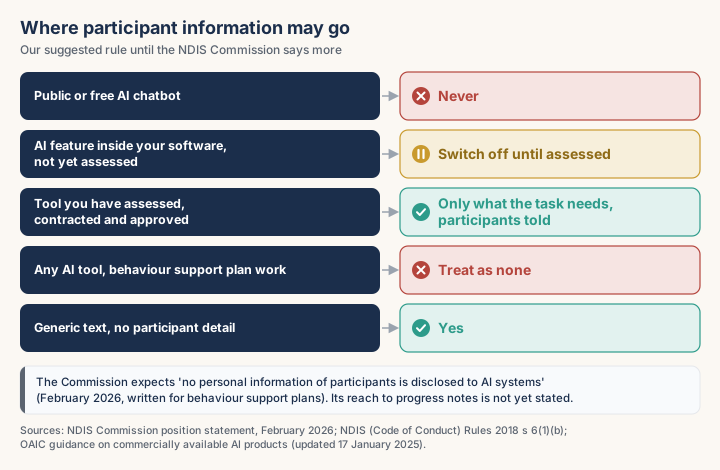
| Tool type | Participant information | Why |
|---|---|---|
| Public or free AI chatbot on a personal account | Never | The OAIC recommends not entering personal or sensitive information into publicly available generative AI tools; the Commission expects none to reach AI systems. |
| AI feature inside your existing software, not yet assessed | Not until assessed (Step 5); switch it off meanwhile | OAIC: turning off features that would disclose personal information. |
| Tool the provider has assessed, contracted and approved | Only what the task needs, only if participants have been told (Step 4) | Our suggested position; the Commission has not addressed this case. |
| Any AI tool, for a behaviour support plan | Treat as none (Step 7) | The Commission's expectation is written for BSPs. |
| Generic text with no participant detail (a training handout, a roster template, a letter template) | Yes | No personal information involved. |
Step 4: Tell participants and get consent they understand
Participants have to be told, in a way they understand, before AI touches their information. The Code of Conduct guidance for providers, April 2024, sets out what that explanation covers: what personal information will be collected and held, including recorded, audio and visual material; why it is held; who will have access; how it is kept secure; how it will be used; how to access and amend it; and how to complain about a privacy breach. A scribe that records a session, and an AI tool that drafts notes, both belong on that list.
The Practice Standards set the standard of the explanation. Sch 1 cl 5 of the Rules requires that "Each participant can access supports that respect and protect their dignity and right to privacy." The Information Management indicator requires that "Each participant is informed of how their information is stored and used, and when and how each participant can access or correct their information, and withdraw or amend their prior consent." The Privacy and Dignity indicators require confidentiality advice given in language the participant understands, and agreement on what personal information will be collected and why, including recorded audio or visual material.
Consent under APP 6.1(a) must be informed. If data leaves Australia and you rely on consent, APP 8.2(b) lets you disapply APP 8.1 only where you expressly inform the participant that, if they consent to the disclosure, APP 8.1 will not apply to it, and they then consent on that basis. Code s 6(1)(a) requires respect for the participant's own decision-making: use their language and mode of communication, involve their chosen supporters or guardian where that is their arrangement, and record the answer. Withdrawal is in the same indicator: "withdraw or amend their prior consent" means you need an alternative way to produce the note or report. The wording belongs in our NDIS information management and privacy policy template.
Step 5: Approve one tool and get its answers in writing
Approve one tool, in writing, and put the assessment on record. The OAIC's guidance on commercially available AI products says organisations "should conduct due diligence to ensure the product is suitable to its intended uses", including whether it has been tested for those uses, how human oversight can be embedded, the privacy and security risks, and who will have access to information input or generated.
Where is the data processed and stored? The OAIC flags "where the servers are located and whether personal information could be disclosed outside of Australia". APP 8.1 and s 16C make you answerable for an overseas recipient's breaches.
Is our data used to train models? Some products let the vendor collect customer input "for further training and development of AI technologies", and the OAIC warns it "may be difficult to establish reasonable expectations" for that secondary purpose.
How long are inputs, recordings and drafts kept, and can we delete them? APP 11.1 requires reasonable steps to protect information from misuse, interference and loss, and from unauthorised access, modification or disclosure.
Which sub-processors see the data? Ask for the list, and for how you are told when it changes.
Can the feature that lets outside tools read our data be switched off, and is it off? Tie the answer back to your Step 2 inventory.
Record each answer with the date and the page it came from. For the full scribe assessment, see our guide to assessing an AI scribe.
Step 6: Write the rules for support workers
Workers carry the duty in their own right. Section 5(2)(b) of the Rules covers persons employed or otherwise engaged by NDIS providers, so a support worker who pastes a participant's details into a chatbot is personally exposed under s 6(1)(b), as well as the provider. The Commission's worker guidance says workers "should also follow their NDIS provider's privacy policy and procedures where they exist and are not inconsistent with these laws". The OAIC's controls include "prohibiting your staff from entering personal information in the AI inputs."
These are our suggested rules for the worker card, short enough to read in one sitting:
- Use only the approved tool, from a work account.
- Put no participant names, dates of birth, addresses, NDIS numbers, health or behaviour details, photos or recordings into any other AI tool.
- Never copy an AI draft into the record unread.
- The worker who signs the note is its author.
- Report any slip the same day to the named person.
Step 7: Treat behaviour support plans as the strict case
Behaviour support plans are the strict case, because the Commission's only statement was written for them. It does not endorse AI in developing or reviewing behaviour support plans, and it expects all information to be appropriately de-identified, with no personal information of participants disclosed to AI systems. It also restates that plans must be person-centred, evidence-informed, reflective of the person's needs, uphold the person's dignity and right to privacy, and be developed in consultation with the participant, their family, carers, guardian, NDIS providers and support workers. The statement sits with the Commission's other behaviour support position statements on its behaviour support rules page.
Our suggestion: keep participant information out of AI for any behaviour support plan work, including interim plans and reviews, and never let AI output substitute for the consultation the plan requires.
Step 8: Review every AI draft before it becomes a record
No AI draft goes into a participant's record until a person has read it. The Commission's statement lists "inaccurate or misleading content or advice generated by AI" among its risks, and the OAIC notes that "AI systems are known to produce inaccurate or false results"; under APP 10 you must take reasonable steps to ensure the personal information you collect, use and disclose is accurate. Code s 6(1)(c) requires care and skill, and s 6(1)(d) requires integrity, honesty and transparency. The provider guidance requires accurate, up-to-date and legible records reporting relevant details of a participant's service history, medication and support needs, created at the time of an event or as soon as possible afterwards, and retained for a minimum of seven years after service provision. Practice Standards cl 12 requires information to be "identifiable, accurately recorded, current and confidential".
The reviewer checks, at minimum:
- names and who was present
- times and durations, because they drive claims
- medications and allergies
- incidents and behaviours
- what the participant said, in their own words
- anything the AI added that did not happen.
Our suggestion: label AI-assisted records so the review is visible later.
Step 9: Handle an AI error as an incident and, where needed, a complaint
An AI error can be an incident, and sometimes a reportable one. Under s 9(1) of the Incident Management Rules, the incident management system must cover acts, omissions, events or circumstances connected with providing a support or service that have, or could have, caused harm to the person with disability. Our reading: a wrong medication, allergy or risk detail in an AI-drafted note, which a worker could act on, is a circumstance that could have caused harm, so it belongs in the incident system even if no one was hurt. Under s 10(3), every incident is assessed for whether it could have been prevented, how well it was managed, what remedial action is needed, and whether others need to be notified, considering the affected person's views.
It becomes a reportable incident only if what follows from it is one of the s 73Z(4) events: death, serious injury, abuse or neglect, unlawful sexual or physical contact or assault, sexual misconduct, or unauthorised use of a restrictive practice. Our reportable incident decision tool works through that list.
A disclosure of participant information to an unapproved tool is a possible data breach: where there are reasonable grounds to suspect an eligible data breach, s 26WH(2) requires a reasonable and expeditious assessment, completed within 30 days. Anyone can complain about a Code breach to the Commission, and Code s 6(1)(e) requires you to "promptly take steps to raise and act on concerns". The AI incident category belongs in our NDIS incident management template.
What good looks like at audit
The Commission has published no audit criteria for AI use, so this mapping is our suggestion.
| Obligation | Evidence |
|---|---|
| Code s 6(1)(b) privacy | The participant-information rule, the approved-tool register, the Step 2 inventory with dates. |
| Privacy and Dignity (Core module cl 5) | The plain-language participant information and consent records, including for recorded sessions. |
| Information Management (Core module cl 12) | Consent and withdrawal records, the vendor answers from Step 5, the data location and retention settings. |
| Code s 6(1)(c) and (d), accurate records | The review rule and a sample of AI-assisted notes showing review. |
| Incident management (cl 14 and the Incident Management Rules) | The AI incident category and entries. |
| Workers bound by the Code (s 5(2)(b)) | Signed worker rules and training records. |
| Privacy Act APP 8 and s 16C | The data location answer and the contract. |
| Behaviour support (the February 2026 statement) | The BSP rule and evidence that plans were developed in consultation. |
Three common mistakes:
Assuming the statement covers only behaviour support. It was written for behaviour support plans, but its legal hook, s 6(1)(b), binds every provider and worker. Treat the reach as open.
Trusting the software's anonymiser to de-identify a note. One platform's anonymiser describes itself as "not exhaustive" and "a strong safeguard, not a guarantee". The legal test is reasonable identifiability, and a progress note usually still fails it with the name removed.
Leaving a default-on feature switched on. At least one platform ships external AI access on by default for new and trial accounts. Unless someone switched it off, the feature is on without anyone having chosen it.
Run Step 2, this week, on every tool, including the features inside the software you already use.
Two documents carry this procedure into daily use. The AI acceptable use policy holds the approved-tool register from Step 2 and the rules from Step 6, and the NDIS information management and privacy policy is where the participant information and consent wording from Step 4 belongs.
Frequently asked questions
Can NDIS providers use ChatGPT?
Yes, for work that contains no participant information: templates, training handouts, roster formats, generic letters. No for participant information. The OAIC recommends that organisations do not enter personal or sensitive information into publicly available generative AI tools, and the Commission's February 2026 statement, written for behaviour support plans, expects no personal information of participants to reach AI systems, warning that disclosure to "a third-party AI platform, such as ChatGPT, without appropriate safeguards may breach section 6 (b) of the NDIS Code of Conduct".
Does the NDIS Commission's AI position statement apply to progress notes?
The Commission has not said whether the statement's expectation reaches progress notes, shift notes or therapy reports. The statement is titled for behaviour support plans and was announced to specialist behaviour support and implementing providers, but its legal hook, s 6(1)(b), binds every provider and worker. Our suggested reading: apply it to every participant record until told otherwise.
Is using AI a breach of the NDIS Code of Conduct?
No, not in itself. The Commission's February 2026 statement says it "does not prevent NDIS providers using AI, so long as such use complies with providers' legal obligations". Disclosing sensitive personal information to a third-party AI platform without appropriate safeguards may breach the Code. Compliance is a civil penalty provision under s 73V of the NDIS Act: 10,000 penalty units for a serious contravention by a provider, 250 penalty units in any other case.
Do we need participant consent to use an AI scribe in NDIS sessions?
Yes, in practice. A scribe that records a session collects recorded material in audio and/or visual format, which the Privacy and Dignity indicator requires participants to understand and agree to, and the Information Management indicator requires consent, under APP 6.1(a), to collect, use and retain information. These indicators are audited for Core module (certification) providers; explain it in the participant's language and record the answer whatever your audit pathway.
Is de-identifying a progress note enough to use it with AI?
Usually not. The Privacy Act test is whether the individual is "reasonably identifiable", and the OAIC warns that information may be at risk of re-identification even when de-identified or anonymised. One software anonymiser describes itself as covering common patterns but "not exhaustive". A note about one person, one day, one place, with named workers and family, is usually still identifiable with the name stripped.
Do unregistered NDIS providers have to follow these rules?
Yes. The Code applies to all NDIS providers and persons engaged by them "regardless of whether they are registered", and our reading of the Privacy Act is that disability care is a health service, so the Act very likely applies whatever your turnover: confirm with your adviser. The Practice Standards audit applies to registered providers only, but the Code and the Privacy Act do not depend on registration.
Key terms
Part of
NDIS Provider ComplianceLast reviewed