Key Takeaways
- The Medicare Healthy Kids Check can be claimed from 1 November 2026. F2026L01359, made on 1 October and registered on 2 October 2026, adds it to the general medical services table as a health assessment for a child who "is 3 years old".
- There is no new item number. GPs bill time-tiered items 701, 703, 705 or 707 ($71.00 to $321.75) and prescribed medical practitioners bill items 224 to 227 ($56.85 to $257.40), all at a 100% benefit.
- The doctor's own time sets the tier. MBS note AN.0.36 picks the item by "the personal attendance time". A practice nurse may help collect information, but by our reading nurse time does not move the claim up a tier.
- The check is once per child per lifetime. A practice cannot see claims made elsewhere, so ask the parent, record the answer and name the target group on the claim. Services Australia rejects a subsequent health assessment claim that does not specify a different target group.
- Clause 2.15.11(2) lists seven parts the assessment must include, from a history under six headings to "offering a written report on the health assessment to the patient's parent or carer, with recommendations on matters covered by the health assessment".
- An Aboriginal or Torres Strait Islander child can also have the item 715 health check ($254.10) in addition to the Healthy Kids Check, "provided all services are clinically relevant", according to the MBS factsheet.
From 1 November 2026, a GP can bill a Medicare Healthy Kids Check for a 3-year-old on the existing health assessment items 701 to 707, with the item chosen by the GP's own attendance time, once per child per lifetime. Prescribed medical practitioners use items 224 to 227. The record must show seven required parts, ending with a written report offered to the parent or carer.
What is the Medicare Healthy Kids Check and who is eligible?
The Medicare Healthy Kids Check is a new type of MBS health assessment for 3-year-olds, created by the Health Insurance Legislation Amendment (2026 Measures No. 3) Regulations 2026, F2026L01359. The regulations were made on 1 October 2026, registered on 2 October and take effect on 1 November 2026. Item 1 of Schedule 1 adds paragraph (h) to subclause 2.15.2(1) of the general medical services table (GMST): "a Medicare Healthy Kids Check, in accordance with clause 2.15.11, for a patient who: (i) is 3 years old; and (ii) has not already received such an assessment; and (iii) is not an in-patient of a hospital".
Item 2 inserts clause 2.15.11, which defines the check as an assessment of "the patient's physical, social and emotional development, health and wellbeing", and of whether health care, education, referrals or other assistance should be offered to the child or the parent or carer.
The MBS Online factsheet, last updated 28 August 2026, says the service "is available once per child per lifetime" for "Medicare-eligible 3-year-olds". It still opens "Subject to the passage of legislation" because it predates the regulations by five weeks; that condition has been met. MBS Online's November 2026 news page, updated 1 October 2026, drops it: the check "will be introduced for 3-year-old children using the time-tiered health assessment items (701-707 and 224-227)".
The eligibility tests, and what each one needs in the record:
| Test | Where it comes from | What to record (our suggestion) |
|---|---|---|
| The child is 3 years old | GMST 2.15.2(1)(h)(i) | Date of birth and date of the check |
| No previous Healthy Kids Check | GMST 2.15.2(1)(h)(ii); factsheet "once per child per lifetime" | The parent's answer at booking |
| Not a hospital in-patient | GMST 2.15.2(1)(h)(iii) | Place of the attendance |
| Medicare eligible | Factsheet | Medicare number checked |
| Usual GP "if reasonably practicable" | GMST 2.15.14(3) | Why another GP did it, if one did |
The instrument says "is 3 years old", so our reading is that the last eligible day is the day before the child's fourth birthday. The factsheet says children "under 3 years or over 4 years old who require assessment or children aged 3 years old who require more than one assessment can continue to access MBS time-tiered attendance items". It does not mention a child aged exactly 4. Where the factsheet and the instrument diverge, the instrument is the test.
The usual-GP rule in clause 2.15.14(3) applies to every health assessment. MBS note AN.0.36 defines the usual GP as the practitioner or practice that has provided most of the patient's services in the past 12 months, or is likely to in the next 12, so a family new to the practice can qualify.
Which MBS item do you bill for a Healthy Kids Check?
The explanatory statement to F2026L01359 says the check "will be provided under existing time-tiered MBS health assessment items 224, 225, 226, 227, 701, 703, 705 and 707 provided by general practitioners and prescribed medical practitioners". The November 2026 MBS data file does not mention the check anywhere (the descriptors for items 701 to 707 last changed on 1 July 2018), so a search of the item list for "Healthy Kids" finds nothing. Billing staff need to know that before the first booking.
The item is chosen by the practitioner type and, in the words of MBS note AN.0.36, the "length of time spent with the patient (i.e. the personal attendance time)". The fees below are from the MBS Online item pages and match the November 2026 data file:
| Tier (personal attendance time) | GP item | Fee | PMP item | Fee |
|---|---|---|---|---|
| Brief, not more than 30 minutes | 701 | $71.00 | 224 | $56.85 |
| Standard, 30 to under 45 minutes | 703 | $165.05 | 225 | $132.05 |
| Long, 45 to under 60 minutes | 705 | $227.75 | 226 | $182.15 |
| Prolonged, 60 minutes or more | 707 | $321.75 | 227 | $257.40 |
Every item carries a 100% benefit. The item 703 descriptor says "more than 30 minutes" where AN.0.36 says "at least 30 minutes", so a check of exactly 30 minutes sits on the line. Record the real start and finish times and bill what the clock shows.
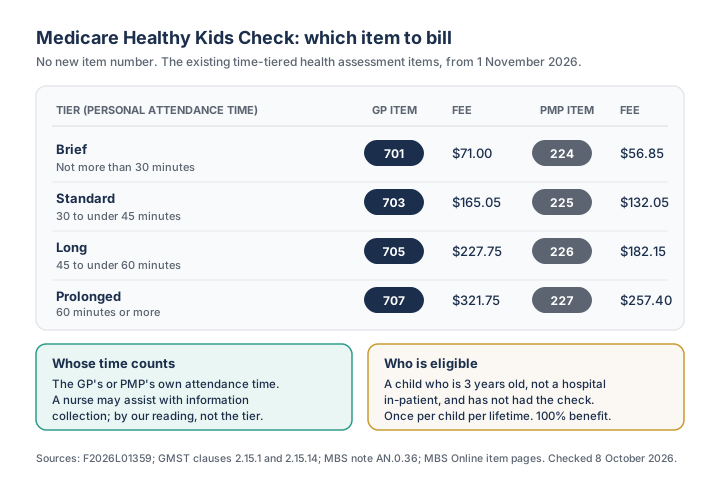
GMST clause 2.15.1(1) says items 701 to 715 "apply only to a service provided in the course of a personal attendance by a single general practitioner on a single patient". Clause 2.15.14(4) and (5) let practice nurses and Aboriginal and Torres Strait Islander health workers and practitioners assist, under the GP's supervision, with "information collection" and, at the GP's direction, with giving information about recommended interventions. By our reading, nurse time spent with the family while the GP is elsewhere does not lift the tier. AN.0.36 also says the items are "for a complete service" and that the nurse item 10997 "may not be claimed in conjunction with these items".
The Professional Services Review has already dealt with nurse time counted as attendance time. Its Director's update for August 2026 records a GP whose reviewed services included item 707. The Associate Director had persisting concerns that included "failing to meet the minimum time requirement, including time spent by a practice nurse with the patient as part of the attendance time". That GP agreed to repay $280,000 to the Commonwealth.
Two more rules apply. AN.0.36 counts time needed to communicate, such as working through an interpreter, provided the notes say why. And clause 2.15.14(2) says "a separate consultation must not be performed in conjunction with a health assessment, unless clinically necessary".
What must the Healthy Kids Check include?
Clause 2.15.11(2) lists seven parts the assessment "must include"; the factsheet adds "but is not limited to". Read as a checklist, each part is a line the record should show:
| Part | Clause 2.15.11(2) | What the record should show (our suggestion) |
|---|---|---|
| History | (a)(i) to (vi) | An entry under each of the six headings, including immunisation status and allergies |
| Examination | (b)(i) and (ii) | Eyesight, hearing, teeth and gums; height, weight, centiles and BMI |
| Assessment | (c) | The GP's conclusions from the history and examination |
| Advice | (d) | What was advised to the parent or carer |
| Interventions and referrals | (e) | Each referral made or arranged, or that none was needed |
| Medical record | (f) | "adding a record of the health assessment to the patient's medical record" |
| Written report | (g) | That the report was offered, and the answer |
The history is the longest part. Paragraph (a) requires the child's medical history "including previous presentations, hospital admissions, medication, immunisation status and allergies"; behaviours and wellbeing; "an assessment of the patient against age-appropriate developmental milestones"; family relationships, social circumstances, care arrangements and "engagement in early childhood education and care"; "nutrition, physical activity, screen use, sleep hygiene and sleep patterns"; and "toileting, including bowel habits and urinary continence". Paragraph (b) requires examining "eyesight, hearing and oral health (teeth and gums)" and measuring height and weight "to assess the patient's growth against published centile charts, including body mass index".
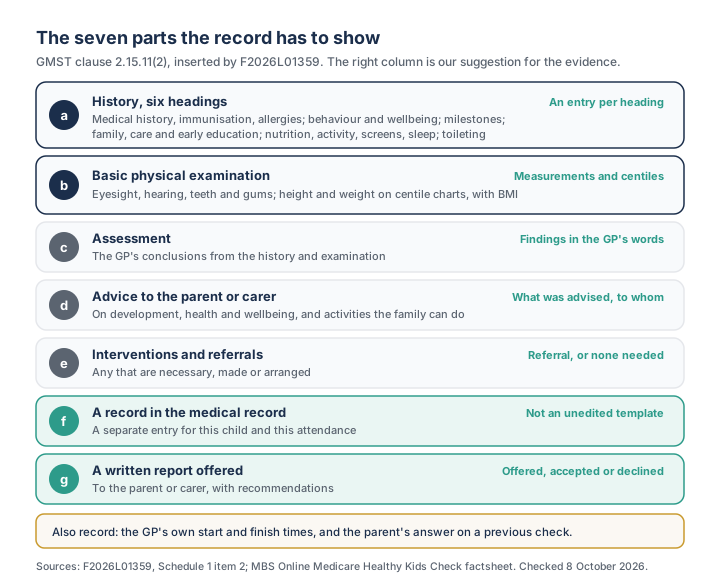
A template makes the seven parts hard to miss, and the same PSR update shows where templates go wrong: a GP who agreed to repay $365,000 had persisting concerns that included "failing to record a separate entry for each attendance or modify templates to reflect the correct details of each patient". Leave each field in a Healthy Kids Check template blank for the GP to complete for this child; pre-filled normal findings are the pattern the PSR described. Our PSR care plan template post covers the same pattern on care plans.
How do you evidence once per lifetime and the target group?
The instrument makes a previous Healthy Kids Check a bar to eligibility, and a practice cannot see a claim made by another practice. The test therefore rests on asking. Our suggestion: ask the parent at booking whether the child has had a Healthy Kids Check anywhere, record the answer in the child's file, and repeat the question at the start of the attendance.
The claim itself needs the target group. AN.0.36 says that where a patient is eligible for more than one health assessment, the practitioner "should ensure they identify which target group the health assessment relates to when submitting claims to Services Australia". Services Australia's record-keeping page asks you to tell it "which target group the health assessment claim is for" and warns: "If you don't specify that the subsequent health assessment was for a different target group, we'll reject your claim."
That matters for the few 3-year-olds in another target group, such as a refugee child or a child with an intellectual disability. AN.0.36 says "Patients can receive each health assessment they are eligible for", so on our reading each claim on items 701 to 707 needs its own target group named. If the parent is unsure whether a check was done, record that too: the record then shows the practice asked.
What goes in the written report to the parent or carer?
Paragraph (g) requires "offering a written report on the health assessment to the patient's parent or carer, with recommendations on matters covered by the health assessment". The duty is to offer. Compare the item 715 descriptor on MBS Online, which requires offering a written report and then, "if the offer referred to in subparagraph (viii) is accepted", giving it. Clause 2.15.11 has no matching words, but a report accepted and never handed over is hard to defend. Our suggestion: record the offer and the answer, and give the report the same day when the parent accepts.
A practical structure, ours rather than the department's, follows the seven parts: what the history and examination found, the GP's assessment, the advice given, each referral and where it went, and what the family should do next. Write it in words a parent can act on.
AN.0.36 says a document an item requires must be kept for 2 years, but the child's record runs far longer: our medical record retention calculator puts the floor at the patient's 25th birthday in every state and territory.
How does it sit beside item 715 and the Thriving Kids supports?
Item 715 is the Aboriginal and Torres Strait Islander health assessment, at $254.10 with a 100% benefit. It is not time-tiered, and its descriptor makes it "applicable only if a service to which this item or item 228, 92004 or 92011 applies has not been provided to the patient in the preceding 9 months". The factsheet says children eligible for other health assessments, "including the Aboriginal and Torres Strait Islander health check, can continue to access these MBS services in addition to their Medicare Healthy Kids Check, provided all services are clinically relevant".
The factsheet does not say whether both can be delivered at the same attendance. A practice that wants to do both on one day should ask the AskMBS advice service (askMBS@health.gov.au, named in the factsheet) and keep the reply on file.
Referrals under paragraph (e) are where the check meets Thriving Kids. The factsheet names "referral to appropriate supports (including Thriving Kids supports)". The NDIA says the first phase of Thriving Kids supports started on 1 October 2026, for children aged 8 and under with developmental delay or autism and low to moderate support needs, with all supports in place by 1 January 2028. Our Thriving Kids guide covers the rollout state by state.
What should practices set up before 1 November?
Nothing can be claimed before 1 November 2026. The setup can start now:
- Build a recall list of children who are 3. On 1 November 2026 that is every child born between 2 November 2022 and 1 November 2023 (our calculation from the "is 3 years old" test). Children born in late 2022 have only weeks of eligibility left, so contact them first, then add each child as they turn 3. Our recall and reminder policy template sets out the follow-up attempts and records.
- Add the booking question. Reception asks whether the child has had a Healthy Kids Check anywhere, and the answer goes in the file before the appointment.
- Build the clinical template from clause 2.15.11(2). One field per history heading, the examination measurements with centiles, the assessment, advice, referrals, and the report offer. Add start and finish time fields for the GP's own attendance.
- Brief the nurses. They may assist with information collection and, at the GP's direction, give information about recommended interventions. Their time with the family does not set the tier, by our reading of clause 2.15.1 and AN.0.36.
- Write the parent report template, and map the referral pathways. List local paediatric, allied health and early childhood services, plus Thriving Kids supports as they reach your state.
- Tell billing staff the item rules. No new item number, the tier from the GP's recorded time, the target group named on every claim, and the 1 November 2026 MBS changes that land the same day.
Frequently Asked Questions
What item number is the Medicare Healthy Kids Check?
There is no new item number. GPs bill the existing time-tiered health assessment items 701, 703, 705 or 707 ($71.00, $165.05, $227.75 or $321.75) and prescribed medical practitioners bill items 224 to 227 ($56.85 to $257.40). The item depends on the practitioner's own personal attendance time, under MBS note AN.0.36. The explanatory statement to F2026L01359 names these eight items.
Can a practice nurse do the Healthy Kids Check?
No. GMST clause 2.15.1 limits items 701 to 707 to a personal attendance by a single general practitioner. Under clause 2.15.14 a practice nurse may assist with information collection, under supervision. By our reading nurse time does not count toward the tier, and the PSR's August 2026 update records a GP who agreed to repay $280,000 after counting practice nurse time as attendance time.
How often can a child have a Medicare Healthy Kids Check?
Once. The MBS factsheet says the service "is available once per child per lifetime", and the regulation requires that the child "has not already received such an assessment". A 3-year-old who needs a second assessment is seen on the ordinary time-tiered attendance items, according to the factsheet. Ask the parent at booking and record the answer.
Can a 4-year-old have a Medicare Healthy Kids Check?
No. The regulation applies to a child who "is 3 years old". By our reading the last eligible day is the day before the fourth birthday. The factsheet says children under 3 or over 4 can use the time-tiered attendance items instead, but the regulation is the test.
Can you claim item 715 and the Healthy Kids Check for the same child?
Yes. The MBS factsheet says children eligible for the Aboriginal and Torres Strait Islander health check can access it "in addition to their Medicare Healthy Kids Check, provided all services are clinically relevant". Item 715 pays $254.10 and cannot be repeated within 9 months. The factsheet does not say whether both can be done at one attendance, so ask AskMBS before planning that.
Does the parent have to accept the written report?
No. Clause 2.15.11(2)(g) requires the GP to offer "a written report on the health assessment to the patient's parent or carer, with recommendations on matters covered by the health assessment". The parent can decline. Record the offer and the answer, and give the report the same day if the parent accepts.
Can the Healthy Kids Check be done by telehealth?
No. The explanatory statement names only items 224 to 227 and 701 to 707, and GMST clause 2.15.1 limits those items to a personal attendance. The required examination of eyesight, hearing, teeth and gums, and the height and weight measurements, also need the child in the room.